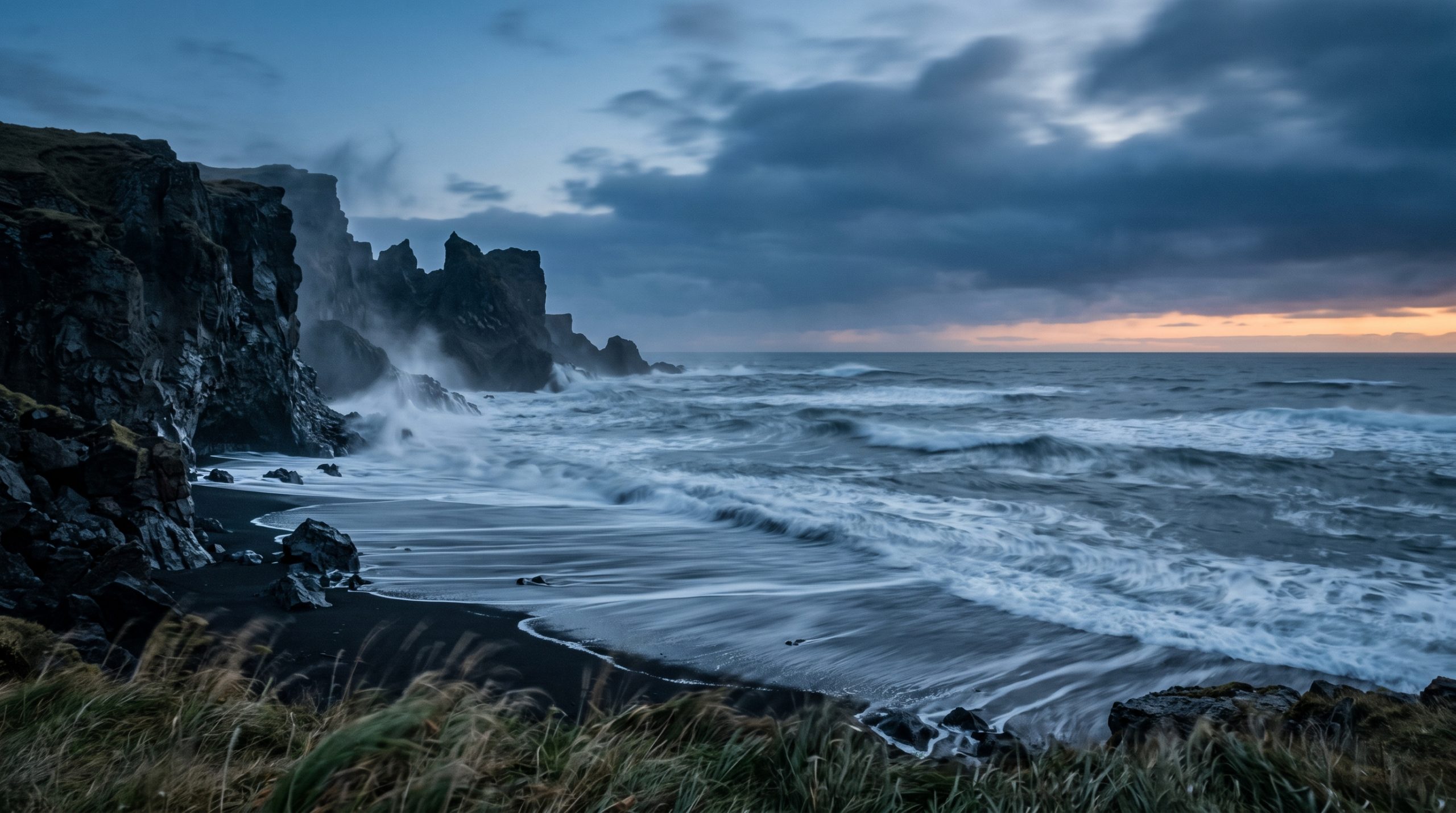
Around the winter solstice, Reykjavik gets a little over four hours of daylight. The sun comes up close to 11:20 and is gone again by about 15:30, and in between it never climbs high enough to go harsh. That is the entire working day in December, and it is the clearest reason this question matters more in Iceland than in almost anywhere else we work.
Photography and film are not two versions of the same thing here. One keeps the frame you print and hang at the top of the stairs. The other keeps the noise of a waterfall from thirty meters back, the wind dragging at a coat, your own voices saying the words out loud. Iceland is unusually good to both mediums and unusually hard on any attempt to cover them with one pair of hands.
We are eight people, four photographers and four filmmakers, and photo, film and planning are one service rather than three bookings. So the comparison below is between two things we do equally, not a nudge toward the one we would rather sell.
Our recommendation, and the light that drives it
For Iceland we recommend both on one day, with a dedicated photographer and a dedicated filmmaker. Light is why. December gives you roughly four usable hours, and around the June solstice the sun rises before 3:00 and sets after midnight. Neither window rewards one person switching between stills and motion. Choose one only by what you most want to keep.
Photo, film and both, compared on what Iceland actually decides
These are the criteria that change the answer in Iceland specifically. Wind, the length of the day, and whether sound is part of what you are keeping.
| What it decides | One dedicated photographer | One dedicated filmmaker | Both together, one day |
|---|---|---|---|
| What you keep | Frames you can print, hang and hand to your parents | Motion and sound: water, wind, your voices | Both, with neither person switching mode mid-hour |
| Cost | The Adventure, from $4,900 | The Adventure, at the same rate as photography | The Expedition, from $7,900 |
| Sound | None recorded | Ambient sound and vows where the wind allows | Professional audio for vows and meaningful moments where conditions allow |
| A forecast of 8 to 15 m/s | Works in your favor: spray, hair, cloth in motion | Needs shelter for the audio and a stabilized rig | One person works the gust while the other waits out the lull |
| Aerials | A handful of frames from altitude | Aerial movement carried through the whole film | One permit, one time window, both uses |
| A four-hour December day | One medium covered end to end | One medium covered end to end | Both covered inside the same short window |
| Delivery | Highlights in 5 days, full gallery in 3 weeks | Highlights in 5 days, finished film in 3 weeks | Highlights in 5 days, both in 3 weeks |
| Genuinely better at | Stillness, faces, anything destined for a wall | Weather, water, voices, the passage of an hour | A day that reinvents itself every ninety minutes |
Team travel is included worldwide, so the flights and accommodation for whoever is assigned to your day are already inside those figures. What each experience covers, and the multi-day Odyssey for couples splitting a trip between the south coast and the north, sits on our coverage and pricing page.
What a still frame does with Icelandic wind
Read an Icelandic forecast and you get wind before you get temperature. The Met Office publishes it in meters per second, and a routine day on the front page of vedur.is sits somewhere in the 3 to 10 m/s band, with 8 to 15 m/s common enough in the northwest that nobody comments on it. For a photographer, that is not an obstacle. It is the subject.
Wind is what stops black sand portraits looking like studio work. Cloth lifts, hair goes sideways, spray comes off the falls in sheets, and a fast shutter turns all of it into a single held instant that never quite existed to the naked eye. Stills also handle Iceland’s habit of changing its mind. A squall crosses a valley in a couple of minutes; a photographer can stand under a lava overhang, wait it out, and take the four minutes of raking light that follow. Nothing is lost by pausing.
The low sun helps enormously. Because Iceland sits just south of the Arctic Circle, the sun tracks a long shallow arc rather than climbing overhead, so what other countries get for forty minutes at dawn stretches out here. In late autumn you can work usable side light for most of the hours you have. And for the aurora between September and April, a still camera on a tripod remains the most forgiving tool there is.
The plain case for photography is the wall. A film gets watched properly a handful of times a year. A print gets seen every day, and in ten years the frame above your stairs will be the image your family argues about affectionately. If that is the thing you would be sad to lose, say so and we will put a photographer on your day and build the timeline around frames.
What film keeps that a still cannot: water, wind and your own voices
Iceland is a loud country. Standing near a waterfall in full spring melt, you cannot hold a normal conversation, and that noise is a genuine part of what the place felt like. A photograph cannot carry it. A film can, and the difference the first time a couple watches it back is not subtle.
The same wind that flatters a still photograph is the one real enemy of the audio. This is craft rather than luck. We pick the vow location by wind direction rather than by view, which usually means a gully, a lava wall, the lee side of a headland, or the sheltered lower half of a canyon, with the open coastal frames kept for the portraits either side. On the Expedition, professional audio for vows and meaningful moments is part of the coverage where conditions allow, and the timeline puts the vows in the calmest part of the day rather than the prettiest.
Motion is the other half. Ice grounded on the sand at Breidamerkursandur rocks in the surf rather than sitting still. Cloud shadow runs across a glacier tongue faster than you expect. Steam bends. A film holds the two-minute stretch where the weather turns and then clears, which in Iceland is usually the most memorable part of the day and the part a sequence of stills can only imply. Aerials belong here too: drone footage is included wherever it is legal, safe and appropriate, and in a film it carries movement through a cut rather than sitting as one isolated frame.
The fastest way to settle this for yourselves is to stop reading and look. Our published galleries and films hold both mediums from the same days, so you can see what a still frame does with an Icelandic squall and what the film does with the sound of it, then decide which one you would miss.
Three things that actually settle it in Iceland
Most of the photo versus film debate online is generic. These three are specific to this island, and between them they decide it for most couples who write to us.
The number of hours, not the quality of them
In midwinter you are working with four to five hours of daylight. That is enough for a properly built day, and the light inside it is better than most people expect. What it does not allow is one person alternating between a stills body and a cinema rig, because every switch costs minutes you cannot borrow from a longer afternoon. In June the opposite problem appears. With sunset after midnight and only a few hours of true dusk, the day can run twelve hours and one person cannot sustain two mediums across it.
Whether your voices are part of what you keep
If the legal ceremony happens in Iceland, a District Commissioner registers it, the paperwork goes in well ahead of your date, and the celebrant is booked and paid directly by you. Many couples handle the legal side at home and hold the real exchange of vows on a beach or a moss field instead. Either way, those words exist once. Sound is the single thing film keeps that photography structurally cannot, and it is the reason we lean toward having a filmmaker present when the ceremony matters more to a couple than the portraits do.
The aerial window runs on a clock
Aerials in Iceland run under European open category rules, with a 120 meter ceiling and separate permission needed inside protected land. The Nature Conservation Agency of Iceland handles photography, filming and drone permits for protected areas, currently charging 83,200 ISK to process a filming or photography application, with the krona trading near 140 to the dollar, so a little under six hundred dollars. Processing takes up to fifteen working days from the point every document is in, and work cannot begin before the permit is granted. Thingvellir and Vatnajokull run their own systems entirely.
The conditions matter as much as the fee. Permits issued for protected waterfalls carry time windows, and from May through August those windows fall before 8:00 or after 18:00. In front of Skaftafellsjokull it is before 9:00 or after 18:00. Several famous places are not inside protected areas at all, and the agency has said so plainly in its own permit letters: Seljalandsfoss, Kvernufoss, Kirkjufell, Stokksnes, Studlagil and Solheimajokull among them, though landowner and parking rules still apply. Skogafoss, by contrast, is a protected natural monument, and Fjadrargljufur is a nature reserve. Permit research and logistics guidance are ours in every case. The government, venue and landowner fees themselves are yours.
Four trip shapes and what we would build for each
Nothing about this decision is a personality quiz. It comes down to how many days you have, what has to happen legally, and which of the two mediums you would actually be sorry to lose.
- Three days in January, one held back for weather. Both mediums on the same day, because the four-hour window will not survive being split. We build one location cluster instead of three, keep drive times under an hour, and hold a night block for the aurora if the sky opens between September and April.
- A week in June, south coast to Snaefellsnes. This is Odyssey territory: several days, several regions, photography and film, with a custom proposal rather than a fixed shape. The aerial windows before 8:00 and after 18:00 line up neatly with the quietest hours at the roadside sites, and in June both edges of the day are luminous.
- The legal ceremony happening in Iceland. The vows are the center of the day, so sound is not optional. A filmmaker is on the ground, the vow location is chosen by wind direction, and the timeline is built backward from the calmest hour. Our guide to planning an elopement covers the sequence for the legal side.
- One image above the fireplace, and nothing else matters as much. A dedicated photographer, a timeline built around two or three locations with genuinely different light, and no compromise made for a camera that needs to roll.
Tell us which of those four is closest to your trip, along with your month and how early you are willing to be out. We will come back with the shape we would actually build, including the honest version if a different week would serve you better. Send Us a Message.
What generic photo-versus-film advice misses in Iceland
The first piece of received wisdom is that film needs summer. It does not. Winter light in Iceland is the best light in Iceland, because the sun never gets high, and a low sun is what gives moving footage its depth. The genuine winter constraint is arithmetic, not quality: with sunrise near 11:20 and sunset near 15:30 in late December, you get one properly good block and it has to be planned to the quarter hour. Building that timeline is our work, not yours.
The second is that the northern lights are a stills-only subject. That was true for a long time and is not now. Between September and April, on a clear night with real activity, aurora reads on video in something close to real time, which is a very different keepsake from a thirty-second exposure. We will not promise you a sky, because nobody honest can. We will build the night block, watch the forecast, and be standing somewhere dark and useful if it happens.
The third is the assumption that a busy site is a ruined site. What is actually true is duller and more useful. The middle of the day at the roadside waterfalls on the Ring Road is crowded and the light is flat, and no amount of skill fixes both at once. The same locations at 6:30 in the morning are close to empty, and the permitted aerial windows in summer happen to sit exactly there. If you are willing to be out before breakfast, Iceland is a quiet country. If you would rather not be, that is worth telling us, because there are valleys and inland canyons where the middle of the day is still yours alone, and our destination elopement guides are where we keep those notes.
Common questions
Can one person shoot both photo and video for our Iceland elopement?
One person can do both, but not without one medium losing. Our Adventure puts one dedicated photographer or one dedicated filmmaker on your day, fully committed to that medium. The Expedition puts both on the ground together, which in a four-hour winter window is the only way to have the two properly covered.
Do we need a permit to film at Skogafoss or Seljalandsfoss?
Skogafoss is a protected natural monument, so filming and photography there fall under the Nature Conservation Agency’s permit system. Seljalandsfoss is not inside a protected area, though landowner and parking rules still apply. Permit research and applications are part of what we do for every destination. The fees themselves are paid by you.
Can you film the northern lights on our elopement day?
Between September and April, yes, when the sky is clear and there is activity. Aurora records on video now rather than only in long exposure. We plan a night block into the timeline and watch the forecast, without ever promising a sky that nobody controls.
Will our vows be audible on the film with Iceland’s wind?
With planning, yes. We choose the vow location by wind direction rather than by the view, which usually means a canyon, a gully or the sheltered side of a headland. The Expedition includes professional audio for vows and meaningful moments where conditions allow, and the open coastal frames go either side of the ceremony.
Is drone footage included in Iceland?
Yes, wherever it is legal, safe and appropriate. Iceland caps flights at 120 meters and requires separate permission inside protected areas, where summer time windows sit before 8:00 or after 18:00. We confirm the permit and the window before the film is planned around aerials.
We only want one dedicated person. Photo or film for Iceland?
Choose by what you want to keep. Iceland gives film more to work with than most countries do, because so much of the place is motion and noise. If what you picture is a print on the wall rather than something you watch, choose the photographer. Tell us which and we will build the day around it.
How soon do we get the photos or the film?
Highlights reach you within 5 days, while the trip still feels recent. The full gallery or the finished film follows within 3 weeks. That is the same for photography, film, and both together.
Start with the one thing you would hate to lose
Our calendar is currently open across 2027, 2028 and 2029, and Iceland’s best weeks tend to be decided by what a couple wants rather than by what is left. Start with three things: your month, whether the legal ceremony happens in Iceland, and which of photography or film you would be sorry to lose. That is enough for us to tell you whether one dedicated person or a photographer and filmmaker together fits what you are picturing.
From there it is straightforward. The inquiry form comes to us, a reply and the initial brochure go back within 24 hours, and a tailored proposal follows. Once the contract is signed and the 30 percent retainer is paid, planning begins and the location design, timeline and permit work start in earnest. We keep the planning thread in writing, at whatever hour suits you across the time zones. Start Your Story.