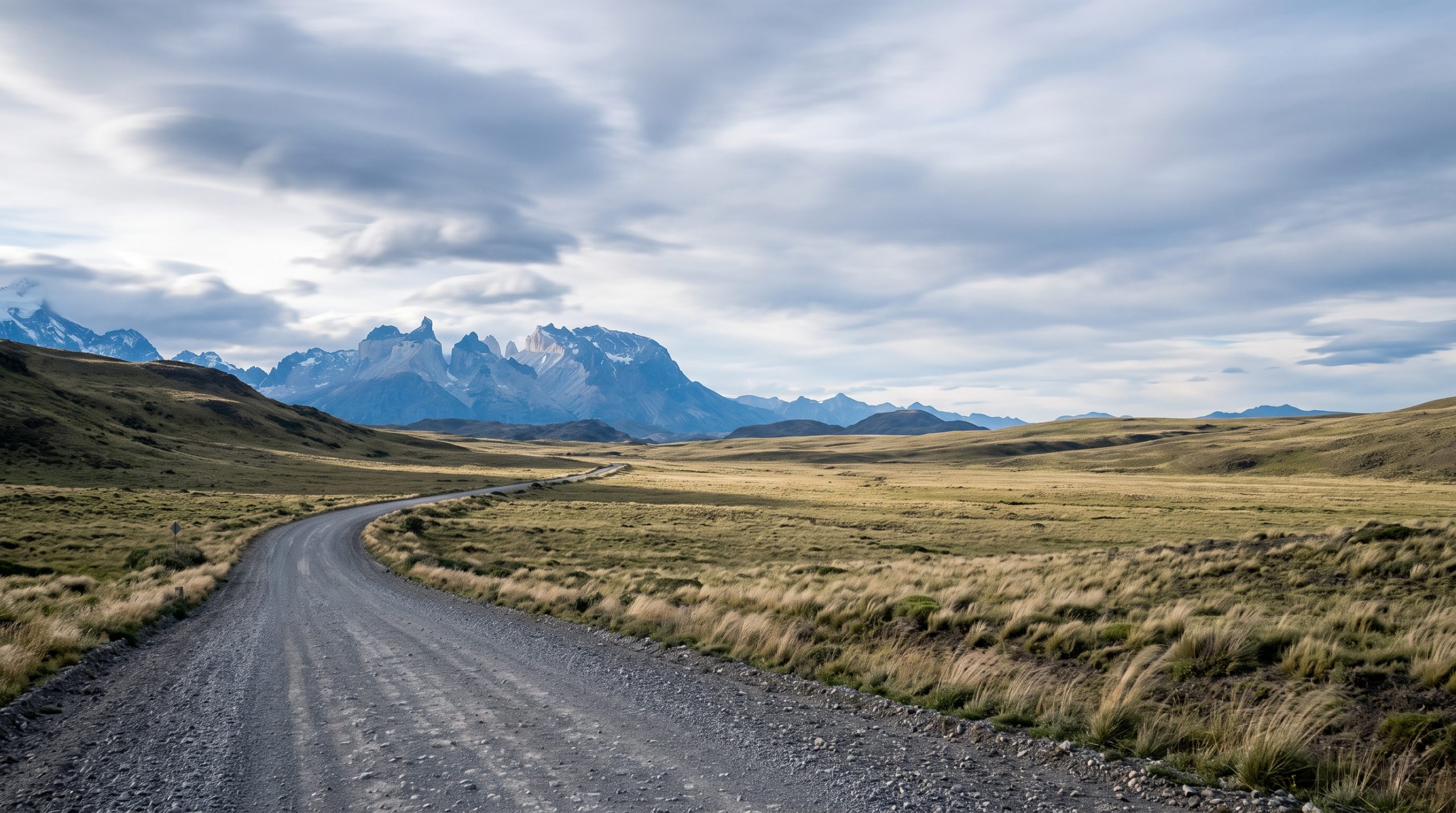
The first thing Patagonia does to a plan is stretch it. A route planner puts El Calafate to El Chaltén at 220 kilometers, which sounds like a lazy afternoon. It is three hours, on one road, through steppe where the horizon holds still for forty minutes at a time.
The second thing it does is hand you more daylight than you know what to do with. On 21 December the sun comes up over Torres del Paine at 05:33 and does not go down until 22:06. With twilight at both ends that is around eighteen hours of workable light. A gift and a trap, and most Patagonian timeline mistakes come from not knowing which.
What follows is the operational side: airports, borders, real drive times, light, drones and wind.
Chile or Argentina: the decision that sets everything else
Fly into El Calafate (FTE) for the Argentine side, or Punta Arenas (PUQ) for Chile and Torres del Paine. Then plan on three to four hours of onward road. Give Patagonia five to seven days on the ground, expect gravel and wind, expect a summer sunset after 22:00, and commit to one country rather than trying to cover both.
Getting in: FTE, PUQ, and the day Buenos Aires quietly eats
There is no airport at El Chaltén and none inside Torres del Paine. Every arrival is a flight plus a drive, and the drive is what people underestimate.
For the Argentine side, Comandante Armando Tola International Airport at El Calafate is the gateway. Nonstop flights from Buenos Aires take about three hours and fifteen minutes, on carriers including Aerolíneas Argentinas, and they leave from both of the city’s airports. That is where a day disappears. Long-haul flights from the United States land at Ezeiza, most southbound domestic services leave from Aeroparque, and Ezeiza sits at least an hour from the center. Connecting between the two on the same day is technically possible and practically grim. We build in a night in Buenos Aires instead.
For Chile, Punta Arenas is the entry point, a real city with car rental and outfitters. From there it is roughly 247 kilometers north to Puerto Natales, about three hours fifteen, with around ten scheduled buses a day plus private transfers.
| Airport | Opens up | Onward leg | Plan on |
|---|---|---|---|
| Comandante Armando Tola (FTE), El Calafate | Perito Moreno and El Chaltén | 220 km to El Chaltén | About 3 hours |
| Presidente Carlos Ibáñez del Campo (PUQ), Punta Arenas | Puerto Natales, Torres del Paine | 247 km to Puerto Natales | About 3 hours 15 |
| Punta Arenas (PUQ) in one push | Torres del Paine, same day | About 320 km to the park | 4 hours driving, 4 to 7 by bus |
Where the map lies, and the town that fixes it
Patagonian distances behave badly. Surfaces change without warning, and the scheduled transport is built for trekkers, not for anyone with a ceremony hour to hit.
Punta Arenas to Torres del Paine is about 320 kilometers and roughly four hours if you drive yourselves. By bus the same journey runs four to seven hours, because you change in Puerto Natales and the two legs are not timetabled to meet. Puerto Natales to the Laguna Amarga entrance looks like ninety minutes on a screen and takes the bus two to three hours. Plan on the longer number. Past the bridge at Laguna Amarga the surface turns to dirt.
Three park entrances sit on the bus network: Laguna Amarga, Pudeto and Administración. Administración is only served from April to October, which catches out couples who screenshot a route in August and travel in January. The catamaran across Lake Pehoé from Pudeto is a thirty minute crossing on a seasonal timetable, and one of the few fixed points in a Paine day. We never put a ceremony hour before the last sailing.
Two rental car rules are worth knowing before you book. You cannot collect or return a hire car inside Torres del Paine; it has to be Puerto Natales, Punta Arenas or El Calafate. And taking a Chilean rental into Argentina needs a permit arranged in advance, not at the border post.
The route we most often talk couples out of is El Calafate to Puerto Natales treated as a there-and-back. It is a full travel day with an international crossing in the middle. Done once, in one direction, it is fine driving. Done twice inside a five-day trip it costs you both of the mornings you came for.
Where you sleep solves most of it in advance.
| Base | Reaches | The gain | The trade |
|---|---|---|---|
| Inside the park (Lago Pehoé, Las Torres) | The massif, on foot or a short drive | No pre-dawn transfer at all | Very few beds, and they go first |
| Puerto Natales | The park in two to three hours | Restaurants, car rental, real supply | First light means leaving in the dark |
| El Calafate | Perito Moreno and the FTE runway | Easiest arrival and departure days | Wrong side of the border for Paine |
| El Chaltén | Fitz Roy trailheads from your door | You walk to the landscape, no driving | Three hours from the nearest airport |
For a December or January date we work on locking park-side beds a year or more ahead, and we open that conversation in the first planning exchange rather than after the timeline is set. Leave it late and the elopement still happens, but from Puerto Natales with a 03:30 alarm attached. Our destination guides cover the wider region.
Sunrise at 05:33, sunset at 22:06
Patagonia sits far enough south that day length restructures the whole elopement. These are the numbers for the Torres del Paine massif; El Calafate and El Chaltén run within minutes of them.
| Date | Sunrise | Sunset | What it does to the day |
|---|---|---|---|
| 1 November | 06:16 | 20:56 | Both ends reachable, wind at its most assertive |
| 21 December | 05:33 | 22:06 | Roughly eighteen hours of light with twilight |
| 15 February | 06:56 | 21:15 | The most forgiving mix of light and weather |
| 20 March | 07:53 | 20:05 | Autumn color arrives on the lenga forest |
| 15 April | 08:35 | 19:08 | Civilized sunrise, short day, quiet trails |
In late December you cannot honestly work both ends of the light in one day. First color hits the granite before 05:00 and the last usable light goes around 22:53. Chasing both means a twenty hour day and a couple who stop enjoying it around hour fourteen. We pick one end, build outward, and hold the other loosely in case the weather hands us something.
A real December day on the Chilean side, based inside the park, runs like this.
- 04:15 up, coffee, dressed in layers rather than the outfit
- 05:00 in position on the lakeshore, the massif already taking color
- 05:33 sunrise, roughly forty minutes of the light you came for
- 07:00 change out, walk back, second breakfast, sleep if you want it
- 13:00 the long flat middle, used for travel, a boat or nothing at all
- 18:30 dress properly, hair, the unhurried hour
- 19:45 on the ceremony ground with the sun still high and warm
- 20:30 vows
- 21:30 the hour the light turns gold and nobody remembers the alarm
- 22:06 sunset, then forty five minutes of blue
April is the same shape compressed. Sunrise at 08:35 means you eat breakfast first, and 19:08 sunset means dinner is dinner rather than an afterthought. Couples who would rather be warm than heroic often find the shoulder months suit them better, and it is worth telling us which you are. Our guide to how elopements actually work covers the rest.
Park passes, drones and the paperwork with a real lead time
Torres del Paine entry is bought online in advance through pasesparques.cl, the official CONAF channel, not on the morning you arrive. The tariff is seasonal, with summer running 1 November to 31 March, and it is charged per person. It sits outside our fee, with the other items on the coverage and pricing page. Los Glaciares also charges per person, and since November 2024 the northern sector around El Chaltén carries its own charge as well as the southern sector at Perito Moreno.
Drones deserve a straight answer. Aerial filming is not permitted inside Torres del Paine, and in Chile the registration, operating authorization and remote pilot credentials come from the DGAC. So we design a Paine film for the ground, using movement, long lenses and the scale of the massif behind you. In Argentina, park land is administered by Parques Nacionales and the airspace by ANAC, so both get confirmed before we plan a sequence around a drone. Our published films and galleries show how the ground-built version reads.
Argentina registers civil marriages at the Registro Civil for the district where one of you is domiciled, with witnesses and a waiting period between filing and the ceremony. Chile sets no minimum residency and asks for two adult witnesses. Most couples flying in from the United States sign at home and treat the Patagonian ceremony as the one that counts. We research your chosen ground either way, because a private estancia, a park sector and a municipal viewpoint are three different conversations.
Wind, layers and the ten minutes that matter
Patagonian wind is not weather that arrives and leaves. It is the ambient condition, strongest in spring, and it decides more about your clothing than temperature.
Fabric first. Heavy crepe, structured satin and thick silk behave in wind because they have weight. Chiffon, tulle and light organza become sails, and a long veil in a Paine gust turns into a two-person operation that pulls attention away from the vows. A defined waist keeps the shape readable and a short train keeps you mobile on gravel. If a flowing skirt is non-negotiable, tell us early and we will build the day around the sheltered pockets. They exist, and we know where they are.
Underneath, merino. A thin base layer under a dress is invisible and changes how long you can stand still on a ridge. Bring a wool overlayer that lives just out of frame, and boots for the approach with your real shoes in a pack, because the last two hundred meters to most of the good ground is loose rock.
The ceremony hour needs its own thought. At 20:30 in December the air can go from shirt sleeves to needing wool inside twenty minutes once the sun drops behind the ridge line, even with sunset ninety minutes away. In April, add gloves and a hat for the walk in. Every month, bring more hair pins than you think.
How we turn all of this into one schedule
Everything above becomes a document. We build the timeline backwards from the light for your date, use real drive times rather than planner times, and put a buffer either side of anything with a fixed departure. A ceremony hour never sits next to the last catamaran or a border post. We hold a second location in reserve for every part of the day, close enough that the transfer fits the window.
There are eight of us, four photographers and four filmmakers, and that changes what a long gravel drive means. On The Expedition a dedicated photographer and a dedicated filmmaker travel with you as a pair. When the next location is forty minutes of ripio away, one goes ahead to read the wind and the light while the other stays with you, so you arrive to a plan rather than a scouting exercise. Two vehicles, two sets of gear, a colleague in reserve.
The Adventure covers one full day with one dedicated photographer or one dedicated filmmaker, from $4,900, The Expedition covers one full day with both working together, from $7,900, and The Odyssey runs two to seven days across one or several destinations on a custom proposal. Team travel is included worldwide, so the flights and accommodation that get us to Punta Arenas are ours. Highlights reach you in five days, the full gallery or film in three weeks.
Tell us the month you are considering and we will tell you what the light does that week, and what the drive from your base really takes. Check Your Date.
Common questions
How many days do we need in Patagonia for an elopement?
Five to seven days on the ground, not counting travel days. That buys two weather windows for the ceremony instead of one, a settling-in day after the three hour fifteen minute flight from Buenos Aires, and room for the drive between sectors.
Torres del Paine or El Chaltén, if we can only pick one?
Torres del Paine gives the widest range of ground within a short radius, from lakeshore to forest to the massif itself, and it suits couples happy to drive gravel between locations. El Chaltén puts you at the trailhead with no driving at all, and Fitz Roy is the more vertical single subject. Tell us which morning sounds better and we will point you at the right side of the border.
Can we do both Torres del Paine and El Chaltén on the same trip?
Yes, on a route of nine days or more, moving in one direction rather than doubling back. The link between them is a full travel day with an international crossing, so a five-day trip attempting both spends two of those days in a car. This is the shape The Odyssey exists for.
Do we need to rent a car, or can we use buses and transfers?
Private transfers work better than buses, because the scheduled services are timed for trekkers and can turn a two hour leg into a longer one. If you do rent, you cannot collect or return the car inside Torres del Paine, and taking a Chilean rental into Argentina needs a permit arranged in advance.
Can we have drone footage of the Torres del Paine towers?
Not inside the park, where aerial filming is not permitted, and in Chile the credentials and operating authorization come from the DGAC. We confirm what is possible on your route before planning any part of the film around aerials, and we build the Paine footage on the ground, where the scale reads just as well.
Will our Patagonia ceremony be legally recognized in the US?
Most couples traveling from the United States handle the legal signing at home, because Argentina registers civil marriages at the Registro Civil for the district where one of you is domiciled and applies a waiting period. Chile requires no residency and asks for two adult witnesses. We research the rules for your location and tell you which route is simpler.
What months have the best weather, and how bad is the wind?
February and early March give the most settled mix of temperature, light and wind, with sunrise around 06:56 and sunset around 21:15 in mid-February. Spring, October into December, is the windiest stretch and also the emptiest. We plan sheltered alternatives for every location, and the wind in the frames is often what couples like most afterwards.
Two years out, and what to lock first
We are booking 2027, 2028 and 2029, and in Patagonia the order matters more than the lead time. Date and season first, because that fixes the light. Park-side beds second, because there are very few. Then us. Everything runs in writing and asynchronously, across whatever time zones you are in: you send the inquiry, we reply with an initial brochure within 24 hours, a tailored proposal follows, and planning begins once the contract is signed and the 30% retainer is paid.
Send us the month and the kind of morning you want to wake up to. Send Us a Message.