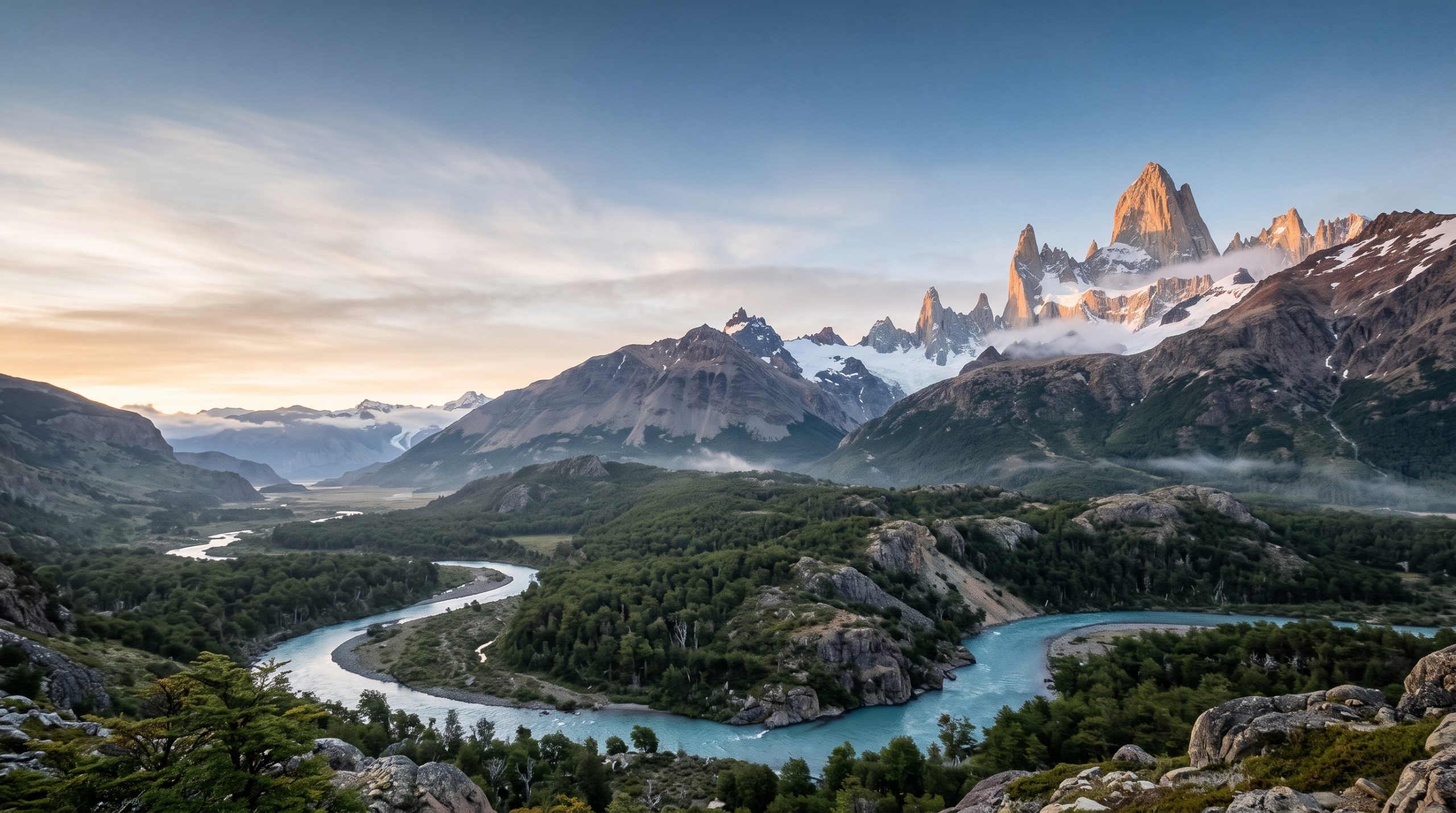
In late December the sun clears the horizon over Torres del Paine at around 5:30 in the morning and stays up until after ten at night. Magallanes never changes its clocks, so the same viewpoint in late June sees sunrise closer to ten in the morning. Nothing reorganizes an elopement day in Patagonia more than that spread, and almost nobody mentions it before the flights are booked.
The second fact is the wind, and it does not behave the way most visitors expect. It is usually at its quietest between first light and about eight in the morning, it builds through the afternoon, and it is stronger in high summer than in winter. On the steppe below the Cuernos, gusts over 100 km/h are an ordinary January afternoon rather than an event. That is not a warning. It is the reason we put vows at six in the morning and walking at three.
We work here, so we will be blunt about one thing. The Mirador Fitz Roy above Laguna Capri at one in the afternoon in January is busy, and the light is flat and directly overhead. The same granite an hour before sunrise is one of the great sights on the continent, and you may have it nearly to yourselves. Most of our job in Patagonia is arranging for you to be in the right place at the hour nobody else has organized themselves for.
Torres del Paine, El Chalten, and what we cover in each
We photograph, film and plan elopements across Chilean and Argentine Patagonia, from Torres del Paine to El Chalten and Lago del Desierto. One team designs the locations, builds the timeline, researches the permits and shoots both cameras. Coverage runs from one full day to a week spanning both countries, and team travel to Patagonia is included.
Sixteen hours of daylight, and the twenty minutes that matter
A late December day in the park holds about sixteen and a half hours of sun. Civil dawn arrives just before five, sunrise near 5:30, sunset a little after 22:00, and the last usable light close to 23:00. We do not shoot for eighteen hours. What those numbers really mean is that the day has two separate ends and a long, honest gap in the middle, and that the gap belongs to you.
First light on the towers is what people fly here for, and it lasts minutes. The granite goes copper, then pink, then ordinary. Standing at the mirador at the base of the towers for that means walking up the Ascencio valley in the dark and arriving with the biggest effort of the day already spent. If being married in that light is the point, the drive-up viewpoint at Laguna Azul gives you all three towers across water a short walk from the car, and the whole eastern side of the park does a quieter version of the same trick.
A 5:45 ceremony in December means leaving your room at 4:45. That is one reason we push for accommodation inside the park boundary rather than in Puerto Natales, which sits roughly two hours from the Laguna Amarga entrance: the pre-dawn hour then depends on nothing but your alarm. Park entry itself is bought in advance through CONAF’s official platform, pasesparques.cl, and the system now asks you to choose your route, with a capacity limit on each one. We book the section your morning actually uses and confirm the current tariff while the timeline is being written.
By eight the wind is usually announcing itself, and that is a cue rather than a problem. We move down into the lenga forest, onto the Rio Paine bridges, or out to Salto Grande, a short flat walk from the Pudeto car park, where the falls are loud enough that nobody notices you. Between roughly eleven and five in midsummer the light is high and hard. You eat, you sleep, you drive to the next sector, and we scout. From about 19:30 the Cuernos begin to warm, and we finish on water: the shore of Lago Pehoe, a beach on Lago Nordenskjold, the Serrano river with the massif behind it.
El Chalten runs on the same clock and a different geometry. Fitz Roy stands at the end of the main street, so you can be somewhere real within an hour of waking. The Mirador de los Condores is about a 45-minute walk from the edge of town and hands you the whole massif with the valley below it. Chorrillo del Salto is a short drive and a flat walk. Lago del Desierto is 37 km north on Ruta Provincial 41, gravel for much of it, about an hour and a half each way. Laguna de los Tres, the frame everyone knows, is roughly 20 km round trip and eight to ten hours of walking with the final kilometer climbing steeply. That is an Odyssey with a camp in it, not a single day in a dress.
| Period | Sunrise and sunset in the park | What the timeline looks like |
|---|---|---|
| Mid November | 05:53 and 21:21 | Spring green, snow still high on the peaks, early alarms and the year’s most theatrical wind |
| Late December | 05:33 and 22:07 | Two full ends to the day and light until nearly eleven at night, which is the best insurance a cloudy morning can have |
| Mid February | 06:56 and 21:16 | The balance month: fourteen hours of daylight, warm evenings, a 6am start instead of a 4am one |
| Mid March | 07:53 and 20:05 | Autumn color in the lenga and a dawn ceremony that starts after breakfast rather than before it |
| Early April | 08:28 and 19:18 | Late sunrise, first fresh snow on the granite, fewer people on every trail, shorter days to work with |
Two cameras in a five-minute window of light
When the towers go copper you have a handful of minutes. In those minutes a photographer wants to be thirty meters back holding the wide frame with you small under the granite, then in close for your faces. A filmmaker wants a slow move that runs eight or ten unbroken seconds, then a second angle to cut to. One person cannot do both, and a photographer who is also grabbing some video will hand you a compromised version of each. That is why the Expedition sends two of us, and it counts for more here than in a place where good light lasts an hour.
Both of them are ours. They have read the same location plan, they know which direction the wind is coming from, they know the vows happen at 5:45 because that is the quiet hour, and they have worked the same ridge together before. They are not two vendors who met at breakfast and are still negotiating who stands where while the color drains off the rock.
Aerials need saying plainly. Drones are not permitted inside Torres del Paine without prior written authorization from CONAF, and Argentina’s national parks take the same position over Los Glaciares. So we design the film on the assumption that there is no drone above the towers and none above Laguna de los Tres, and we plan any aerial work on legal ground outside the park boundaries with the authorization confirmed before it enters your timeline. Film and photography authorizations in Chilean protected areas run through CONAF’s regional office, and that is a matter of weeks rather than days, which is why we start it early.
Wind is the other argument for two people. Expedition days include professional audio for the vows, and a lapel mic in a 60 km/h gust records the gust. So we put the ceremony where a mic has a chance: inside a stand of lenga, in the lee of a moraine ridge, on the sheltered side of a lake in the first hour of light. Then we take you back out into the open for the frames that need it, because a dress and hair moving in Patagonian wind is the picture, and it is the frame that separates this place from anywhere else we work.
The finished result is worth looking at before you decide anything. Our published galleries and films sit side by side because that is how they were made, on the same morning, from the same plan. There are eight of us, four photographers and four filmmakers, so there is always a second camera on the ground and a colleague in reserve. In a region that is two flights and a long drive from almost everywhere, that redundancy is not a detail.
Planning for a mountain that hides
The question we are asked most about Patagonia is what happens if the peaks never come out. It is the right question. Fitz Roy and the Torres make their own weather and can sit behind cloud for days in any month of the year. Our answer is structural rather than comforting.
- No day is built around a single hero location. Every Torres del Paine timeline we write has a clear version, a low-cloud version and a wind-from-the-west version, and all three exist on paper before you land.
- Forest, rivers, waterfalls and shorelines photograph better in soft flat light than in sun. A morning that hides the towers improves the lenga stands and Salto Grande instead of ruining them.
- The order of days is flexible from the start. If Thursday reads clear at dawn and Friday does not, we ask you to be married on Thursday, and because we plan the whole trip rather than one appointment, moving it costs nothing.
- In December and January the sixteen-hour day is the safety net. A morning that closes in still has an entire evening standing behind it.
- If that skyline is the reason you are going at all, the Odyssey runs two to seven days across one or several destinations, which is simply more chances at the same weather.
We have stood on the shore at Laguna Azul with nothing above the water but grey, and watched the towers appear for a few minutes just before ten at night. That is the place being itself. The planning is what makes it a good day in either version. Tell us the month you are considering and we will tell you honestly what that month tends to do, and how we would build around it: Check Your Date.
Everything we handle, and what Patagonia charges separately
Every experience, in Chile and Argentina alike, includes the planning as well as the shooting. There is no version where you receive a photographer and a list of things to figure out yourself.
In every Patagonia experience
- Destination and location design, from the sector of the park down to the specific viewpoint and the hour we use it
- A custom timeline built around real light and real travel time on gravel roads
- Permit research and logistics guidance, including park entry routes and film authorizations
- Weather alternatives and backup planning written before you travel
- Drone footage where it is legal, safe and appropriate, which in Patagonia means outside the national park boundaries
- Professional audio for vows and meaningful moments on the Expedition, where conditions allow
- Team travel worldwide: flights, accommodation and ordinary travel for the assigned team, with no long-haul surcharge for the end of the Americas
- Highlights delivered in 5 days, and your full gallery or film in 3 weeks
Where coverage starts
The Adventure covers one full day with one dedicated photographer or one dedicated filmmaker, from $4,900. The Expedition covers one full day with a dedicated photographer and filmmaker working together, from $7,900. The Odyssey runs two to seven days of photography and film across one or several destinations and is quoted as a custom proposal. Full detail sits on our pricing page. Guest count does not change the fee. It changes access, permits, transport and the timeline, which is a planning conversation rather than a price one.
What Patagonia bills you directly
- CONAF park entry per person for Torres del Paine, bought in advance by route through pasesparques.cl in Chilean pesos
- The Los Glaciares access fee for the El Chalten trail sector, in Argentine pesos, revised often enough that we confirm it at planning time
- Any government, venue or landowner permit fees, including estancia access outside the park
- Accommodation, your celebrant, and vendors such as florals or hair and makeup
- Unusual transport: helicopters, private boats, 4×4 charters, horses, mountain guides
How a Patagonia enquiry becomes a held date
- You send the inquiry form with your month, and the region if you have chosen one.
- We reply within 24 hours with our initial brochure.
- We work through the shape of it in writing: which park, which sector, how early you are willing to be awake.
- We send a tailored proposal for your dates and your version of the day.
- You sign the contract and pay a 30% retainer, and planning starts immediately.
- Remaining payments are set out in the proposal, and from there we move into location design, timeline and permits.
If you are earlier than that and still deciding between countries, our destination guides and the planning fundamentals cover the groundwork we would otherwise repeat to you.
The couples who get the most out of this place
Patagonia rewards people who are willing to be awake at 4:15, who do not mind an hour and a half of gravel to reach a lake, and who can hear at breakfast that today is going the other way and treat that as part of it. If you want mountains more than you want styling, this is your landscape.
If a pre-dawn alarm is genuinely not your idea of a good morning, say so, because Patagonia has an answer for that. Sunrise sits near 07:53 in mid March and 08:28 in early April, the lenga turns red, and the trails are quieter. If uneven ground is out of the question, both ends of the region have drive-up viewpoints and flat walks that hold the same skyline. Tell us which of those you actually want and we will shape the day around it, or tell you plainly which month or which sector fits it better.
Common questions
Do we need a permit to elope in Torres del Paine?
You need park entry, bought in advance by route through CONAF’s pasesparques.cl, and depending on the scale of the day a film or photography authorization from CONAF’s regional office. We do the research and the paperwork guidance, and any government or landowner fees are paid by you.
Can you fly a drone over the Torres or over Fitz Roy?
No. Drone flying is prohibited inside Torres del Paine without prior written authorization from CONAF, and Argentina’s national parks apply the same rule to Los Glaciares. We plan aerials only on legal ground outside the boundaries, with the authorization confirmed first, and we design the film so it never depends on them.
Can Americans legally marry in Chilean Patagonia?
Chilean civil marriage is celebrated before an officer of the Registro Civil with two witnesses, and both partners must appear in person at the registry beforehand to give notice. It is possible, and it adds days and paperwork to your trip. Most couples we plan for sign at home and keep Patagonia for the ceremony itself.
Can we do Torres del Paine and El Chalten on the same trip?
Yes, and it is one of the best reasons to book an Odyssey. The two sit in different countries with a land border and a long drive between them, so we treat the crossing as its own day rather than a transfer, and we put the first ceremony on the side whose forecast looks better.
How fit do we need to be for the Laguna de los Tres viewpoint?
It is roughly 20 km round trip, eight to ten hours, with a steep final kilometer, so it belongs in a multi-day plan with a camp rather than in a single day. For the same skyline in an hour, the Mirador de los Condores is about 45 minutes from the edge of El Chalten.
How soon do we see the photos and the film?
Highlights reach you 5 days after the day itself, and the full gallery or film lands within 3 weeks. Both come from the same team that planned and shot it, so the film and the photographs tell the same story rather than two overlapping ones.
How far ahead should we be planning a Patagonia elopement?
We are currently taking Patagonia elopement bookings for 2027 through 2029. Park entry routes carry capacity limits and film authorizations take weeks, so most of our Patagonia planning runs a year or more ahead of the date, and the earliest conversations are the easiest ones.
Start with the month you have in mind
Send us the month, even a rough one, and whether Chile, Argentina or both is pulling harder. We will come back within 24 hours with the brochure and an honest read of what that month does to the light and the wind. From the first reply onward, the whole process stays in writing, at whatever hour suits the time difference between us, so nothing about planning this needs to interrupt your week: Tell Us Your Story.