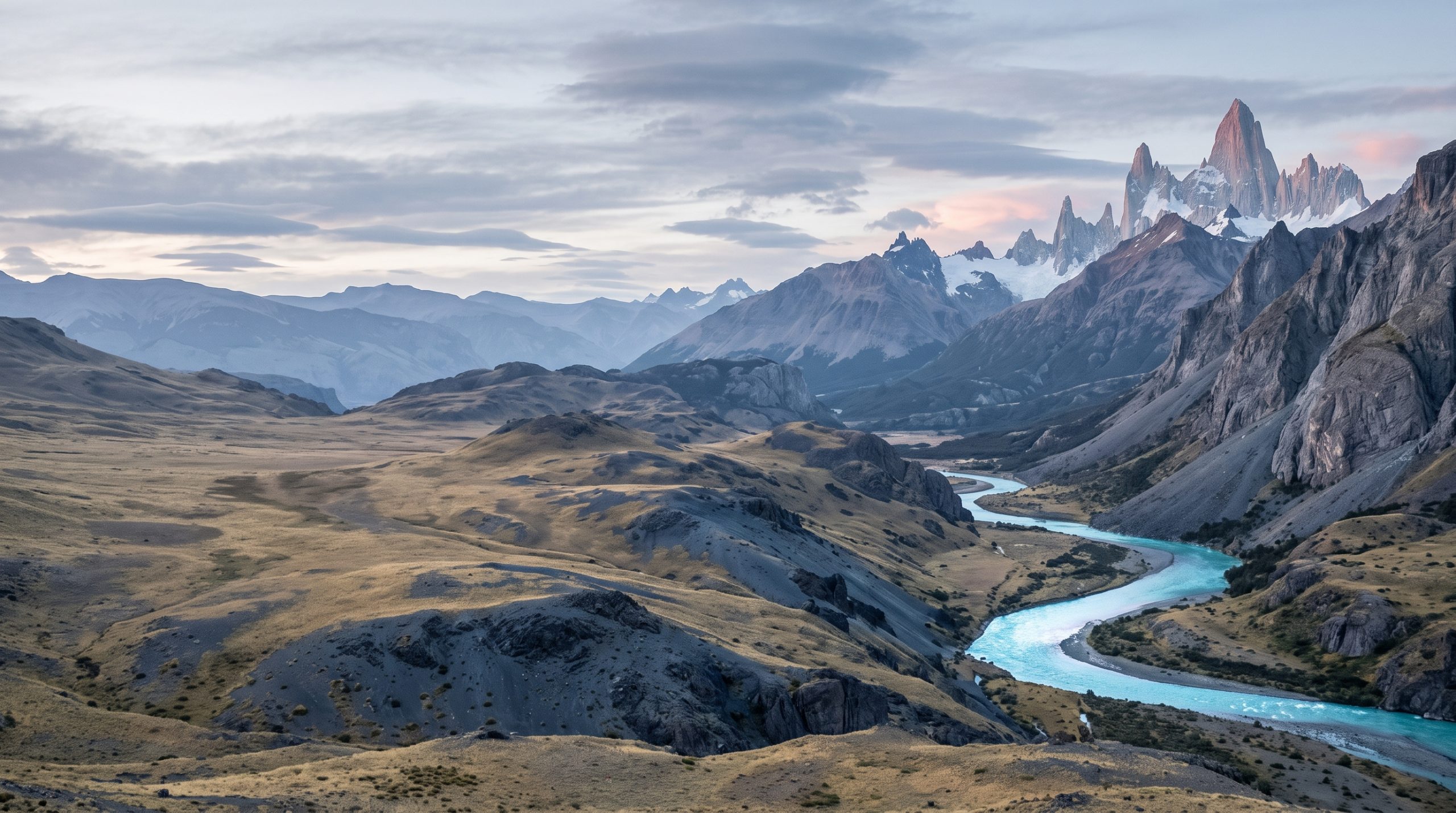
The trails above El Chaltén were free to walk until October 2024. Then Los Glaciares put three control points on the north side of the park and began selling access to the ground beneath Fitz Roy, which until then had been the last great free view in Patagonia.
The Chilean side moved further. Under Resolución 514/2027, CONAF rebuilt the Torres del Paine ticket into daily passes and passes of two or more days. The change was due in January, was pushed back to 1 May 2028, and took a non-resident adult from CLP 46,000 to CLP 80,000, close to ninety US dollars at the rate in force when it landed.
Those are the numbers couples find first, and neither of them decides what a Patagonia elopement costs. What decides it is how many mornings you are willing to give the weather, whether you stay on one side of the border, and how many cameras are pointed at you while the granite is red, for the few minutes it stays red. Our destination guides cover the regions. This page covers the money and the shape of the day.
Two park tariffs, one team fee
We photograph, film and plan elopements on both sides of Patagonia as one team. A full day with a dedicated photographer or a dedicated filmmaker starts at $4,900. A day with both working together starts at $7,900. Team travel to Patagonia is included. Park entry, lodging and ground transport stay in your name.
The day, from 4:40am to a sky still light at ten
Take mid-December in Torres del Paine. Around the solstice the park runs to more than sixteen hours of daylight, and it spends almost all of the good ones at the two edges. The sky starts to lift near 4:40am, the first colour reaches the towers shortly after half past five, and there is still workable light in the west after ten at night. The Argentine side runs about fifteen minutes behind: through December and January the sun is up over El Chaltén before six and down after ten.
That reads like a generous day. It is really two short days with a hole in the middle, and the hole is the wind. Mornings in the park are usually the calm stretch; gusts build through the afternoon and in the windier months run at averages around 60 km/h. So we do not spread ten hours of coverage evenly across sixteen hours of daylight. We load the ends.
A December morning on the Chilean side tends to start with a 3:45am coffee and a dark drive. CONAF publishes entry and exit times for the main sectors inside the park, and a pre-dawn plan has to fit inside them, which is one of the first things we check against your date before we suggest a single location. By 4:40 you are standing somewhere with the ridgeline going grey behind you. By 5:40 the best of it is finished. Whatever the light did, it did in about fifteen minutes, and there is no version of that morning where you drive somewhere else and try again.
Vows go in the calm, which in practice means somewhere between six and nine. Then we stop, properly: back down for breakfast, sleep, dry socks, and a long gap through the flat white middle of the day while the wind does its work. We pick the day up again around five in the afternoon on ground chosen to suit a rising wind rather than argue with it, and the final hour of coverage often runs past nine with the lakes still holding light.
El Chaltén asks a different question, because the frames people want there are earned on foot. Fitz Roy is 3,405 m of granite standing more or less above the town, and the classic view from Laguna de los Tres is roughly four hours of walking one way, with the steep part at the end. A sunrise up there means camping or starting around half past one in the morning. That belongs in some couples’ day and not in others, and we would rather say which we think it is than let you find out at the trailhead. The valley of the Río de las Vueltas, the lenga forest and Laguna Capri all hold light beautifully and cost you an hour instead of a night.
If the peaks are in cloud on your date
This is the real worry, and the honest answer is that both Fitz Roy and the towers spend plenty of mornings behind weather. We do not plan around hoping. We plan three windows into one day, with the drive times between them already written down, so a closed summit at five in the morning becomes a decision instead of a wait. The lower ground here is not a consolation prize either: glacial lake shores, beech forest, moraine and open pampa all photograph strongly under exactly the flat cloud that hides the peaks, and the film gains something from low cloud moving fast.
If a specific summit matters more to you than a specific date, tell us that in your first message. Two to seven days of coverage on the Odyssey buys three or four attempts at the same frame, which is how couples who want that particular skyline usually get it.
If you already have a month in mind, send it with the region you are leaning toward and we will tell you what the light does on those exact dates. Check Your Date
What the second camera does at half past five
Patagonian light poses a problem that no amount of skill solves alone. One camera can hold the wide frame while the granite burns, or it can stay close on your hands and faces while you speak. Inside a fifteen-minute window it cannot do both, and this is not a landscape that offers you a second run at it after breakfast.
That is the whole reason photography, film and planning are one service here rather than three purchases. There are eight of us, four photographers and four filmmakers, and the pair assigned to your day have worked out the geometry of it before you land. Not a photographer plus a videographer hired separately who introduce themselves in a dark car park at four in the morning and then negotiate about who stands where while the sky changes.
In this specific place, that changes three things. Position: with a filmmaker beside the photographer, the wide frame and the close one exist at the same moment, from the same light, and neither person has to compromise. Sound: the Expedition adds professional audio for vows where conditions allow, and in Patagonia that condition is wind, so the two of them agree the vows spot the evening before, with rock or a stand of lenga behind you and the wind off the audio. Reserve: eight people means a colleague already briefed on your plan, which is the sort of thing that matters when weather reshuffles flights into El Calafate.
Both mediums also read this country differently, and it is worth knowing which you actually want more. Stills hold the scale, the two of you tiny against a wall of ice. Film holds the movement that stills cannot: cloud tearing off Cerro Torre, the grass laid flat, your voices half carried away. If you want to see how that resolves before you commit, our published galleries and films are the place to look, and Patagonian days are among the ones we are most glad to have on film as well as in frames.
What we handle, and when the work lands
Every experience, on either side of the border, includes the planning as well as the filming. Not planning as a phrase on a page: planning as the document that tells you when to leave the hotel.
- Destination and location design, built around your date and real driving time on Ruta 40 and the park roads rather than map distances.
- A custom timeline written to the light, with the calm hours and the wind hours in the right places.
- Permit research and logistics guidance: which zone your ticket covers, which authority governs the ground you want to stand on, what has to be requested and by when.
- Weather alternatives and backup planning, with locations and drive times attached, not vague promises to be flexible.
- Drone footage where it is legal, safe and appropriate. Where aerials are not permitted on your ground, the film is built on movement at eye level, and this landscape supplies plenty.
- Professional audio for vows and other meaningful moments on the Expedition, where conditions allow.
- Highlights delivered in 5 days. The full gallery or film in 3 weeks.
Guest count does not change our fee. Bringing four people or none affects access, permits, transport and the timeline, and we plan for it, but the number of chairs is not what we charge for.
Where coverage starts, and what stays in your name
The full structure of the three experiences, and what separates them, sits on the pricing page. Two things about it are worth stating plainly here.
First, team travel is included worldwide. Flights, accommodation and ordinary ground travel for the assigned team are inside the fee, and Patagonia carries no long-haul surcharge. A team flying to El Calafate or Punta Arenas is priced the same way as a team driving to a Scottish loch. There is no separate travel invoice arriving in month nine of your planning.
Second, the costs that stay with you are the local ones, and in Patagonia they are unusually easy to itemise:
- Park entry. Torres del Paine at the CONAF non-resident rate set out at the top of this page, bought in advance through the pasesparques.cl portal and scanned as a QR code at the gate. Los Glaciares at ARS 45,000 for a non-resident entry, sold by zone, so a Fitz Roy day and a Perito Moreno day are two separate purchases. The Argentine tariff is reset in pesos by the parks administration, and the figure that applies to your date goes into your permit list with the timeline.
- Any government, venue or landowner permit fees your locations require. The research and the paperwork guidance are ours, the fee itself is yours.
- Accommodation in El Chaltén, El Calafate, Puerto Natales or a lodge inside the park, plus your celebrant and any vendors you want.
- Unusual transport, when you want it: helicopters, private boats on the glacial lakes, 4×4 charters, mountain guides.
Multi-day work across both countries is the Odyssey, two to seven days, one or several destinations, quoted as a custom proposal because a Chaltén-plus-Paine itinerary and a three-day Chaltén itinerary are not the same job.
How a Patagonia 2027 date moves from enquiry to plan
- You send the inquiry form with your month, the region you are drawn to and roughly how many days you have on the ground.
- We reply within 24 hours with our initial brochure and a first read on whether your dates and your locations agree with each other.
- We build a tailored proposal: the experience that fits, the team assigned, the shape of the day, the permits in play.
- You sign the contract and pay a 30% retainer. The date is then held for you, and the remaining payment stages are set out in the proposal.
- Planning begins in earnest. Locations, timeline, permit research, weather alternatives, transport, and the answers to the small questions that arrive at eleven at night. Our guide to how to plan an elopement covers the fundamentals while you wait for your date.
- We shoot the day, then deliver: highlights in 5 days, the full gallery or film in 3 weeks.
We currently have Patagonia elopement dates available through 2027–2029, and Patagonian dates in the December to February window tend to be spoken for earliest simply because that is where the daylight is.
Couples this landscape rewards
Patagonia suits people who are genuinely fine with a 3:45am alarm, uneven ground under their shoes, and a plan that may change at breakfast. It suits couples who would rather be cold and alone at the right hour than comfortable and surrounded at the wrong one. If the wind in your hair in every frame sounds like the point rather than the problem, this is your place.
| If you want | The frame it gives | The hour that matters | What it asks of you |
|---|---|---|---|
| El Chaltén, Fitz Roy | Vertical granite, forest, glacial lagoons | Sunrise before six in December and January | Walking, and ticketed trail access since October 2024 |
| Torres del Paine | Open valleys, big water, the towers themselves | The 4:40 to 5:40 window, inside CONAF sector hours | Pre-dawn driving and tickets bought online in advance |
| Both parks | Two countries in one film | A whole travel day given to the border | Several days, which means the Odyssey |
If none of that sounds like you, the answer is not a different photographer, it is a different shape of day. Late February and March bring shorter nights, warmer mornings and colour in the lenga forest, and a valley-floor day around El Chaltén needs no summit at all. The park roads, the lake shores and the estancia country all give you Patagonia without a 1:30am start. El Calafate to El Chaltén is 215 km up Ruta 40, about three hours, and a day built on that axis can be gentle without being ordinary. Write down what you actually want your morning to feel like and send it to us, and we will either build that or tell you honestly which month and which side of the border fits it better.
Common questions
Do we need a permit to hold a ceremony in Torres del Paine?
Access to the park is a ticket rather than a permit, bought before you travel through CONAF’s online portal and scanned at the entrance. Anything beyond two people standing on public ground, including commercial filming, sits with the park authority and the rules vary by sector. We do the research and tell you what has to be requested and when; the fee itself is paid by you.
Will our marriage be legal if we hold the ceremony in Patagonia?
In Argentina the legal act is performed in front of a civil registry official, and a ceremony held on a mountain or a lakeshore carries no legal weight by itself. Most couples we plan for handle the legal signing at home and keep Patagonia for the words that matter. Tell us your nationalities and your dates and we will map out what the paperwork route looks like before you book flights.
What do park entry fees add to our 2027 budget?
On the Chilean side, a non-resident adult ticket for Torres del Paine sits near CLP 80,000 under the structure that came into force on 1 May 2028, in daily and multi-day forms. On the Argentine side, Los Glaciares charges ARS 45,000 for a non-resident entry and sells it by zone, so El Chaltén and Perito Moreno are separate. Peso tariffs are reset periodically, and the current figure goes into your planning documents.
What happens if Fitz Roy or the towers are in cloud on our date?
We work to three planned windows rather than one, with drive times between them written into your timeline, so the morning can move at five o’clock without anyone improvising. Low cloud is also genuinely good for the forest, the lake shores and the moraine, and it gives the film movement that a clear sky does not.
Can we photograph both Torres del Paine and El Chaltén on one trip?
Yes, on the Odyssey, which runs from two to seven days and can cover more than one destination. Build in a full day for the border crossing, and remember that El Calafate to El Chaltén alone is 215 km and about three hours before you add Chile. Two separate single days in two countries is not a thing the geography allows.
Which months give us the light we want, and which are too short?
Mid-November to mid-March is the window where daylight, temperatures and trail conditions line up, with December and January giving over sixteen hours of light and the largest crowds. November is quieter on the trails and windier. Deep winter is a real option for the open country of the Chilean side, but around the June solstice the day is roughly eight hours shorter than in December, so we plan tighter and closer to the road.
How soon after the day do we see the photographs and the film?
Highlights reach you in 5 days, while you are probably still travelling. The full gallery or film follows in 3 weeks.
Tell us the month, and which side of the border
We handle the planning in writing so nothing depends on matching time zones, at whatever hour suits you and across whatever time difference sits between us: the first reply and brochure inside 24 hours, then the proposal, then a timeline that tells you when to leave the hotel in the dark. Send us the month you are thinking about, the peak you cannot stop looking at, and how you feel about a 3:45am start, and we will come back with the day that fits. Start Your Story