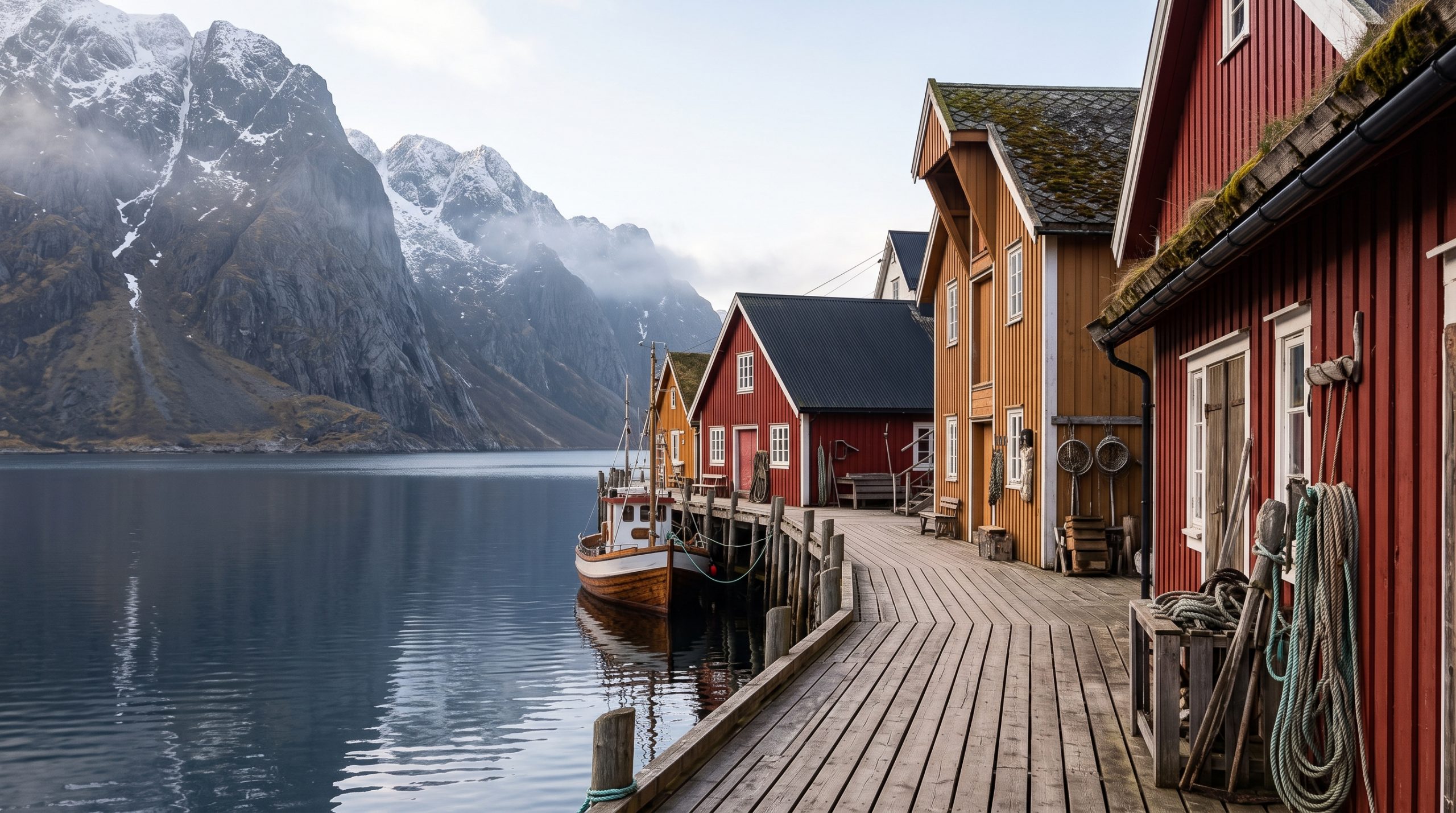
Nusfjord is the one village in Lofoten you pay to walk into. The fee at the entrance is currently 100 kroner a person, roughly ten US dollars at recent exchange rates, and it is not a museum ticket. It is a private village that around twenty five people still live in, run as a working operation, with a bakery just inside the gate and a general store that has been selling to fishermen since the harbor’s best years.
Getting there is its own filter. Nusfjord sits 6.2 kilometers off the E10, the road that carries every car, coach and camper the length of Lofoten, and those 6.2 kilometers climb over a shoulder of rock before dropping to sea level in a series of tight bends. Nobody arrives here without meaning to. From Leknes it is about 27 kilometers, which sounds like nothing until you drive the last part of it.
You will find Nusfjord described online as a UNESCO World Heritage Site. It is not one. What it actually holds is more interesting: in 1975, UNESCO’s Architectural Heritage Year, Nusfjord was picked as one of three pilot projects in Norway for preserving wooden building environments. That decision is the reason the quays, the cod liver oil works and the rows of rorbuer are still standing in the shape a fisherman would recognize, rather than rebuilt into something tidier.
The gate, the fee and the paperwork, in one paragraph
Yes, you can marry in Nusfjord. The village is privately run, so permission comes from the operator rather than a park authority, and day visitors currently pay 100 kroner each to walk in. Overnight guests do not. The legal side runs through Skatteetaten, whose marriage license stays valid for four months once issued.
Six kilometers off the E10, and why that matters
The turn off the E10 is unremarkable and easy to miss. What follows is a narrow road with passing places, a long pull uphill and then a descent that ends at the water. Cyclists describe it accurately as up a hill and down again. In a rental car it is slow rather than difficult, and the honest planning number is not the distance but the fact that you should never treat Nusfjord as a quick stop on the way to somewhere else.
There are two places to leave a car. The upper parking area sits above the village and gives you the high view over the whole harbor, the one that made Nusfjord famous, which day visitors miss entirely once they have walked down. Below that, closer to the entrance, space is limited and fills at peak times in summer. The final hundred meters down into the village is steep enough that we plan around it rather than pretend it is flat.
Here is the part almost nobody writes down. In wedding clothes, Nusfjord is one of the gentlest locations in Lofoten. There is no hike. Total walking on a ceremony morning is measured in minutes, and the surfaces are gravel lanes, wooden quays and short flights of steps between buildings. What catches people out is the planking. Wet timber, salt and a long hem do not mix, and heels find the gaps between boards immediately. Flats or boots for the moving, whatever you like for the standing still, and we build the route so the walk between the ceremony spot and the door of a warm building is short.
Most day visitors spend two to four hours here, which tells you something useful. The village is small enough to see quickly and rich enough to hold a camera for a full day, and those are not the same thing.
A harbor with walls: what the light really does
Nusfjord sits at 68 degrees north, and the almanac for that latitude is dramatic. From around 26 May to roughly 17 July the sun does not set at all. Near the solstice it drops to about a degree and a half above the horizon around midnight and sits in the north, then climbs again. By mid August the sun is up around half past four in the morning in the northeast and down close to ten at night in the northwest. Around the September equinox you get a near twelve hour day, sunrise about a quarter to seven, sunset about a quarter past seven.
Now the part the almanac cannot tell you. Mountains stand on both sides of this basin, close and steep, so direct sun reaches the harbor later in the morning and leaves it earlier in the evening than any sunrise table suggests. In practice that is a gift rather than a problem, because the water in the harbor is nearly always flat and it throws light back up onto the buildings and onto faces. The rorbuer are painted the color they are for a reason, and shade does not dull them.
Early February is the version of Nusfjord we would argue hardest for. The sun comes up around ten to nine in the southeast, sets around four in the afternoon in the southwest, and never climbs above roughly eight degrees. That is seven hours of light that behaves like a permanent late evening, low and sideways, with snow on the quays. From early December to early January the sun stays below the horizon entirely, and the middle of the day turns a deep blue that the village lamps cut straight through. Both of those are strong days. Neither is the summer day people imagine when they book Lofoten.
The summer midnight sun needs one honest note. At eleven at night in June the light is low and northern, which puts it on the peaks above the village rather than down in the harbor. That hour gives you soft, even light on two people and glowing rock behind them. If you want the sun itself in the frame at midnight, we walk you out toward the mouth of the inlet or back up the road, and we tell you the walking time before you decide. You can see how both versions look in our published elopement stories and films, harbor light and ridge light side by side.
Who you ask, and who signs
Most Lofoten locations are open ground where a small private ceremony needs nobody’s blessing. Nusfjord is the opposite, and that turns out to be simpler. The village is operated as one business, Nusfjord Arctic Resort, which is why there is a gate at all. The operator’s own explanation of the entrance fee is that it pays to maintain the historic buildings and surroundings. So a ceremony on the quay is a conversation with a landowner rather than an application to an authority, and it is answered by one party who can say yes.
The legal marriage is separate. Since 1 January 2018 the authority to perform civil marriages in Norway sits with the municipalities rather than the district courts, and people who are not resident in Norway can marry civilly in a Norwegian municipality provided they meet the conditions of the Marriage Act. Before any date can be fixed, Skatteetaten checks that you meet those conditions and issues a marriage license, the prøvingsattest, which is valid for four months. Municipalities can agree to hold a ceremony somewhere other than the town hall, with the couple covering the additional costs under the national regulation on municipal ceremonies, but that is arranged case by case rather than assumed.
Plenty of the couples we plan for handle the legal registration at home and keep Nusfjord for the ceremony they actually want, with their own words and no queue behind them. Both routes work, and the choice changes the timeline more than it changes the day. Permit and venue fees are paid by you; the research, the correspondence and the sequencing are ours, and the same logic covers drone work. Aerials over a village this small run on rules and an agreed window, so we confirm the window with the village before the film leans on them. If you are still deciding how the legal and the meaningful fit together, our planning fundamentals walk through the order of operations.
Sleeping inside the gate
Guests staying at the resort are not charged the entrance fee, and that single detail rearranges the entire day. Day visitors arrive and leave inside a few daylight hours. If you sleep in a rorbu, the harbor at four in the morning and the harbor at eleven at night belong to you, your witnesses and whoever is on the fish dock. This is one of the rare places in Lofoten where the standard advice to arrive early genuinely works, because the village does not just quiet down. It empties.
Two cameras in a village twenty five people live in
Nusfjord is tight. The lanes between the rorbuer are about two people wide, the quays are narrower than they look in photographs, and there is a limited number of places to stand where you are not in someone’s shot. That is precisely why we send photography and film as one team rather than two suppliers meeting on the morning. We divide the geometry before we arrive: one of us low on the quay, one back on the higher ground above the boathouses, then a swap between the vows and the rings so neither of you sees a lens where a face should be. Wind funnels along the inlet and rattles halyards and drying racks, so on an Expedition day the audio goes on the two of you rather than out in the open air where the harbor is loudest.
Our coverage runs from the Adventure at $4,900 with a dedicated photographer or a dedicated filmmaker, to the Expedition at $7,900 with both working together through a full day, to the Odyssey for couples spending several days moving between Lofoten villages. The full picture of what each one includes is worth reading before you write to us, because team travel is inside the price in every destination we work in.
Who should think twice. If what pulled you to Lofoten was empty white sand and enormous ridgelines, Nusfjord will feel small, and it works better as a rich second hour than as the whole day. It suits couples who respond to architecture, working boats, timber and reflected water, and who would rather spend the morning close to a warm room than climbing. Tell us which of those two people you are and we will shape the day accordingly, or point you to the month and the stretch of coast that fits it better. Our destination guides cover the alternatives within an easy drive.
Common questions
Do we still pay the entrance fee if we are staying in a rorbu at Nusfjord?
No. The operator confirms that guests staying at Nusfjord Arctic Resort are not charged the village entrance fee, which currently sits at 100 kroner a person for day visitors. If your guests are driving in for the ceremony and staying elsewhere, budget the fee for each of them and let us handle the arrangements with the village in advance.
Can we drive down to the harbor, or do we have to walk up from the parking area?
There is parking above the village and more limited space closer to the entrance, which fills at busy times in summer. The last hundred meters down is steep. We usually plan for one vehicle to go low with clothes, rings and anything heavy, and everyone else to come down on foot, which also gets you the long view down over the harbor on the way in.
Is there enough light in Nusfjord in early February for a ceremony?
Yes, and it is some of the best light of the year here. In early February the sun rises around ten to nine and sets around four in the afternoon, never climbing much above eight degrees. That gives you roughly seven hours that all behave like golden hour. We place the ceremony in the middle of it and keep the walk to a warm building short.
Will Nusfjord be quiet enough for a ceremony in July?
In the middle of a July day, no. Most visitors spend two to four hours in the village and July delivers a steady stream of them. Because the sun does not set at all between late May and mid July, the answer is not to fight for space at two in the afternoon but to hold the ceremony at ten at night or four in the morning, when the gate has done its work.
Do we need a Norwegian marriage license to marry in Nusfjord?
Only if you want the ceremony in Nusfjord to be the legally binding one. In that case Skatteetaten must check that you meet the conditions of the Marriage Act and issue a marriage license, valid for four months, and the ceremony itself is arranged with a Norwegian municipality. Many couples instead register the marriage at home and hold the ceremony they care about in the village.
Your first morning in the village
The shape of it, briefly. You wake inside the gate, the harbor is glass, and there is nobody on the quay. We work the reflected light and the empty lanes for the first hours, break while the day visitors come and go, then take the village back in the evening when the light is long and the drying racks are ticking in the wind. Highlights reach you five days later, the full gallery or film inside three weeks. Our Lofoten calendar is currently open across 2027, 2028 and 2029, and everything from the first reply to the finished timeline happens in writing, so you can read it, think about it and answer when it suits you. Send us the dates you are holding and what you want the morning to feel like, and we will come back with a plan for the village and an honest read on the light in that week. Start Your Story.