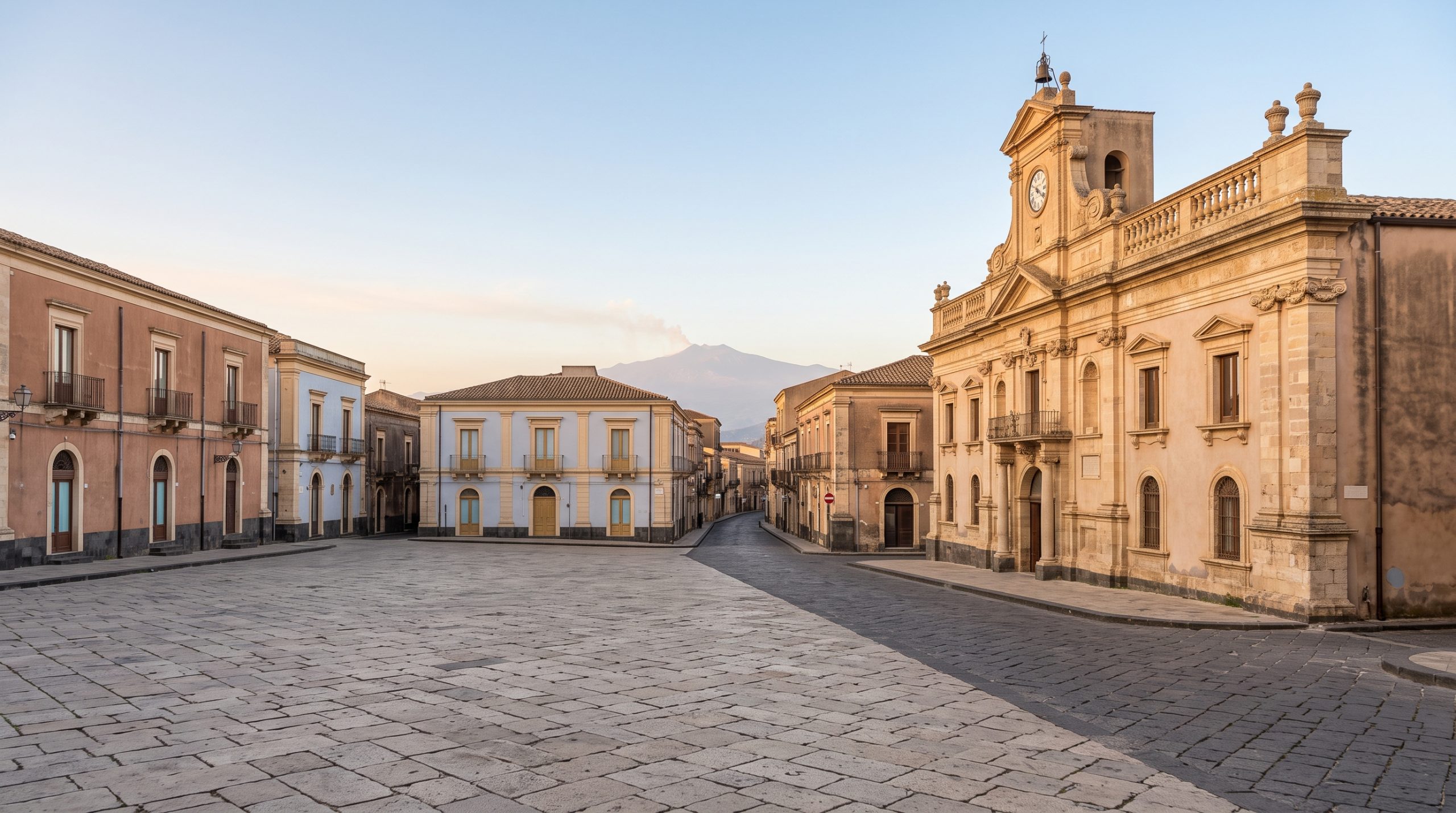
The document American couples know as a nulla osta has another name on the desk where you actually sign it, and for Sicily that desk belongs to the United States rather than to Italy. It is the Consulate General in Naples on Piazza della Repubblica, or the Consular Agency in Palermo at Via Vaccarini 1, where marriage affidavits are taken by appointment Monday through Thursday and every fee is paid by card.
What you swear there is a Dichiarazione Giurata: an affidavit that nothing under US law stands in the way of your marriage. The marriage office of the comune works from that piece of paper, and it carries no weight until an Italian Prefettura has legalized the consular signature on it. Two offices, in one order, and the order cannot be reversed.
Treat this as a planning map, not a legal opinion. The office issuing the documents remains the source of truth for your case. What follows is the chain as the US Mission in Italy publishes it, rearranged into the sequence it actually takes when the wedding is in Sicily.
The nulla osta under its Italian name
In Sicily the nulla osta is the Dichiarazione Giurata, a sworn affidavit that US law raises no impediment to your marriage. You sign it before a consular officer in Naples or Palermo, pay $50 per notary seal, then have that signature legalized at a Prefettura before the comune will accept it.
Where the nulla osta process needs patience
Our honest rating for two Americans marrying in Sicily is fiddly. Not difficult, not out of reach, but assembled from five or six short errands that each depend on the one before, several of them in offices that open for a couple of hours on particular mornings. Nobody is going to refuse you. The system simply assumes you have unlimited weekdays.
The law is the easy half. There is no residency requirement waiting to catch you out, and the notice period that governs Italian residents largely does not govern you: where neither party is an Italian citizen or a resident, the US Mission states that banns are automatically waived, or posted for a shorter period that can run from a single day to a week depending on the town hall. The civil ceremony is performed by the mayor or one of the mayor’s deputies, and it is brief.
The fiddly half is the paper behind it. A birth certificate has to leave your hands twice before it is usable in Italy. An affidavit has to be sworn by four people who are not related to you. A legalization counter opens for one hour at a time. Read the chain once and it stops being intimidating, because most of it can be finished in the United States before you pack a bag. For the wider view of how an elopement abroad gets built around constraints like these, our guide to planning an elopement covers the fundamentals.
The nulla osta chain from home to comune
Collected out of order, this chain stalls. Collected in order, it is a fortnight of admin at home and two mornings of errands in Italy. Each item below states who issues it and what has to be done to it before an Italian office will look at it.
- Valid US passports. Your proof of citizenship at the consular appointment and your photo identification at the comune. Everything downstream copies the name exactly as it appears on this page.
- Long-form birth certificates. Italian consulates ask for the long form showing your parents’ names, legalized with an apostille issued by the Secretary of State of the state that issued the certificate, and accompanied by a separate Italian translation. This is the one item that takes real calendar time, because the certificate has to be ordered, then apostilled, then translated.
- Divorce documents, if either of you has been married before. The divorce certificate together with a certificate of no appeal issued by the county clerk where the divorce was registered.
- The Atto Notorio. A sworn statement that no impediment to the marriage exists under US law, signed by four witnesses in total, over 18, not related to either of you or to each other, appearing in person with valid passports before an Italian consular officer in the United States. You can instead swear it in Italy before an authorized office, which needs two revenue stamps of 16 euros and one of 10.62 euros, an interpreter if you or any of the witnesses does not speak Italian, and proof of your legal presence in the country, which a plane ticket satisfies.
- The Dichiarazione Giurata. Sworn after you land, at the Consulate General in Naples or the Consular Agency in Palermo, at $50 per notary seal. Both of you sign your own, so plan on two seals. Naples accepts payment in person at the consular cashier; the Palermo agency takes credit cards only.
- Legalization of that affidavit. The Ufficio Legalizzazioni of the Prefettura in Palermo or Naples authenticates the consular signature. Where you sign decides where you legalize, so an affidavit taken by the Palermo agency goes to the Palermo Prefettura.
- The Declaration of Intention to Marry. Made at the Ufficio Matrimoni of the comune where you are marrying, in front of the civil registrar, with an interpreter present if you do not speak Italian. This is the appointment that puts your date in the register.
- The apostille on your Italian marriage certificate. Issued by the competent Prefettura after the wedding. Ask for a copy of the certificate and its apostille while you are still in Italy, because that is the version that travels cleanly back to a US county recorder.
Work back from your Sicily ceremony date
Two clocks run at once and only one of them is legal. The legal clock, for a couple where neither party is Italian or resident in Italy, is short: the notice at the town hall is waived or compressed into somewhere between a day and a week. The other clock is availability, and it is the one that actually sets your date. Consular notarial appointments have to be booked well ahead, the Prefettura counter opens in narrow windows, and the comune has its own list of free dates and rooms.
The real minimum on the ground, with everything else already done, is a few working days. The comfortable minimum, and the one we build Sicilian legal weeks to, is five clear working days in Sicily before the ceremony, with the Atto Notorio finished at home and the apostilled birth certificates travelling in the same folder as the passports. Five days absorbs a closed counter without touching the wedding date.
| Step | Where it happens | When we want it done |
|---|---|---|
| Long-form birth certificates, apostilled and translated | Vital records office, then the Secretary of State of the issuing state | Before anything else moves |
| Atto Notorio, four witnesses in person | Your Italian consulate in the United States | Finished at home, before you fly |
| Dichiarazione Giurata, $50 per notary seal | Naples, or the Palermo agency, Monday to Thursday | Your first working day in Sicily |
| Legalization of the affidavit | Ufficio Legalizzazioni, Prefettura of Palermo or Naples | The same week, on a day the counter opens |
| Declaration of Intention to Marry | Ufficio Matrimoni of your comune | Several working days ahead of the ceremony |
| Civil ceremony with the mayor or a deputy | The room or outdoor site your comune has approved | The hour we hold for the light |
| Apostille on the marriage certificate | The competent Prefettura | Before you fly home |
Opening hours, revenue stamps and the rest of the small print
This is where a Sicilian legal week is won. None of it is dramatic. All of it is the kind of thing you only learn by standing in the queue, so here it is in advance.
- The legalization counter opens for one hour. The consulate lists the Naples Ufficio Legalizzazioni at Via Vespucci 172 as open Monday, Wednesday and Thursday from 1:00pm to 2:00pm. Three days a week, sixty minutes at a time. Plan the drive, the parking and the lunch around that window rather than the other way round.
- Palermo takes cards, never cash. The Consular Agency at Via Vaccarini 1 states that all fees are paid by credit card only, and offers non-emergency services Monday through Thursday, by appointment and subject to availability. Bring a card that works abroad and a second one in the other bag.
- The $50 is per notary seal. Two affidavits means two seals, and if the consulate seals anything else for you that day, each one is counted separately.
- Consular staff cannot witness your documents. The notarial guidance says it plainly: if your document needs a witness, you arrange the witness. Nobody behind the glass can sign for you.
- Revenue stamps come from a tobacconist. An Atto Notorio sworn in Italy runs on two marche da bollo of 16 euros and one of 10.62 euros, bought at any tabaccheria under the white T on a dark ground. There is one on nearly every corner in Palermo, Catania and Siracusa, and none of them are inside the office that wants the stamps.
- Witnesses are 18 and up, with photo identification. Any nationality is fine. The rule people miss is that a witness cannot also act as your interpreter, so if the two friends you flew in are also your only Italian speakers, you need a third person in the room.
- Published guidance on banns varies because most of what is written online describes Italian residents. The line that governs a visiting American couple is the consular one: waived, or posted for a shortened period of one day to a week, at the town hall’s discretion.
- Hall fees are local, and sometimes nothing at all. What a marriage room costs depends on the town, the season and the day of the week. The consulate’s listing for the Palermo marriage office at Piazza Giulio Cesare 52, open Monday, Wednesday and Friday from 8:30am to 1:00pm and again on Wednesday from 3:00pm to 5:00pm, records no rental fee for the hall.
- Names must match across every page. We read the passport, the birth certificate, the translation and the affidavit side by side, middle names included, before anything is handed over a counter.
Use the quoted fees and timings as planning guidance, then confirm the live figures with the issuing authority before submitting anything.
Marrying at home first, then a ceremony under Etna
A good share of the American couples who elope in Sicily sign the legal marriage at home, in a short county appointment with two friends, and hold the ceremony that matters to them here. We want to be plain about this: it is not a workaround and it is not a lesser version. It is the option we would pick ourselves for a couple with limited leave, or for anyone who wants vows outdoors at an hour no register office can offer.
What changes is entirely administrative. No consular affidavit in Naples or Palermo. No Prefettura counter, no four witnesses at an Italian consulate, no Italian-language rite, no interpreter beside you, no apostille to collect before your flight. Your celebrant, whom you pay directly, writes the ceremony with you in English, and it runs exactly as long as you want it to.
What does not change is everything you will remember. If anything the location freedom widens, because a legal civil ceremony has to take place in a room or an outdoor site the comune has approved, while a celebrant-led ceremony can happen on a lava field above Zafferana Etnea at first light or on the Ortigia sea wall before the fish market opens. Landowner and access permissions still apply, and researching them is our work either way. The photography and the film are identical in scope, and so is the delivery.
What we can coordinate while you handle the legal file
Our side of a Sicilian wedding is the shape of the day around the offices. We research the permits and access rules for the places you want to stand in, design the locations, and build a timeline from real Sicilian travel times rather than the optimistic ones a mapping app gives for the SS114 in August. Weather alternatives are planned before you arrive rather than improvised on the morning.
We also hold the two hours that matter. The comune offers the slots it has and the light does what it does; the craft is placing the ceremony inside the overlap and putting the portraits on either side of it. If the registrar can only take you at four in the afternoon in late June, we plan the ridge or the water for two hours later, and the drone, where flying is legal, safe and appropriate, for the gap in between.
On The Expedition a photographer and a filmmaker work the day together, which counts for more at a civil ceremony than anywhere else in an elopement. The registrar’s part is short, in Italian, in one room, and it does not run twice. One of us covers the vows and the signing on film, with audio on the words themselves where conditions allow, while the other stays free to move for stills. There are eight of us in the team, so there is always a second camera on the ground and a colleague in reserve.
What stays with you is the filing and the fees. We do not submit your documents and we do not sign as your witnesses, because we are behind cameras from the first frame to the last. Government, venue and landowner permit fees are yours, along with your celebrant, accommodation and anything unusual on wheels, water or rotors. Team travel is included worldwide, so flights and accommodation for the pair covering your day are already accounted for. Highlights reach you in 5 days and the full gallery or film in 3 weeks, and our published stories and films will show you how Sicilian light behaves at both ends of the day. Coverage is one price whatever the guest count, and the tiers sit on our pricing page.
If you have a comune in mind already, or only a stretch of coast and a month, tell us what the day should feel like and we will build the legal week around it. Send Us a Message
Common questions
Do we both need a nulla osta, or just one between us?
Both of you. Each partner swears their own Dichiarazione Giurata in front of a consular officer, whether single, divorced or widowed, and the notarial fee is charged at $50 per seal, so a couple pays for two.
Can we get the nulla osta in Palermo instead of travelling to Naples?
Yes. The Consular Agency in Palermo at Via Vaccarini 1 takes marriage affidavits by appointment, Monday through Thursday, with fees paid by credit card only. If you swear it in Palermo, the Palermo Prefettura is the office that legalizes it.
Do we still need the Atto Notorio if we have the nulla osta?
Yes. The consular chain for Sicily lists both documents. The only choice is where you obtain the Atto Notorio: at your Italian consulate in the United States with four unrelated witnesses over 18, or in Italy before an authorized office with revenue stamps and an interpreter.
How many days before the wedding do we need to be in Sicily?
The legal notice for non-resident foreigners is waived or shortened to between a day and a week, so the binding constraint is office hours rather than law. We build Sicilian legal weeks with five clear working days on the ground before the ceremony.
Do we need an interpreter at a Sicilian civil ceremony?
If you do not speak Italian, yes, at the Declaration of Intention to Marry and at the ceremony itself. The interpreter is a separate person from your two witnesses, because a witness is not allowed to serve as the interpreter.
Who can act as our witnesses at the town hall?
Two people over 18, of any nationality, each with valid photo identification. They do not need to be Italian and they do not need to speak Italian. The four witnesses required for the Atto Notorio are a separate requirement and cannot be relatives of either of you.
Can two women or two men do this in Sicily?
Italy has recognized civil unions since 5 June 2016 under Law 76 of 2016, rather than same-sex marriage. The US Mission publishes a parallel document chain for entering into a civil union in the Naples consular district, using the same affidavit, the same legalization step and the same declaration at the comune.
How do we prove the marriage once we are back in the United States?
Ask the comune for a copy of the marriage certificate before you leave Italy, then have the competent Prefettura issue the apostille on it. That apostilled copy is what a US county recorder will want to see.
Pick your month first, then your comune
The paperwork does not care which month you choose. Everything else does. An August ceremony in the Val di Noto belongs at seven in the morning or after seven in the evening and nowhere in between. A May sunrise on the lava above Zafferana Etnea can want a jacket while the coast below is in shirtsleeves, and September holds warm water and quieter hydrofoils out of Milazzo for the Aeolians. Choose the month and the region first, tell us the shape of the day you want, and we will fit the office hours around it rather than the other way round. If a different month or a different coast serves that shape better, we will say so.
After that it is straightforward, and all of it happens in writing, which suits both paperwork and a six-hour time difference. You send the inquiry form, we reply within 24 hours with our brochure, a tailored proposal follows, and a signed contract with a 30% retainer starts the planning. We are booking 2027, 2028 and 2029, and our destination elopement guides are good reading while you decide between Etna, the Val di Noto and the islands.
Send us the month, the two or three places you keep coming back to, and tell us if you want the register office in the story. We will tell you what the chain looks like from where you are standing. Check Your Date