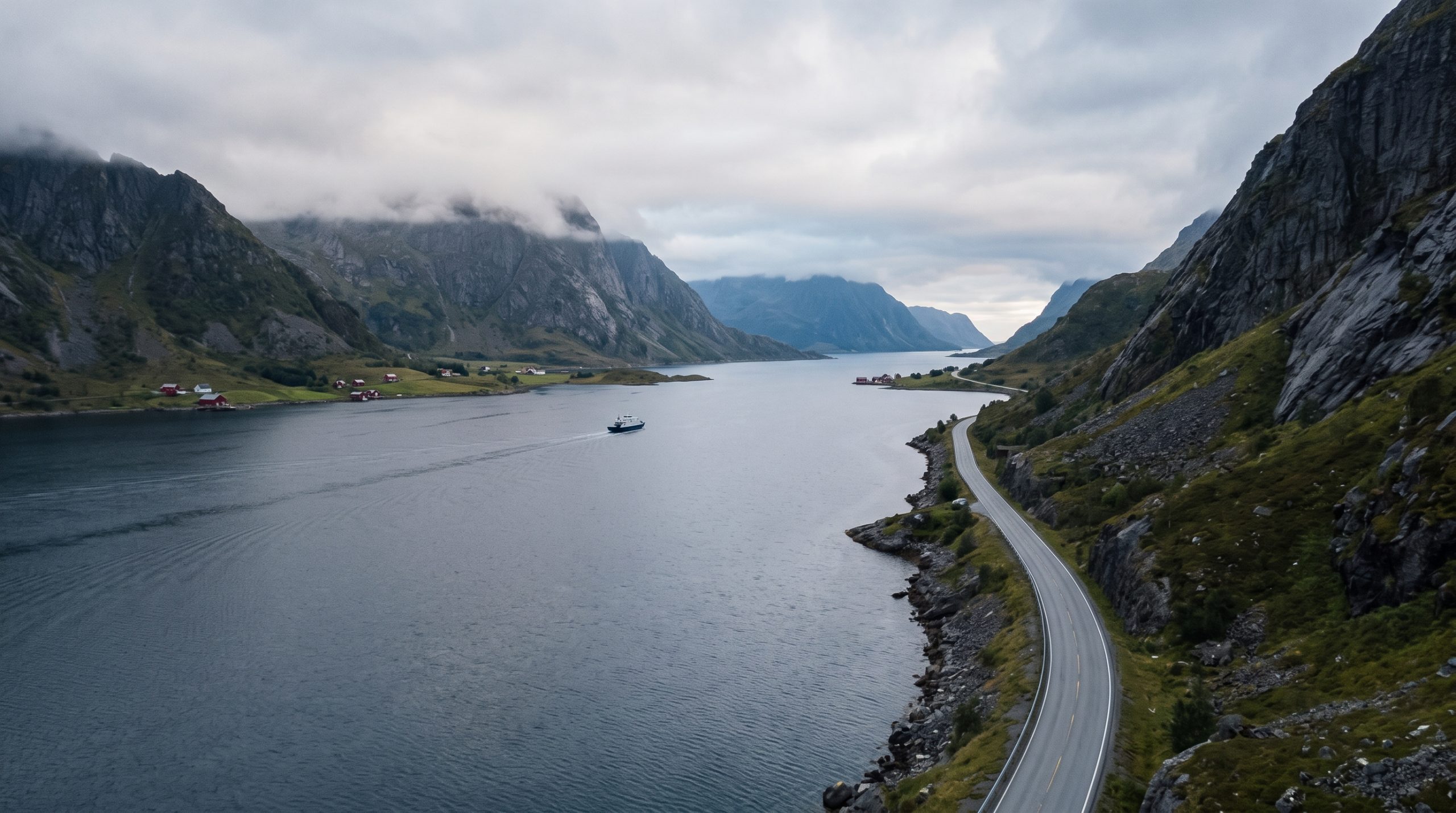
The Norwegian half of a marriage is not complicated. It is narrow. One office issues one document, the prøvingsattest, and that document is valid for four months from the day it is written. Everything else in the chain has to fit inside that window, in order, without a gap.
That is why four weeks does not work. Skatteetaten, the Norwegian Tax Administration, publishes four to five weeks for a marriage license that has to be reviewed by hand, which is what happens when the paperwork arrives from outside Norway. Your certificate of no impediment has to reach them as an apostilled original, by post. Several municipalities want the original license in their hands two weeks before they will stand in front of you and read the words. Stack those honestly and you land at twelve weeks.
We have built days around this in Lofoten in June, when the sun never leaves the sky, and above Tromsø in January, when the light is a two-hour blue smear across the middle of the day. The paperwork behaves the same in both. What changes is how much room you have left to move the ceremony hour, and that is where getting the sequence right pays you back.
Twelve weeks, and where they go
Norway needs about twelve weeks. Roughly four go on ordering your home country documents, getting them apostilled and posting the originals. Four or five go on Skatteetaten’s manual review of the marriage license. The rest covers your municipality’s own deadline for the original certificate. Straightforward paperwork, on a tight clock.
How complicated this feels in practice
On a scale running from straightforward to not realistically available to visiting couples, Norway sits at fiddly. There is no residency requirement and no waiting period after you land. The document list is short, and one national office reviews it rather than four regional ones. What catches couples out is sequence: two separate four-month clocks, an apostille that has to be attached before you submit, and originals that travel by mail.
The exception is a divorce granted outside Norway. That normally has to be recognized by the County Governor before you can remarry here, and it is a separate application with its own queue, so it belongs at the front of the plan rather than alongside everything else.
We are photographers and filmmakers, not lawyers. Rules change and circumstances differ, so confirm the detail with the relevant registry office or your own consulate before you book flights.
What to collect, and when
This assumes you have already settled the destination and the rough shape of the day. If you have not, our guide to how to elope is the better place to start, then come back to this list.
- Documentation that your stay in Norway is legal. Norway requires anyone marrying here to be lawfully in the country, and it is on you to document it. For most American couples that is the visa-free Schengen entry in your passport and nothing more.
- Your home country certificate of no impediment. Skatteetaten wants the original, issued by the authorities in your home country, apostilled or legalized, no older than four months, in English or a Nordic language. Where a country does not issue such a certificate, Skatteetaten’s own guidance accepts proof of your civil status instead, so ask your issuing office which of the two it can actually produce.
- Proof of civil status from your country of residence, if you live somewhere other than the country whose passport you hold. That is two documents rather than one, and both have to be current.
- Papers closing any earlier marriage. Documentation that the previous marriage has legally ended, plus a declaration that division of the former matrimonial property has been started or completed. If the divorce was granted outside Norway, County Governor recognition comes before this step, not after.
- Certified translation, where a document is in neither English nor a Nordic language. Norwegian authorities are specific about who may do it: a certified translator, a teacher at a university or college, or a municipal interpreting service. The translation has to state that it is a translation of the original, and work produced or certified through a consulate is accepted.
- The declarations. A personal declaration from each of you, and a sponsors’ declaration signed by two people over 18 who know you both. Norwegians call those two forlovere.
- The application to Skatteetaten. Filed online, with the foreign originals posted separately. This review is national, so the step is identical whether you are marrying in Vågan or in Bergen.
- The prøvingsattest itself. It arrives in Altinn, Norway’s digital mailbox, and it carries no stamp and no signature. That is normal rather than an error. If you are not set up as an online user in Norway it goes to your registered address by post instead, so allow for transatlantic mail. From there it goes to whoever is marrying you.
- Photo ID and two witnesses on the day. A passport, national ID card, driving license or bank card with a photo. Two witnesses aged 18 or over, who can be any two adults.
Published advice on language varies, and you will find guides insisting that every document must be in Norwegian. Skatteetaten issues the license, and Skatteetaten asks for English or a Nordic language, so that is the standard to work to.
Build the calendar backwards from the ceremony
Every date we hold in Norway gets a version of this table, with your municipality’s deadlines written into it. The middle rows are the ones that do not compress.
| When | What moves | Who you are waiting on |
|---|---|---|
| Sixteen weeks out | Date, hour and municipality chosen. You ask your issuing office what it produces and how long it takes | You |
| Twelve weeks | Certificate ordered, apostille attached, originals in the mail to Norway | Your state or national office |
| Eight weeks | Application filed with Skatteetaten. Manual review runs four to five weeks, longer if a document goes for an authenticity check | Skatteetaten |
| Four weeks | License in hand. You confirm its four-month validity still covers your date | You |
| Two weeks | Municipal deadline for the original license. Trondheim, for one, asks for it 14 days ahead | The municipality |
| Ceremony day | Photo ID, two witnesses aged 18 or over, an authorized officiant | Everyone in the room |
| Three days after | The officiant sends the marriage notification to Skatteetaten | The officiant |
| Two weeks after | Marriage certificate issued, plus postal delivery time to reach you | Skatteetaten |
The real minimum is around eight weeks, and only if your certificate comes back quickly and nothing is sent for an authenticity check. The comfortable minimum is twelve, and twelve is what we plan to. When a couple writes to us six months out, we spend the first month on the date, the hour and the light rather than on documents, because ordering the certificate too early creates the same problem as ordering it too late.
The four-month window is the whole puzzle
Two clocks run in this process and they run in opposite directions. Your home country certificate must be no older than four months. The Norwegian license is valid for four months from the day it is issued. Order your documents a year ahead and the first clock has run out before Skatteetaten opens the file. Order them a month ahead and the review will not finish. The sweet spot is narrow, which is the single most useful thing to understand about marrying in Norway.
The application is digital and the evidence is not. Skatteetaten asks for the original certificate from your home country’s authorities, on paper, in the post, and it does not accept electronic certificates from the Nordic countries either. International mail sits at the front of the timeline, before the four or five weeks of review, and nobody counts it until it is too late to speed it up.
The apostille or legalization is attached in the country that issued the document, not in Norway. It is a separate errand with its own turnaround, and it happens before you submit rather than after Skatteetaten asks for it.
Then there is the municipality, which is a different authority from the one that issued your license, with different hours and its own habits.
- The original license usually has to reach the municipality in advance. Trondheim asks for it 14 days before the ceremony, and other municipalities set their own deadline.
- Municipal offices keep weekday hours, and Norway takes a long Easter, so a spring date can have fewer working days in front of it than the calendar suggests.
- Some municipalities marry couples only at the times and places they publish. Trondheim states that plainly and caps its City Hall ceremonies at 20 people including the two of you and your witnesses. Others will consider a location of your choosing and may charge for the officiant’s extra time.
- The civil ceremony is published as free of charge, and municipalities offer it free to their own residents. If you live elsewhere, or want an hour or a place that costs the officiant extra time, a fee can apply.
- Which municipality you are dealing with depends on exactly where you stand. In Lofoten, a beach in Flakstad and a summit in Vågan are two different offices. We work through that destination by destination in our elopement guides.
Two smaller things worth having in front of you. Trondheim confirms in writing that photography and filming are allowed during the ceremony, which is not universal, so we confirm it with your municipality rather than assume it. And if you are changing a name, Skatteetaten’s own advice is to wait until after the trip, because a new passport takes time and a mismatched booking is a poor way to start a honeymoon.
Fees and deadlines quoted here were correct at the time of writing and are worth re-checking with the office that issues them.
What changes if the legal signing happens at home
A large share of the couples we film in Norway are already legally married when they arrive. They signed at a courthouse or a county clerk’s desk at home, with two witnesses and a fifteen-minute appointment, and they came here to say the words that actually matter to them, in a place they chose on purpose. This is not the consolation prize. In practice it is the stronger plan for a lot of people.
What changes is only administrative. No prøvingsattest, no apostille, no international post, no municipal deadline, no minimum notice at all. Nobody has to be authorized, so the person who reads your vows can be your sister, your friend from college, or one of you reading to the other with nobody else on the beach.
What changes practically is better than that. The ceremony hour becomes yours. We can put the vows at 11pm under the Lofoten midnight sun, or at half past eleven in the morning in Tromsø in December when the sky does its short blue burn, instead of at a time a registrar’s diary allows. We can stand somewhere a municipal officiant will not travel to. We can move the whole thing 24 hours on a weather call, which in Northern Norway is a real advantage rather than a theoretical one.
What does not change is everything you came for. Same day, same light, same vows, same team, same delivery. Highlights land in 5 days and the full gallery or film in 3 weeks either way. The films and galleries we publish are a mix of both routes, and you cannot tell from watching which couple had a Norwegian license in their pocket.
If you are weighing the two, tell us which one you are leaning toward and where you want to be standing, and we will lay out what each version of the day looks like on your date. Send Us a Message with the month you are circling.
What we handle from our side
We hold the date, we design the locations, and we build a timeline around the light and real travel time rather than around wishful driving estimates. We research the permits and the access rules and tell you which ones carry a fee you pay directly. Where a municipal registrar is involved, we hold your date against their availability and work the ceremony hour into the light instead of the other way around, which is the difference between vows at the golden end of a Lofoten evening and vows at two in the afternoon because that was the slot.
There are eight of us, and photography, film and planning come from one team rather than from a photographer and a videographer who introduce themselves in a hotel lobby. On a legal ceremony day that pays twice. Two of us on the ground means the vows are covered from two angles in a room where you get one pass at them, and where the municipality is happy with it, two adults from our team can sign as your witnesses, so you are not recruiting strangers on a Tuesday morning in Svolvær.
What stays with you is the filing. We are not lawyers, we do not submit your application and we do not sign for your documents. You order the certificate, you post the originals, you receive the license and you send it on. Everything that sits around that, we hold. Coverage, what is included in each experience and what is billed separately are all laid out on our pricing page.
Common questions
Do we have to live in Norway to elope there?
No. There is no residency requirement for the marriage itself. Norway asks that you are lawfully in the country on the day and can document it, and that anyone resident abroad brings a certificate of no impediment from their home country. Beyond that, visiting couples marry on the same terms as residents.
How long does Skatteetaten take to issue the marriage license?
Skatteetaten publishes four to five weeks for a case handled manually, and says the time can run longer when foreign documents are sent for an authenticity check. Cases that clear automatically are issued immediately, but that route belongs to people already registered in Norway, not to visiting couples with paper originals in the post.
How old can our home country documents be when we submit them?
The certificate of no impediment must be no older than four months, and it has to be the apostilled or legalized original. That is exactly why we do not order documents a year out. Twelve weeks before the date is early enough for the review and late enough that the certificate is still current when it is read.
Can we legally get married outdoors in Norway?
It depends on the municipality, not on Norway. Some publish a fixed list of times and places and marry couples only there. Others will consider a location you choose and may charge for the officiant’s extra time. We check the municipality that governs your exact spot before we build the timeline, because in Lofoten that can change between two beaches half an hour apart.
Can our photographer and filmmaker be our two witnesses?
Norway asks for two witnesses aged 18 or over, and any two adults can do it. Where the municipality is content with the arrangement, two of our team signing as witnesses is a normal way to run an elopement with no guests. It is one reason we like having two of us on the ground for a legal ceremony.
One of us is divorced. What does that add to the timeline?
A divorce granted outside Norway generally has to be recognized by the County Governor before you can remarry here, which is a separate application with its own queue. You will also need documentation that the earlier marriage has legally ended, plus a declaration that division of the former matrimonial property has started or been completed. Begin with this one, ahead of everything else.
When do we get the Norwegian marriage certificate?
Your officiant sends the marriage notification to Skatteetaten within three days of the ceremony. Skatteetaten registers the marriage and issues the certificate, with a processing time of up to two weeks plus postal delivery. If you are not an online user in Norway it goes to your registered address, so allow for international mail before you need it for a name change at home.
Pick the hour, then start the clock
Choose the date and the hour first. The light in Lofoten in late June behaves nothing like the light in Tromsø in January, and the hour you want the vows to happen shapes which municipality can help you and whether the legal route is worth the twelve weeks at all. Once that is settled, the paperwork is a list with dates against it.
We keep the planning trail in writing, on your schedule and in your inbox. You write, we reply within 24 hours with an initial brochure, and the planning starts from there. We are currently taking dates across 2027 through 2029, so tell us the date you are circling and the coast or the ridge you keep coming back to. Check Your Date