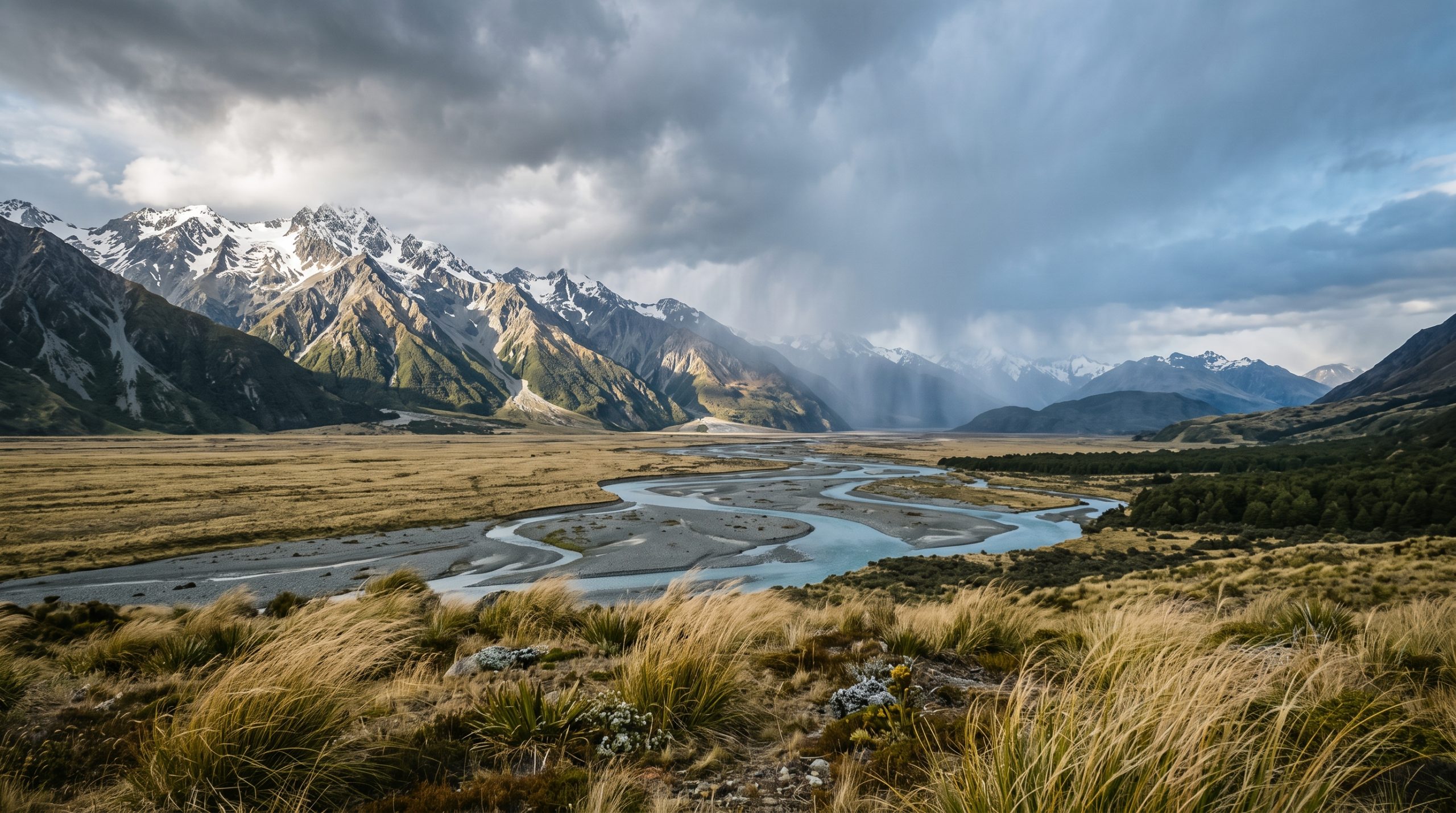
Google Maps says Queenstown to Milford Sound is four hours. NZTA, who maintain State Highway 94, say four to five. The operators who drive it every day allow six to seven in winter. All three numbers are honest, and the space between them is the most useful thing to understand before you plan a New Zealand elopement from the other side of the Pacific.
The South Island reads compact on a screen. It drives long. Distances that look like a comfortable morning turn into most of a day once you add a tunnel that runs on traffic signals, a fuel stop in the last town with services, and the fact that you will want to stop, because the reason you came is out the window.
This is the planning file: what the paperwork actually takes, which drives to believe, what a month choice does to your light, and how we build a day around all of it. We are booking into 2028, so a 2027 date sits comfortably inside the window.
The bottom line before you book flights
Fly into Auckland or Christchurch, connect to Queenstown, and give yourselves at least nine days on the ground. Your marriage licence takes a minimum of three working days to issue and stays valid for three months. Most iconic ceremony spots sit on public conservation land, which means a permission from the Department of Conservation.
Why nine days beats five
Two of your days are gone before you start. Flying west across the Pacific eats a calendar day at the date line, and the first full day in New Zealand is rarely one you would want photographed. Then there is the drive from the airport to wherever you are actually getting married, which is almost never nothing.
That leaves the part that matters. We want one held day in reserve for weather, one day to be somewhere long enough to learn its light, and a ceremony day that is not also a travel day. Five days on the ground gives you a ceremony with no slack in it. Nine gives you a ceremony, a spare, and time to be in the country rather than moving through it.
Every visitor pays the International Visitor Conservation and Tourism Levy, NZ$100 a person since 1 October 2024, collected alongside your NZeTA before you fly. The New Zealand dollar has been trading in the region of sixty US cents, so budget roughly sixty US dollars each for the levy and forget about it. It is the one border cost couples are surprised by, and it is small.
If you are still at the stage of deciding what shape this trip takes at all, our guide to how to plan an elopement covers the decisions that come before the map.
The licence, the celebrant and the concession
Three separate approvals, three separate offices, and they do not run on the same clock.
The marriage licence comes from the Department of Internal Affairs, which runs the national marriage register. It is applied for online, the fee sits around NZ$150 for a ceremony led by a celebrant, and it takes at least three working days to issue. It is valid for three months, so there is no advantage in applying a year ahead. The licence names the place you intend to marry, which is why we settle the location properly before anyone fills in a form.
A registered marriage celebrant has to perform the ceremony. That is set by the Marriage Act 1955 and there is no way around it, so the celebrant is booked before the licence application rather than after.
Then there is the land. Aoraki Mount Cook, Fiordland, the Routeburn, most of the coastline you have been saving images of: these are public conservation land. DOC calls permission to run a business or an activity on that land a concession, and it is a real application rather than a form filled in on the way to the airport. DOC offers up to one hour of pre-application advice before you lodge anything, and that conversation is where we start, because it tells us what a specific site will and will not carry.
| What | Who issues it | When it happens |
|---|---|---|
| Marriage licence | Department of Internal Affairs | Inside the three months before the date, allowing at least three working days |
| Celebrant | A registered marriage celebrant | Before the licence application, since the ceremony details follow the celebrant |
| DOC concession | Department of Conservation | As soon as the location is settled, starting with pre-application advice |
| Aerial permission | CAA rules, plus DOC on conservation land | Confirmed before the film is designed around drone work |
Permit research and the logistics of all of this sit with us. The government, venue and landowner fees themselves are paid by you, which is the normal split and keeps everything transparent.
Where the map lies: the road to Milford Sound
This is the drive that catches people out, and it is worth being specific.
Queenstown to Te Anau is around 170 km and takes about two hours on a good road. Te Anau to Milford Sound is 120 km, and NZTA states plainly that it takes at least two hours non-stop. Non-stop is the part nobody manages. The road climbs into Fiordland through country that makes you pull over, and then it arrives at the Homer Tunnel, which is a single lane through the mountain running on traffic signals in the busy months. You wait your turn at the portal. Everyone does.
| Leg | Distance | Map estimate | What we plan on |
|---|---|---|---|
| Queenstown to Te Anau | 170 km | 2 hours | 2 hours, plus fuel and food in Te Anau |
| Te Anau to Milford Sound | 120 km | 2 hours | At least 2 hours moving, closer to 3 with stops |
| Queenstown to Milford Sound, one way | 288 km | 4 hours | 5 hours in summer, 6 to 7 in winter |
| Queenstown to Milford and back in a day | 576 km | Not offered | 12 to 14 hours door to door |
Two practical notes on that road. Te Anau is the last town with fuel and food before the fiord, without exception, so the tank gets filled there whether or not it needs it. And in winter, chains belong in the car for the approach to the tunnel; most rental companies will ask you to confirm you have them, and the hire desk conversation is easier if you already know the answer.
Here is the honest verdict on the round trip. Queenstown to Milford Sound and back inside one day is 12 to 14 hours of your life, most of it looking at the back of a windscreen, arriving at the fiord in the middle of the day when the light is at its least interesting and the coach fleet is at its most numerous. It is technically possible. It is a poor use of a ceremony day. If Milford is the picture in your head, sleep in Te Anau and go in at first light with the road to yourselves.
NZTA closes the Milford Road on average about eight days a year, almost all of them in winter. That is rare enough that it should not drive your date, and frequent enough that we never build a timeline whose only version involves being through the tunnel by a fixed minute.
Choosing a month when the seasons are upside down
December to February is high summer here. June to August is winter, and midwinter in Fiordland gives you somewhere around eight and a half hours of daylight, which sounds restrictive and is actually a gift: sunrise happens at a civilized hour and the whole day sits in low light. Summer runs the opposite way, with light so long that a first-light start and an evening ceremony are two ends of one enormous day, and we plan a proper gap in the middle for you to eat and sleep.
Fiordland is temperate rainforest. It rains, often, and the couples who understand that before they arrive have a much better time than the ones hoping for blue sky. Rain on that coast fills the walls with waterfalls that do not exist on a dry day. Cloud sitting low in a valley gives a film scale that clear weather flattens. You can see how weather like that reads in our published stories and films, which is a more useful preview than any forecast.
The shoulder months are the quiet argument. March and April hold reasonable light with thinner traffic on the Milford Road. October and November bring snow still sitting on the tops with spring on the valley floor. If you have a fixed date because of work or family, tell us the date and we will tell you which region does the most with it. Our destination elopement guides go deeper on individual locations.
Aerials need two approvals, not one
Drone work in New Zealand runs under the Civil Aviation Authority’s Part 101 rules: below 120 metres, within visual line of sight, and with the consent of whoever owns or occupies the land underneath. Anything outside those limits needs a Part 102 certificate. On public conservation land, DOC permission is a separate approval on top of the aviation rules, and it applies to any drone of any size.
What that means for you is simple. We confirm both approvals for your specific location before we design a single sequence around aerials, so the film is built on shots we know we can fly rather than shots we hope to.
How we build a day that survives a slow tunnel
Buffers are the whole craft. A ceremony hour never sits directly against a boat departure, a road with signals on it, or the last light of the day with nothing behind it. We hold a second location in reserve within a sensible drive of the first, chosen because it works in different weather, not because it is nearby. And we build backwards from the light on your actual date rather than from a generic sunrise time.
There is always more than one of us on the ground for an Expedition, and on a long-drive day that changes what is possible. One of us can leave for the next location and be scouting the light while the other stays with you, so nobody arrives cold to a place they have never seen. Two sets of bodies, lenses and batteries travel with the team, which matters when the nearest camera shop is several hours of mountain road away. Photography, film and planning come from the same eight people, so the timeline the filmmaker is working to is the timeline the photographer wrote.
Team travel is included worldwide, so our flights to New Zealand, our accommodation and our ground transport are not a line item you carry. Coverage starts with the Adventure at $4,900 for one full day with a dedicated photographer or filmmaker, and the full structure is set out on our pricing page.
Highlights reach you five days after the day. The full gallery or film follows within three weeks, while you are still telling people about it.
Check Your Date and tell us the week you are thinking about. We will come back with what that week does in Fiordland, Otago or the West Coast, and where we would put your ceremony hour.
Common questions
How many days before the ceremony should we land in New Zealand?
Three, if you can. One day disappears to the date line, one to jet lag, and the third gives you a weather buffer that costs nothing if you do not need it. Couples who fly in 48 hours ahead get married tired, and it shows in the first hour of the day.
Do we have to apply for the marriage licence in person?
The application is made online through the Department of Internal Affairs, and your celebrant will tell you exactly what needs signing. Allow at least three working days for the licence to be issued, remember it is valid for three months, and get the ceremony location settled first, because the licence names it.
Is it worth driving Queenstown to Milford Sound and back in one day?
Not on your ceremony day. It is 12 to 14 hours door to door and it puts you at the fiord at the flattest hour of the day. Sleeping in Te Anau turns the same trip into a two-hour drive at dawn with the road almost empty.
Can we fly a drone over the fiords and the national parks?
With the right permissions, in the right places. The Civil Aviation Authority’s Part 101 rules set the flight limits, and DOC permission is required separately on public conservation land. We confirm both for your location before aerials go into the plan, and drone footage is included wherever it is legal, safe and appropriate.
What happens if the Milford Road closes on our date?
We move to the alternative we planned in the first week, not the alternative we invent that morning. Closures average about eight days a year and cluster in winter, so every Fiordland timeline we build has a Te Anau-side version that stands on its own rather than reading as a consolation.
Do our parents change what this costs?
No. Our fee does not move with guest numbers. What guests change is access, permits, transport and the shape of the timeline, so tell us early who is coming and we will build the day so that a group of six still fits through a track that suits two.
How far ahead do we need to lock a 2027 date?
We are booking 2027, 2028 and 2029. Planning starts once the contract is signed and the 30 percent retainer is paid, and for New Zealand we would rather have six to twelve months to work with, because concessions and celebrants are the slowest moving parts of the file.
Starting a 2027 file from the northern hemisphere
Send us the inquiry form with your rough window, the number of people, and the one landscape you keep coming back to. You will have a reply and our initial brochure within 24 hours, and a tailored proposal after that. Everything runs in writing, on your schedule and across time zones, which is how planning between New Zealand and North America should work anyway.
Tell us what you actually want the day to feel like, and we will tell you honestly which month, which valley and which hour delivers it. Send Us a Message.