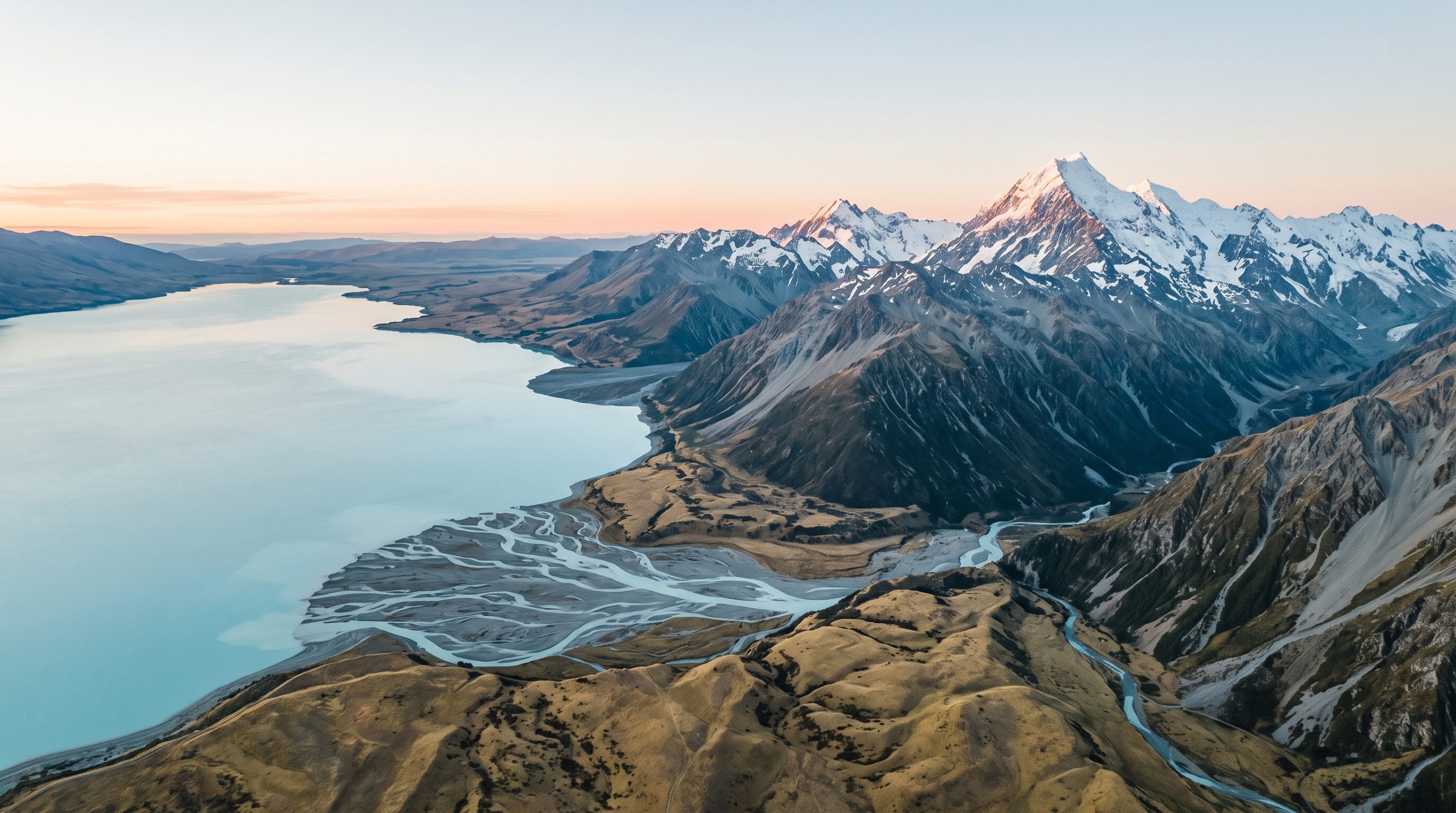
In Queenstown, the gap between the longest day of the year and the shortest is six hours and fifty-two minutes. Late December hands you around fifteen and a half hours between sunrise and sunset, the sun up before six and colour still in the sky past ten at night. Late June gives you under nine hours, with nothing happening until after half past eight in the morning. Every honest line in a New Zealand elopement budget starts there, because daylight decides how many places one day can hold, and the number of places decides what you spend on driving, flying and permits.
The willow standing in the shallows at Roys Bay in Wanaka has a queue most mornings. By nine the light behind it has gone flat and there are people politely waiting their turn for the same frame, which is the honest truth about the country’s most photographed tree in the middle of summer. Forty-six kilometres up the road from Queenstown, the head of Lake Wakatipu at Glenorchy is empty at that hour, the water is glass, and the drive takes about forty-five minutes. That one swap changes a morning more than any piece of gear does.
New Zealand also has a paperwork clock. Your marriage licence cannot be issued until the third day after you give notice, and it expires three months from the date of issue, so the application window is narrower than most couples expect when they start reading about how eloping actually works. What follows is the arithmetic of a 2027 date on South Island ground: what we charge, what the government charges, and what belongs to a helicopter operator or a celebrant.
The two halves of a 2027 budget
A New Zealand elopement splits in two. Our half is photography, film and planning from one team, with the assigned crew’s flights and accommodation already included, and coverage starts at one clear figure. New Zealand’s half is the marriage licence, currently stepping to NZ$158 in mid-2028, plus a celebrant, any permit fees, transport, and where you sleep.
Sunrise before six, light until ten: how a December day gets spent
Summer in the Southern Lakes is not one long shooting day. It is two very good windows with a long, bright, mostly useless middle, and the whole cost of the day depends on how you use that middle.
A December morning starts at 4:30. We are out of Queenstown by ten to five, on the Glenorchy road with the lake on the left, and standing where we want to be while civil twilight is still doing the work around quarter past five. Sunrise lands just before six. At forty-five degrees south the sun comes up on a slant rather than straight, so the low, sideways light runs closer to an hour than the twenty minutes couples are used to from home. That single fact is why a New Zealand morning holds a ceremony and portraits and still gets you to breakfast.
Between seven and half past eight we move off the open lake edge into beech forest and river flats, the Dart and Rees valleys or the mossy tracks around Bobs Cove. Shade holds detail while the tops go hard and contrasty. By nine the day belongs to walkers and coaches, and we send you back to town to eat, change and lie down.
The afternoon is a driving window or a resting one. Over the Crown Range, the highest sealed road in the country at 1,076 metres, Wanaka is about an hour from Queenstown, which means a single day can genuinely hold two catchments with different weather. If a helicopter is part of the plan, we book it toward one end of the day rather than the middle, because mountain air is at its most cooperative early and late and operators plan the same way.
Vows tend to sit between five and seven in the evening, with the celebrant joining us on the ground rather than in a room. Then the long descent: sunset after half past nine, the last usable colour around quarter past ten, and in February and March a full dark that arrives early enough to actually shoot stars if we have moved inland toward the Mackenzie Basin and its international dark sky reserve.
Winter reverses everything, and it is cheaper on your legs. In June the sun is not up until after 8:30 and it is gone near five, so we plan one strong location and perhaps a second, the frost sits in the valleys until mid-morning, and nobody sets an alarm for four. Fewer hours does not mean less film. It means a tighter, colder, quieter day, and the light on snow at that latitude is the best argument for a winter date that we know. Our destination guides go month by month if you want to compare before you write to us.
Tell us the week you are circling and we will send back the shape of the day, hour by hour, before you commit to anything: Check Your Date.
Seventy minutes on a summit, two cameras, one team
Here is where a New Zealand day differs from almost anywhere else we work. If you fly, the aircraft shuts down on the mountain for a fixed block of time, often around seventy minutes, and the flight in from Queenstown takes fifteen to twenty-five minutes each way. That shutdown is the whole event. Ceremony, vows, portraits, the walk along the ridge, the moment you sit down and look at each other and realise it is done. A photographer and a filmmaker who have never worked together spend the first ten minutes of that block negotiating position, and those ten minutes are not recoverable.
We are eight people and we work as one unit, so the negotiating happened weeks earlier, in the timeline. On a tussock summit the photographer wants the ridge line clean and the sky behind you. The filmmaker wants the lee side of the same summit, because that is where your vows are audible over the wind, and on The Expedition there is professional audio running on both of you. Those two wants are in direct conflict about ten metres of ground. Solving that in advance, with a plan that puts the ceremony in the shelter and the portraits on the edge, is not a small thing when the rotors are cooling and you have an hour.
Wind is the honest headline of New Zealand’s high ground, and it is not a problem to be scared of, it is a variable to plan around. A nor’wester over the Southern Alps will make an exposed terrace above Wanaka unworkable for audio while making it spectacular for film, so we build the day with a sheltered second position within a few minutes’ walk and we tell you in advance which one is plan A. On the West Coast and in Fiordland the variable is rain, and rain is genuinely better for moving pictures than for stills. Cloud dragging through beech forest, water coming off the rock in ribbons, the sound of it. A film gains something in that weather that a gallery has to work harder for, which is one of the reasons couples who choose both formats here rarely regret the second one.
Aerials run on permission and a window. Commercial filming on Queenstown Lakes District Council land, including its parks, reserves and road reserves, needs an approved film permit, and drone work there has to go through an operator holding the right Civil Aviation certification. Council applications take about five working days for straightforward requests and need public liability insurance and site documents attached, so we confirm the permit and the flight window before we design any part of the film around a drone shot. On public conservation land the land manager decides separately. You can see how the two formats sit together in our published films and galleries, which is the most useful ten minutes you can spend before deciding between one camera and two.
What travels with us across New Zealand, and when the work lands
Everything in this list is in every experience, in every destination, at every guest count. Guests change access, permits, transport and timeline. They do not change the fee.
- Destination and location design, built from the ground rather than from a map.
- Full planning, including a custom timeline written around the actual light and real driving times for your date.
- Permit research and logistics guidance for conservation land, council reserves and private landowners.
- Weather alternatives and backup positions, named in advance rather than improvised.
- Drone footage where it is legal, safe and appropriate.
- Professional audio for vows and the moments that matter, on The Expedition, where conditions allow.
- Travel for the assigned team: flights, accommodation and ordinary transport, worldwide, with no long-haul surcharge.
- Highlights delivered in 5 days. The full gallery or film in 3 weeks.
Five days matters more than it sounds. You will still be in the country, or barely home, when the first images and the highlight film arrive, and that is when your people want to see them.
Where coverage starts, and what New Zealand bills separately
The Adventure is one full day with one dedicated photographer or one dedicated filmmaker, from $4,900. The Expedition is one full day with a dedicated photographer and a dedicated filmmaker working together, from $7,900. The Odyssey runs two to seven days across one or several destinations with photography and film, quoted as a custom proposal because a Milford day and a Mount Cook day and a Catlins day do not add up in a straight line. There is no half-day version of any of this. The full breakdown lives on the pricing page.
The long-haul question
The worry we hear most often about New Zealand is not the fee. It is the assumption that flying a team to the far side of the planet gets added on afterward, turning a clear number into an open one. It does not. Team travel is included worldwide, which means flights, accommodation and ordinary travel for the crew assigned to your date, in New Zealand exactly as in Norway or Patagonia. There is no European rate and no long-haul rate. The figure you read is the figure, and the reason we can hold that line is simple logistics: with eight of us we build travel around the calendar rather than pricing it as a one-off emergency.
What does sit outside our fee is everything the country charges you directly. These are the lines to put in your own spreadsheet, in New Zealand dollars.
| Line | Who pays | Notes |
|---|---|---|
| Photography, film, planning, our travel | Included in our coverage | Flights and accommodation for the assigned team, worldwide |
| Marriage licence | You | NZ$158 from 18 June 2028. Applied for online, issued no earlier than the third day after notice, valid three months |
| Marriage certificate | You | NZ$35 from the same date, optional, easiest to order with the licence |
| Celebrant | You | Independent celebrants set their own fees and travel charges |
| Permit fees | You | Charged by the land manager. The research and the application work are ours |
| Accommodation, food, rental car | You | Queenstown and Wanaka peak in December and January |
| Helicopter, boat, 4×4, mountain guide | You | Quoted per charter by the operator, not per head |
Two honest notes on that last row. A helicopter is quoted for the aircraft, so an Expedition team means two more seats and sometimes a larger machine, and we put that in front of you in writing before you decide between one camera and two rather than after. And government fees here are small in the scale of the trip. At the rates of the past year or so, a New Zealand dollar has been buying a bit under sixty US cents, which puts the licence somewhere near ninety US dollars. It is the flights, the beds and the aircraft that move a New Zealand budget, never the paperwork.
How a New Zealand enquiry moves into planning
- You send the inquiry form with your dates, or your rough window, and the kind of ground you are drawn to.
- We reply within 24 hours with our initial brochure and honest first thoughts on your date.
- We put together a tailored proposal: coverage, team, and the shape of the day we would build.
- You sign the contract and pay a 30% retainer.
- Planning begins. Locations, timeline, permit research, weather alternatives, vendor introductions.
- The remaining payment steps are set out in your proposal, so nothing about money arrives as a surprise.
Couples who do well on South Island ground
New Zealand rewards a particular temperament, and it is worth being honest about which one. The couples who get the most out of a summer date here are up before five without complaining, comfortable walking on uneven tussock and river stones in whatever they are wearing, and genuinely relaxed about a plan that changes at seven in the morning because the cloud came in lower than forecast. Fiordland especially asks for that flexibility, and gives back more than anywhere else in the country when you grant it.
If a 4:30 alarm sounds like the opposite of a good start to a marriage, say so in your first message. April and May in the Southern Lakes bring sunrise past seven, calm mornings, and larches turning gold above Wanaka, and it is a gentler day in every respect. If flying is not for you, the Glenorchy valleys, the beech forest at the head of the lake and the Mackenzie Basin all sit at the end of a road. If you want the country rather than one corner of it, that is what the Odyssey shape is for, two to seven days with the driving built in. Tell us what you actually want your morning to feel like and we will either build the day around it or tell you plainly which month fits it better.
Common questions
What does a New Zealand elopement cost in total for two people?
Add three things: our coverage, the country’s fixed costs, and your own travel. The fixed costs are modest and knowable, led by a NZ$158 marriage licence and a celebrant fee. Everything variable sits in flights, accommodation and any aircraft charter. Our travel is not a variable, because it is already included.
Do we need a permit to get married in a New Zealand national park?
It depends on the land manager rather than the postcode. Public conservation land, council reserves and private stations all run their own permissions, and commercial filming on Queenstown Lakes District Council land needs an approved film permit. We do the research and the applications. Any fee the agency charges is paid by you.
How far ahead do we apply for the marriage licence?
No earlier than three months before your date, because that is when it expires, and not so late that the third-day issuing rule squeezes you. We put the application date in your planning timeline with margin built in. The licence fee moves to NZ$158 on 18 June 2028, so every 2029 date sits on the new figure.
Is a helicopter necessary for a Queenstown or Wanaka elopement?
No. Plenty of the best ground we use in both valleys is reached by road and on foot, including the lake edge toward Glenorchy and the forest tracks around Lake Wakatipu. A flight buys you altitude and solitude for a fixed block of time, and it is quoted by the operator for the whole aircraft.
What happens if the weather turns on our date?
We move, and we move to somewhere we already chose. Every timeline we write carries named alternatives, usually a sheltered position minutes from the exposed one and a second catchment an hour away over the Crown Range. Deciding that in advance is the difference between adapting and improvising.
Can one team really cover both photography and film?
That is The Expedition: a dedicated photographer and a dedicated filmmaker from the same eight-person team, planning the day together and shooting it together. Nobody meets for the first time in a car park at 4:45am, and with eight of us there is always a second camera on the ground and a colleague in reserve.
When do we get the photos and the film?
Highlights in 5 days, while you are still travelling. The full gallery or the finished film in 3 weeks.
Are you taking bookings for 2027 and 2028?
Yes. Our New Zealand calendar is currently open across 2027, 2028 and 2029, and a date is held once the contract is signed and the 30% retainer is paid.
Holding a week in 2027
New Zealand is a long way from home for most of the couples who write to us, which is exactly why the planning should feel light. We keep the planning in one written thread: the inquiry form, our reply and brochure inside 24 hours, then a proposal you can read twice at your kitchen table before you decide anything. Send us the window you are thinking about, the ground you keep coming back to, and what you want the morning to feel like, and we will come back with the honest version of the day and what it costs. Start Your Story.