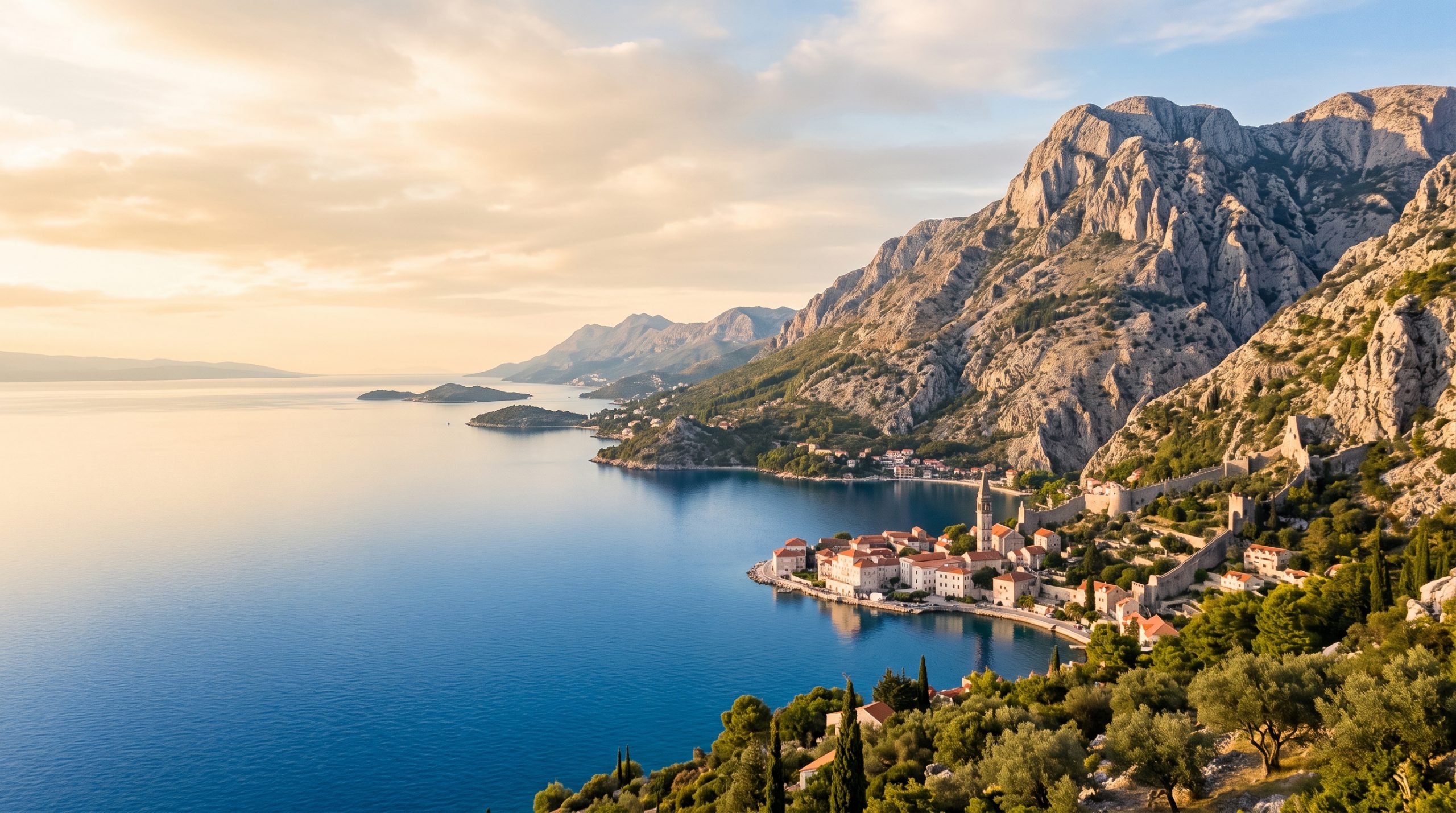
Two hours of driving and one passport check separate Dubrovnik’s old harbor from the inner Bay of Kotor. Couples write to us treating the two countries as near enough to interchangeable, then choose between them on flight times. What they are actually choosing is a shape of day.
Croatia runs sideways. It is a long coast with a thousand-odd islands hanging off it, and the best days are governed by a ferry timetable and a boat captain willing to leave before dawn. Montenegro runs upward. From the water at Kotor you can be on high limestone with the whole bay underneath you inside half an hour of climbing, and on the Durmitor plateau, where Bobotov Kuk tops out at 2,523 meters, by the afternoon.
The legal calendars differ too, and for plenty of couples that is what settles it. Croatia opens your ceremony window 30 days after you declare your intention to marry. Montenegro asks you to apply at least 15 days ahead. Same sea, different arithmetic.
Montenegro wins the ground, Croatia wins the water
For most couples with a week or less, Montenegro. It stacks sea level, forest and 2,000 meter karst inside a single day of driving, and its legal route asks for 15 days notice where Croatia’s asks for 30. Choose Croatia when the day belongs to boats, islands and swimmable water rather than height.
Kotor Bay versus Dalmatia, on the numbers that matter
This is the table we end up rebuilding in almost every reply about the two countries, so here it is in one place. Every figure below belongs to the destination, not to us.
| Criterion | Croatia | Montenegro |
|---|---|---|
| Legal notice | Ceremony date falls between 30 and 45 days after you declare your intention to marry | Apply to the local registrar at least 15 days before the date |
| Marrying away from the registry office | Arranged town by town with the local matičar | Administrative fee of 100 euros, against 20 euros inside official premises |
| Documents for US citizens | Apostille plus translation by a sworn court interpreter; birth certificate reissued within the last 90 days | Apostille plus Montenegrin translation; the no impediment document issued by the US Embassy in Podgorica needs no apostille |
| Ground within an hour of the coast | Walled towns, ferry ports, more coast | Sea level to high ridge, then open plateau |
| Peak season company | Dubrovnik’s port holds most cruise days to around 8,000 passengers | The Port of Kotor publishes its ship and yacht calls year by year |
| Aerial work | EU Regulation 2019/947, open category, below 120 meters and in sight | Authorization through Montenegro’s own Civil Aviation Agency |
| Park entry | Plitvice priced by season, ticket covers the Kozjak boat and the panorama train | Durmitor charges per person per day, currently around 5 euros |
| Genuinely better at | Water: island days, boats, swimmable karst rivers | Relief: mountain and sea in the same twelve hours |
Our own line on that table does not move between the two. Team travel is included worldwide, so the assigned photographer and filmmaker reach Žabljak the same way they reach Hvar and the fee is identical. The Adventure is one full day with a dedicated photographer or a dedicated filmmaker, from $4,900. The Expedition puts both on the same day, from $7,900, and adds professional audio for vows where conditions allow. The Odyssey runs two to seven days across one or several destinations on a custom proposal, and the detail of what each covers sits on the pricing page.
The Montenegro case: one road from the bay to the high karst
Kotor sits at the closed end of a bay with walls rising straight out of the water. That geometry gives you two things and takes one away. It gives shelter, which means clean audio for vows and a boat that stays level. It gives height within reach, because the switchback road above the town puts you over the entire inlet in about half an hour of driving.
What it takes away is the evening. Direct sun leaves the inner bay well before the printed sunset, because a ridge is standing in front of it. Couples who plan a bay sunset from a weather app are usually an hour late by the time they arrive. We run the water in the morning and take the height for last light, and the whole day inverts cleanly once you know that.
Beyond Lovćen the country changes character fast. The Durmitor plateau holds Black Lake, the Tara river canyon and Bobotov Kuk at 2,523 meters, and the park charges a small daily entry fee per person in its tourist core, currently around 5 euros. In late spring the high ground is still under snow while the bay is already warm, so we build April and May days on the canyon rim and the lake shore rather than the ridges, and keep the summits for the second half of the year.
Montenegro is outside the EU and outside Schengen, and prices everything in euros anyway. Coming in from Croatia means a passport check, which is a timing item rather than an obstacle, and we build it into the drive rather than discovering it. Drone work runs through Montenegro’s own Civil Aviation Agency rather than an EU operator number, so we confirm the authorization and the window before anyone designs a rising shot into the film.
The Croatia case: ferries, karst water and a coast that keeps going
Croatia’s real advantage is water you can get onto and into. Hvar, Brač, Vis and the Kornati chain are not scenery you drive past. They are places where a morning is spent on a deck, and the difference between a good Croatian day and an ordinary one is almost always whether there is a boat in it. Jadrolinija’s public timetable will shape a day built around scheduled ferries. A chartered boat rewrites the day entirely, and that charter is one of the things couples pay for directly, alongside permit fees and where they sleep.
Inland, the karst rivers do something Montenegro cannot match. Plitvice has been UNESCO listed since 1979, works through three entrances, and its ticket includes the electric boat across Kozjak and the panorama train. Be honest with yourself about what it is: a boardwalk park you move through in one direction, in company, with prices stepping up through the June to September peak. It is a beautiful place to walk and a difficult place to stand still in, so we treat it as a morning leg rather than a whole day, and Krka gets the same handling.
Then there is the light. Dalmatia faces west over open water, which gives it long, unblocked evenings that the inner Bay of Kotor simply does not get. If your idea of the day ends with the two of you on a rock with the sun going down into the sea rather than behind a mountain, Croatia is the honest answer and we will say so.
The concession runs the other way as well. Velebit and Paklenica are proper mountains, but they are a separate leg of a trip rather than an extension of a coastal morning, and pretending otherwise is how itineraries fall apart. Both countries appear in our published galleries and films, and the difference reads within a few frames: Croatia ends in open horizon and long horizontal light, Montenegro stacks the frame from water to rock in a single vertical.
Thirty days or fifteen: the calendar that settles it
If the legally binding ceremony has to happen on the trip, this section outranks every scenic argument above it.
Croatia
Croatia works through the registry office, the matični ured, and the registrar known as the matičar. You declare your intention to marry, and the ceremony date is then set in the period between 30 and 45 days after that declaration. There is a route to marrying sooner where there are justified reasons for it, decided locally. The e-Citizens portal handles the declaration, appointment booking for official premises and the administrative fees online, though a location outside those premises is arranged directly with the office that will send the registrar. Documents need an apostille and a translation into Croatian by a sworn court interpreter, and a US birth certificate has to be a copy issued within the previous 90 days.
Montenegro
Montenegro asks US citizens to apply to register the marriage at least 15 days before the date, at the registrar in the town where it will happen. The administrative fee is 20 euros inside official premises and 100 euros outside them, which is the important half of that sentence: marrying somewhere other than a municipal room is a normal, priced, nationally understood request rather than a favor. Documents issued in the US need an apostille and a Montenegrin translation, and the no impediment document obtained from the US Embassy in Podgorica does not need one.
A good number of the couples we work with sign the paperwork at home in the week before they fly and keep the ceremony abroad entirely for the words they actually want to say. That is a legitimate route, not a compromise, and it removes the calendar from the decision completely. Our guide to planning an elopement walks through both approaches, and permit research and logistics guidance are part of every experience we run.
Four real trip shapes, four different answers
Abstract advice is useless here, so these are the shapes that actually arrive in our inbox.
- Five nights, legal ceremony has to happen on the trip. Montenegro. The 15 day application fits inside a realistic run-up, the 100 euro fee for an outdoor ceremony is a known quantity, and the country is small enough that a bad forecast is answered by driving for an hour rather than rebooking a ferry.
- Nine or ten nights, and they want a boat. Croatia. Base in Split or Dubrovnik, give one full day to an island with a skipper, and let the legal paperwork happen at home. This is the version where the middle of the day is as good as the edges, because the water is doing the work.
- Not willing to start at 3am. Croatia, and without apology. West facing coast, long evenings, and a ceremony hour that lands after dinner rather than before breakfast. In Montenegro the same couple is fighting the ridge shadow every evening.
- Sound matters as much as frames. Montenegro, in the inner bay, where the water is flat and the wind is not editing the vows for you. On exposed Dalmatian cliffs we work the lee side of the island instead, which is a real constraint on where the ceremony can stand.
If you want both countries, that is an Odyssey rather than a choice, and the border crossing between them is one of the easiest multi-country moves in Europe. Send us the dates and the constraint you cannot move, whether that is a fixed date or a grandmother who is coming with you, and we will tell you which country we would build it in. Tell Us Your Story.
The advice that sends couples to the wrong country
The standard recommendation is to fly into Dubrovnik and photograph the old town at sunset. Dubrovnik’s port authority holds most cruise days to around 8,000 passengers and reports that only 18 days out of a 243 day cruise season go past that estimate. Eight thousand people is a great deal of company for a walled town that size, and the hour everyone photographs is the hour the streets are fullest and the marble is already in shade. The old town is worth an hour, but it is worth it at first light, with the walls above you empty and the harbor quiet, and then it is worth leaving.
The second piece of received wisdom is that Montenegro is simply Croatia with fewer people in it. Kotor’s waterfront on a two ship day is not quiet either, and the Port of Kotor publishes its calls, which is exactly why we check the day’s schedule before we set the hour. The genuine difference is where the empty ground sits. In Montenegro it is twenty minutes uphill. In Dalmatia it is a ferry ride away, which is a better day if you have the time for it and a worse one if you do not.
The third assumption is the one that reshuffles whole trips: that Croatia must be the easier country legally because it is in the EU. Membership does make aerial work more predictable, since Croatia sits inside EU Regulation 2019/947 and the open category rules that go with it, below 120 meters and within sight. Marriage runs the opposite way. The country in the EU is the one with the longer wait, and couples who discover that after booking flights are the ones who end up with a symbolic ceremony they had not planned for. Our destination guides are built around that kind of ordering problem.
Common questions
Can we legally get married in Montenegro during a one week trip?
Usually yes, provided the application reaches the registrar in the town where you are marrying at least 15 days before the date. The documents are prepared before you travel: apostilles on US issued paperwork, translation into Montenegrin, and the no impediment document from the US Embassy in Podgorica, which does not need an apostille itself.
Do we have to be in Croatia 30 days before the wedding?
Not for 30 continuous days, but the ceremony date is set in the window that runs from 30 to 45 days after you declare your intention to marry, so the declaration has to happen well ahead of the date. There is provision for marrying sooner where justified reasons exist, decided locally. Many couples handle the legal step at home instead.
Does eloping in Montenegro cost less on the ground than Croatia?
The official numbers are small in both. Durmitor is around 5 euros per person per day, and Montenegro’s administrative fee for marrying outside official premises is 100 euros. What actually moves ground costs is transport and where you sleep, and a chartered boat in Dalmatia will outweigh every entry fee in either country. Our own coverage is priced the same for both, because team travel is included worldwide.
Can we do Croatia and Montenegro in the same elopement?
Yes, and it is one of the more comfortable pairings we plan. The coastal border crossing is straightforward, Montenegro uses the euro, and two to seven days under the Odyssey lets you take the Dalmatian water and the Bay of Kotor without rushing either, on a proposal built around the route.
Are drones allowed over the Bay of Kotor?
Aerials in Montenegro run on authorization through the country’s Civil Aviation Agency rather than an EU operator number, and we confirm the permission and the time window before building any part of the film around a rising shot. In Croatia the same work sits inside EU Regulation 2019/947, below 120 meters and within visual line of sight.
Which is quieter in July, Dubrovnik or Kotor?
Neither old town is quiet in July. Dubrovnik’s port keeps most cruise days near 8,000 passengers, and Kotor’s port publishes its calls so the busy days are knowable in advance. The practical answer is that Montenegro puts empty ground twenty minutes above the crowd, while Croatia puts it on a boat.
How far ahead should we book for either country?
Dates are currently open across 2027, 2028 and 2029. Send the inquiry form and you will have a reply and the initial brochure within 24 hours, then a tailored proposal. Planning starts once the contract is signed and the 30 percent retainer is paid.
Send us the week you have and we will send back the country
The decision is rarely made on which coast is more beautiful, because both of them are. It comes down to how many nights you have, whether the legal ceremony has to happen on the ground, and whether the picture in your head ends with open water or with rock above you. Tell us those three things and we will answer with a country, a region inside it and a timeline built around real light and real travel time. Everything from there happens in writing, in your own time, wherever you are. Highlights reach you within 5 days of the day itself and the full gallery or film within 3 weeks. Start Your Story.