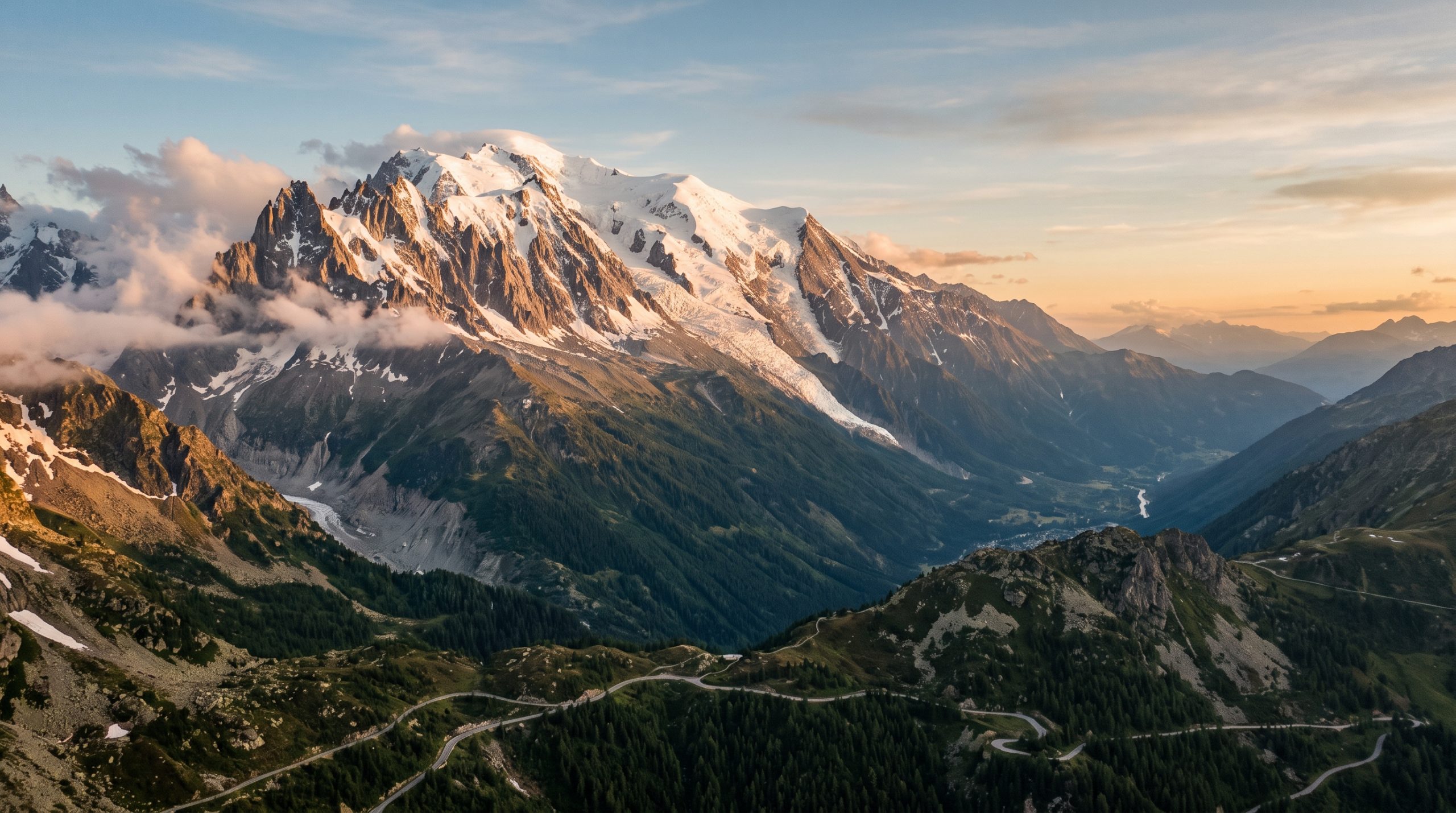
In late June the sun comes up over Chamonix at about 5:40 and does not set until nearly 9:30 at night, which reads like fifteen and a half hours of usable light. It is not. The town sits at 1,035 meters under walls of rock and ice that stand more than two thousand meters above it, so the first light of the day never reaches the valley floor at all. It lands on the summits and on the western balconies opposite them, and the pink part of it lasts a few minutes.
That single fact governs everything about filming a wedding day here, and it is why almost nothing you can buy a ticket for will hand you that hour. No lift in the valley starts running early enough in summer to put you on a balcony at first light. You walk up in the dark, or you sleep high and step out of a refuge into it.
We are eight people, four photographers and four filmmakers, and photography, film and planning are one service rather than three vendors introducing themselves in a hotel car park at 4am. Our Mont Blanc calendar is currently open across 2027, 2028 and 2029 on the massif. Since you got here from a search about cost, the number goes first.
The number first, then the mountain
A full day on the Mont Blanc massif with one dedicated photographer or one dedicated filmmaker starts at $4,900. A photographer and a filmmaker working the same day together start at $7,900. Team travel, planning, permit research and a timeline built around Alpine light are included. Lift tickets and permit fees are yours.
Why the light hour comes before the first cable car
What follows is a real late-June day with a kind forecast. Shift it by two weeks in either direction and the shape still holds from mid-May to early October, though every time on the list moves. The general logic of building a day around light sits in our notes on how to plan an elopement. This is that logic with Chamonix numbers in it.
4:15. Out of a hotel door in Chamonix with headlamps on. We cross to the western side of the valley, because for the first hour of the day you want to be looking at the Mont Blanc massif rather than standing on it. The walk in is stony and it takes about an hour, and there is no version of it that is not dark.
5:15. In position, cold, wind coming down off the ice. This is when we set the ceremony spot properly, because the wind direction on the day decides which side of the boulder field you stand on. The Aiguilles Rouges nature reserve begins here, and its rules are worth knowing before you plan anything: no dogs, no swimming in Lac Blanc or Lac Chéserys, bivouac by reservation only, and no overflight at any time of year.
5:40. Sunrise on paper. What actually happens is that the Drus and the Verte turn a color they hold for about four minutes while the valley 1,300 meters below you stays gray. Ibex work these terraces at this hour and the ptarmigan give themselves away by moving. Nobody else is up here. That is the frame you came for, and it is over quickly.
6:00 to 7:30. The vows. Light is still low and side-on, the massif is fully lit, and the air is the clearest it will be all day. If there is a single hour on a Chamonix day that we protect from everything else, this is it.
8:30. Down, and breakfast in town while everyone else is in line for tickets.
10:30. The cog railway to Montenvers, twenty minutes from 1,035 meters to 1,913, then the cable car that drops you toward the Mer de Glace itself. The glacier is retreating and the walk to the ice gets longer every decade, which makes this a strange and moving place to film rather than a pretty one. The rock walls above it are enormous and completely indifferent to you, and that contrast is the whole reason to go.
13:00. We give the middle of the day back to you. Midday on white rock and glacier ice is flat and hard, and Alpine afternoons build cloud upward from the valley almost as a rule. Eat, sleep, get out of your dress. Nothing good is happening outside for three hours.
16:30. The Aiguille du Midi if you want it, twenty minutes from town to 3,842 meters. We will be straight about this one: the terraces are narrow, the crowd is real, and every photograph taken up there is the same railing with the same summit behind it. It is still worth thirty minutes, for the cabin, the walkway and the sheer scale of the Vallée Blanche below. We treat it as a sequence in the film, not the centerpiece of the day.
20:30. Back on the western side, above the trees, on foot again for the same reason as the morning. The massif faces the evening sun square on, so the last light climbs the faces rather than falling across them.
21:26. Sunset, then a blue hour that runs almost to ten o’clock. In late June you are back at the hotel eating dinner at an hour that would be pitch dark in September.
The morning the massif is in cloud
This is the thing couples write to us about most, and it deserves a real answer rather than reassurance. Mont Blanc generates its own weather and a clear valley does not guarantee a clear summit. So we never build a day with one location in it.
Every timeline we send for this valley carries a second and third shape. The low option uses the ground that works in flat light: larch woods above Argentière, the Arve running milky with glacier flour, the moraine below Montenvers, the old hamlets with their timber and stone. The far option is the Italian side, through the tunnel to Courmayeur, where the southern flank of the massif regularly sits under a different sky than Chamonix does. Skyway Monte Bianco climbs from Entrèves toward Pointe Helbronner in two stages of four and seven minutes, and on the right morning it is a completely different day from the French side.
Cable cars also have their own wind limits, so we design a timeline where no critical hour depends on one cable. We set the ceremony hour after we have seen the morning, usually the evening before, and we tell you what we are seeing rather than making you guess. On multi-day coverage we hold two sunrise windows instead of one, which is the single most effective weather decision available on this mountain.
Tell us the month you are looking at and we will tell you what the massif tends to do in it. Check Your Date.
Two cameras on one ridge, and what the second one changes
The case for a photographer and a filmmaker on the same day is easy to make as a slogan. Here is what it means on this specific mountain.
Start with those four minutes of color on the Drus. A photographer working alone has to choose in that window: hold the still frame of the two of you against the massif, or build a slow move and lose the frame. Nobody does both. With two of us on the balcony, one holds the frame while the other runs the move, and neither of you is asked to repeat the moment that only happened once.
Wind is the second reason, and it is constant here. A veil that misbehaves in a photograph is often the best thing in the film, and the two crafts want opposite instructions in the same minute. Our filmmaker will ask you to walk the same twelve meters four times. Our photographer needs you still, close, and not looking at a lens. Those two requests do not fit in one person’s mouth.
Then there is lift arithmetic. The Aiguille du Midi ride is twenty minutes and the space at the top is tight. One of us travels with you and works the cabin and the arrival; the other is already in position, or follows on the next car with the long lens and shoots you as a small shape against 3,842 meters of rock. Split like that, a busy terrace becomes usable. Handled by one person, it becomes a compromise.
Aerials matter less here than couples expect, and we would rather say that out loud than promise you a drone film. Drones stay on the ground over the massif from 1 July to 31 August, and the Aiguilles Rouges nature reserve prohibits overflight in every month. Drone footage is included where it is legal, safe and appropriate, so on the massif we plan the aerial windows deliberately, usually in June or September and away from the reserve, and we build the rest of the film from movement on the ground. Two people on a moraine for scale. The red train climbing out of the trees. Snow smoking off a ridgeline behind your shoulders.
The Expedition also brings professional audio for the vows where conditions allow, which on an exposed balcony is a positioning decision more than a gear decision. We put you where the rock breaks the wind, and that is almost always where the light is doing something interesting anyway. Being eight people is the quiet part of all this: there is always a second camera on the ground and a colleague in reserve, which counts for more in a valley where a plan gets rebuilt at 4am than it would in a walled garden.
The only honest version of this argument is the finished work, so go and watch some. Our published films and galleries show what a mountain morning looks like when both cameras were there for it.
Everything that arrives with us
No tiers of service, no upgrades to decline. Every experience includes the following.
- Destination and location design across the valley, the Aiguilles Rouges side and the Italian flank of the massif.
- Planning and a custom timeline built around light and real travel time, including lift ride times and walking times in the dark.
- Permit research and logistics guidance, including the town hall route for anything that occupies public space in Chamonix.
- Weather alternatives and backup planning, written into the timeline rather than improvised.
- Drone footage where it is legal, safe and appropriate.
- Professional audio for vows and other meaningful moments where conditions allow, on the Expedition.
- Team travel worldwide: flights, accommodation and ordinary travel for the assigned team, with no long-haul surcharge and no European exception.
- Highlights delivered in 5 days, and the full gallery or film in 3 weeks.
Guest count does not change the fee. It changes access, permits, transport and the timeline, which is a planning conversation rather than a price one, and it is worth telling us early if there will be twelve of you on a mountain path at 5am.
Team travel is included, lift tickets are not
Our starting figures and what sits inside each one are laid out on the pricing page. Coverage runs from a single full day to a multi-day Odyssey across two to seven days and one or several destinations, quoted as a custom proposal. Whichever shape you choose, getting the assigned team to Chamonix and housing them there is our cost, not a line added to your invoice.
What the massif does add is third-party cost, and it is worth seeing it in euros. The euro has been trading a little above the dollar for some time, so read these figures as slightly larger in dollars.
| Item | Who covers it | Detail |
|---|---|---|
| Photography, film and planning | You | Starting figures on the pricing page |
| Team flights, accommodation, ground travel | Us | Included worldwide, every destination |
| Aiguille du Midi, adult return | You | Priced dynamically, currently up to around 83 euros, cheaper when booked early |
| Montenvers railway and Mer de Glace, adult | You | From 49.70 euros |
| Balcon Nord pass, Montenvers plus Plan de l’Aiguille | You | Around 48.40 euros, or 68.40 euros with the ice cave |
| Permit and site fees where a site charges them | You | Research and applications are ours |
| Celebrant, accommodation, flowers, dinner | You | Booked by you, planned with us |
| Mountain guide, helicopter, private transfers | You | Only where the day genuinely needs one |
Lift tariffs get reset each season, so we confirm the current figures for your dates in the proposal instead of asking you to trust a number on a web page.
How a Mont Blanc film enquiry moves into planning
- You send the inquiry form with your dates, or the month you are circling if the date is still soft.
- We reply within 24 hours with our initial brochure.
- We build a tailored proposal: locations for your dates, the light you would be working with, and which coverage fits.
- You sign the contract and pay a 30% retainer. The remaining payments are set out in the proposal.
- Planning begins. Timeline, permit research, alternates for weather, travel and transfer logic, the whole shape of the day.
- We shoot the day. Highlights reach you in 5 days, everything else in 3 weeks.
The couples this valley works hardest for
Chamonix rewards people who are genuinely happy at 4:15 in the morning, who can walk an hour on stony ground without it ruining the mood, and who can hear at dinner that tomorrow now starts ninety minutes earlier and find that exciting rather than upsetting. If that is you, this is one of the great mountain landscapes on earth to be married in.
If a dark walk-in is not your idea of a good start, say so and we will build a different day. Late September sunrise arrives nearly two hours later than at the solstice, which changes the whole arithmetic of getting high before the light. The Italian side offers gentler ground with the same massif in view. A two-day shape puts the ceremony on the morning that behaves and leaves the second morning as insurance. There is no wrong answer here, only a day designed around the wrong assumptions, and the way we avoid that is by asking.
Timing matters more than most people expect. The Aiguille du Midi closes for several weeks of maintenance between the autumn and winter seasons, recently from the start of November until a few days before Christmas, so a December date needs checking before anything else gets decided. Our destination guides go deeper on when each region peaks.
Common questions
Do we have to be legally married in Chamonix for the day to count?
You do not, and almost no one does. A French civil marriage is celebrated at the mairie, in a commune where one of you has a domicile or a residence established by at least one month of continuous habitation at the date the banns are published. So couples traveling in sign the paperwork at home and hold a symbolic ceremony on the mountain. Nothing about the day we plan changes.
Can we get first light on the balconies without walking up in the dark?
In June, no. Sunrise is around 5:40 and no lift is turning at that hour, so it means roughly an hour on foot with headlamps or a night spent high, with bivouac in the nature reserve by reservation only. In late September sunrise comes nearly two hours later, which makes the same view a far easier morning. Tell us which trade you would rather make.
Will you fly a drone over Mont Blanc?
Where and when it is permitted. Drones stay grounded over the massif from 1 July to 31 August, and the Aiguilles Rouges nature reserve prohibits overflight all year. Aerials are included where they are legal, safe and appropriate, and we confirm the window in writing before a single shot gets planned around them.
What happens if the Aiguille du Midi is closed on our date?
Nothing important. It shuts for several weeks of maintenance between the autumn and winter seasons and it holds cabins in high wind, so we never make it load-bearing. Montenvers, the Aiguilles Rouges balconies and the Italian side all stand on their own, and your timeline will already name which one replaces it.
Can our dog be part of the day?
Not inside the Aiguilles Rouges nature reserve, where dogs are not allowed at any time of year. There is plenty of valley and forest ground where they are welcome, so tell us at the inquiry stage and we design the morning to include them properly rather than fitting them in.
Does your fee change if we bring guests?
No. Guest numbers affect access, permits, transport and the shape of the timeline, not what you pay us. Twelve people on a mountain path before dawn is a logistics question, and it is one we would rather solve in the planning than on the morning.
How quickly do we see the photographs and the film?
Highlights land with you in 5 days, while you are probably still in the Alps. The full gallery or film follows within 3 weeks.
Is one day enough on the massif, or should we plan more?
One day works, and it is what most couples book. Two or more days buys you a second sunrise window, the Italian side as well as the French, and room to move the ceremony to the morning with the better sky. That longer shape is the Odyssey, running two to seven days across one or several destinations, quoted as a custom proposal.
Your window on the massif
All of this happens in writing, at whatever hour suits you, wherever you are. Send us your dates, or just the month, plus a sentence about the kind of morning you want, and we reply within 24 hours with an initial brochure and honest thoughts on what the light does then. If your month is wrong for what you are picturing, we will say so and tell you which one is right. That is a better conversation to have now than in June 2027 at 4am on a stony path. Start Your Story.