The first number that matters is four. That is how many seats a Robinson R44 has, and one of them belongs to the pilot. The two of you climb in, your celebrant takes the third seat, and the machine is full before anybody has mentioned a camera. Almost every quote you will be sent for a landing at Moke Lake or Coromandel Peak is, underneath, a conversation about that arithmetic.
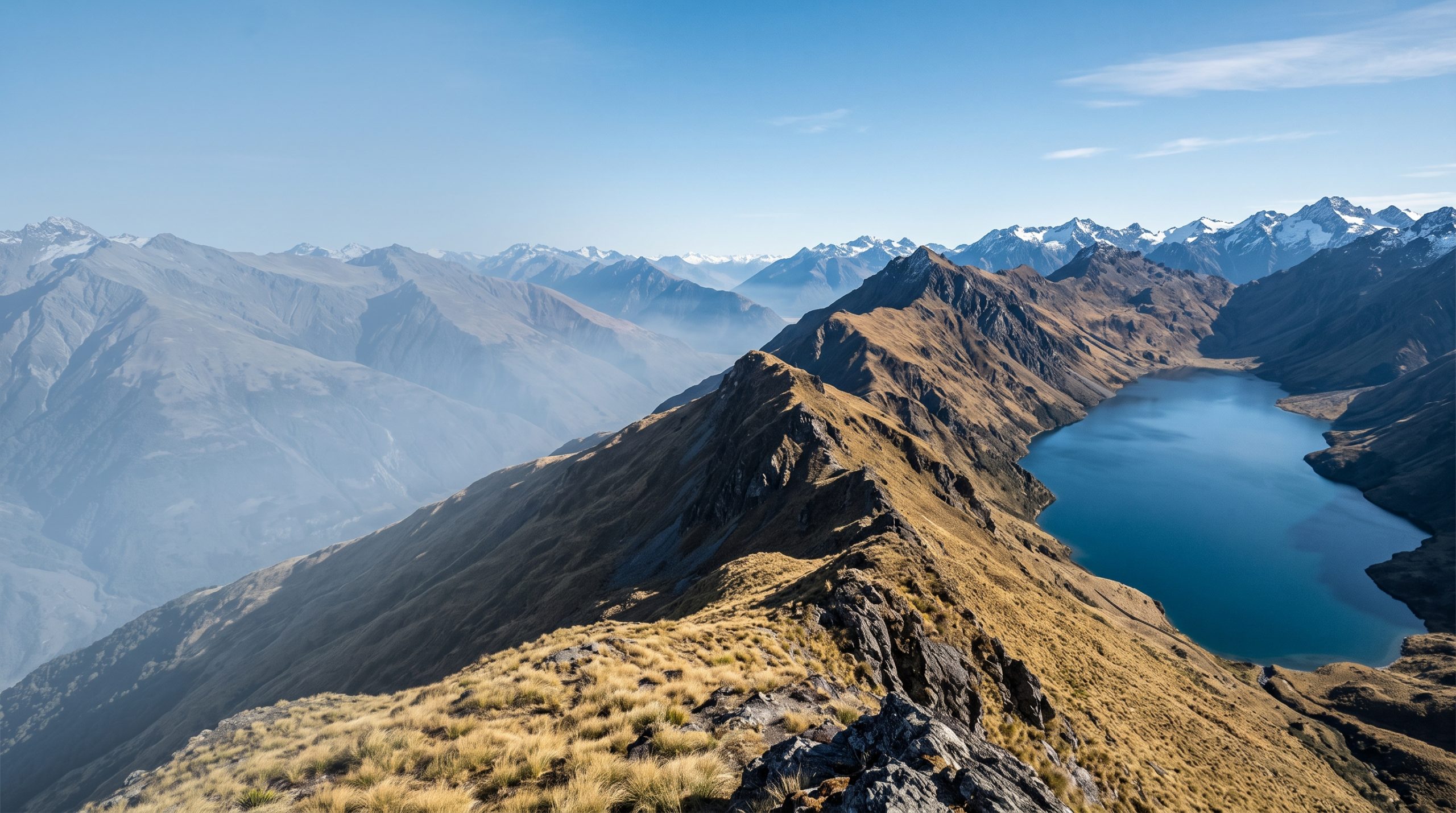
Coromandel Peak sits high above Lake Wanaka, with the lake’s islands below it and Mount Aspiring National Park across the water. It is roughly a twenty-minute flight from Queenstown, and there is no other way in. Moke Lake is the opposite proposition. It is a quiet lake in the hills behind Queenstown that you drive to, where a helicopter is an option rather than the front door.
So the honest answer to what a landing costs begins with which of those two things you are actually buying: an aircraft as transport, or an aircraft as access.
What the invoice is really for
A helicopter landing is charter time, and charter time is sold by the minute in a machine with a fixed number of seats. Coromandel Peak is around twenty minutes from Queenstown each way. Moke Lake you can drive to. You pay the operator directly for the aircraft, and our coverage sits separately from it.
Seats, not scenery, set the number
The R44 is a four-seat helicopter with the pilot in one of those seats. It is the machine a great many Southern Lakes wedding flights get quoted in, which is why the leanest version of a summit ceremony is two people plus a celebrant, with the pilot and whoever else is standing on the rock signing as witnesses. New Zealand asks for two witnesses. Add them as separate people and the seat count has already outgrown the aircraft.
Now put a photographer in. Now add a filmmaker. Every person is a seat, and seats only come in whole aircraft: either you move up to a larger machine, or a second R44 flies, and that second aircraft bills its own minutes in both directions. This is the biggest single lever on your helicopter cost, and it has nothing to do with which peak you choose.
Weight matters as much as headcount. A dress in a garment bag, two camera bodies, lenses, an audio kit and a drone all sit inside the load the pilot signs off before departure, and a helicopter lifts less on a warm afternoon high up than it does on a cold morning at the pad. Operators ask for honest weights for exactly this reason. Give them honest weights, because rearranging a load on the ground spends daylight you wanted for the ceremony.
Our side of the arithmetic is fixed and published on the pricing page: The Adventure covers a full day with one dedicated photographer or one dedicated filmmaker from $4,900, The Expedition puts a dedicated photographer and filmmaker on the mountain together from $7,900, and multi-day work across more than one landing is quoted as a proposal. Guest numbers never move that figure. They move the aircraft.
The twenty minutes from Queenstown, and what they buy
Flight time is the meter. Twenty minutes out to Coromandel Peak and twenty back means forty minutes of air before a single vow has been read, and if a second machine is carrying the team, those forty minutes exist twice. Nothing about that is a hidden cost. It is simply the part of the quote couples do not expect, because they are thinking about a summit rather than about a return journey.
If you are already staying in Wanaka, the same summit is a far shorter hop. Shorter hops are cheaper hops. That is genuinely worth knowing before you book accommodation, because the town you sleep in quietly sets the length of your flight.
Ground time counts too, and it is the part worth protecting. The pilot shuts down on the landing site, which is what makes vows audible up there, and those minutes on the rock belong to your charter. We ask for enough of them that nobody is working against a rotor start: a ceremony, a proper first look at the view, portraits that move around the site rather than repeating one spot, and a moment where the two of you are simply left alone.
The other thing minutes buy is variety. Coromandel Peak pairs with further landings on the same flight, among them Lochnagar, Lake Hope and Tyndall Glacier, so one longer flight often delivers more range than two short ones on separate days. Snow underfoot at one landing and tussock at the next, inside the same hour, is a real thing here rather than a sales line.
Moke Lake: the landing you do not need
Moke Lake is reached on a road that turns to gravel before it arrives, and the land around the water is public, with campers at the far end through the warm months. At lake level, a helicopter buys you almost nothing your own feet will not. That is not a criticism of the lake, which is as calm a piece of water as you will find on the Queenstown side of the hills. It is a note about where the money goes: here, a machine earns its keep by giving you height above the valley, or by pulling aerials over still water on the way through to somewhere else. In wedding clothes the lake is forgiving. The shoreline is flat tussock and small stones, walkable in almost anything, though a long train collects seed heads and the grass stays wet until the sun clears the ridge.
Coromandel Peak: access that arrives with the aircraft
Coromandel Peak is not a place you can put yourself. Access to the landing site is arranged directly with the landowners by the helicopter companies, which is why there is no form for you to fill in and no council counter to visit. The operator’s relationship is the permission, and it travels with the flight. Booking the machine books the ground, and on the good sites that ground is yours alone while you are standing on it. For couples who have been reading about permits for weeks, that is an unusually simple answer. It also solves the clothing problem outright: you step off the skid onto rock in whatever you are wearing, and the walk is the two metres from the aircraft.
The peak takes sun for most of the day, so light snow clears off it quickly and the site works across the seasons rather than only in high summer.
There is not a great deal of room on a summit landing site, and that is exactly where photography and film coming from one team stops being a preference and becomes practical. Two people who have shared a landing zone before know how to divide it without a word: one low and wide with Lake Wanaka behind you, the other close on hands and faces from the opposite side, neither of them drifting through the other’s frame. Wind on an exposed summit does whatever it likes to sound, so audio goes on before the rotors wind down and the vows are recorded from close range instead of hoped for. How the peak actually renders, and what a film cut on a summit sounds like, is easier to judge from our published elopement stories and films than from any description we could write here.
Sun in the north, and the hour we hold back
This is the southern hemisphere, so the sun swings through the north rather than the south, and it leaves a high open summit long after the valley floors have gone blue. That single fact decides most of our timelines out here. A bare peak at midday is flat and hard, with shadows straight down under everyone’s eyes, and a photograph made at the same spot ninety minutes before the sun goes is a different photograph entirely.
So the shape we build most often runs low first and high last. Moke Lake early, while the water is still and the valley is holding cold air, then the drive or the flight across, then the landing on Coromandel Peak for the end of the day. In winter the sun never climbs far, which is generous on a summit: the light stays raked and long through the middle of the day, and a ceremony at noon is genuinely workable rather than a compromise. Early flights are possible too, and they make a different kind of day, colder and quieter, with the light arriving while you are already standing there.
Cloud base, wind and a plan that still works
A summit landing is decided by cloud base far more than by rain. Operators read the day’s window and fly it, and our job is to make sure the ceremony is not the only thing pinned to the top of a mountain. That means a ground-level alternative chosen in advance and driven, not improvised: the Moke Lake shoreline behind Queenstown, or the Glendhu Bay side of Lake Wanaka if you are already over that way, both of them places we would happily photograph on their own merits.
The paperwork wants deciding early for the same reason. A New Zealand marriage licence is issued through the Department of Internal Affairs, the application asks where the ceremony will take place, and it has to be arranged at least three working days before the date. The fee for a licence with your own celebrant sits a little above 150 New Zealand dollars and is reviewed from time to time, so treat it as one of the smallest lines in the whole budget. Our guide to planning an elopement covers the sequence, and the destination guides cover how the Southern Lakes behave month by month.
What we do not do is leave the weather conversation until the week of your date. Permit research, the alternative locations, the timeline built around the light and the real travel time between two lakes: that work is part of every experience we run, and it is why a low cloud base becomes a change of plan rather than a lost day.
Common questions
Can we land on Coromandel Peak without booking through a helicopter operator?
No, and that is the useful part. Access to the landing site is held by the helicopter companies flying out of Queenstown and Wanaka, through their own arrangements with the landowners, so there is nothing for you to apply for separately. You book the flight, and the permission to stand there comes with it.
Does the helicopter wait with the rotors turning while we get married?
On a wedding landing the pilot shuts the machine down, which is why vows are audible on a summit at all. That ground time is part of the charter you are paying for, so we ask for enough of it that the ceremony, the portraits and a few minutes of the two of you alone all fit without anyone rushing.
Do our two witnesses need their own seats on the flight?
If you bring witnesses, yes, they occupy seats. New Zealand requires two, and in a four-seat R44 with the pilot in one seat there is no room for them alongside a photographer and a filmmaker. Many couples have the pilot and the team sign instead, which keeps one aircraft doing the whole job.
If the cloud sits low over Wanaka on our morning, what happens to the day?
We move to the ground plan we chose with you months earlier, which is a real location rather than a fallback: the Moke Lake shoreline, or Glendhu Bay on Lake Wanaka. The flight may also shift by a few hours if the window opens later, which is why we keep the middle of the day loose on any heli date.
Is Moke Lake worth a landing when you can simply drive in?
At water level, rarely. The lake gives you almost everything on foot. Where a machine pays for itself around Moke Lake is height, which means a landing on the tops above the valley, or aerials over the water as part of a flight going somewhere else.
How much of the helicopter cost is paid to you rather than to the operator?
None of it. Charter flights, private boats and mountain guides are booked and paid separately by you, while planning, permit research, the timeline and the team’s own travel are inside our fee. The coverage page sets out what each experience includes.
Choosing between the road and the rotor
A day that uses both tends to work best: an early hour at Moke Lake with nobody else on the shoreline, breakfast somewhere warm, then the flight across to Coromandel Peak for the last of the light and a ceremony with Lake Wanaka spread out underneath. Highlights reach you five days later, and the full gallery or film three weeks after that. Our New Zealand calendar is currently open across 2027, 2028 and 2029, and we keep every planning decision in writing, at whatever hour suits you: send the form and you will have a reply and our brochure inside 24 hours, a tailored proposal after that, then a contract and a 30% retainer before planning starts.
Tell us which of the two places you keep coming back to, how many people are standing with you, and where you plan to sleep the night before. Those three answers set the flight, and the flight sets almost everything else. Check Your Date.