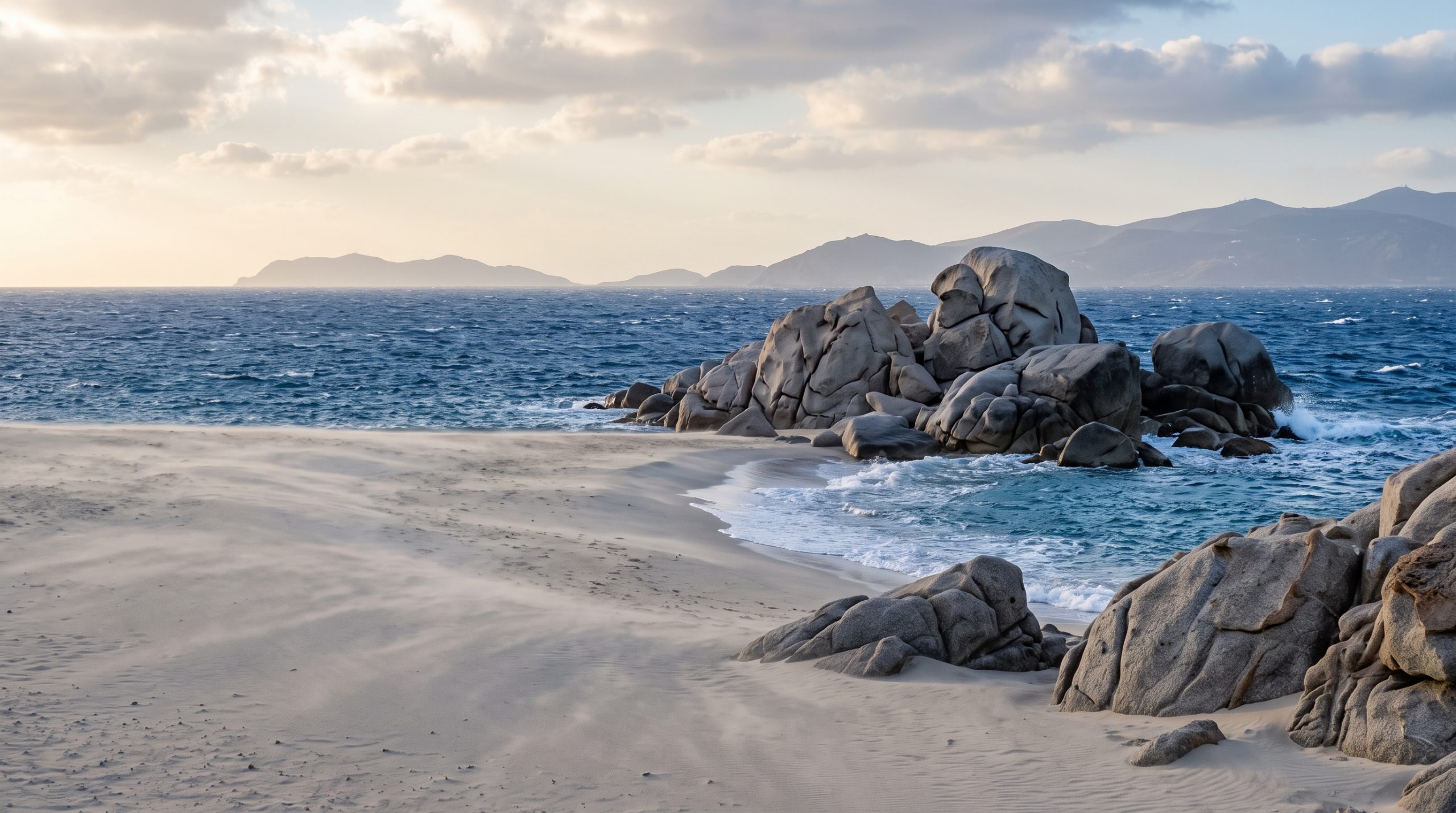
Mikri Vigla means little lookout, and the rock in the middle of the beach earned the name honestly. Under Frankish rule it was a watch point, set there to give the island warning of anything coming in off the water. It still reads the sea, and it still does one more job that matters enormously if you are getting married on this beach: it splits the wind in two.
North of the rock is Parthena, a long strip of sand that takes the meltemi full in the face and has been one of the best kite spots in the Aegean for decades. South of it the water goes flat and warm and the sand keeps running toward Kastraki. The walk between those two worlds takes about two minutes.
That is the whole planning problem here, and the whole opportunity. Mikri Vigla sits roughly 18 kilometers south of Naxos Town on the island’s west coast, which means the sun sets into open water and the wind arrives with more force than the island forecast suggests. Get the hour and the side of the rock right and this is one of the most generous stretches of coast in the Cyclades for a small ceremony.
Which side of the rock you stand on
Mikri Vigla is a west-facing Naxos beach cut in two by a granite headland, about 18 kilometers south of Naxos Town. The north side, Parthena, is a kitesurfing beach that catches the summer meltemi head on. The south side lies sheltered behind the rock and runs empty for kilometers. Vows go on the quiet side, portraits on the granite.
Why the wind reads stronger here than the island forecast
The meltemi is the north wind of the Cyclades, and through the summer it is less an event than a condition, blowing across whole weeks at a time. What makes this particular beach different from a sheltered cove on the other side of Naxos is geometry. Mikri Vigla sits in the gap between the hills of Naxos and the island of Paros, and as the meltemi funnels down that narrow strait it is compressed and pushed faster. A forecast written for Naxos as a whole can read several knots short of what you actually feel standing on Parthena in the middle of the afternoon.
The sport confirms it better than any forecast can. The island’s first kite center opened on this beach in 1997 and has been affiliated with the International Kiteboarding Organization since 2004, which is a long time for a spot to keep delivering wind on demand.
For a wedding morning, wind that reliable is an asset rather than an obstacle, because you know in advance what you are working with. We put the exposed side in the first two hours of daylight, when the air here is usually at its softest, and we put anything that needs stillness in the lee of the headland. A veil on Parthena in August is a decision rather than an accessory. If you want the wind visible in every frame, we will stand you where it is strongest and let it work. If you want your hair to behave through the vows, we move you around the rock, and it costs you a two-minute walk.
Eighteen kilometers, then soft sand
Most couples reach Naxos by sea. The quickest boats from Piraeus run the crossing in around three and a half hours, the conventional ferries take closer to four or five, and there are usually several sailings a day in season. The flight from Athens is about forty minutes and much less frequent. One thing worth knowing before you build a timeline: the fast catamarans are the vessels most affected by strong summer wind, so we plan arrivals with a day in hand rather than landing the morning of the ceremony.
From the port, Mikri Vigla is a short drive south, under half an hour on the coast road, past Agia Anna and Plaka. There is parking close to the sand. Couples stay in Chora for the restaurants and the old town, at Plaka for the long beach, or in rooms at Mikri Vigla itself, which puts you five minutes from your own ceremony and means nobody is driving anywhere in the dark.
Now the part nobody writes down. The distance from the car to the sand is trivial; the surface is not. Dry sand above the tideline is deep and soft, and heels disappear into it before you have gone ten steps, so the practical answer is barefoot from the car park and shoes carried. On the headland the ground changes completely. It is granite, in slabs and coarse steps, grippy when dry and warm underfoot by mid-morning, with edges that will find a long train every time. We either carry the train up the rock ourselves or keep the trailing fabric frames down on the sand where they belong. Nothing about the walk is difficult. It is just that a dress designed indoors meets two surfaces here, and knowing which shoes come off when is the difference between a relaxed hour and a fussy one.
What a west-facing beach does with the light
This coast faces the sunset, which sounds simple and has one consequence people miss. At dawn the sun comes up behind you, over the interior hills that climb toward Mount Zas, so official sunrise and useful light are not the same moment. The top of the granite catches first. Then the light slides down the west face and out onto the sand, soft and low, while the sea is usually at its flattest of the day. By seven in the morning in high summer we have often had this whole beach to ourselves apart from someone laying out a kite.
Midday is the hour we avoid. Sun directly overhead, pale sand throwing glare back up, and no shade on the rock worth the name. If your ceremony has to sit in the middle of the day, we take it south of the headland where the water is calm enough to be the whole background and the granite gives you something to stand against.
Evening is the reason most couples come. The sun goes down into water rather than behind a ridge, so the light stays usable right to the end. In July it drops toward Paros across the channel; by October it has slid further south and falls into open sea. The last twenty minutes turn the west face of the rock from grey to copper, and the granite holds that color for a few minutes after the sun has gone, which is when the frames people remember tend to happen.
Honesty about that hour: the top of the rock at sunset is the obvious viewpoint on this coast, and you will not have it alone in August. The fix is not arriving earlier. The fix is being fifty meters lower, on the seaward slabs, where the same light hits and nobody bothers to climb. If you want to see how granite, water and low sun behave together in finished work, our elopement galleries and films are the fastest way to judge whether this coast looks like your kind of day. Highlights reach you five days after the ceremony, and the full gallery or film follows within three weeks.
Kites, sunbeds and the hour it goes quiet
Parthena is around 600 meters long, and in July and August it is a working sports beach. Schools operating, gear laid out on the sand, riders on the water from late morning onward. That is character rather than damage, and kites in the background of a wide frame are genuinely beautiful. But if you have pictured an empty beach at six in the evening in August, adjust the picture.
The wind is also a clock, which helps. People arrive when it does, so the early hours belong to almost nobody. And where “get there early” runs out, walking takes over: south of the rock the sand continues for a little over three kilometers to Kastraki, and ten minutes on foot puts you past the last umbrella. Genuine emptiness here is a distance, not a time of day. On the organized stretches the sunbed rows go out in the morning, so we set ceremonies outside those lines instead of negotiating around them.
This beach suits couples who like being outside and do not mind that the landscape has opinions. If your idea of the morning involves stillness, silk that hangs straight and no sound but water, we would rather tell you now that late September and early October are calmer on average than August, and that the sheltered south side is where that day exists. Tell us which version you actually want and we will shape the hours around it, or point you at a different Naxos beach or a different month in our destination elopement guides.
Two routes to being married on this sand
There are two honest paths, and couples use both. You can marry legally in Greece, which runs through a municipal office and needs your documents prepared and translated well ahead of the date. Or you can complete the legal marriage at home and treat the ceremony here as the one that counts, which is what a large share of the couples we work with choose. The route changes your paperwork and your lead time, not your day.
A quiet ceremony on open sand with nothing built is also a different proposition from bringing chairs, an arch and amplified sound onto a public beach. If you want a build, that conversation starts early and with the right office. Permit research and logistics guidance sit inside every experience we run; the government, venue or landowner fees themselves are yours to pay. Our guide to planning an elopement walks through the sequence in order.
Two cameras on a narrow ridge
The usable spine of the headland is not wide. Two people who have never worked together will spend the hour walking into each other’s frames, and on a rock this size there is nowhere to hide. Our photographers and filmmakers come from the same eight-person team and run off one timeline, which in practice means the filmmaker works long from lower on the slope while the photographer stays close, then they trade positions on a nod. Wind decides the audio plan: a microphone on the exposed side is fighting the meltemi all the way, so the vows go in the lee of the granite where the sound is clean, and the wind gets the portraits afterward. The Adventure covers a full day with one dedicated photographer or one dedicated filmmaker from $4,900, the Expedition puts a photographer and filmmaker on the same day from $7,900, and the rest of what each includes is set out on our experiences and pricing page. Team travel to Naxos is included in every one of them.
Common questions
Is Mikri Vigla too windy for a ceremony?
Not if you use the rock. The north side is a kite beach for a reason, but the south side sits in its shelter and the water there goes flat. We also place exposed-side moments in the first hours of daylight, when the air is usually at its calmest, and keep the vows themselves in the lee.
Will kitesurfers end up in our photographs?
On Parthena in July and August, yes, unless we work early or stay south of the headland. Many couples like them in the wide frames. If you would rather have none, we plan the ceremony hour south of the rock and walk toward Kastraki, where there are no schools operating.
Can we walk the granite headland in a long dress?
Yes, and it is a short climb rather than a hike. The rock comes in slabs with grippy dry surfaces, so the only real issue is a train catching on edges. We carry it up, or keep the trailing frames on the sand and use the headland for the close, wind-in-the-fabric work.
Do we need a permit for a ceremony on the beach?
It depends entirely on scale. A small private ceremony with no structures is a very different request from an arch, seating and amplified sound on a public beach, and the second needs permission arranged in advance with the municipality. We do that research and make the approaches as part of planning; the fees themselves are paid by you.
What if wind delays our ferry from Athens?
It is the fast catamarans that feel strong summer wind most, so we build timelines with a spare day between arriving on Naxos and the ceremony. That single buffer removes almost all of the risk, and it also gives you a morning to see the beach before the day you are married on it.
Naming your hour on this beach
A day here usually looks like this: on the sand before the light reaches it, vows in the shelter south of the rock while the sea is still glass, breakfast somewhere in Mikri Vigla, then back out to the granite in the last hour of sun when the west face turns copper. Between those two ends there is a long, unhurried middle where nothing is scheduled, which is the part couples tell us afterward they remember.
Our current Cyclades availability runs across 2027–2029, and Every planning step stays in one written thread. Send us the date, the shape of day you want and which version of this beach appeals, and a reply with our first brochure comes back within 24 hours. Tell Us Your Story.