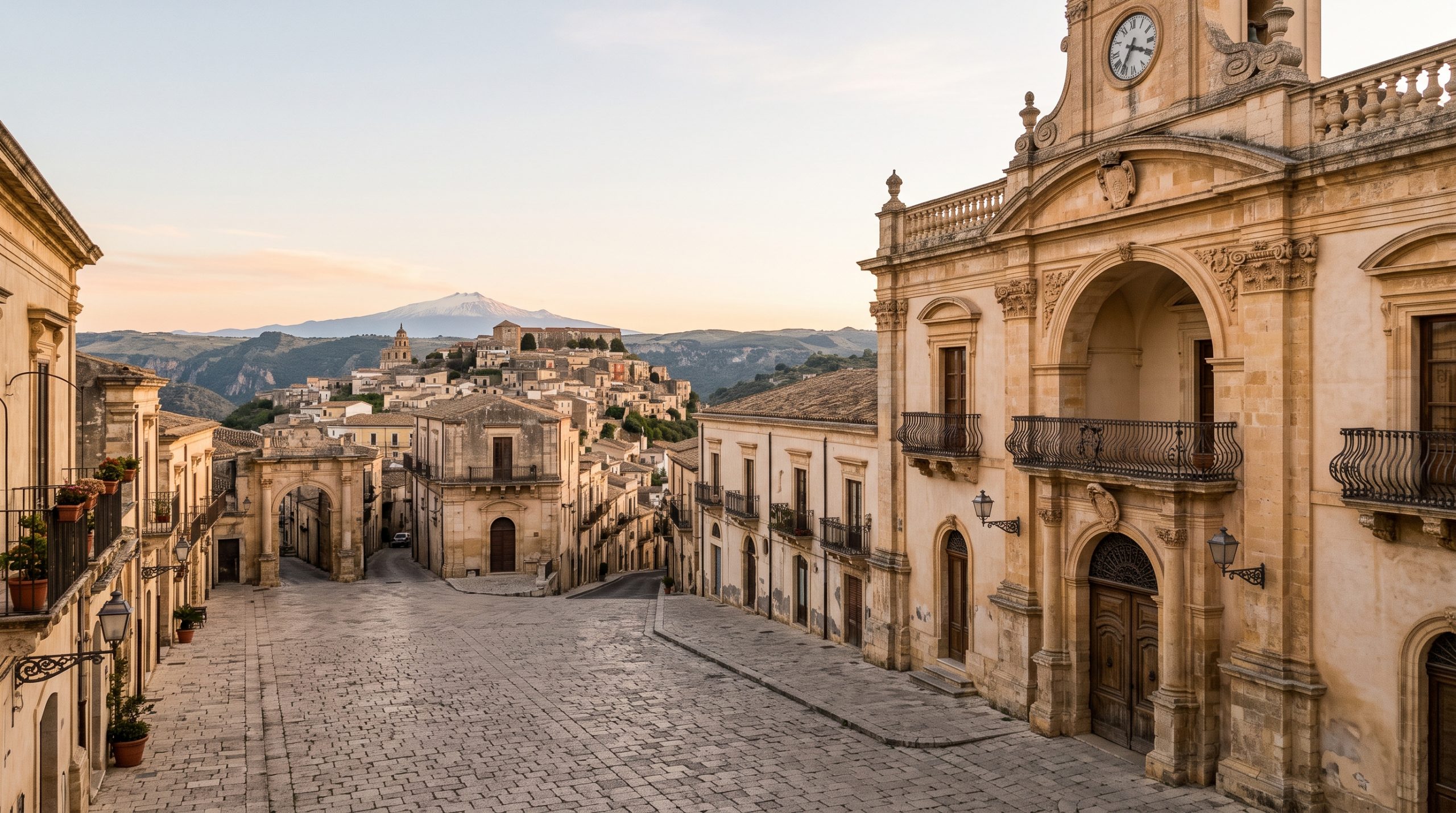
The legalization office at the Prefettura in Palermo sits at Via Sampolo 69, and it opens two mornings a week: Wednesday and Friday, nine until noon. That one detail shapes more Sicilian wedding weeks than any venue decision, because one of the documents you need for a civil marriage here has to cross that desk before a comune will accept it.
A civil ceremony with the mayor is the least discussed of the ways couples marry in Sicily, and for Americans it is entirely available. The chain is not short. It runs from a birth certificate ordered in your home state to a room in a town hall in Noto, Taormina or Ortigia, by way of an Italian consulate near you, a US consular officer in Italy, and that office on Via Sampolo. Nothing in it is hard. All of it is sequential, which is a different problem, and a solvable one.
Our role is planning and documenting the day, not providing legal advice. Re-check personal requirements with the competent office before committing flights. What follows is the chain as the governing offices publish it, in the order you will meet it.
Two affidavits, one apostille, five working days
Yes, Americans can marry in a Sicilian comune with no residency in Italy. You collect apostilled, translated birth certificates, an Atto Notorio, and a Dichiarazione Giurata sworn in Italy and legalized at a Prefettura, then make a Declaration of Intention at the town hall. Budget several working days on the island beforehand.
The admin happens up front; the wedding day is simple
Honest rating: fiddly, front-loaded, and entirely within reach of a couple who can keep a checklist. The day itself is the easy part. A civil marriage in Italy takes minutes. Two witnesses, a register, the officiant reading the articles of the civil code that describe what you are agreeing to, and you sign.
The load sits months earlier, in the collecting. Every document that originates outside Italy has to be legalized for use in Italy and translated into Italian, and that applies to your birth certificate and to any paper that ended a previous marriage. Then there are two sworn statements, obtained in two different countries from two different governments, one of which needs an Italian office to stamp it before a Sicilian registrar will look at it.
Two things make it lighter than it reads. First, requirements are not uniform from comune to comune, and the US Embassy’s own guidance for this consular district notes town halls that do not ask for the Atto Notorio at all. The comune where you marry is the office whose answer governs, so that question goes in writing before anything else is ordered. Second, you are not moving to Italy. There is no residency requirement, no waiting period spent living in the province, no Italian language test. You arrive as visitors and you marry as visitors.
Where Sicily does ask something of you is the hour. Civil ceremonies run on the comune’s calendar, in office hours or in the slots the council has approved, which in July means an eleven o’clock ceremony while the light you came for arrives at a quarter past eight in the evening. And the terraces above the Ionian that appear in every search result are busy and flat at midday in August. Neither is a reason to give up on the mayor. Both are reasons to plan the legal half and the photographed half of the day as two separate hours, which is exactly what the planning fundamentals we work through with every couple are built to do.
The paperwork in the order you have to collect it
Order matters here more than anywhere else, because three of these items have clocks on them and two of them cannot be started until an earlier one exists.
- Long-form birth certificate, one each. It must show both parents’ names. Italian consulates ask for the long or extended form, and a short abstract will be sent back. Order fresh copies from the state where you were born.
- Apostille on each birth certificate. Issued by the Secretary of State of the state that issued the certificate. The apostille goes on the certificate itself.
- Italian translation of each birth certificate. Submitted as a separate document. The apostille is not translated.
- Papers from any previous marriage. If either of you has been married before, the final decree needs the same apostille and the same Italian translation.
- The Atto Notorio. A sworn statement that nothing under US law prevents your marriage. Obtain it at the Italian consulate with jurisdiction over where you live, which requires you both to appear with four witnesses who are not family, each carrying a passport copy and a birth certificate copy. It is valid for a maximum of 90 days, so it is the item that sets your earliest start date. If a US appointment is not workable, the same document can be sworn in Italy at the Ufficio Atti Notori of a tribunale. Palermo’s court handles this through its Volontaria Giurisdizione office in Piazza Vittorio Emanuele Orlando, open Monday to Friday from 8:30am to 1:00pm, and there you need two witnesses instead of four, revenue stamps of 16 euro, 16 euro and 10,62 euro, and an interpreter if you or any witness does not speak Italian. Reckon on four to ten days for collection, or the same day if you use a 31,86 euro stamp in place of the smaller one.
- The Dichiarazione Giurata. Sworn in Italy in front of a US consular officer, stating that there is no legal impediment to your marriage under the law of your home state. Sicily falls in the Naples consular district. This is a notarial service appointment, so it is booked well in advance and it happens after you land.
- Prefettura legalization of the Dichiarazione Giurata. For a Sicilian wedding this is done at the legalization office of the Palermo or Naples Prefettura. Palermo’s, on Via Sampolo, currently opens on Wednesday and Friday mornings only.
- The Declaration of Intention to Marry. Made in person by both of you at the marriage office of the comune where you will marry, in front of the civil registrar, with everything above in hand.
- Apostille on your Italian marriage certificate. After the ceremony, from the Prefettura with jurisdiction over the comune. This is the stamp that makes the certificate straightforward to use at home.
That is nine items, and only three of them happen in Sicily. The first six are envelopes, appointments and tracking numbers, worked through from your kitchen table months before you fly.
Work back from the mayor’s available hour
We work to a comfortable runway rather than a possible one. The paperwork can be assembled faster than the table below suggests, but the two constraints you cannot argue with are the 90-day life of the Atto Notorio and how far ahead your nearest Italian consulate is releasing appointments. Six months is comfortable. Three is tight but real.
| When | What happens | Where |
|---|---|---|
| 6 months out | Comune confirms date, officiant, approved location and its own tariff in writing. Consulate appointment requested. | Sicily and the US |
| 4 to 5 months out | Birth certificates ordered, apostilles requested, translations prepared | Your home state |
| Inside 90 days | Atto Notorio sworn with four witnesses | Italian consulate for your jurisdiction |
| Ceremony week, day one | Dichiarazione Giurata sworn in front of a US consular officer | Naples consular district |
| Ceremony week, Wednesday or Friday morning | That declaration legalized at the Prefettura | Palermo, Via Sampolo 69 |
| 1 to 3 working days before | Declaration of Intention to Marry, both of you present | The comune’s marriage office |
| Ceremony day | Two witnesses, aged 18 or over, of any nationality | Town hall room or an approved outdoor location |
| After | Apostille on the marriage certificate | Prefettura with jurisdiction |
Read that ceremony week again, because it is the part couples underestimate. Swear, legalize, declare, marry, in that order, with a Palermo office that opens on two mornings. A Saturday ceremony wants a Monday or Tuesday arrival, not a Thursday one, and if your comune sits three hours from Palermo, as Noto does, the legalization morning is a whole day of the week gone. Our destination work starts here rather than with the view, and the same logic runs through our destination elopement guides.
Where the chain snags: stamps, short hours, short certificates
None of these are disasters. They are the eight things that turn a calm week into a rushed one, and every one of them is avoidable if you know it in March.
The short-form birth certificate. The wallet-sized abstract many Americans have on file does not carry parents’ names, and consulates ask for the long form. Order it before you order anything else, because the apostille and the translation both queue behind it.
The apostille on the wrong page. It belongs on the original certificate, not on the translation, and the two travel together as separate documents.
Four witnesses, not two. The Atto Notorio at an Italian consulate needs four people who are not related to you, standing in that consulate with you, with copies of their passports and birth certificates. Couples read the word witnesses, think of the two friends coming to Sicily, and arrive one appointment short.
The 90-day clock. Swear the Atto Notorio too early and it lapses before your date. Book the appointment months ahead, then take a slot that lands inside the window. Consulate calendars, not the document, are usually what makes this tight.
Cash at the tabaccheria. Revenue stamps for the Italian route are bought at a tobacconist before you reach the counter, in the exact denominations, not paid at the office window. Any bar or shop with the white T on a blue sign sells them.
The interpreter rule. If you, your partner or even one of your witnesses does not speak Italian, an interpreter is required for the Atto Notorio at the tribunale. That is a person to arrange, not a formality to mention on the day.
Whose answer counts. Published guidance on Italian marriage paperwork varies, and the reason is real: the comune’s registrar decides what that comune accepts, including the form of the Italian translation. So we ask them, in writing, and keep the reply. US consular officers say so themselves, plainly, on the embassy’s marriage page: they are not trained in Italian law and cannot interpret Italian marriage requirements for you.
The stamp after the wedding. The apostille on your Italian marriage certificate is the step people forget, because by then they are on a boat somewhere off Ortigia. Decide before the ceremony if you are collecting it in person or arranging it from home.
The prices and lead times here are a snapshot. Reconfirm them with the relevant authority before you build flights around them.
Legally married at home, ceremony on the Ionian
Plenty of the couples we work with in Sicily sign at a county office at home on a Tuesday morning, in ordinary clothes, with a parent as witness, and then hold the ceremony that matters to them on a ridge above Taormina. This is not a downgrade or a workaround. It is a timing decision, and it is often the better one.
What changes: no consulate appointments, no apostilles, no Wednesday morning in Palermo, no Italian translations. A celebrant leads the ceremony instead of the mayor or the registrar, and you write it yourselves, in your own language, at whatever length you want. The certificate comes from home.
What does not change: the location, the vows, the witnesses if you want them, the walk down through the cactus and the dry stone, the sound of your voices recorded properly, the film. Nothing about how the day looks or feels depends on which country holds the register.
What you gain is the clock. Free of the comune’s slots, the ceremony can start at 5:40 in the morning on a June ridge with Etna going pink behind you, or at the last blue minutes on a sea wall in Ortigia when the day boats have gone. Access to some locations still needs permission, and the site fee still belongs to whoever owns the ground, but the hour becomes yours to choose. That single freedom is why we raise this route early rather than late.
Both routes are good. Tell us which one you are leaning toward and what kind of morning you actually want, and we will shape the day around it, or tell you honestly which month and which corner of the island fits it better. Send Us a Message with your dates and we will come back with the real shape of that week.
What we arrange around the ceremony, and what only you can sign
We plan around the constraints. That means holding your date against the comune’s calendar and the officiant’s availability before anything is announced, building the timeline on real travel time rather than map lines, and putting the ceremony hour where the light is worth having. Catania to Taormina is under an hour by road. Palermo to Noto is a three-hour drive, not a morning errand. Permit research and logistics guidance are part of every experience we run, along with the weather alternative we hold in reserve for the coast.
Comune tariffs for civil ceremonies are set locally by council resolution, and the pattern is consistent across Sicily: more for non-residents than residents, more for a Saturday, more for an approved outdoor location than for the council chamber. We ask for that figure in writing at the same moment we ask for the available slots, so it lands in your budget in March rather than in June. Government, venue and landowner fees are paid by you. The research and the coordination are ours.
What stays with you: the appointments, the sworn statements, the signatures, the two witnesses. We are not lawyers and we do not file paperwork on your behalf.
Because photography and film sit inside one team, an eleven o’clock civil ceremony does not have to be rationed between two vendors’ plans. A dedicated photographer and a dedicated filmmaker cover the register, the reading and the walk out of the chamber from two positions at once, with audio on the vows, and the evening light later becomes its own hour rather than a compromise. You can see how Sicilian stone and sea behave on camera in our published galleries and films. Highlights reach you in five days, and the full gallery or film in three weeks.
Coverage, what each experience includes and where they start are set out on our pricing page.
Common questions
How many days before the wedding do we need to be in Sicily?
Enough to swear the Dichiarazione Giurata, have it legalized at a Prefettura and make the Declaration of Intention at the comune, in that order. Because the Palermo legalization office opens on Wednesday and Friday mornings, we plan around five working days on the ground, which usually means arriving at the start of the week for a weekend ceremony.
Who actually performs a civil marriage in an Italian comune?
The mayor holds the office of civil registrar for the comune, and in practice the ceremony is conducted by the mayor, a deputy, a councillor or a registry official acting on that authority. All of them make the marriage equally valid. Which one you get depends on the day and the town, and smaller comuni are often where the mayor appears personally.
Can we be legally married on a beach or a terrace in Sicily?
Only in a location the comune has formally designated as a place where civil marriages may be celebrated. Many Sicilian councils have added gardens, historic terraces and municipal halls beyond the town hall itself, and the list is specific rather than general. The council chamber is always available, and the approved outdoor locations are the first thing we check when a couple names a town.
How many witnesses do we need, and can they be American?
Two at the ceremony, both aged 18 or over, and nationality does not matter. They do not need to speak Italian. Keep that separate from the four non-family witnesses required if you swear the Atto Notorio at an Italian consulate in the US, which is a different appointment in a different country.
Do our documents have to be translated into Italian, and who can do it?
Yes. Anything issued outside Italy needs an Italian translation alongside the legalized original, and the apostille itself is not translated. Italian consulates ask for the translation to be submitted with the apostilled birth certificate. The comune where you marry is the office that decides what form of translation it accepts, so we get that answer in writing early.
Will our Sicilian marriage certificate be recognized in the United States?
A marriage that is valid in the country where it was performed is valid in the US. The Italian certificate is what proves it, and it is treated as valid once it carries the apostille issued by the Prefettura with jurisdiction over the comune where you married. Order several copies while you are still in Italy.
Can same-sex couples have a ceremony with the mayor in Sicily?
Yes, through a civil union rather than a civil marriage, which is the legally recognized route in Italy. The US Consulate General in Naples, whose district covers Sicily, publishes the document steps for civil unions in its area, and they follow the same shape: sworn statements, legalization, then a declaration at the comune. The Italian Ministry of Justice states that impediments relating to the sex of the parties are not relevant to the no-impediment declaration a foreign national files.
Picking your hour between Etna and the sea
Sicily rewards couples who decide early which half of the day the paperwork owns and which half is theirs. Once that is settled, the rest is enjoyable: a chamber in Noto at eleven, lunch that runs long, then a road east and a ridge at seven.
We keep every planning decision in writing so the process works across time zones. Send an inquiry and you will have a reply and our first brochure inside 24 hours, then a proposal built around your dates and your route through the island. Our Sicily dates are currently open across the 2027–2029 seasons. Check Your Date and tell us which town you have your eye on.