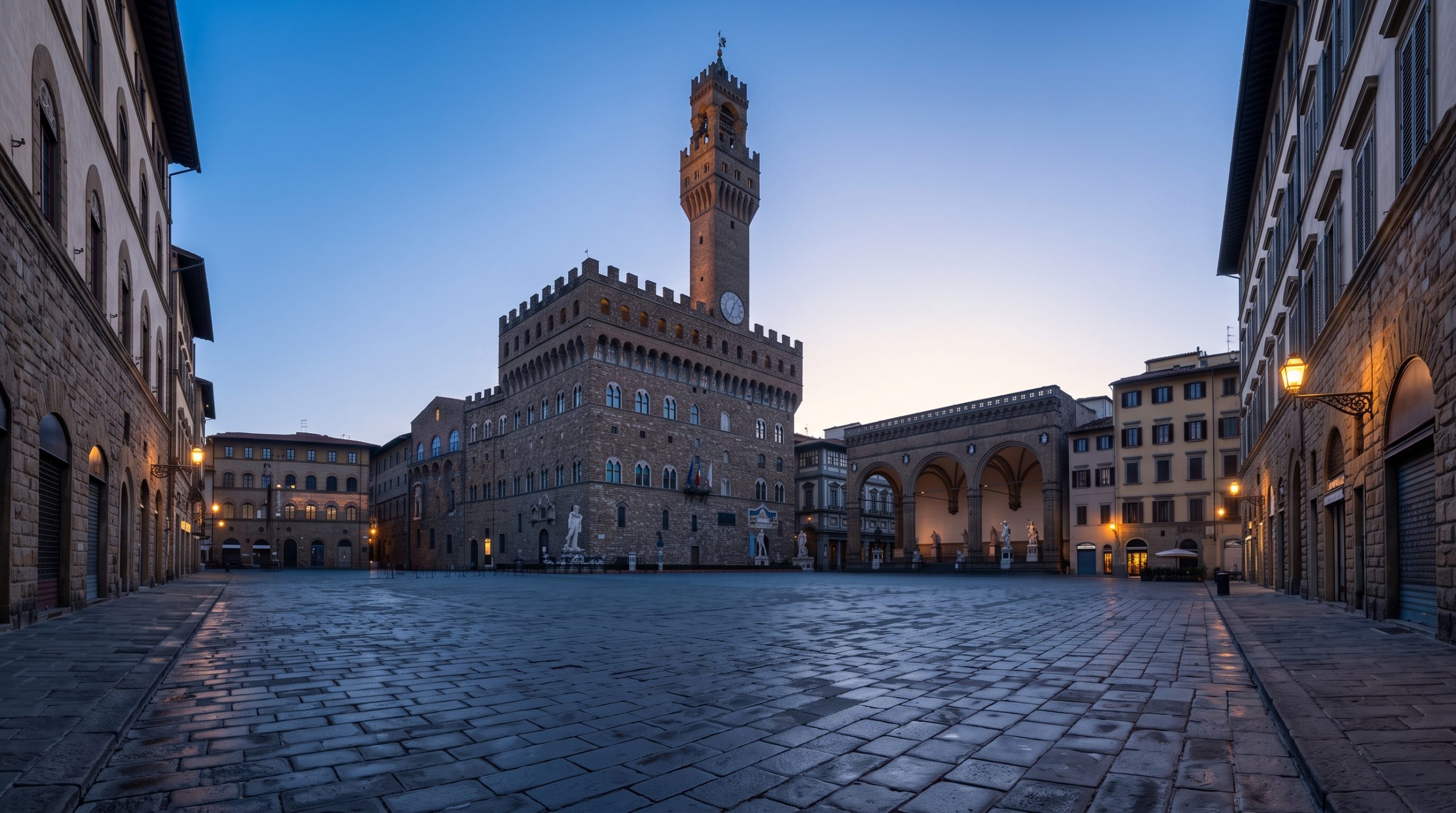
The Comune di Firenze has a rule that quietly decides the shape of nearly every American wedding in this city. Under a council decision taken in November 2014, Saturday ceremonies in Palazzo Vecchio’s wedding room are kept for people registered as living in Florence, or on the city’s AIRE list of Italians abroad. If you are flying in from Denver or Charleston, your legal ceremony happens on a weekday.
That turns out to be the most useful constraint in Florence. A Tuesday at six in the morning is not the same city as a Saturday at noon. The jewellers’ shutters on Ponte Vecchio are still down, so you see the bridge as a structure rather than a row of windows. The flagstones in Piazza della Signoria are wet from the overnight cleaning. The only other people out are a runner, a man unloading crates, and whoever is opening the first bar on Via dei Neri.
The catch is that the hour with the best light and the hour the registrar works are rarely the same hour, and they can sit several hours apart. Everything below is about that gap: where the light lands first, which rooms the city will marry you in, and how you move between them on foot in wedding clothes.
Sunrise is yours, the ceremony hour is the Comune’s
Florence genuinely empties before the crowds arrive: from first light until mid-morning the centre belongs to residents and delivery vans. The legal ceremony runs on the Comune’s own calendar of approved rooms and time bands, which rarely matches sunrise. So the morning is built in two halves, with the quiet hour used first and the registrar’s room after.
Where first light actually lands in a city of narrow streets
Sunrise here swings a long way through the year. In the third week of June the sun is up around 5:35 and civil twilight starts just before five. At the September equinox sunrise is closer to 7:00, and by the second week of October it is not up until about 7:25, which is the difference between a 4:30 alarm and a comfortable one.
Sunrise time is not the same as light on your face, and in Florence the gap is wide. The centre is four and five storeys of stone standing over streets a few metres across. On 21 June the sun does not reach twenty-five degrees above the horizon until just after eight; at the September equinox, not until half past nine. Everything before that is open-sky light, which is why the early hour in Florence belongs to the places with sky over them: the bridges, the lungarni, the piazzas, the terraces on the hill.
The river does something specific. Through the centre the Arno runs almost due east to west, and the classic view of Ponte Vecchio from the middle of Ponte Santa Trinita points along that channel at about 99 degrees. Sunrise crosses that bearing twice a year, in the first days of March and around the ninth to the thirteenth of October. On those mornings the sun comes up directly behind the bridge and the whole thing goes to silhouette over a lit river. In late June sunrise sits at 56 degrees, well to the left over the hills, and the light rakes across the arches instead of coming through them. Two completely different photographs from the same three metres of parapet.
Piazzale Michelangelo is where most pages get it wrong. The view from the terrace to the Duomo runs at 327 degrees, north-northwest. At sunrise the sun is behind your right shoulder, so the dome, the tower of Palazzo Vecchio and the whole north bank are lit from the front with the haze sitting behind them. At midsummer sunset the sun goes down at 304 degrees, on the same side of the sky as the view, so the city flattens into glare and dust. That is the hour the terrace is three deep at the balustrade. We will happily take you up in the evening if the sky is doing something worth having, but sunrise on that terrace is the better light and the emptier place, and it is not a close call.
The rooms the city will marry you in
The room officially designated for civil marriages and civil unions is the Sala di Cosimo I in Palazzo Vecchio, known to everyone as the Sala Rossa: red walls, tapestries, a ceiling worth arriving early for. For residents of Florence and Italians on the city’s AIRE register it is free on set mornings. For everyone else there is a tariff, and the Comune is unusually clear about how it is built. The fee steps up modularly against four criteria, the main one being where you live, so two Americans living in the United States sit at the top of the scale.
The same published tariff list covers the other places the city will perform the ceremony: the Salone de’ Cinquecento and the Sala dei Gigli in Palazzo Vecchio, the Sala di Lorenzo, a room at the Museo Stefano Bardini across the river, and the Giardino delle Rose on the Oltrarno hillside. Each carries its own fee. The tariff list also treats any departure from the standard weekly calendar of days and time bands as a separate, higher band, and lists a set charge, currently 1,000 euros, for extending the slot where both of you are foreign citizens living abroad. An unusual hour in Florence is something the city prices rather than refuses, which is a better starting position than most cities give you.
Those fees are paid by you, directly to the Comune. Reading the tariff list, working out which band you fall into, confirming what each room allows and building the timeline around the slot you are given is our work, and it is included in every experience we run.
| Room | Where it sits | What an early hour gives you |
|---|---|---|
| Sala Rossa (Sala di Cosimo I) | Palazzo Vecchio, Piazza della Signoria | The square still empty on the way in and on the way out |
| Salone de’ Cinquecento | Palazzo Vecchio, the great hall | The largest room the city offers, and a long walk to the front of it |
| Sala dei Gigli | Palazzo Vecchio, on the museum route | Painted walls and a gilded ceiling, sized for a handful of guests |
| Museo Stefano Bardini | Oltrarno, near Ponte alle Grazie | Deep blue walls that need no decorating, and the river a minute away |
| Giardino delle Rose | Hillside below Piazzale Michelangelo | Outdoors, city behind you, a shorter climb than the terrace |
The paperwork, in the order it has to happen
- The Atto Notorio, a sworn statement that nothing in your own law stands in the way of the marriage. Italian consulates in the United States issue it, which is the simpler route, and it can also be obtained in Italy.
- The Nulla Osta, sworn in person in front of a US consular officer. In Florence that is the Consulate General on Lungarno Vespucci 38, downriver from Ponte Vecchio past Ponte Santa Trinita and Ponte alla Carraia.
- The Declaration of Intention to Marry, made in person at the Comune’s marriage office with the full set of documents, ahead of the ceremony date.
- After the ceremony, the apostille on the Italian marriage certificate, which is what makes it recognised at home.
None of it is difficult, but it is sequential, and two of the steps happen in person in Italy before the wedding day. That is the real reason a Florence morning is planned backwards from the Comune’s date rather than forwards from your flights. Our guide to how eloping actually works covers the general shape; the Florence order above is what we work to.
Cobbles, ramps and silk at six in the morning
The historic centre is a restricted traffic zone, so wherever a car can reach, the last stretch is on foot. At six that is a gift. At ten it is a negotiation with a delivery van reversing up the same street.
Two things about the ground. The big flagstones, the warm grey pietra forte the city is both paved and built in, are polished smooth by centuries of feet and genuinely slippery when the cleaning crews have just been through. The smaller cobbles between them eat narrow heels. Flats or boots for the walking, with whatever you actually want to be married in carried by someone else, is not a compromise in Florence. It is simply how the morning works.
Then the hill. The Giardino delle Rose and Piazzale Michelangelo both sit on the Oltrarno slope above the river, reached by stone ramps and staircases that switchback up from the San Niccolò gate. It is a continuous climb with no shade on it, and in a dress with a train the honest version is this: walk up in flats, change at the top, and let someone carry the hem on the last flight. The garden sits meaningfully lower than the terrace, which matters more than it sounds at half past five in the morning.
How the city photographs before the shutters go up
Pietra forte takes its colour from whatever the sky is doing. For the twenty minutes before sunrise the whole centre reads cool and blue and the river holds the sky; then the top floors go bronze and the change runs down the buildings fast. That speed is the reason we are standing somewhere specific rather than wandering with a map. Our galleries and films from mornings like this show what the difference between 5:50 and 6:20 in a stone city actually looks like on the page and on screen.
Room to work is the practical question on a bridge. The parapet on Ponte Santa Trinita is narrow and the pavement on the lungarni is narrower, so a photographer and a filmmaker who have never worked together spend the good light standing in each other’s frames. Ours split it out of habit: one on the parapet line, one back at the corner where the bridge meets the road, then they trade. Sound is the other Florence-specific thing. Wind funnels along the river channel and it is unkind to vows, so audio gets placed where a building blocks the channel, and the bells at seven are either the best thing in the film or the reason a take shifts by four minutes. A dedicated photographer and filmmaker working the same day is what our coverage is built around.
Haze, heat and the loggias we keep in reserve
In July the sun is up before six, and that hour is the only cool one Florence offers all day, which makes an early ceremony a comfort decision as much as a photographic one. Autumn mornings often bring haze off the Arno. It is lovely close up and it erases the long view from the hill, so a hazy forecast moves us into the streets rather than up the slope.
Rain is the easiest weather here. Within a few minutes of Piazza della Signoria you have the Loggia dei Lanzi, the colonnade around the Uffizi courtyard, the arcades along the lungarno and the loggia of the Mercato Nuovo, all covered, all stone, all worth photographing on their own terms. A wet Florence morning changes the frames, not the plan. Aerials are the one element we never assume over a centre this dense: drone work is either planned around a cleared window or designed out of the film from the start, and you will know which before the timeline is signed off. Our destination guides go further into choosing the month.
Common questions
Can we get married in Palazzo Vecchio on a Saturday?
Not as visitors. Under a Comune decision from November 2014, Saturday celebrations in the Sala Rossa are reserved for people resident in Florence or registered with the city’s AIRE list. Non-residents take the weekday slots in the Comune’s calendar, which is why nearly every Florence wedding we plan lands midweek, in the quietest hours of the week.
Is sunrise at Piazzale Michelangelo really better than sunset?
For faces and for the city, yes. The terrace looks north-northwest at about 327 degrees, so at sunrise the light arrives over your shoulder and lights the domes. At midsummer the sun sets at 304 degrees, almost in line with the view, and the city turns to glare. Sunset there is a fine place to stand and a hard place to photograph.
Where do we change out of walking shoes on the way up the hill?
There is no cloakroom on that hillside, so we plan the change instead of improvising it. Usually that means climbing in flats with shoes and veil carried, then a few minutes at the top behind the planting at the Giardino delle Rose, or beside the car at the terrace. It is unglamorous for four minutes and it protects the next two hours.
Will the church bells interrupt our vows?
They will, and it is worth planning for rather than hoping around. Bells across the centre mark the hour and the half hour from early morning and they carry a long way over stone. With a dedicated filmmaker on the day we set the vows a few streets from the nearest tower and, if the hour is close, simply wait four minutes. Recorded on purpose, those bells are the best sound in a Florence film.
How long before the ceremony do we need to be in Florence?
Long enough to complete two in-person steps on working days: the Nulla Osta in front of a US consular officer at the Consulate General on Lungarno Vespucci, and the Declaration of Intention to Marry at the Comune’s marriage office. We work the arrival date backwards from the slot the Comune gives you and tell you in writing which weekday you need to be on the ground.
Choosing your weekday morning
Tell us the week you are looking at and we will tell you what the sun is doing that week, which of the city’s rooms are realistic for it, and whether the bridge or the hill is the better place to be standing at first light. If a 4:30 alarm is not your idea of a good start, say so, and we will build a later day around the shaded streets, the Oltrarno workshops and the gardens instead. We keep the planning in one written thread: the inquiry form, our reply and first brochure within 24 hours, then a proposal built around your date. Dates are currently open across our 2027, 2028 and 2029 Tuscany seasons, and planning begins with a signed contract and a 30% retainer. Start Your Story.