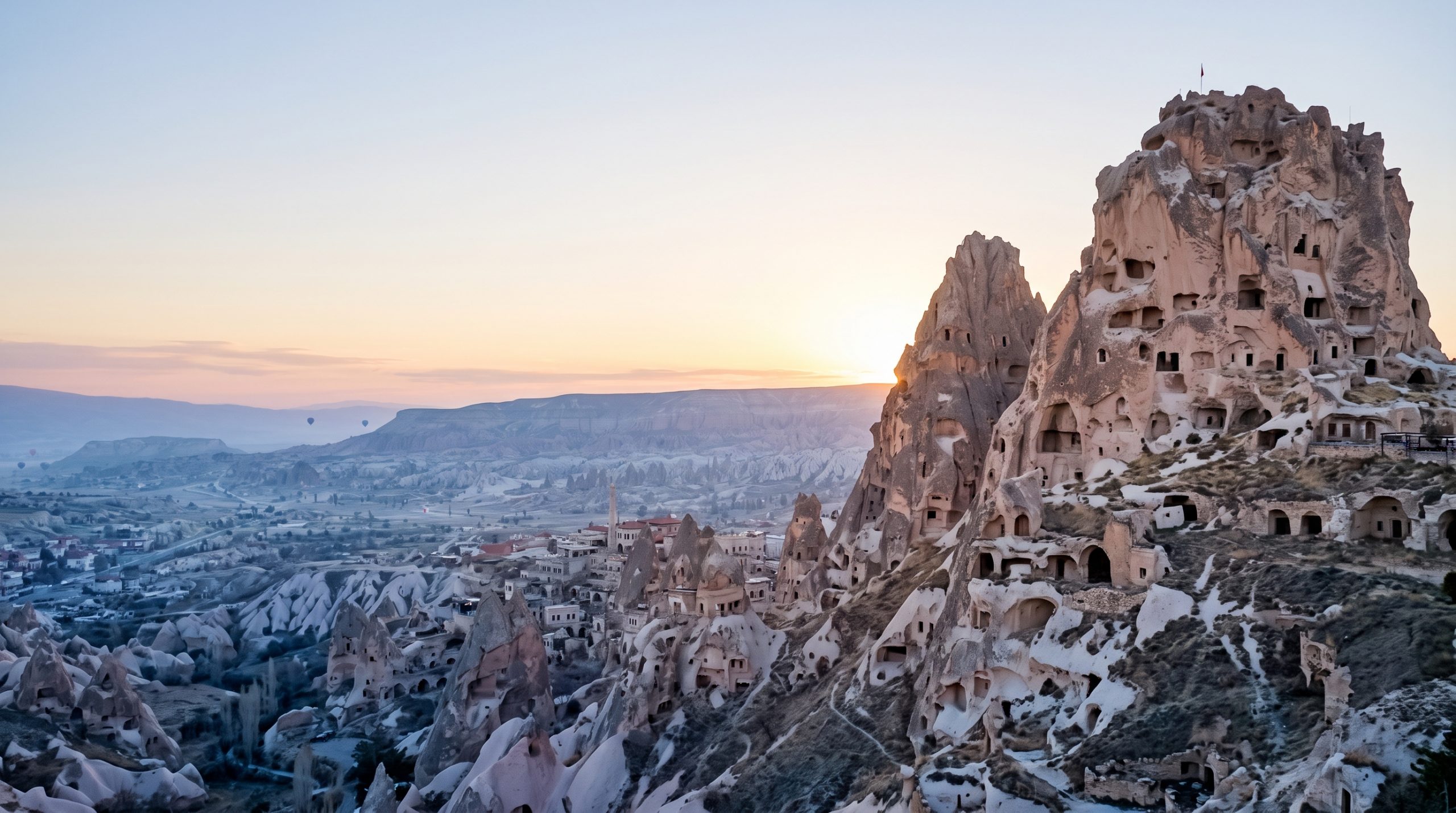
The gate at the foot of Uchisar Castle opens at eight in the morning. In late June the sun is already up by about 05:15, the balloons are back on their trailers by seven, and the light everybody flies to Cappadocia for has been and gone before the ticket window lifts its shutter. That single mismatch shapes almost everything about a wedding day on this rock.
The castle is not a building. It is a block of volcanic tuff standing roughly 60 meters above the rooftops of Uchisar, hollowed out over centuries into rooms, corridors and staircases, and its summit is the highest point in the region. From up there you look northeast over Goreme, east to the snow on Erciyes at 3,917 meters, and straight down into Pigeon Valley.
Getting married here means two separate things, and it helps to keep them apart from the beginning. One is the ceremony: your words, on the rock, inside public visiting hours. The other is Turkish civil marriage, which happens at a registrar’s desk with translated paperwork and has nothing to do with the view.
Vows on the summit, paperwork at a registrar’s desk
You can hold a private ceremony on Uchisar Castle during public visiting hours, with a ticket, like any other visitor. Legal marriage in Turkey is a separate civil act before an authorized registrar, with documents translated into Turkish and certified, so most couples handle the registration elsewhere and keep the rock for their vows.
The gate opens after the balloons have landed
Turkey stays on the same clock all year, which makes this easy to plan and impossible to fudge. The municipality opens the castle every day of the week, roughly 08:00 to 19:00 through the warm half of the year and closing nearer 17:00 in winter, with the ticket window shutting about three quarters of an hour before the site itself. Those hours sit neatly inside the day. The two hours worth photographing sit outside them.
Balloons fly in the calm hour around sunrise because that is the only part of the day the air column reliably allows it, a standard flight runs about an hour, and by nine the thermals coming off the valleys have usually ended passenger flying for the morning. In June that means the sky is full at 05:30 and empty by 07:00, a clear hour before you could buy a ticket. In the last week of December, sunrise is closer to 07:55 and the arithmetic almost works in your favor for once.
So we stop treating the summit as the vantage point and start treating the rock as the subject. First light happens outside the ticket line, on the ridge above the Nevsehir road, on the valley rim where Pigeon Valley drops away, on a hotel terrace in the village with the tuff filling the frame behind you. The gate opens while that light is still warm, and the first ninety minutes inside are the quietest of the whole day, because every other visitor in Cappadocia is either in a balloon basket or asleep.
The end of the day runs the other way. Uchisar is the last stop on the standard afternoon coach circuit, so the crowd builds from mid-afternoon and peaks at the exact hour the guidebooks recommend. Arriving early does not help, because the problem is not the queue at the booth, it is thirty people sharing a summit ledge that comfortably holds six. And in every season the gate closes before the sun actually goes down, so we spend the last hour where the light is: outside, on the ridge, with the castle lit and empty of us.
Where the light lands on the tuff, and from which side
The rock has no single good hour, it has faces. In late June the sun clears the horizon at about 59 degrees, which from the summit is almost exactly over Goreme, so the first light of the day strikes the eastern face above Pigeon Valley and everything on the Nevsehir side stays blue for another half hour. By evening the sun has swung round to roughly 301 degrees, well north of west, so the valleys below the eastern face lose direct light long before the rock does. In mid-January the whole arc collapses: the sun rises around 117 degrees, close to the line of Erciyes, and sets at about 243 degrees, which means low, raking light across the tuff for most of a short day.
That is the part worth planning against, and it is why a ceremony hour on this rock is a decision rather than a default.
| Date | Sunrise | Sunset | What it does to the day |
|---|---|---|---|
| 21 June | 05:16 | 20:08 | Balloons and first light both finish before opening. Vows go inside the morning slot or on the ridge at dusk. |
| 15 August | 05:54 | 19:37 | Same shape, slightly kinder. Midday on the summit is bright and shadeless, so we work the two ends. |
| 21 September | 06:26 | 18:41 | Sunrise and sunset sit almost due east and west. The best balance of usable light inside opening hours. |
| 15 January | 07:57 | 17:42 | The gate opens close to sunrise. Cold, low sun, thin crowds, and a real chance of snow on the tuff. |
Cappadocia in January is a different place from Cappadocia in September, and both of them photograph beautifully in ways that have very little to do with each other. Our published galleries and films are the fastest way to see which one you actually want: the pale, hard-edged summer version of this landscape, or the version where frost sits in the carved windows and the whole valley is grey and gold for four hours before the light quits.
Fifteen minutes of rock-cut stairs, in a dress
The climb from the entrance to the summit takes a fit visitor fifteen to twenty minutes at a walking pace. In wedding clothes, double it and be happy about it.
The route is a staircase, not a path. The steps are cut into the rock, uneven in depth, and polished smooth in the well-used sections. Several passages are single file, and there are places where you stoop to get through a doorway that was carved for somebody shorter and in more sensible clothing. Nobody is going to hold a train off the stone for you unless somebody is assigned to do it, so we assign it: one of us climbs behind with the fabric, which is also the reason the interior frames on the way up tend to be the ones couples keep.
Practical shape of it. Boots or flats for the climb, and change at the top rather than at the bottom, because the descent in smooth soles is the part that actually asks something of you. A veil is a coin toss up there, since the summit funnels wind that the village never feels. There is no shade anywhere on the rock, so in July we are up early and down before the stone starts radiating heat back at you. The whole visit, gate to gate, sits comfortably inside an hour and a half.
Getting up there from Goreme, Nevsehir and the airports
Uchisar sits about 4 km from Goreme and 7 km from Nevsehir, which is ten minutes of driving from the first and a little more from the second. Kayseri is roughly 75 km away, an hour or so of driving. There is a paid car park close to the entrance, and it fills from mid-afternoon. On foot, Goreme to Uchisar is about 45 minutes on the road, or an hour and a half if you come up through Pigeon Valley, which is the walk to do in trainers on a different day rather than in a dress on this one. Most couples we work with here stay in Uchisar itself, in one of the cave hotels ringing the base of the rock, which turns the morning into a five-minute walk instead of a transfer.
The ticket window belongs to the town hall
This matters more than it sounds. Uchisar Castle is run by the Uchisar municipality rather than the Ministry of Culture and Tourism, so the national Museum Pass that covers Goreme Open Air Museum and the underground cities does not get you in here. You buy a ticket at the gate, by cash or card, at a per-person rate the town sets and revises. It also means the conversation about anything beyond an ordinary visit happens with the town, which is a considerably shorter chain of permission than at a national site. Asking is our job, and it happens long before your date is fixed.
Aerials are their own conversation. Filming from the air in this region needs authorization from the civil aviation authority and from the provincial governor’s office in Nevsehir, and drones stay on the ground while balloons are operating, which covers the whole sunrise window. So aerial footage here lives in a mid-morning slot, and we confirm the paperwork and the window before we build any part of the film around it. Where it does not come together, the film is designed to work without it, which is not a compromise so much as a decision about what the rock actually needs.
The legal marriage runs on a separate track. Turkey recognizes only civil marriage, performed by an authorized official, and for a couple where one or both are foreign nationals that means a municipal marriage registrar or a civil registry director. Both of you apply in person, with passports, evidence that there is no impediment to the marriage, and the supporting documents translated into Turkish and certified for use in Turkey. Once a file is approved, the registrar can issue a marriage permission document valid for six months, which lets you marry before any authorized registrar in the country and gets reported back to the issuing office afterward. Certificates come out in Turkish and French, with an English page on request. Two nationals of the same country can also marry before their own mission in Turkey, if their national law allows it. Plenty of couples simply marry at home first and come here for the ceremony that matters to them, and if you want the sequence set out properly, start with our guide to planning an elopement.
Standing room for two cameras, and who this rock suits
The physical shape of this place is the argument for how we work. On a single-file stair with a ledge at the top, a photographer and a filmmaker who met that morning spend the day stepping into each other’s frames. Ours do not, because they have done it together before and because the plan already says who is where. One works close on the summit while the other is out on the ridge with a long lens, holding the frame that shows how small two people are on top of 60 meters of rock, and then they swap. Wind is the other reason to be deliberate here: the summit is exposed, so on the day with a photographer and filmmaker together the vows get recorded in the lee of the rock or in a carved chamber below the top, where the audio is clean and the acoustics do something interesting. A full day with one of us starts at $4,900, and the day with both starts at $7,900.
Cappadocia rewards couples who will trade a sensible bedtime for an empty landscape, and Uchisar in particular rewards anyone willing to treat the famous hour as the one to avoid. If the pre-dawn version of this is not your idea of a good morning, say so in your first message. There is a gentler shape to the day here, built around a late breakfast, a mid-morning climb and a long evening on the terraces, and there are months where that shape is better than ours anyway. We would rather build the day you want than the day the guidebooks describe. If you are still comparing regions, our destination guides put this rock next to the other places that do this kind of light.
Common questions
Can we stay on top of Uchisar Castle for sunset?
Not in any season. The site closes before the sun sets, and the ticket window shuts earlier still, so the summit empties while the sky is at its best. The last hour of light is spent outside the ticketed area, on the ridge and the terraces, where the castle itself is in the frame.
Does the Cappadocia Museum Pass cover Uchisar Castle?
No. The site belongs to the Uchisar municipality rather than the Ministry of Culture and Tourism, so the national pass that gets you into Goreme Open Air Museum is no use at this gate. Pay per person at the booth, by cash or card, on the day.
Can we be on the summit while the balloons are up?
In summer, no. Balloons launch in the hour around sunrise and are down by seven, well before the gate opens at eight. In deep winter the two nearly meet, since sunrise is not until about 07:55. Either way, the balloon frames are made from the ridge and the valley rim, not the summit.
Is there anywhere to change shoes or clothes at the castle?
There is nothing at the gate: no lockers, no changing room. That is why we base this morning in Uchisar village itself, where the walk from most hotels to the entrance takes a few minutes, and why the change of footwear happens at the top of the climb rather than the bottom.
How many people can come up the rock with us?
Our fee does not move with guest count, but the rock does have opinions. The stairs are single file and the summit ledge suits a handful of people, so a group beyond six or eight spreads out across the upper terraces instead of standing together. Tell us the number early and we shape the ceremony position around it.
What a date on this rock takes from here
End to end, a day here reads like this: dark, then the ridge while the balloons rise over Goreme, then the gate at eight and an empty staircase, vows on the summit or in a carved chamber out of the wind, breakfast in the village, an afternoon somewhere with no coaches in it, and the last light back on the ridge with the castle lit behind you. Highlights reach you within five days and the full gallery or film within three weeks.
the whole plan from your first message to that morning stays in writing, on your own time and across whatever number of time zones sit between us. Send the inquiry form and you will have a reply and our initial brochure within 24 hours, then a proposal built for your date, and planning starts once the contract is signed and the 30 percent retainer is paid. We are booking 2027, 2028 and 2029 now, so if Uchisar is where you want to stand, Tell Us Your Story.