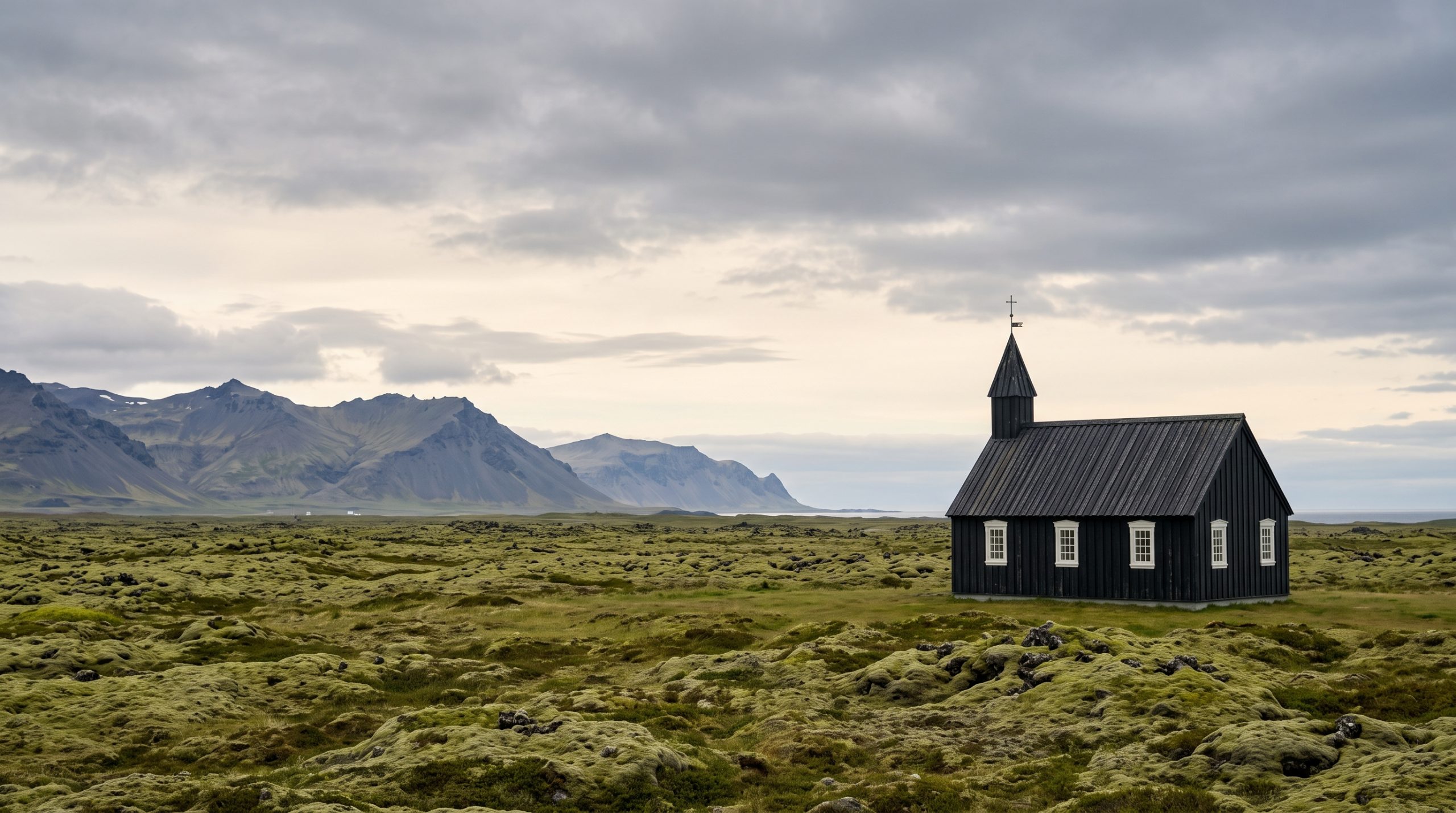
The candlesticks on the altar at Búðakirkja are older than the church that holds them. They date from 1767, and during a ceremony they carry the only open flame the parish allows anywhere in or near the building. Everything else that burns stays outside the stone wall, or stays unlit.
The church you have seen in a hundred photographs went up in 1848, raised by a local woman, Steinunn Sveinsdóttir, after the church authorities of the day argued against rebuilding it at all. The iron ring on the door still carries a pointed line about that. There has been a church on this patch of lava and sand since 1703, and the black timber standing there now is a working parish church, protected, and looked after by people who live within a few kilometres of it.
That is the thing to know before you plan a wedding at Búðir. It is not a venue. It is a building you rent by the hour from a parish that has first claim on it, standing on a flat plain inside a nature reserve. Once you understand those two facts, the day becomes straightforward to build.
Two bookings, not one
Marrying at Búðakirkja means two separate arrangements. The church and its grounds are rented from the parish in blocks of one, two or three hours, through the church keeper, by email. The legal marriage runs through an Icelandic district commissioner and has nothing to do with the building. Neither part is hard. They simply move at different speeds.
The hour you rent, and what it does not include
An hour in the church and on its grounds currently sits at 46,000 ISK, with the two and three hour blocks priced above it. At any exchange rate of the past few years that is a few hundred dollars rather than the thousands most couples brace themselves for. The parish publishes a price list by year and is direct about one consequence: book eighteen months or more ahead and you pay according to the list for the year you marry, not the list you read on the day you booked.
A confirmation fee holds the date and is not refundable. The balance falls due at least five days before, and up to that five day mark a cancellation returns everything except the confirmation fee. There is also a paid pre-visit, currently 6,500 ISK, which is how couples see the interior in advance or get time inside to place flowers. It is only offered alongside another event in the church, so it has to be arranged rather than assumed.
What the rental does not include is worth stating plainly, because it catches people out. The parish supplies no officiant, no florist, no decoration, no accommodation, and no photographer or filmmaker. It supplies the church, the ground inside the wall, and a church keeper. Congregational life comes first, and the parish can move or cancel a booking for its own activities or for maintenance. That priority is precisely what has kept this a church instead of a wedding venue.
The house rules are short and specific. Nothing is scattered in or around the building, so no rice, petals, glitter or confetti; soap bubbles, small flags and ribbons are welcome instead. No food or drink inside. Nothing is moved, added or decorated without the church keeper’s agreement, because the church and its surroundings are both protected. The gates in the stone wall stay shut behind you.
The paperwork that makes it a marriage
Iceland runs a document check called an examination of marriage conditions, applied for online through Ísland.is or, where the electronic route will not take you, by sending the form and your documents to the district commissioner by email. The certificate costs 6,700 ISK, paid by transfer to the District Commissioner of Vestmannaeyjar, with foreign transfer charges added on top. A marriage report is completed and submitted to the district commissioner, and for a foreign citizen the copy of the passport has to be confirmed by a notarius publicus.
Who may marry you is set by law rather than by the parish. Ecclesiastical ceremonies are conducted by ministers of the National Church and of registered religious organisations in Iceland, while civil ceremonies are conducted by district commissioners and their legally trained representatives. Inside Búðakirkja, responsibility for a ceremony sits with the parish priest in consultation with the parish committee, so the officiant is a conversation to open early rather than a box to tick late. Permit research and the order of operations are part of every experience we plan; the government fees themselves stay with you. Our guide to planning an elopement sets out the sequence.
Route 54, then 574, then a four minute spur
Búðir is roughly 175 km from Reykjavík, on Route 54 and then Route 574, the road that loops the Snæfellsnes peninsula. The turn down to the church is a short spur, Road 5723, and from the loop road the whole detour takes about four minutes. There is a small parking area, and from it the walk to the church door is short and entirely level.
In wedding clothes that is a gift, and it is rarer in Iceland than you would think. You can step out of the car and be at the door in a minute wearing exactly what you plan to stand in. The shore is a different proposition. The walk from the same parking area along the coast runs from about 500 metres to a kilometre and a half and is mostly sand, so a hem drags and thin soles fill. Klettsgata, the old road through the lava field, crosses bedrock worn into grooves by generations of horses, and it is no place for a long train. We keep boots in the car and order the day so the fabric-punishing parts come after the vows rather than before.
Wind is the other clothing fact here. The plain is open to the sea and a veil on it behaves like a flag, so we plan for pinned hair, a jacket that lives in the car, and a second standing position in the lee of the church wall. The peninsula also hands us alternatives within minutes of the turn: Rauðfeldsgjá a few kilometres further along 574, Arnarstapi and Hellnar joined by their coastal path, Ytri Tunga to the east where seals haul out in July and August. Snæfellsjökull is the horizon on a clear day. Our destination guides go wider on the peninsula if you are still choosing between its coasts.
Open ground on three sides, a mountain wall on the fourth
Búðakirkja stands inside a low stone wall on ground so flat that nothing shadows the church except the church. The sea lies south and east. Búðahraun, the lava field, is west. The mountainous spine of the peninsula rises to the north, and it is the only high ground in the frame.
This is the part almost every guide to Búðir skips, and it changes how the day is built. At a fjord or a cliff base you wait for the sun to clear a ridge, and the ceremony hour is dictated by that wait. Here, first light touches the timber not long after it clears the sea horizon, and the last light stays on the walls until it is gone. Your ceremony hour is decided by wind and cloud, not by shadow.
In late June the sun goes down to the northwest, out across the lava, and comes back to the northeast behind the mountains, and the sky between barely darkens. Those hours are the best trade on the whole peninsula, because the light arrives low across the reserve and the parking area is empty. Late December runs the opposite way. The sun stays low in the south over the water and never climbs, so the entire short day carries the sort of light other places get for forty minutes. What it will not give you is a bright interior, so for a December ceremony inside the church we set the vows in the middle of the day and step straight outside afterwards while the light is still on the walls.
Then there is the black itself. The timber is coated in pitch and holds almost no highlight, which is why so many pictures of this church look identical: shot from the parking side around midday, it flattens into a black cut-out on grey. A white dress against that wall is a wide brightness range for one frame to hold, so we work at an angle to the timber rather than flat against it, or move you out onto the plain with sky behind you and let the church be the small dark shape in the distance. Both approaches live in our stories and films, and the difference between them is an hour of the day, not a lens.
The wall is yours, the plain belongs to everyone
Búðakirkja is one of the most photographed buildings in Iceland, and it is only fair to describe the hour when most people arrive. From late morning to late afternoon the traffic comes in pulses, as the loop road feeds cars and small coaches into that four minute detour. The lot fills, empties, and fills again.
Your rental gives you the church and the ground inside the wall. It does not close the plain. The lava field, the sand and the old track sit inside Búðahraun, protected since 1977 and a nature reserve of just over 1,000 hectares, and other people are entitled to be out there while you are standing at the door. Most are gracious about a wedding. Some will photograph the church anyway, because that is what they drove out for. Arriving early genuinely works at Búðir in a way it does not at the peninsula’s headline stops, and the reason is the geography of the detour rather than luck: nobody passes this church on the way to anywhere.
Reserve rules shape our planning more than crowds do. Off-road driving is prohibited and the vegetation is not to be disturbed, so we work from the marked trails and the sand. Eleven of Iceland’s sixteen fern species grow in this lava, and it is not ground to walk across for the sake of one frame. Drone flying and photography inside protected areas, Búðahraun among them, run on a permit from the Environment Agency of Iceland, so we confirm the permit and its window before designing any aerial into a film. If you want the day to reach further in, Frambúðir, the old fishing station, is about three kilometres out along the lava from the hotel beside the church.
A small room, two cameras, and one dry acoustic
The interior is a single small room, and two people cannot circle it. Before the doors close we agree who holds the aisle and who works from the back, and we do not cross each other’s line for the duration of the vows. Nothing gets moved to make that work, because nothing in this church may be moved. Outside on the plain the wind has nothing to break it, which is unkind to sound, and the timber interior is the opposite: close, dry, every word landing. When it blows, the vows go inside and the wide frames go out. The Expedition adds professional audio for the vows where conditions allow, which at Búðir usually means recording them within those four walls.
One full day with a dedicated photographer or a dedicated filmmaker starts at $4,900, and the day with both working it together starts at $7,900, with everything each one covers, team travel to Iceland included, set out on our pricing page. Highlights reach you five days after the day itself, and the full gallery or film inside three weeks.
Common questions
Can we hold the ceremony outside the church instead of inside it?
The rental covers the church and the grounds within the stone wall, so an outdoor ceremony on the grass is possible. Not everything is permitted in every timeslot, so the shape of it is agreed with the church keeper when the hours are booked, and we hold the indoor position in reserve for wind.
Do we have to rent Búðakirkja if we only want photographs there?
No. Outside the wall you are a visitor on the reserve like anyone else, and many couples build a morning at Búðir without booking the building. Renting buys the interior, the enclosure and certainty about your hour. Aerials need the Environment Agency permit either way.
Does the church rental come with a minister?
It does not. The parish is explicit that no officiant, florist, decoration or accommodation can be booked through the church. Responsibility for what happens in a ceremony there rests with the parish priest, in consultation with the parish committee, so the officiant is arranged separately and early.
Is there anywhere at Búðir to change out of hiking boots?
Búðir is a church, a hotel low behind the hill, and lava. The church is not a changing room: no food or drink inside, and nothing rearranged. We build changing into the timeline at your accommodation, or work out of the car at the parking area, which is a short level walk from the door.
Can the parish move our booking after we have paid?
Yes, and they say so up front. Búðakirkja can move or cancel a booking for congregational activity, maintenance or circumstances outside its control, because parish work takes priority. This is why we plan a second hour and a second position on the plain rather than a single fixed moment.
How far ahead should we book the church?
Book the church before anything else, because it is the only fixed point in the day. Rentals eighteen months out are charged at the price list for the year of the wedding, so the figure moves but the date holds. Dates are currently open across our 2027, 2028 and 2029 Iceland seasons.
Choosing your window at Búðir
Two decisions shape everything else here: which hour of the day you stand at that door, and how many hours you book. Get those right and the rest of the day falls into place around them, from the drive out on Route 54 to the last frames on the sand. We work in writing from first message to final delivery, so there is nothing to schedule: send the form and a reply with our brochure comes back within 24 hours, then a tailored proposal, then a 30% retainer and planning begins. Tell us the month you are considering and what kind of morning you actually enjoy, and we will tell you honestly which hour at Búðakirkja fits it. Check Your Date