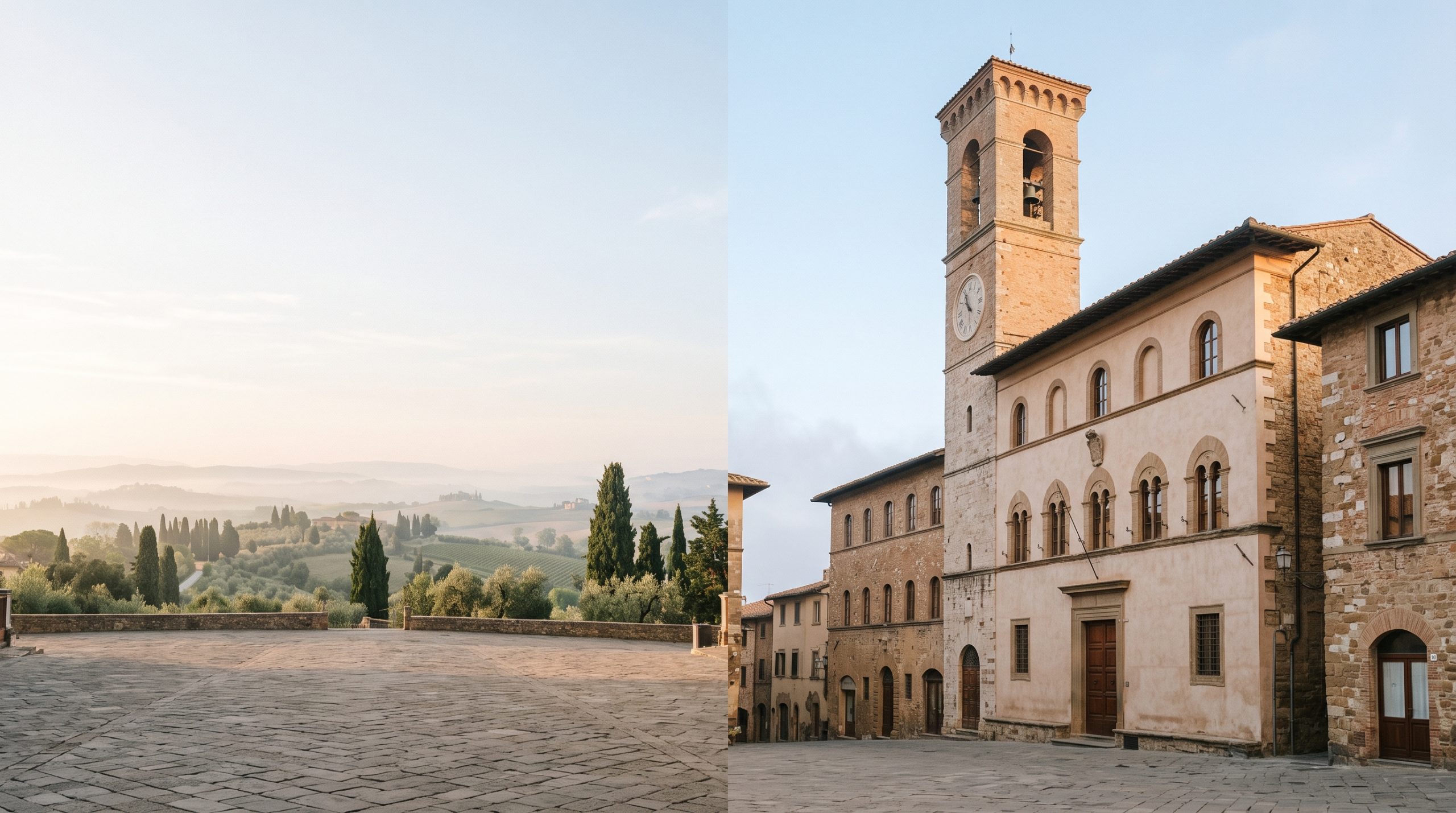
The first thing to know about marrying legally in Italy is that the Italian state is not the slow part. Most American couples arrive expecting weeks of banns posted on a town hall noticeboard, the way Italian residents do it. If neither of you is an Italian citizen and neither of you lives in Italy, that requirement is either waived outright or cut to somewhere between one day and a week, depending on the comune.
What actually governs your timeline is a small set of validity windows and a handful of in-person appointments, two of which happen in Italy in the days before the ceremony, at counters that open at nine in the morning and stop issuing tickets well before lunch.
So the useful answer to how many months you need is not “as many as you can get”. Assemble the file too early and a certificate expires before the date. Here is the chain, in the order you collect it and counted backwards from the ceremony, as we build it for couples eloping in the Dolomites or above Lake Como.
Two to three months of preparation, then a short cluster of appointments in Italy
You do not need six months. Two to three is comfortable: order and apostille your American documents, decide where the Atto Notorio gets sworn, then complete the sworn declaration and the Declaration of Intention to Marry in Italy in the days before the ceremony. Non-resident couples have the banns requirement waived or shortened.
The real difficulty is the calendar, not the forms
Nothing in the Italian chain is legally hard for two unmarried American citizens. There is no residency requirement to satisfy and no waiting period to sit out. The friction comes from the number of desks involved: an American consular officer in Italy, an Italian Prefettura, either an Italian consulate at home or a court in Italy, and the marriage office of the comune where you will marry. Each one keeps its own hours, asks for its own revenue stamps, and works to its own validity window.
That is fiddly, not difficult, and fiddly is a scheduling problem. Scheduling is most of what planning an elopement is anyway. Our destination guides cover the landscape side of Italy. This page is the paperwork.
We use these rules to build wedding timelines; we do not act as legal advisers. Confirm the final requirements for your circumstances with the relevant registry office or consulate before travel is fixed.
The document chain, in the order you collect it
Every document that originates outside Italy has to be legalized for use in Italy and translated into Italian. For an American document, legalizing it means an Apostille from the state that issued it, which is why this part of the work starts at home rather than in Italy.
- Birth certificates. An original or certified copy for each of you, then an Apostille from the issuing state, then a translation into Italian. Both steps are required. An Apostille does not stand in for the translation, and a translation does not stand in for the Apostille.
- A divorce decree, if either of you has been married before. Same treatment as the birth certificate: it originates outside Italy, so it needs the Apostille and the Italian translation before any Italian office will look at it.
- Atto Notorio, route one, sworn at home. This is the declaration that under the law you are subject to in the United States there is no obstacle to the marriage, and it is sworn by two witnesses at the Italian consulate with jurisdiction over where you live. The witnesses appear in person, must be over 18 with valid photo ID, must know you, and cannot be family members or future family members. The Consulate General in Chicago publishes a maximum validity of 90 days, so this document is timed to your date rather than ticked off early.
- Atto Notorio, route two, sworn in Italy. Taken in front of a court official in the city where you will marry. The US Mission in Italy lists two revenue stamps of 16 euro each plus one of 10.62 euro, with the document generally ready to collect after four to 10 days. An urgent version issued on the spot takes two stamps of 16 euro plus one of 31.86 euro.
- Dichiarazione Giurata. The affidavit stating that nothing in the law of your US state of residence prevents the marriage, sworn in front of an American consular officer in Italy: the Embassy in Rome, or the Consulates General in Milan, Florence and Naples, with consular agents in Genoa, Venice and Palermo. Download and complete the form for your specific post beforehand, and do not sign it. The signature has to happen in front of the officer.
- Legalization of the Dichiarazione Giurata. Carried to the Ufficio Legalizzazioni of a Prefettura inside the same consular district where it was sworn, with a 16 euro marca da bollo for each document, bought from any tabacchi.
- Declaration of Intention to Marry. Filed at the marriage office of the comune where the wedding will take place, in front of the ufficiale di stato civile, with an interpreter alongside you if you do not speak Italian. The date is set once this is done.
- The Apostille on your Italian marriage certificate. Obtained after the ceremony from the legalization office of the Prefettura with jurisdiction, and the last step the US Mission lists in the sequence.
The ceremony itself is performed by the mayor or a deputy, with two witnesses present. They can be of any nationality, must be over 18, and must have valid photo identification. If an interpreter is needed, that is a separate person again, because a witness cannot serve as interpreter.
Turn the Italian ceremony date into a month-by-month plan
Two clocks run in opposite directions here. The certificates have a ceiling: Italian consular guidance puts the certificate of marital capacity at six months of validity from the day of issue, with three months in certain cases, which is why a postponed wedding can often reuse the same paperwork as long as it stays inside the window. An Atto Notorio sworn in the United States has a tighter ceiling again. The appointments in Italy have a floor instead, because each one has to be finished before the next can begin.
| Step | Real minimum | What we plan to |
|---|---|---|
| Birth certificates ordered and apostilled | About six weeks out | Three to four months out |
| Italian translations completed | A few weeks out | Alongside the Apostilles |
| Atto Notorio at an Italian consulate in the US | Inside 90 days of the date | Eight to ten weeks out |
| First contact with the comune marriage office | Once the documents exist | As soon as the date is chosen |
| Arrival in Italy | Several working days ahead | A full week, with a spare morning |
| Dichiarazione Giurata, then Prefettura legalization | Two consecutive working mornings | Two mornings plus a day of slack |
| Declaration of Intention to Marry | Before the ceremony | The day the documents are complete |
We plan to the right-hand column. Not because the left one is wrong, but because it assumes every counter is open on the morning you turn up, and a morning lost at a Prefettura is not a morning you get back later in the week. Published guidance on validity does vary from office to office, and the one whose answer governs is the marriage office of the comune where you will marry, because that is the desk that accepts or refuses your documents.
Six things that decide whether the week runs smoothly
- The 90-day clock on an Atto Notorio sworn in the US. Organized couples tend to do this one first, because it involves two witnesses and a consulate appointment at home. It is also the document most likely to run out before the ceremony. Book it once the date is fixed, not once the engagement is.
- Legalization counters keep short mornings. The Prefettura in Florence runs its legalization office Monday to Friday from 9:00 to 11:00. In Rome the office works Monday, Tuesday, Thursday and Friday from 9:00 to 12:00, which means Wednesday is not a working day for that particular errand.
- Revenue stamps come from a tobacconist. The 16 euro marca da bollo is bought at a tabacchi and handed across the counter with the document, one stamp per document. It is the sort of errand that takes four minutes if you know about it and half a morning if you do not.
- The Prefettura has to match the consular district. A Dichiarazione Giurata is legalized in the district where it was sworn. One issued at the Consulate General in Milan can be legalized at any Prefettura within Milan’s jurisdiction, while one sworn in front of the consular agent in Venice or Genoa goes back to the Prefettura in Venice or Genoa respectively.
- An unsigned form is the correct form. Print and fill in the version published for your specific post, then leave the signature line empty. The consular officer watches you sign.
- Witnesses do two different jobs, under two different rules. The two who swear the Atto Notorio have to know you personally and cannot be family or future in-laws, which rules out the sibling you were planning to bring. The two who sign at the ceremony can be any nationality, over 18, with photo ID. If you need an interpreter, that is a third person entirely.
None of that is a reason to feel nervous about the week. It is a reason to know the hours before you build the itinerary, which is the part we handle: we put the appointment mornings and the driving time into the same timeline as the light, so nothing important lands on the day you were meant to be at a counter.
Sign at home, then hold the ceremony in Italy
A large share of the couples we work with sign the legal paperwork at a county office at home, weeks before the flights, and let Italy hold the ceremony. It is worth saying plainly that this is not a lesser version of the day. It removes the consular appointment, the Prefettura morning and the comune’s diary, and it hands back the one thing paperwork quietly takes from you, which is the hour.
A civil ceremony in Italy is conducted by a municipal official during municipal working hours. Sunrise on a Dolomite pass happens at a completely different time of day. When the legal side is already done at home, your vows can be read before six in the morning on a ridge with nobody else on it, or in the last twenty minutes of light on a terrace above the water, and the rest of the day gets built outward from that moment. You can see how both versions look, legal and ceremony-only, in our published elopement stories and films.
What does not change is everything we do. Destination and location design, planning, a custom timeline built around light and real travel time, permit research and logistics guidance, weather alternatives, drone footage where it is legal and safe. Highlights reach you in five days and the full gallery or film in three weeks either way. Vows read to each other on a mountain are still vows.
One detail worth knowing if a blessing is part of your thinking: a religious ceremony in Italy led by clergy who are not Roman Catholic requires the civil ceremony to be performed first for the marriage to be legal. That reorders the day, so it is better raised in the first email than the last. The fundamentals of planning an elopement cover how these pieces usually fit together.
Tell us which shape you want and we will build the timeline around it, or tell you honestly which month and which region make it easier. Tell Us Your Story.
What we can schedule and what stays in your hands
We design the destination and the locations, hold your date against what the comune can actually offer, and coordinate the ceremony hour with the light rather than discovering the clash in week three. Where a marriage office can only give you a mid-morning slot, we shape the hours either side of it so the strongest light of the day is still yours, and we keep a weather alternative ready within a short drive.
Photography, film and planning come from one team of eight, which matters most in the two places where a legal Italian wedding is tightest. A comune room is small and the legal part is brief, so a dedicated photographer and a dedicated filmmaker who work together every week can cover the signing from two angles at once instead of negotiating position with a stranger hired separately. On our Expedition coverage the filmmaker also records professional audio for the vows, which is the difference between remembering the room and hearing it. Everything included in each experience is set out on our coverage and pricing page.
What stays with you: the government, venue and landowner permit fees themselves, the celebrant, accommodation, and any unusual transport such as a private boat or a mountain guide. The paperwork stays with you too. We research and plan around it, but we are not lawyers and we do not file documents on your behalf, so the consular appointment and the Prefettura window are yours to attend.
Treat the quoted fees and processing windows as the version used to build this timeline. Re-check the current amount and deadline with the issuing office before you lock in flights or appointments for marry legally in italy.
Common questions
How far in advance do we need to start the paperwork to get married in Italy?
Two to three months of preparation is comfortable. Birth certificates need ordering, apostilling and translating, and the Atto Notorio has to be timed so it is still valid on your date. Starting a year out does not help, because the certificates that matter most have validity windows measured in months.
Do we have to be in Italy for a few days before the ceremony?
Yes, if the legal marriage is happening in Italy. The Dichiarazione Giurata is sworn in front of an American consular officer in Italy, then legalized at a Prefettura, then your documents go to the comune for the Declaration of Intention to Marry. Those are separate visits on separate working mornings, which is why we build in a spare day.
Can we get the Atto Notorio in the US instead of in Italy?
Yes. It can be sworn by two witnesses at the Italian consulate with jurisdiction over where you live, and the Consulate General in Chicago publishes a maximum validity of 90 days for it. The alternative is to swear it in front of a court official in the city where you will marry, which involves revenue stamps and generally four to 10 days for collection.
Do banns have to be posted if neither of us lives in Italy?
For Italian citizens and residents, banns are posted at the town hall for two consecutive weeks including two Sundays, after the Declaration of Intention to Marry has been filed. If neither of you is an Italian citizen or a resident of Italy, they are automatically waived or posted for a shorter period, varying from one day to a week depending on the town hall.
Who can be our two witnesses at an Italian civil ceremony?
Two people of any nationality, over 18, with valid photo identification. Only two sign, whatever the size of your group. One of them cannot double as your interpreter. The witnesses who swear the Atto Notorio are governed separately: they have to know you personally and cannot be family members or future family members.
Do we need an interpreter at the ceremony if we do not speak Italian?
An interpreter should be with you both when you file the Declaration of Intention to Marry and at the ceremony itself, and must be someone other than your two witnesses. It is a small booking that is easy to forget, and the comune will expect it to be in place.
What do we do with the Italian marriage certificate afterwards?
The Apostille is obtained from the legalization office of the Prefettura with jurisdiction over the place you married. The US Mission in Italy lists it as the final step in the sequence, after the ceremony itself, so plan a morning for it or arrange for it to be collected.
Can same-sex couples marry in Italy?
Italy has recognized civil unions since 5 June 2016, under Law 76 of 20 May 2016, and they carry almost all of the legal protections and rights of marriage. Marriage itself is not available to same-sex couples in Italy. The US Mission in Italy publishes a parallel document chain for civil unions, built on the same Dichiarazione Giurata and Atto Notorio, and many couples choose instead to marry at home and hold the ceremony in Italy.
When to write to us, and what to send first
Dates are currently open across 2027, 2028 and 2029. Send the region you are drawn to, a date or even just a month, and whether the legal marriage is happening in Italy or at home, because that single answer changes the shape of the whole timeline. You will have a reply and our initial brochure within 24 hours, then a tailored proposal. A signed contract and a 30% retainer start the planning. All of it runs in writing, at whatever hour suits you, which helps when you are several time zones from the people building your day. Check Your Date.