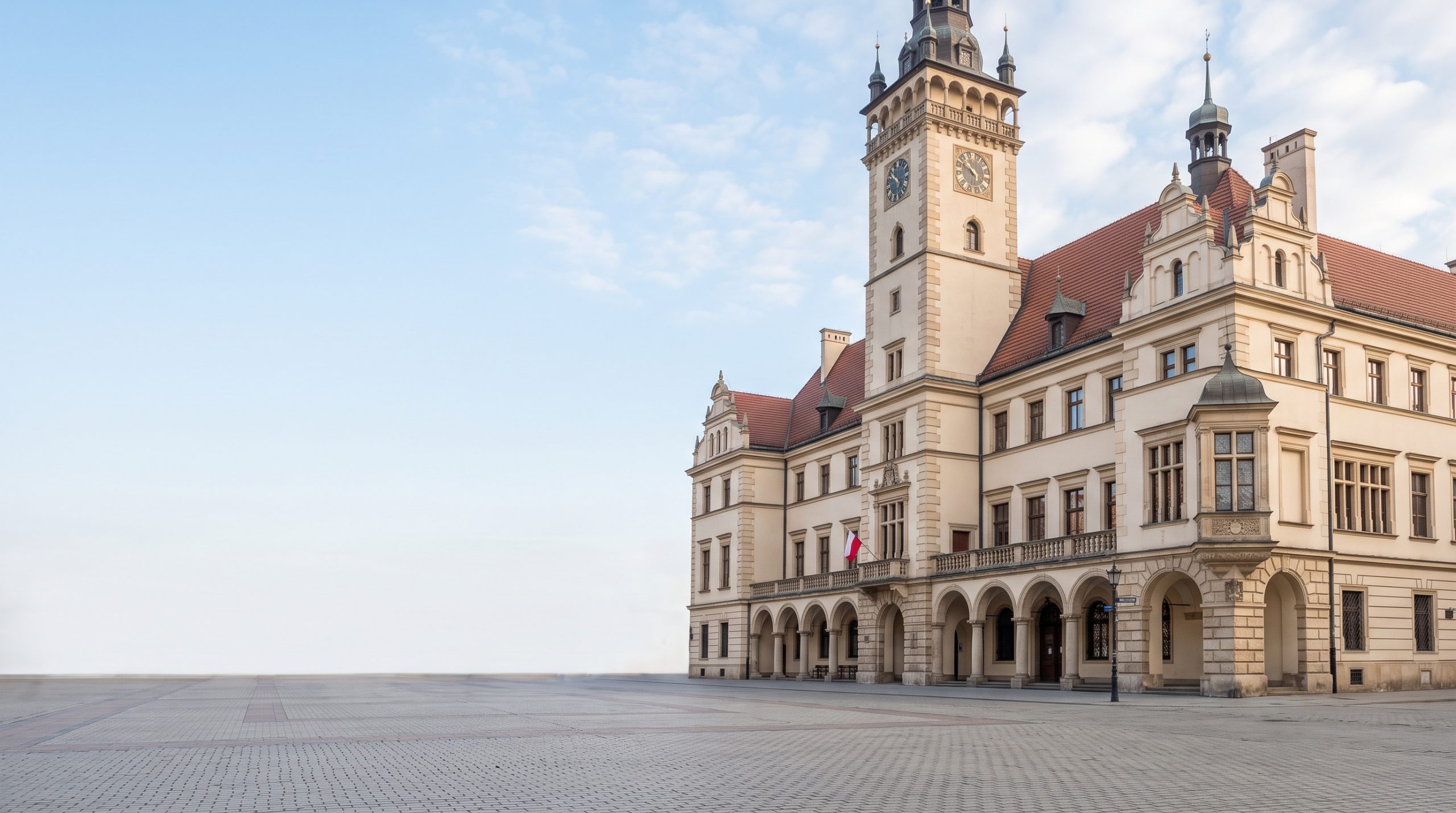
A Polish civil marriage does not start with a venue or a date. It starts with one page signed in front of the head of a registry office, the zapewnienie, a written assurance that you know of nothing that would stand in the way of the marriage. From the day you sign it, Polish law makes you wait a full month before you can make your declarations. You also cannot sign it earlier than six months out, so there is a window rather than an open runway.
If you are American, there is a second thing to know before anyone looks at flights. Poland asks a foreign partner for a document showing that their own country sees no obstacle to the marriage, and the United States does not issue one. The U.S. Embassy in Poland publishes a letter in English and Polish confirming that no such evidence exists at federal level, and that letter is what you take to a Polish district court to be released from producing the certificate.
That court step governs everything else. It is also why most couples who write to us about a wedding day in the Tatras end up legally married at home and standing on a ridge above Zakopane at six in the morning for the ceremony itself. Both routes are set out below, with the offices, the fees and the order things have to happen in.
Marrying in Poland as a foreigner, in one paragraph
Any foreigner may marry at any registry office in Poland. You file documents in person, sign a written assurance, then wait one month before the ceremony. Because the United States issues no certificate of capacity to marry, American citizens apply to a Polish district court to be released from producing one, and that release is where the months actually go.
Where Polish paperwork takes patience for a foreign couple
Here is the honest rating. If one of you lives in Poland, a civil marriage is fiddly rather than difficult: certified copies, sworn translations, a court appointment, a month of waiting, a certificate at the end. If neither of you lives in Poland and you are flying in for ten days, the registry route stops fitting the trip. The Embassy directs questions about which court to use to the local court for your or your partner’s place of residence in Poland, and the documents and declarations have to be filed at the registry office in person by the two of you, not posted from Denver and not handed to a planner.
Stack the steps and the shape is easy to see. Obtaining a court appointment can take several weeks. The decision is then made on the day of the appointment, and it becomes final three weeks after that. Only with a final order in hand is the registry file complete, and only then does the statutory month start running. That is a project measured in months, run mostly from inside Poland.
Which is why the plan we suggest to most visiting couples is the second one on this page: complete the legal marriage where you live, then give Poland the ceremony, the hour and the light. It is a good plan, not a consolation. The vows are the same vows, the ridge is the same ridge, and the morning is entirely yours to schedule. Our planning fundamentals for eloping work the same way in either case.
Our role is photography, film and practical planning rather than legal advice. Rules change and circumstances differ, so confirm the detail with the registry office you intend to use, or with your own consulate, before you book flights.
Build the Polish marriage file in this order
This is the sequence for an American marrying at a Polish registry office. Each step feeds the next, so collecting them out of order is the most common way to lose a month.
- Valid passports for both of you. Identification is checked when you file, and again on the day of the ceremony.
- A certified copy of each birth certificate, ordered from the issuing authority at home. Order two copies while you are there, because the translator works from the original document.
- If either of you has been divorced, a certified copy of the decree together with confirmation that it is final. A U.S. divorce has to be recognized by a Polish court before your registry file can move, which is a separate application and its own lead time.
- The bilingual letter from the U.S. Embassy stating that evidence of capacity to marry is not available from the U.S. federal government. This is the document your court application rests on.
- Sworn translations into Polish of every foreign document. Polish offices accept translations made by a sworn translator on the list kept by the Minister of Justice, by a sworn translator authorized in an EU or EEA member state, or by a Polish consul, so arrange the translation through that route rather than locally at home.
- The district court order releasing you from the obligation to present a capacity certificate. The fixed court fee is 100 zł. The order has to carry the statement that it is final, which arrives three weeks after the decision.
- The written assurance, signed in person at the registry office. It is valid for six months from the day you sign, and it cannot be signed later than one month before the ceremony.
- Proof of the 84 zł stamp duty for drawing up the marriage certificate, in whatever form your particular office accepts.
- If the ceremony is happening away from the office, the consent of the head of that office and the additional fee of 1,000 zł.
- Two adult witnesses with identification, plus an interpreter if either of you or either witness does not speak Polish. The interpreter is yours to provide.
Złoty amounts here convert at roughly four to the US dollar, which puts the certificate fee near 21 dollars and the outside-venue fee near 250. Against flights and a mountain guide, the official fees are the small line in the budget. The time is the expensive part.
Build the Polish ceremony calendar from the registry date
The statutory minimum is clean: one month between the assurance and the marriage. The realistic minimum is set by the court, not the registry office, and the safe planning figure is longer than most couples expect. We hold dates on the comfortable version, because a light window on a Tatra ridge in late September is not something you want to be renegotiating in August.
| Counting back from the date | What has to happen | Where it sits |
|---|---|---|
| Nine to six months | Order certified birth certificates and any divorce decree, print the Embassy letter, book a sworn translator | You, with our checklist |
| Six to three months | Court application for the release, appointment obtained, decision on the day, three more weeks to finality | You, usually with a Polish lawyer |
| Two months to one month | File in person at the registry office, sign the assurance, pay the 84 zł, request consent for an outside ceremony | You at the counter, us holding the date |
| One month, minimum | The statutory wait between the assurance and the declarations | Polish law, immovable |
| Ceremony week | Witnesses, interpreter, identification, the hour set against sunrise or sunset | Us, with you |
Our own calendar sits on top of that. We are currently booking 2027, 2028 and 2029, and we would rather hold a Polish date early and let the paperwork catch up than watch a court timetable decide your season. If you are still choosing between the Tatras, the Baltic dunes and the Bieszczady, our destination guides are the faster way to narrow it down.
Where couples get caught at the counter
None of the following is difficult. All of it is the kind of thing nobody tells you until you are standing in a corridor with a folder.
The same fee, paid five different ways
The 84 zł stamp duty is fixed nationwide, but how you hand it over is set locally. The Warsaw registry office takes it in cash at a district office cash desk or by bank transfer. Poznań will not take cash at all and expects you to arrive with a printed proof of payment, and it serves only visitors who have reserved a slot in advance. Ask your office which mechanism it uses in the same message in which you ask for an appointment.
In person means in person
The documents and declarations needed for the marriage are submitted personally by the couple. There is no postal version and no proxy for this step, so it has to be a real trip, timed at least a month before the ceremony and no more than six months before it.
The translator has to be the right translator
A translation prepared at home, however official it looks, is not the document Poland is asking for. Work from the Ministry of Justice list, or through a sworn translator authorized in an EU or EEA state, or through a Polish consul. Get quotes before you order extra certified copies, because volume is what drives that cost.
Final is a date, not a feeling
The court decision is made on the day of your appointment, and it becomes final three weeks later. Everything downstream waits for that second date, so build the calendar on it rather than on the day you leave the courtroom smiling.
The assurance has a shelf life
Six months from signature. If your date moves late in the planning, check that window first, because it is the one deadline that quietly expires while everything else looks fine.
An outdoor ceremony is the office’s decision too
Marrying away from the registry office is allowed, in a place that guarantees a solemn setting and the safety of everyone present. The head of the office can decline a site that does not meet that standard, and if your requested date cannot be covered outside the office, the office will propose an alternative date. So the site gets chosen with the registrar rather than off a map, and the 1,000 zł additional fee applies once it is agreed.
Use the Poland fees and lead times here as a working estimate rather than a permanent rule; confirm the current numbers with the relevant office before filing.
A home signing can leave the Polish mountain day entirely outdoors
This is the route most of our Polish days take, and there is nothing second-best about it. You sign the legal paperwork where you live, in a courthouse or a county office, often in twenty minutes on a Tuesday. Then Poland gets the part that matters to you: the words, the hour, the weather, the ridge.
What changes practically: no assurance, no statutory month, no 84 zł, no 1,000 zł, no interpreter requirement, no court application, no need to be in Poland twice. The ceremony hour is chosen by the light rather than by an office diary, which in practice means the first cable car up Kasprowy Wierch instead of a mid-morning slot, or a Baltic clifftop at nine in the evening in June. You can have whoever you like read your vows, in your own language, at any hour you please.
What does not change: any of the rest of it. The walk in, the weather calls, the timeline, the drone footage where it is legal and appropriate, the audio of your vows on an Expedition day. Polish law frames marriage as contracted by a man and a woman, so for couples who cannot marry under that rule this route is not a preference but the plan, and we build the day exactly as we would build any other. You can see how these days actually look in our published galleries and films, which is a better guide to Poland at first light than any list of fees.
A word on the famous places, since we are being honest. Morskie Oko is one of the most photographed lakes in Europe and by mid-morning the shoreline is a queue with a view. It is a beautiful place at five in the morning and a bus terminal by eleven. The same is true of Zakopane’s main street and, in high summer, the Słowiński dunes. Our default is early, high and slightly sideways from the obvious spot, and if you would rather have a lie-in than an alpine start, tell us and we will find you a valley or a coastline that looks its best at ten.
What we coordinate in Poland, and what the registry still needs from you
We handle the destination and location design, the timeline built around light and real travel time, permit research and logistics guidance, and the weather alternatives we would actually use. Team travel is included worldwide, so flights and accommodation for the assigned team are not a line you have to think about in Poland or anywhere else. Highlights reach you in 5 days and the full gallery or film in 3 weeks. Coverage and what each experience includes are set out on our pricing page.
Where a second camera earns its place in this particular country is the ceremony hour. On an Expedition day the photographer and filmmaker are one team who have worked together before, so when the registrar starts speaking one of us stays on the declarations and the signature and the other holds on your two witnesses, and neither of us has to step across the other to get there. It also means the ceremony can be set against a sunrise that is only worth ten minutes, because two people are covering it rather than one person choosing.
What stays with you: the registry and court fees, sworn translation costs, the outside-venue fee if it applies, a celebrant if you want one, accommodation, and any unusual transport such as a 4×4 into the Bieszczady or a mountain guide in the high Tatras. We do not file your paperwork and we do not stand between you and the office. What we do is plan the day around the constraints those offices set, hold your date against registrar availability, and put the ceremony where the light is.
Tell us the shape you want and we will tell you honestly which month and which region fits it. Send Us a Message with your rough dates and we will come back with a first read on the calendar.
Common questions
Do we have to live in Poland to get married there?
No. You may marry at any registry office in Poland, and there is no residency requirement for the marriage itself. The complication is the court release from producing a certificate of capacity to marry, because the Embassy points jurisdiction questions to the court for your or your partner’s place of residence in Poland.
Can two American citizens marry each other in Poland?
Neither of you can produce the capacity certificate Poland asks a foreigner for, so both of you would need a court release, plus sworn translations of both sets of documents and the month of statutory waiting. It is a long road for a couple with no Polish address, and it is the main reason we usually plan the ceremony route instead.
How long does the Polish court release take?
Obtaining the court appointment can take several weeks. The decision is issued on the day of the appointment and becomes final three weeks later, and the registry office needs that final version. Build your calendar on the finality date.
What are the official fees for a civil marriage in Poland?
84 zł of stamp duty for drawing up the marriage certificate, the same in every municipality. Add 1,000 zł if the ceremony takes place away from the registry office, and 100 zł for the court application for release from presenting a capacity certificate. Sworn translations are separate and priced by the translator.
Do our US documents need a sworn translation into Polish?
Yes. The translation has to come from a sworn translator on the list kept by the Polish Minister of Justice, from a sworn translator authorized in an EU or EEA member state, or from a Polish consul. A translation certified at home will not stand in for that.
Can we get married outside the registry office, on a mountain or a beach?
Yes, with the consent of the head of the office and an additional fee of 1,000 zł. The site has to guarantee a solemn setting and the safety of everyone attending, the head of the office may decline one that does not, and if the date cannot be covered away from the office an alternative date is proposed. Choose the site together with the registrar.
Can the one month waiting period be shortened?
The head of the registry office may shorten the statutory month at your request where there are important reasons for it. It is a decision, not a formality, and it is made office by office, so plan on the full month and treat any shortening as a bonus.
Can same-sex couples marry in Poland?
Polish civil marriage is contracted by a man and a woman, so the legal marriage happens in your own country and Poland hosts the ceremony. Practically nothing about the day changes, and we plan it and film it exactly as we would any other.
Your Polish date, from here
Send us your rough window and the two or three landscapes you keep coming back to, and say whether you want the registry route or the ceremony route. We will reply with a first read and an initial brochure within 24 hours, then a tailored proposal, and planning begins once the contract is signed and the 30% retainer is paid. Everything between us happens in writing, at whatever hour suits your time zone.
We are currently booking 2027, 2028 and 2029, and Polish mornings are worth planning for properly. Check Your Date and we will tell you what the light is doing that week.