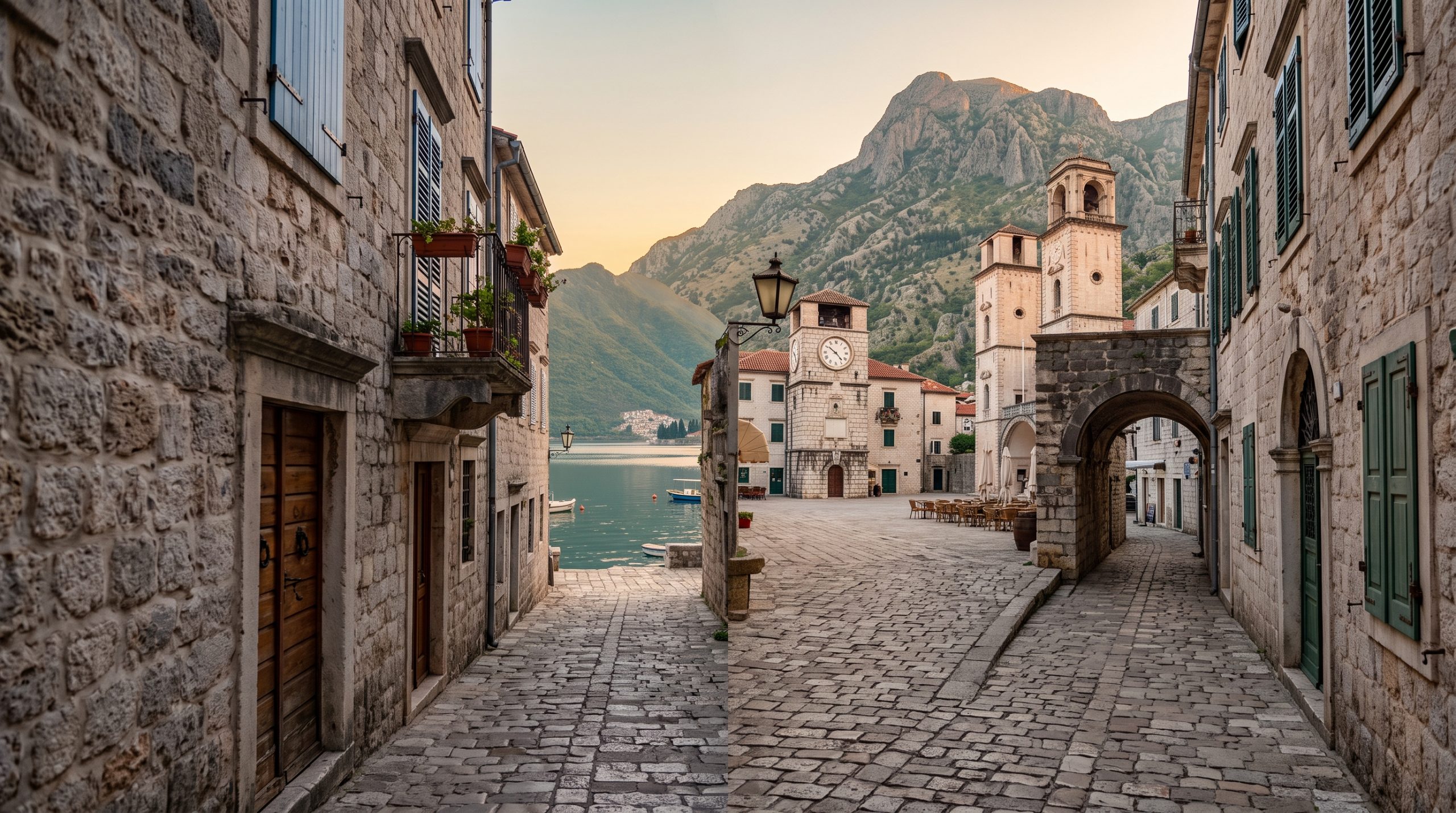
At twenty to six in June, the Sea Gate is just a hole in a wall with nobody standing in it. The marble in front of it is still dark from the night, the chairs on the Square of Arms are stacked, and the loudest thing inside the whole triangle of the Old Town is one shutter going up near the clock tower. The gate was cut in 1555, under Venetian rule, over an older one from the thirteenth century, and in June, for about ninety minutes a day, it belongs to whoever bothered to be there.
Then the first ship ties up. Kotor’s cruise berth is on the quayside directly beside the walls, so there is no tender and no shuttle: passengers step off and reach the gate in roughly five minutes. Most calls run ten to thirteen hours, and on a peak summer day there can be four vessels in port at once. The town does not gradually get busier. It changes at a specific time, and that time is published in advance.
Which is the useful thing about getting married here. Almost everything else about Kotor is fixed geography you cannot argue with. The hour is the one variable completely under your control.
Ceremony at six, ships at seven
Yes, you can marry inside Kotor Old Town. Walking in is free and the lanes are public, so a small ceremony needs no closure and no roped-off square. Ships typically berth from 07:00 and passengers reach the gate within five minutes, which makes the stretch between first light and seven the quiet hour worth building the day around.
We read the port’s arrivals list before we suggest a date
Port of Kotor publishes its cruise ship arrivals on its own site, months out. That calendar is the first document we open when a couple sends us a week in June or a fortnight in September, because two consecutive Tuesdays in Kotor can be completely different towns. One might have a single small vessel alongside from 08:00. The next might have three ships in by seven, each carrying two thousand people or more.
The scale is worth stating plainly rather than softening. The port operator was projecting more than 500 cruise arrivals and over 700,000 passengers across the 2024 season, into a walled town you can cross on foot in ten minutes. That is not a complaint about Kotor. It is the single fact that decides what your morning looks like, and it is knowable in advance.
We pick the date off that list where we can, and where the date is already fixed by family flights or a venue, we shape the hours around whatever is berthed. A day with a 10:30 arrival hands you a genuinely relaxed start. A day with two ships in at seven means we are married and out of the main lanes before the first guide’s paddle goes up. Both work. They are just different mornings, and knowing which one you have bought is the whole job.
One honest caveat: ships are only the portion of the crowd that comes with a timetable. Coaches arrive too, and they do not publish. What the arrivals list gives us is the floor and the ceiling, which is more than most places on the Adriatic will tell you.
Why the low sun never really reaches these streets
This is the part almost every Kotor guide gets wrong, and it is the part that matters most to your timeline. Kotor sits at the very back of the bay with the fortification hill rising steeply behind the town, and the long spine of the Vrmac ridge across the water, dividing the inner bay from the outer one. There is high ground on both sides of you. That has two consequences.
First, sunrise on paper is not sunrise on the stone. Near midsummer the sun clears the horizon at Kotor’s latitude around 05:08, but it has to climb over the mass behind the town before any of it lands in the lanes, and that takes a long while. Second, the light leaves early. Kotor loses direct sun considerably sooner in the day than Budva or Tivat do, and in the depths of winter it can be off the streets by the early afternoon. The famous low golden light that works so well on limestone is mostly blocked at both ends of the day.
What you actually get in the Old Town is better than golden hour for a ceremony, and worse for the postcard. Before the sun arrives, the whole triangle sits in even, cool, shadowless light, bouncing gently off pale stone on both sides of a three-metre lane. Skin renders beautifully. The cathedral of St Tryphon, standing on its square since 1166, holds detail in its facade instead of blowing out. Across the water, the far shore lights up first, so you have a warm, lit backdrop behind two people standing in cool shade. That is a combination you cannot manufacture with lights, and it is worth looking at how it reads in finished galleries and films before you decide anything about timing.
The awkward truth: the only hour direct sun genuinely fills the narrow streets is the middle of the day, which is precisely when the town is at its fullest. The two things you might want never coincide. We choose shade and space over sun and crowds, every time, and say so up front.
| When | Sunrise at Kotor | Light before a 07:00 berth | What that means for the ceremony |
|---|---|---|---|
| Mid-June | Around 05:08 | Close to two hours | Comfortable. Ceremony at 05:45, walls after, breakfast before the gate fills |
| Mid-August | Around 05:51 | About one hour | Tight but workable. One location, no wandering between them |
| Late September | Around 06:30 | Half an hour | We move the plan up the hill, above the arriving crowd |
| Mid-October | Around 06:51 | Effectively none | First light and the first gangway land together, so we work the evening instead |
Marble, 1,350 steps, and what wedding shoes can survive
No vehicles come inside the walls. Cars stop outside the gates, where paid parking runs at roughly two euros an hour, and from the quay or the bus station it is a five to ten minute walk to the Sea Gate. Everything after that is on foot, on stone that generations have polished to a shine. In flat shoes it is nothing. In a heel it needs attention, particularly first thing when the marble is still damp from the night, and it is the reason we build the early section around one square rather than a march between four of them.
Then there are the walls. Kotor’s fortifications run around four and a half kilometres, reach up to twenty metres high in places, and climb the hill in roughly 1,350 steps to the fortress of San Giovanni, about 250 metres above the town. Fit walkers take forty-five minutes to an hour. The ticket desks at the Sea Gate and the River Gate open at eight and the peak-season fee is currently fifteen euros a head, cash.
Now the sentence nobody writes. A full gown on 1,350 uneven medieval steps is a genuine physical undertaking, and the top is not where most couples should be aiming. The first stretch, up to the church of Our Lady of Remedy partway along the wall, already puts the whole red-roofed triangle and the bay below you, and it is achievable in a dress with the hem gathered and someone carrying the water. Trainers go on for the climb and come off at the top; we carry a bag for that as a matter of course. There is also the older back route, the Ladder of Kotor, which joins the wall path higher up and adds about fifteen rougher minutes on a trail rather than steps. It suits couples in boots, not couples in silk.
The registrar, the apostille, and the two witnesses
In Montenegro, the legally binding act is a civil ceremony conducted by a registrar. A religious or symbolic ceremony on its own does not create a marriage. In Kotor the fee at the municipal office is modest, in the region of fifty euros, and the tariff rises several times over if the registrar leaves the building to marry you somewhere else. A ceremony at a viewpoint on the walls, for instance, is arranged through Kotor municipality rather than assumed.
For Americans, the document trail is set out by the U.S. Embassy in Podgorica, and the details are specific: a U.S.-issued birth certificate must carry an apostille from the state that issued it, while a document obtained from the Embassy itself does not need one. You will also need clear photocopies of both passports and of your two witnesses’ identification, plus proof of registered residence from the Montenegrin Ministry of Interior. The ceremony runs in Montenegrin with interpretation.
There is a simpler route that a lot of couples take, and it is not a compromise. Marry legally at home, then treat the hour inside the walls as entirely your own, with no registrar’s schedule attached to it. That removes the last constraint from a morning already governed by ship times, and it is one of the first things we talk through in the planning fundamentals. Whichever route you pick, permit research and the logistics of it are ours; the government, venue and landowner fees themselves sit with you.
On aerials: Montenegro takes drones seriously, with approval required to fly and separate permission needed simply to bring equipment into the country, and the national parks above the bay are closed to them entirely. We include drone work wherever it is legal, safe and appropriate, and over a working cruise port inside a walled UNESCO town we plan the film from the ground first and treat anything airborne as an addition.
Where the morning goes after eight
By half past eight in high season the main lane from the Sea Gate to the cathedral square is a moving column of people, and no amount of patience fixes that. So we leave. Upward is the obvious move, because the wall path climbs away from the crowd faster than the crowd climbs after it, and thirty metres of height buys you a completely empty frame with the town below.
Outward works too. The bay road runs along the water past Dobrota and round to Prcanj, the local bus loops it for a couple of euros, and the far shore gives you what nobody standing in Kotor can have, which is Kotor itself in the frame with the mountain wall behind it. And there is a second quiet window most people miss entirely: ships that arrive at seven and stay ten to thirteen hours leave in the evening. The mountains behind the town take the last warm light while the lanes empty out again. If your date falls on a heavy arrivals day, that evening hour is often the better half of the story, and our destination guides go deeper on how the Boka bay towns differ hour by hour.
If a 5:30 start genuinely is not your idea of a good morning, that is fine and it is worth telling us early. There is a version of this day built entirely around the evening, and there are months where the arrivals list is thin enough that mid-morning inside the walls is perfectly civilised. Tell us the shape you want and we will tell you honestly which weeks in Kotor deliver it.
Two cameras in a three-metre lane
Kotor is the strongest argument we know for photographer and filmmaker coming from the same team. The lanes are narrow enough that two people who met that morning will spend the hour in each other’s frames. Ours split the space by habit rather than negotiation: one working long from the far end of a lane, one close and low, swapping ends on a nod. Stone on both sides throws voices straight back, which is a gift for vows on the Expedition, from $7,900, where a dedicated photographer and filmmaker work the same morning with professional audio; the single-artist Adventure day starts at $4,900. What the stone will not forgive is standing directly in the gate arch, where wind off the water funnels through and ruins clean sound, so we place couples a few metres inside it instead. Highlights reach you within five days, and the full gallery or film inside three weeks.
Common questions
What time do cruise ships actually dock in Kotor?
Typical berthing is 07:00 or 08:00, with calls running ten to thirteen hours, so most ships are still alongside through the afternoon. Up to four vessels can be in port on a peak summer day. Port of Kotor publishes the arrivals calendar in advance, which is how we choose or assess a date.
Can we hold the ceremony up on the Kotor city walls?
It is arranged through Kotor municipality rather than simply turning up, and the wall path itself is ticketed in season at fifteen euros a head with the desks opening at eight. Reaching the fortress means roughly 1,350 steps and 250 metres of climb. We research the permissions and build the timing; the fees are paid by you.
Do we have to do the legal paperwork in Montenegro?
Not necessarily. Many couples marry legally at home and keep the Kotor ceremony entirely their own, which frees the hour completely. If you do want the legal marriage here, it must be a civil ceremony with a registrar, and the U.S. Embassy in Podgorica sets out the documents, including an apostille on a U.S.-issued birth certificate.
How early is too early for light inside the Old Town?
Near midsummer, sunrise at Kotor is around 05:08 and there is usable light in the lanes well before the sun clears the ridge, so 05:30 is a real ceremony hour. By late September sunrise slips to about 06:30, and the workable light and the first gangway arrive almost together, so the plan moves up the wall path instead.
Is there anywhere to change after climbing the steps?
Not on the hill, so we plan it into the logistics. Because no cars come inside the walls, we build the morning from a room inside the Old Town or immediately outside a gate, so the walk from door to ceremony is a few minutes rather than a transfer. Shoes and layers travel with us in a bag.
Picking your morning in Kotor
Dates are currently open across our 2027, 2028 and 2029 Montenegro seasons, and for Kotor the question we ask first is not which month but which day, because the arrivals list answers half your timeline before we plan anything else. Send us the dates you are circling and we will read them against the port calendar, tell you what is berthed, and sketch the shape of an hour that starts before the gate fills. Our own flights and accommodation to Montenegro are already inside the price, wherever you are travelling from. We keep the planning in one written thread, at whatever pace suits you, and you get a reply and our initial brochure within 24 hours. Start Your Story.