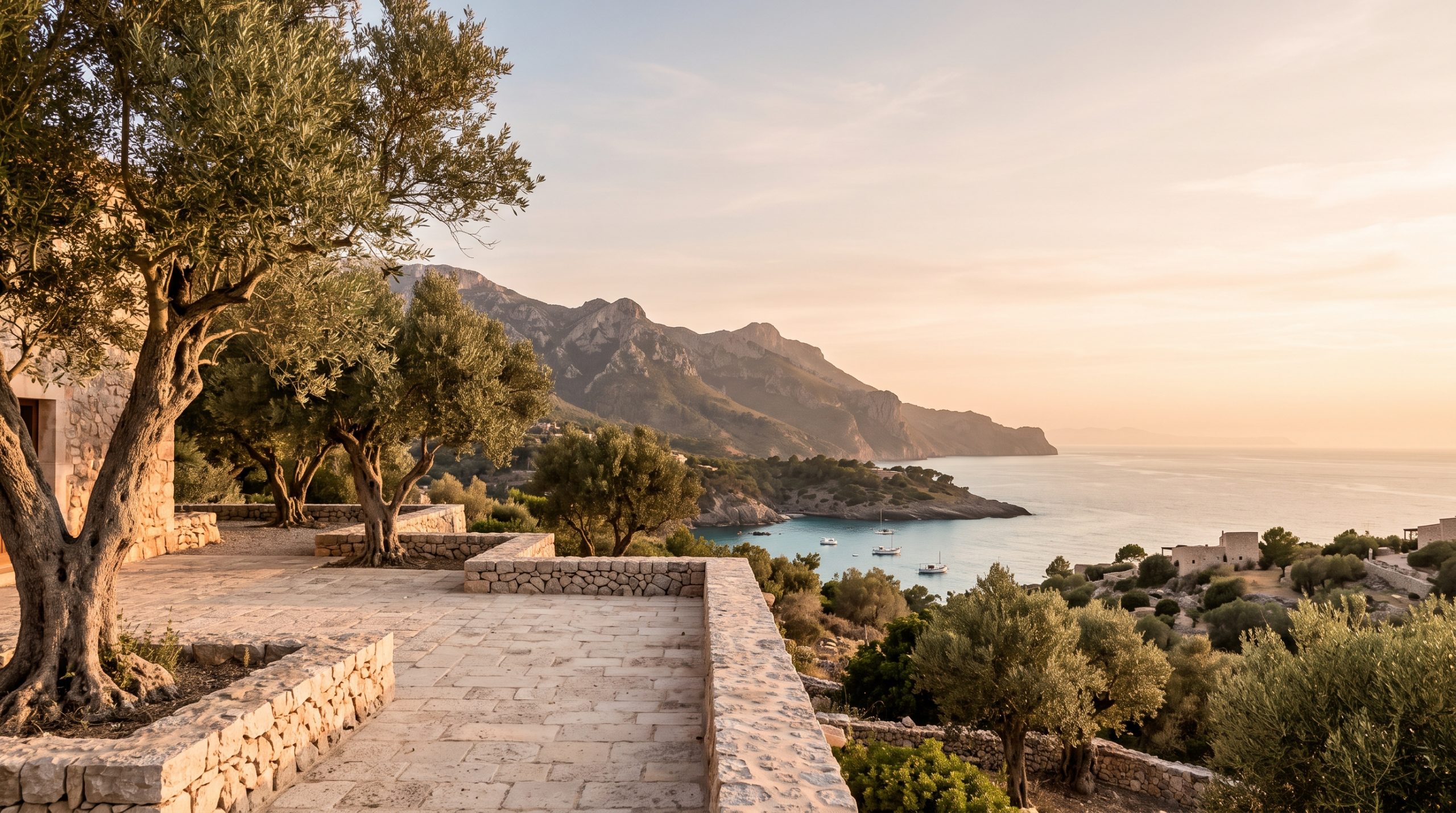
Most couples who write to us about Mallorca ask the same thing first: which office they have to register with. For a symbolic ceremony, the honest answer is none of them. There is no registry file, no notice period, no minimum stay on the island. The legal marriage happens at home in your own county, and the ceremony happens where you want it, at the hour you want it, which in late June can mean vows at 8:40 in the evening on a terrace above Deià while the island’s hotel weddings started at four in the afternoon.
That is the whole mechanism. Spain asks nothing of a non-legal ceremony, so the planning effort moves off the paperwork and onto two things that actually shape the day: who gives you permission to stand on the ground you have chosen, and where the sun is at the moment you turn to each other.
What follows is the chain as it really runs. The documents you need and the ones you almost certainly do not, the timeline counted backwards from the ceremony hour, the details that catch people out, and where the money goes on a day like this.
No registry office, no notice period, no residency
A symbolic ceremony on Mallorca is a non-legal ceremony. You can hold it on any date, anywhere the landowner allows, led by anyone you choose, and Spain requires nothing in advance. The legal marriage is completed at home, before or after. Your planning time goes into location permission and light rather than documents.
The residency rule that settles this for most couples
A Spanish civil marriage is filed at the Registro Civil covering the place where one of you lives. The application asks for a certificado de empadronamiento, the certificate proving you are registered as living in that municipality, and a visiting couple does not have one. Foreign documents in the file have to be translated into Spanish by an official translator, and many of them need a Hague apostille before that. Published requirements vary between municipalities, and the office that governs your answer is the Registro Civil where the file would be opened.
Then there is the room. Civil ceremonies in Spain take place in official spaces: a registry, a court, a town hall. Palma holds its civil ceremonies in the council rooms at Cort, a seventeenth-century building on the old town square, and it is still an indoor ceremony at an allocated hour with another couple waiting behind you. None of that arrangement bends toward a west-facing clifftop in the Tramuntana at nine in the evening.
So the rating, plainly: a Spanish civil marriage is a resident’s route, and for visiting couples the symbolic ceremony is the straightforward one. We would go further: for most couples it is the better version. Marrying at home first turns the Mallorca ceremony into the one part of the process with no queue, no allocated slot and no office calendar attached to it, which is exactly the freedom you need on an island where the good light sits at the two ends of the day.
One exception is worth knowing about. If one of you is Catholic, a church ceremony on the island is arranged through your home parish, which forwards documents to the diocese here, and that process starts many months ahead rather than on arrival. Spain has recognized same-sex marriage since July 2005, and because a symbolic ceremony carries no legal requirements at all, nothing about this route differs for same-sex couples.
Treat this as a planning map for Mallorca, not a legal opinion. The office issuing the documents or permission remains the source of truth for your case.
What changes when the ceremony is not the legal event
On the day, almost nothing changes. You write vows, a celebrant leads, rings are exchanged, a reading lands harder than anyone expected, and the film keeps all of it. Nobody present experiences it as a rehearsal. What changes is administrative: the signature that made you married happened in a county office at home, and what you carry off the island is the gallery and the film rather than a Spanish certificate.
| Requirement | Spanish civil marriage | Symbolic ceremony on Mallorca |
|---|---|---|
| Registered residence in the municipality | Required, evidenced by empadronamiento | Not required |
| File opened with a registry before the date | Required | None |
| Sworn translation of foreign documents | Usually required | Not required |
| Where it can happen | Official rooms, indoors | Anywhere the landowner permits |
| Who leads it | A registrar or authorized official | Anyone you choose |
| Fixed by an office calendar | Yes, including the hour | No, you choose the hour |
Your license, your certificate, and the apostille most couples never need
Here is the chain in the order it has to happen, written for American couples marrying at home and holding the ceremony on Mallorca. The order is not cosmetic; steps four to six only work if the ones before them were done properly.
- Photo ID for both of you, plus paperwork for any earlier marriage that has ended, if your county asks for it. This is what gates the license appointment.
- The marriage license, issued by the county clerk where you apply. This is the one document with a clock on it: the validity window is set by your state, several states add a short waiting period between issue and ceremony, and once the window closes you start again.
- The ceremony at home that solemnizes the license, signed by whoever your state authorizes to officiate and by the number of witnesses your state requires.
- The recorded marriage certificate, ordered as a certified copy from the county or state office that recorded the license. A photocopy or the decorative keepsake certificate will not carry through the next two steps.
- An apostille on that certified copy, issued by the Secretary of State of the state that recorded it. Only needed if a foreign administration will ever ask you to prove the marriage. For a symbolic ceremony on Mallorca, no one will.
- A sworn translation into Spanish, produced by a traductor-intérprete jurado appointed by Spain’s Ministry of Foreign Affairs (MAEC), covering the certificate and the apostille itself. Again, only where Spanish administration is genuinely involved.
For the great majority of couples, steps one to four are the entire chain, and steps five and six never happen. That is the single most useful thing on this page: the apostille and sworn-translation machinery described in most Spanish wedding guides exists for residency, property and consular matters, not for a ceremony on a headland.
Build the Mallorca ceremony around the hour and the ground permission
Sunset on Mallorca swings from just after nine in the evening in late June to around 5:20pm in late December, so the ceremony hour moves by nearly four hours across the year. Island weddings commonly start at 15:00 or 16:00 to keep guests out of the midday heat, and for an elopement we usually do the opposite, building the day at the two ends where the light is worth standing in.
| Before the date | What is done by then |
|---|---|
| 12 to 9 months | Date held, locations shortlisted, contract signed with a 30 percent retainer, planning underway |
| 6 months | Permission requests submitted for public land or a private estate, including the ajuntament and, on beaches inside the coastal public domain, the Demarcación de Costas |
| 3 months | Celebrant confirmed, ceremony hour fixed against actual sunset for your date, travel times driven and checked |
| 6 to 8 weeks | Your county’s license window confirmed, flights and accommodation booked |
| 2 to 4 weeks | License collected where the window allows, vows and readings drafted, timeline finalized |
| 7 days | Weather pattern read, wind direction checked, alternate locations confirmed |
The real minimum is short. Nothing on the Spanish side takes time for a symbolic ceremony, so the floor is set by your county’s license window and by whoever owns the ground you want to stand on. A private finca and a free celebrant can come together in a matter of weeks. The comfortable minimum we work to is six months, and nine for June through September dates in the Tramuntana, because that is when both the good locations and the celebrants who work in English are committed earliest.
The ceremony hour is also where having two of us on the ground earns its place. On The Expedition a photographer and a filmmaker work the same window together, one holding the wide frame while the other stays close for the vows and the audio, which matters when the usable light on a west-facing cove lasts about twenty minutes. Highlights reach you in 5 days and the full gallery or film in 3 weeks, and the elopement stories and films we have published show what that last half hour actually looks like on this coast.
Expiry windows, apostille order, and who is allowed to translate
The mistake we see most often has nothing to do with Spain. It is a license pulled too early. The certificate you hold forever, but the license that authorizes the ceremony has a window measured in weeks in most states, and couples who organize their paperwork nine months ahead sometimes find they organized it into the wrong month. Check the window your county publishes, then work backwards from the wedding date at home, not from the Mallorca date.
If your documents do need to reach a Spanish office, the order is apostille first, translation second. A traductor-intérprete jurado translates the apostille as well as the document underneath it, so a translation produced before the apostille is attached is an incomplete file and gets paid for twice. Along the same lines, only a translator appointed by Spain’s Ministry of Foreign Affairs counts as sworn. A bilingual relative, a notarized translation from home and a US-certified translation are all different things, and the ministry publishes the list of appointed sworn translators by language pair, which is the place to check a name.
On the ground, the thing to get right is who owns the view. A ceremony for two people with nothing but a hat and a bottle of cava is treated very differently from an event with chairs, an arch, amplified sound and forty guests. Once structures or numbers are involved, the ajuntament of the municipality is the office that authorizes use of public space, and beaches sitting within the maritime and terrestrial public domain can also involve the Demarcación de Costas. Those requests go in months ahead rather than weeks, which is why the permission column in the table above sits at six months.
Protected land shapes the film as much as the ceremony. Es Trenc, Mondragó and long stretches of the Tramuntana coast carry conservation designations, and aerial work in Spain runs under AESA rules and the conditions set by Royal Decree 517/2024, with additional requirements over protected natural areas. We confirm the flight window and the operating conditions before any part of the film is planned around aerials, and we build a version of the sequence that works without them.
The last one is timing against everybody else. Sa Calobra and the Formentor road are quiet at first light and busy by mid-morning, so we take them early or not at all. Cala Varques has no road to the sand, so the timeline carries the walk in and the walk out in daylight. The Tramuntana is a UNESCO World Heritage cultural landscape, inscribed in 2011, and it is also a working landscape of terraces, olive groves and private tracks, which means the polite half hour spent finding the right person to ask is often the whole difference between a location working and not working. Our destination elopement guides go deeper on which parts of the island suit which month.
The numbers quoted for Mallorca are useful for planning rather than permanent tariffs; re-check them with the issuing office when your date is fixed. Tell us the shape of day you want and the month you are aiming at, and we will tell you honestly which coast fits it. Send Us a Message.
Who pays for what, and what we take off your plate
The Spanish legal cost of a symbolic ceremony is zero, because there is no Spanish legal step. Your outlay sits in four places: the licensing fee your county charges at home, the celebrant, any permit or site fee attached to the location, and coverage.
Permit and landowner fees are set by whoever governs the ground, and they are paid by you. The research, the applications groundwork and the logistics around them are ours. The same split applies to unusual transport, so a private boat along the Tramuntana coast or a 4×4 up a finca track is billed by the operator. Accommodation, the celebrant and any other vendors are also yours to pay directly, which keeps those choices in your hands.
Travel for our team is included worldwide, so the flights and accommodation for the photographer or filmmaker assigned to you are not a separate line on your side. Coverage starts at $4,900 for one full day with a dedicated photographer or filmmaker and $7,900 for a photographer and filmmaker working together, and the pricing page sets out exactly what each includes.
What we hold: destination and location design, a timeline built on real travel time and the light for your date, permit research and logistics guidance, weather alternatives and backup planning. What we do not do is practice law or file your paperwork, and we will always say so rather than guess. Guest numbers do not change our fee. They change access, permits, transport and the timeline, which is a planning conversation rather than a pricing one, and the planning fundamentals for eloping cover how that works.
Common questions
Is a symbolic ceremony in Mallorca legally binding?
No. A symbolic ceremony has no legal effect anywhere, which is precisely why it has no requirements. Couples complete the legal marriage at home, usually before travelling, and the ceremony on the island is the one everyone remembers.
Can we get legally married in Mallorca as American visitors?
A Spanish civil marriage is filed at the Registro Civil covering the place where one of you lives and the file requires proof of registered residence in that municipality, so it is a route for residents. Visiting couples marry at home and hold the ceremony here.
Do we need to register our US marriage certificate in Spain?
Not for a symbolic ceremony. Registration of a foreign marriage in Spain runs through the Registro Civil Central via a consulate or embassy, and it matters when one spouse is Spanish or resident in Spain. Two visiting Americans have nothing to file.
Can a friend officiate our symbolic ceremony on Mallorca?
Yes. A symbolic ceremony can be led by anyone, and plenty are led by a sibling or a close friend. There are also English-speaking celebrants living on the island who write bilingual ceremonies, which helps when family are travelling from both countries.
Do we need a permit for a symbolic ceremony on a Mallorcan beach?
The marriage law does not require anything, but the land might. Two people with a celebrant and no set-up is a light footprint, while chairs, an arch, amplified sound or a group means the ajuntament authorizes use of the public space, and coastal public domain can bring in the Demarcación de Costas. We research this per location and start it around six months out.
Is a symbolic ceremony different for same-sex couples in Spain?
No. Spain has recognized same-sex marriage since July 2005, and a symbolic ceremony has no legal requirements of any kind, so the planning, the locations and the permissions are identical.
How many days before the ceremony do we need to be on Mallorca?
There is no legal minimum, because there is no file to open. We usually suggest arriving two or three days ahead so you are rested, over the jet lag and able to walk the location with us before the day itself.
Do our documents need an apostille and a sworn translation?
Only if a Spanish office will ever read them. If that applies, the order is apostille first, then a sworn translation of both the document and the apostille by a translator appointed by Spain’s Ministry of Foreign Affairs. For a symbolic ceremony, neither step is needed.
Picking the hour before you pick the view
Choose the month, then the hour of light, then the location, in that order. It sounds backwards and it is the sequence that works, because a cove that is quiet and golden at 7:30 in September is a car park at noon in July, and the ceremony you are imagining is really a description of a particular light. Send us the date you are circling and what you want the day to feel like, and we will come back with a shape for it, including which parts of the island we would avoid in that month.
Everything with us happens in writing. The inquiry form comes to us, you get a reply and an initial brochure within 24 hours, then a tailored proposal built around your date and locations. Our planning calendar is open for 2027, 2028 and 2029 across the Balearics and beyond. Tell Us Your Story.