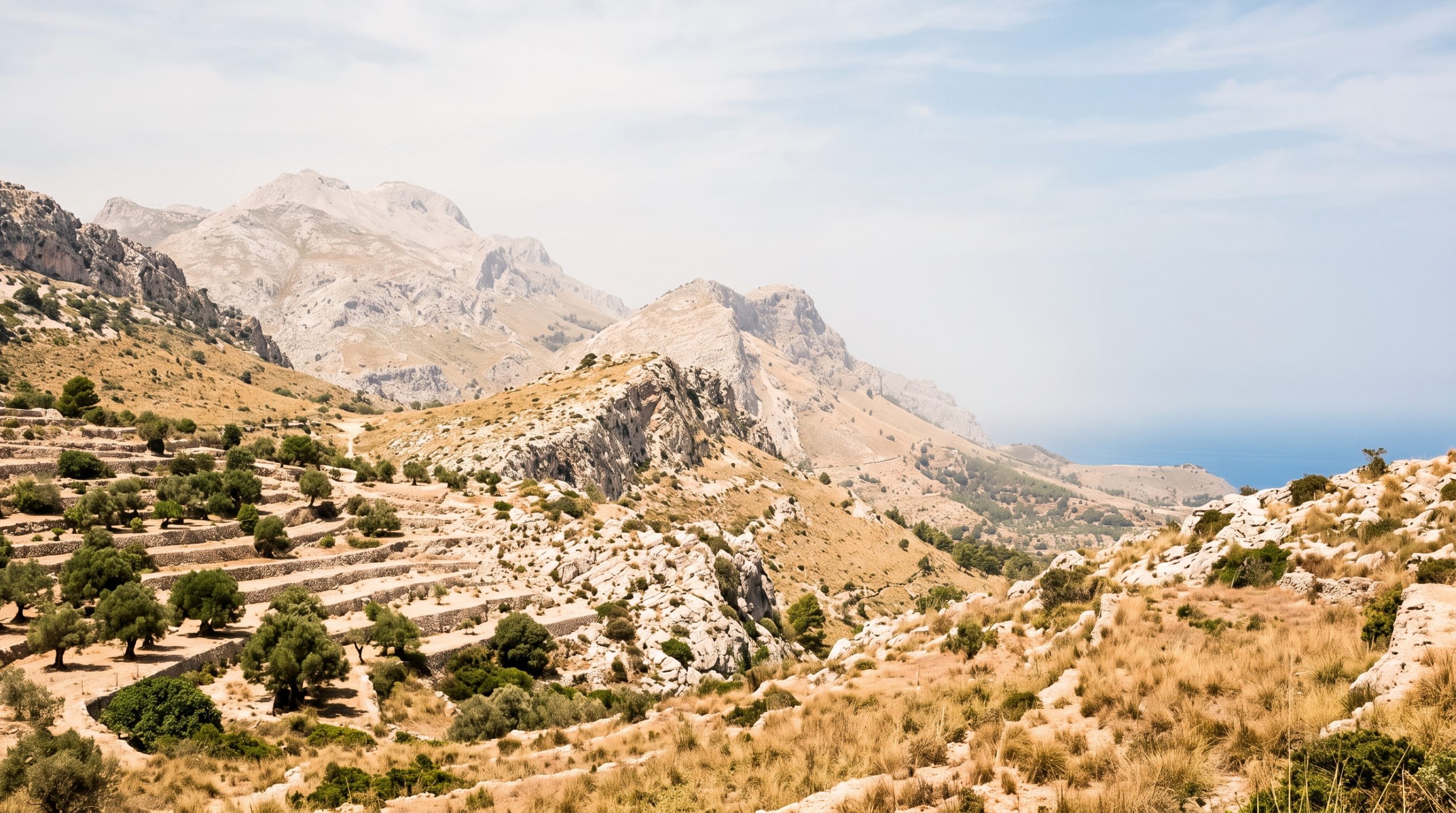
Mid-July on the ridge above Sóller, the sun clears the rock at 6.35am and for two hours the light comes in sideways, gold across grey limestone, the valley floor still cool enough for a jacket. By ten it is finished. At midday the sun stands almost 72 degrees above the horizon, which is close to straight down, and the whole island turns to glare, hard little shadows and a white haze out over the water.
Then it comes back. Sunset in mid-July is 9.17pm, and there is workable light until nearly 9.50pm. That is the real shape of a Mallorcan summer wedding day: two generous ends, and a middle that belongs to shade, lunch and a swim.
This is the timing piece we send couples holding a July or August date, and the figures we work from when the date is still open. Everything below is a number we plan against, not a mood.
The summer fortnight that gives us the most room
The second half of September. The sea still holds August warmth, close to its 26 °C peak, the midday sun has dropped to 53 degrees so the middle of the day becomes usable again, sunset falls near 8pm, and July’s crowd has gone home. Early May is the alternative, with longer light and colder water.
Month by month, with the light times we plan against
Times below are Palma, for the 15th of each month, in local time. The clocks move on the last Sunday of March and the last Sunday of October, so the mid-October sunset of 7.11pm becomes a sunset just after 6pm in the space of one weekend. Temperature and rainfall are the long-run averages for the Palma airport station.
| Month | Heat and sea | Sunrise to sunset | Other people | Our verdict |
|---|---|---|---|---|
| January | Coolest month, mean 10.3 °C; sea 14.5 °C | 08:09 to 17:50 | Almost nobody | Blossom begins, roads empty |
| February | Sea at its floor, 13.7 °C | 07:43 to 18:26 | Low | The blossom fortnight |
| March | Green hills, changeable | 07:02 to 18:56 | Low | Mountains yes, swimming no |
| April | Warming, wildflowers out | 07:13 to 20:27 | Building | Strong high up and inland |
| May | Comfortable all day | 06:36 to 20:57 | Rising fast | Our second choice |
| June | Hot from mid-morning | 06:22 to 21:19 | Heavy | Longest light of the year |
| July | Driest month, 7 mm of rain | 06:35 to 21:17 | The annual peak | Both ends, nothing between |
| August | Warmest, mean 24.6 °C; sea 26.2 °C | 07:02 to 20:46 | The annual peak | Warmest water, split timeline |
| September | Still warm; 51 mm of rain | 07:31 to 19:59 | Drops after week one | Our first choice, second half |
| October | Wettest month, 67 mm | 08:00 to 19:11 | Thinning weekly | Take the first ten days |
| November | Mild days, 51 mm of rain | 07:34 to 17:35 | Very low | The Serra and the interior |
| December | Mean 11.4 °C, sea cooling | 08:03 to 17:27 | None to speak of | Short day, every hour usable |
Why July and August run at both ends
Summer here is not short of light. Mid-July gives you 14 hours 42 minutes between sunrise and sunset, and the longest day of the year runs 14 hours 58 minutes. The problem is never quantity. It is angle.
Between about ten in the morning and six in the evening in July, the sun is high enough that it lights the top of everything and nothing else. Eye sockets go dark. Limestone and whitewash blow out while the shaded side of a face falls away. The sea loses its layers and reads as one flat sheet of silver. That is also the hour when Sa Calobra’s car park is full and the tour boats have landed at the cove.
So we build the day at the two ends and mean it. First light in mid-July arrives around 6.03am, half an hour before the sun itself, and that early half hour on a ridge or a headland is some of the best light of the year: enough to see by, no direct sun yet, the sky doing the work. From sunrise you have until roughly 8.30am before the angle turns hard. That is a real working block, and it is usually the coldest, emptiest, most private part of a Mallorcan summer.
The evening block is longer and easier on people. From about 7.30pm the sun is low over the water on the west coast, the heat has come out of the rock, and you have two hours of it, right through sunset at 9.17pm and on to about 9.48pm before the sky goes. Vows land best about an hour and a quarter before sunset. Guests can eat afterwards, in the dark, when it is finally cool.
The middle is not wasted, it is just used differently. Getting ready somewhere with thick stone walls. Lunch. A boat, where the breeze does what no amount of shade can. Nobody stands in a wool suit at two in the afternoon waiting for a camera, because nothing is scheduled there.
August shortens both ends slightly. By the 15th, sunrise has slipped to 7.02am and sunset to 8.46pm, thirty-one minutes earlier than a month before, and it keeps sliding by about a minute a day, faster once September starts. That matters when dinner service is fixed, so we check the actual date rather than the month.
Three short windows worth shaping a date around
Almond blossom is the narrowest and the most talked about. Millions of trees across the interior and the Tramuntana foothills come out from the last days of January and hold through February, with the reliable stretch being late January to mid-February. A cold spell pushes it back by a week or two, and a mild winter pulls it forward, so we treat the exact peak as something to react to rather than book against. What does not move is the character of it: bare pink and white orchards, low sun all day, and nobody else in the lane.
The warm sea is the second. Water peaks around 26.2 °C in August and February bottoms out at 13.7 °C, and the important thing is how slowly it gives that heat back. September water still feels like summer long after the air has cooled off. If getting into the sea in your dress matters to you, that is the argument for September over May, where the air can be lovely and the water is not.
The third is the fortnight after the first week of September. The Balearic government’s own human-pressure figures have topped two million people present in the islands on a single day at the end of July. Then the school holidays end. The same coves that were unworkable at 11am in July are quiet, and the light has already softened, with sunset at 7.59pm mid-month instead of 9.17pm.
When high summer asks too much of the day
If your picture is a coastal ceremony with warm water and space around you, the first three weeks of August are the hardest version of that. Not because of the heat, which we plan around, but because the small south-east coves are shoulder to shoulder from mid-morning. Move it four to six weeks later and you get the same sea temperature with a fraction of the company.
If you want a long evening, December will not give you one. The whole day is 9 hours 24 minutes and the sun sets at 5.27pm. What December does give is a sun that barely clears 27 degrees at noon, which means the entire afternoon behaves like golden hour. We put winter ceremonies at about half past three and use every minute of it.
If it is the blossom you came for, March is too late. And if the date has to be October, take the first ten days: October is the wettest month on the island with 67 mm on average, and the back half is where that lands hardest.
None of this means a hard date in a hard month is a problem. Tell us the date you already hold and we will tell you exactly what that week does with the light, or which fortnight would serve the day you are describing better. Our destination guides cover the same ground for other coastlines if Mallorca is still one of two or three options.
Roads and boats that keep their own summer hours
Access changes more sharply here by season than weather does, and the two most photographed places on the island are the two most regulated.
Cap de Formentor is the clearest case. The Consell de Mallorca restricts private cars on the Ma-2210 lighthouse road through the middle of the day across the high season, in recent years from around the middle of May to the middle of October, roughly 10am to 10pm. The first stretch, from Port de Pollença to Formentor beach, depends on space in a car park of about 300 vehicles, managed by barriers and live signage. The stretch from the beach out to the lighthouse is closed to private cars in those hours. Buses, taxis, hire cars with a driver, cyclists and walkers all still get through, and the road is open to everyone outside the window. In practice we plan Formentor for first light, or with a driver. The dates and hours shift a little each year, so we confirm the current order before building a timeline around the cape.
Sa Calobra is the other one. The Ma-2141 down from the Coll dels Reis was cut in the 1930s, all hairpins and narrow sections, including the loop that ties itself in a knot below the pass. In July and August it fills from both directions at once, cars from above and boats up from Port de Sóller, and the cove is reached on foot through tunnels bored into the rock. Before nine in the morning it is a different place. We would rather you saw that than took it on trust, so spend time in the films and galleries we have published and watch how the same locations read at the two ends of the day.
Winter access runs the other way. The Serra de Tramuntana is a UNESCO World Heritage landscape and its passes and lanes stay open, but a lot of the coastal resorts, beach restaurants and their car parks close from November until spring. That is mostly good news for us, and the reason November and December days get built around villages, courtyards, olive terraces and the mountain interior rather than a beach club.
How we split a hot Mallorca day before you arrive
Rain is not the summer variable. July averages 7 mm across the entire month. Wind, heat and access are the variables, and all three are plannable.
Every timeline names its own alternatives, chosen by wind direction rather than preference. North wind and the north coast is out, so the day moves to the sheltered south-east or into a Tramuntana valley. Southerly and the ceremony goes to the lee side of the range. The ceremony hour itself is written to be movable by an hour in either direction without collapsing the rest of the day, and the alternatives are picked and checked before anyone flies, not at breakfast on the morning.
The season also decides how many of us should be working at once. A July morning gives you about two and a half hours of good light and then closes. When a dedicated photographer and a dedicated filmmaker are both on the ground in that block, the same 150 minutes produces both the photographs and the film, instead of one of them getting the light and the other getting the aftermath. In late September, when the middle of the day is workable again, there is more room to spread out. Our coverage options and what each one includes set out the difference plainly.
Timings, permits and light are the easy part once the date exists. If you are earlier than that, our guide to planning an elopement covers the order things happen in. When you are ready to test a date against a specific month, send us a message and we will come back with what that week actually does.
Common questions
Is August too hot for a Mallorca elopement?
No, but it is the month that most needs a two-ended timeline. August is the warmest month, averaging 24.6 °C over the whole day and night in Palma, with inland afternoons hotter than the coast. We work the block from sunrise to about half past eight and the block from half past seven in the evening, and keep the middle for shade and water.
What time does the sun set in Mallorca in July?
Around 9.17pm in mid-July, with usable light until roughly 9.48pm. The latest sunsets of the year fall in the last days of June, and the earliest sunrise is around the 14th of June. From mid-July the evening pulls back by about a minute a day, so an early August date is meaningfully different from a late August one.
Can we still get to Cap de Formentor for a sunrise ceremony in summer?
Yes. The private-car restriction on the lighthouse road covers the middle of the day, roughly 10am to 10pm across the high season, so a first-light plan sits comfortably outside it. Buses, taxis and hire cars with a driver are permitted inside the window too. We confirm the current dates and hours for your specific date before the timeline is finalised.
How often does weather actually move a Mallorca elopement?
Rarely in summer, and when it does, we move hours rather than days. July averages 7 mm of rain for the month, against 67 mm in October, the wettest month. What moves a summer day is usually wind direction, which is why every plan carries named alternatives on the sheltered side of the island.
Is the sea warm enough to swim in after the ceremony?
From high summer into autumn, comfortably. Water peaks at about 26.2 °C in August and holds much of that through September. February is the floor at 13.7 °C. May air can be beautiful while the water is still cool, so if getting in matters, September beats May.
When is the almond blossom, and can we plan a date around it?
The dependable stretch is the last days of January through to mid-February, across the interior and the lower Tramuntana. The peak shifts a week or two either way with the winter, so we plan the location for blossom and keep two areas in play rather than promising one orchard on one day.
We already have a fixed date in early August. What changes?
The structure, not the ambition. Ceremony moves to the evening block roughly 75 minutes before sunset, portraits split across dawn and dusk, and the getting-ready and travel go in the hot middle. Locations get chosen for shade and for how early they empty out. It is a day we plan often, and it works.
Choose the fortnight first, then place the two good light blocks
Most couples arrive with a month and leave with a fortnight and two working blocks inside it. We keep that conversation in writing, so you can compare the two light blocks at your own pace, with a first reply and our brochure inside 24 hours. Our current Mallorca calendar runs through 2027, 2028 and 2029, so there is usually more than one good window still open in the year you have in mind.
Send us the date, or the two months you are choosing between, and we will tell you what the sun does on those days. Check your date.