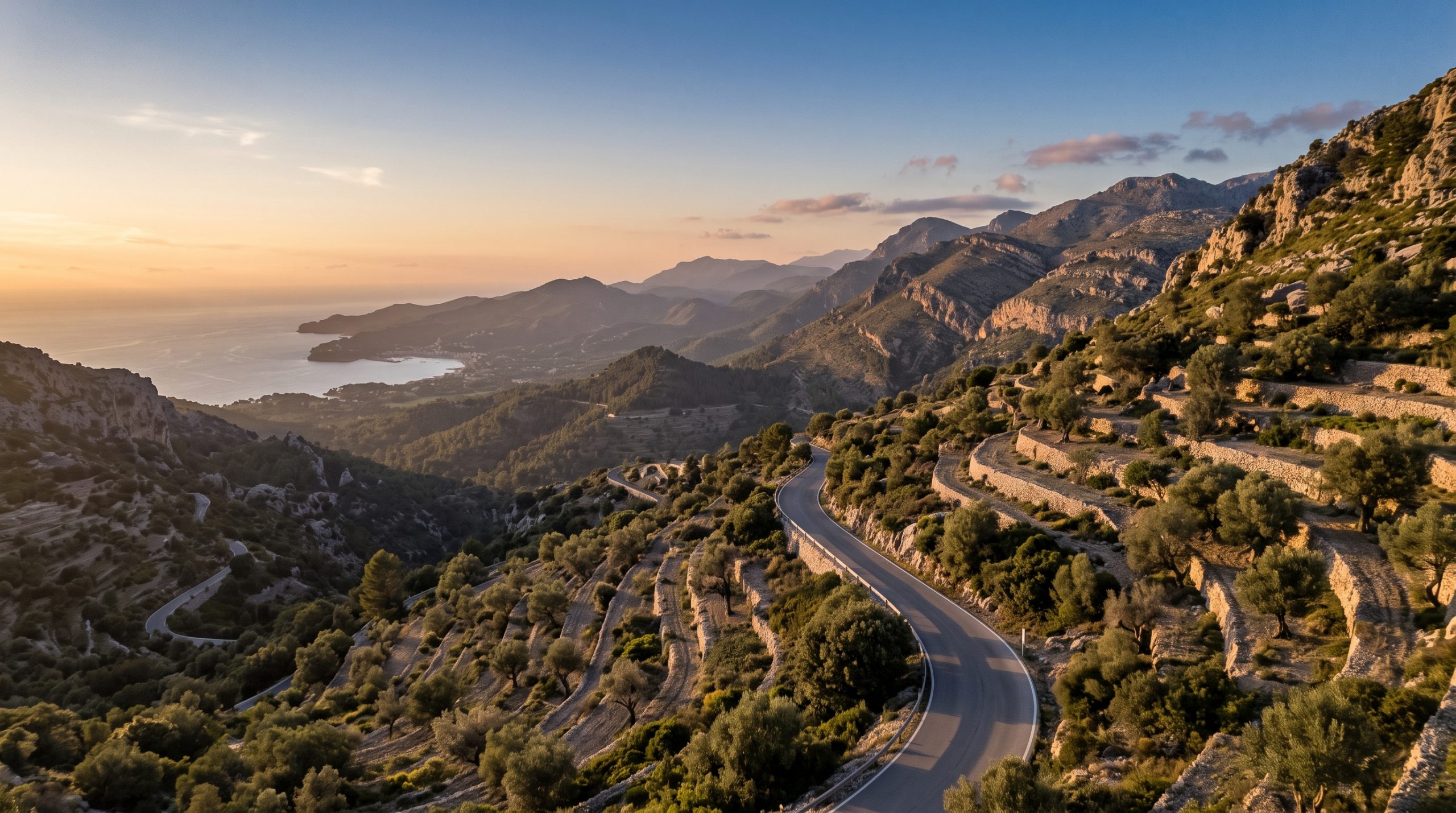
Through the high season, private cars are kept off the Ma-2210 to Cap de Formentor every day from 10:00 until 22:00. Barriers, real-time signage, and a beach car park capped at 300 vehicles. Which means the most photographed headland in Mallorca belongs, for a few hours, to whoever got out of bed. In mid-September first light on the cape comes a little after 07:00 and the sun clears the water at 07:28. By the time the barriers drop you have had three hours out there and you are already driving away with breakfast on your mind.
The other thing nobody mentions is the clock. Spain keeps central European time while Mallorca sits far to the west of it, so solar noon in June lands close to 13:50. The flat, colourless part of the day runs from late morning until past four in the afternoon, and the sun does not set until 21:21. Fifteen hours of daylight, and only about four of them worth pointing a camera at.
So planning a day here is mostly a matter of deciding what to leave out. We are eight people, four photographers and four filmmakers, and photography, film and planning are one service rather than three suppliers who meet in a car park at dawn. We design the day around the island’s light and its access rules, and then we are the ones who shoot it.
What we do on this island, and where coverage starts
We photograph, film and plan elopements across Mallorca, from the Tramuntana cliffs to the northern capes and the quiet south. The Adventure covers one full day with a dedicated photographer or a dedicated filmmaker, from $4,900. The Expedition puts both on the same day, working together, from $7,900. Team travel to the island is included in either.
Fifteen hours of June daylight, and where we put them
Mallorca is compact enough that the whole island is within about four minutes of itself. Sunrise at Formentor is four minutes ahead of sunrise in Palma. What changes everything is the month, because between late June and mid-October the usable day loses nearly four hours off the front and the back.
| Period | First light | Sunrise | Sunset | Last light |
|---|---|---|---|---|
| Late June | 05:50 | 06:23 | 21:21 | 21:53 |
| Mid-September | 07:04 | 07:31 | 20:01 | 20:28 |
| Mid-October | 07:27 | 07:54 | 19:20 | 19:47 |
Mid-September to mid-October is the shape we recommend most often, and the reason is arithmetic rather than taste. A day that runs from 07:04 to 20:28 is thirteen hours long and a couple can be present for all of it. A June day that runs from 05:50 to 21:53 is sixteen hours, and nobody looks like themselves at the end of it. In June we either build two separate blocks with a genuine three-hour gap in the middle, or we pick one end of the day and give it everything.
Here is a real late-September shape, north to west:
- 06:20 Out of the door in Port de Pollença. Coffee in the car, dress and suit in a bag, nothing to carry uphill.
- 07:04 First light on the cape road. This is the blue half-hour, and on film it is the best thing the north of the island does.
- 07:28 The sun comes up out of the sea off the Bay of Pollença. We are working the lighthouse side by now, low and into the light.
- 08:15 Vows on the cape, with the rock at your backs breaking the wind rather than the widest possible view behind you. That trade is deliberate and it is the difference between audio you will want to listen to and audio you will not.
- 09:20 Back down the Ma-2210 while it is still open to us, unhurried, with the road to ourselves.
- 10:00 Breakfast in Pollença old town. You change out of the dress. We back up two cards and check the afternoon forecast for the west coast.
- 13:50 Solar noon. We deliberately do nothing. This is the hour couples try to fill and it is the hour that flattens every frame.
- 16:00 Dry-stone terraces above the Deià coast. The sun is still high but it has started to rake across the walls, and texture is what film wants here.
- 18:40 Down to the water on foot. Short walk, uneven ground, proper shoes in a bag.
- 19:35 The half-hour that sells the island to everyone who has ever seen a picture of it.
- 20:01 Sunset, from a coast that faces the right way for it in summer.
- 20:28 Last usable light. Then dinner, and we are gone.
Two details about that west coast are worth knowing before you pick a date. In June the sun sets at an azimuth of roughly 301 degrees, which from the north-west facing coves means straight into open water. In December it goes down nearer 239 degrees, behind the ridge, and those same coves lose their light well before the published sunset. Winter days belong on the south and east side of the island, and that is a planning decision rather than a compromise.
Weather moves this around and we expect it to. When the Tramuntana wind gets up, the north-west coves go loud and white and the light turns hard, so the alternative sits on the sheltered south or east side of the island, an hour and a bit away with the same sun doing something completely different. That second plan exists before you arrive, not on the morning. Our destination guides go deeper on the regional differences if you are still choosing between coasts.
What the island looks like before ten in the morning
The honest worry about Mallorca is that it is a busy island with a busy airport, and that a cove which looks empty in a photograph has forty people behind the photographer. Sometimes that is exactly true. Cala Deià at noon in August is a car park queue and a lunch rush.
The answer is not a secret location. It is the clock and the calendar. Almost nothing on this island is crowded before 09:00, the Formentor restriction hands you the cape while everyone else is still at the buffet, and the Serra de Tramuntana covers 30,745 hectares of inscribed UNESCO cultural landscape with a further 78,617 hectares of buffer zone around it. There is a great deal of it, and most of it has no car park at all. Move the same day from August to the first week of October and the problem largely stops existing.
Two cameras on a path with room for one
This is where one team stops being a marketing line and starts being a practical matter. The Tramuntana was built for walking single file. Cobbled mule paths, dry-stone terraces a metre and a half wide, cliff steps where one person stands and the next waits. Put a photographer and a videographer who have never worked together on a ledge like that and one of two things happens. They take turns, which halves your day. Or they are in each other’s frames all morning, and you spend a week choosing between a gallery with a tripod in it and a film with a photographer’s elbow in it.
Our photographers and filmmakers have shot the same sequences together for years, so on a narrow ledge they already know the order. Stills first while the film crew sets audio, then a single walk-through that gives the film movement and the photographer the frame at the same time. On the cape, where the whole window is bounded by a barrier that drops at 10:00 and there is no second attempt after coffee, that shared shorthand is the whole reason the morning finishes.
Conditions here also change what each medium can do. Wind is the film’s main problem, not the photographer’s, so the Expedition brings professional audio and we choose the ceremony spot for shelter as much as for the backdrop. Aerials are the opposite: the drone gives the Tramuntana its scale, the 9.5 kilometres of the Sa Calobra road looping back over itself through the 270-degree Nus de sa Corbata and topping out at Coll dels Reis at 682 metres. Those flights depend on a legal, sensible launch point and current Spanish registration, so we confirm what is possible before the film is planned around it. Where a site does not allow it, the wide language comes from the road, the terraces and the water instead. You can see how the island reads in our published galleries and films, which is a better answer than any description of a colour palette.
There is also the plain arithmetic of eight people. There is always a second camera on the ground and a colleague in reserve, which matters more on an island your team has to fly to than it does anywhere within driving distance.
Tell Us Your Story and we will come back with the shape of a Mallorca day built around your month, not a template.
What the coverage includes, and what Mallorca charges separately
Coverage is deliberately simple. One full day, either one dedicated photographer or one dedicated filmmaker on The Adventure, or both working together on The Expedition. Where a couple wants more than one day, more than one region, or a boat day and a mountain day either side of the ceremony, that is The Odyssey: two to seven days of photography and film, quoted as a custom proposal. There is no half-day. The pricing page carries the current figures for all of it.
Included, in Mallorca and everywhere else we work
- Destination and location design, and a custom timeline built around real light and real driving time on this island.
- Permit research and logistics guidance, including which municipality governs the spot you have in mind.
- Weather alternatives and backup planning, worked out in advance for wind direction as well as rain.
- Drone footage where it is legal, safe and appropriate.
- Professional audio for vows and meaningful moments on The Expedition, where conditions allow.
- Team travel worldwide: flights, accommodation and ordinary travel for the assigned team, with no European or long-haul distinction.
- Highlights in 5 days. The full gallery or film in 3 weeks.
The fee does not change with your guest count. Ten people instead of two changes access, permits, transport and the timeline, not the price.
Paid locally, in euros
Mallorca has no single island-wide permission for professional work. Each municipality runs its own process, so Deià, Sóller, Pollença, Santanyí and Palma are five separate answers, and anything on the shoreline itself also sits under the state coastal authority, the Demarcación de Costas. We do the research and tell you what is needed. The fees themselves come out of your budget, along with:
- Accommodation, plus the Balearic sustainable tourism tax your hotel or finca adds per person per night, which runs to a few euros a night and scales with category and season.
- A celebrant for the ceremony, and any estate or finca site fee.
- A hire car or a driver, flowers, rings, dinner.
- Unusual transport, if you want it: a boat along the Tramuntana coast, a 4×4, a mountain guide.
How a Mallorca cost enquiry moves from form to wedding morning
- Send the inquiry form with your month, your rough idea of a location, and anything non-negotiable.
- We reply within 24 hours with an initial brochure.
- We write a tailored proposal: coverage, team, and a first read on what your locations will require.
- Contract signed and a 30% retainer paid. The rest of the payment plan is set out in the proposal.
- Planning begins. Timeline, permits, alternatives, the drive times nobody thinks about.
- Before you travel, the final timeline, the permissions and the weather alternative are confirmed in writing.
We are currently taking Mallorca elopement bookings for 2027 through 2029.
Who Mallorca fits, and which month fits you
This island rewards early risers more than almost anywhere else we work, because the access rules and the crowd patterns both reward them. A 06:20 departure is not a hardship if you like mornings. If you genuinely do not, say so, and we will build the day from the other end: a late-afternoon start on the west coast, everything after 16:00 and dinner well after 21:30. That day exists and it is a good one.
It also helps to be comfortable on uneven ground. The best places here are five to twenty minutes on foot from the nearest parking, on cobbles, terraces and pebble slopes. Nothing technical, but not heels either. If walking is a problem, tell us at the inquiry stage and we will design around it, because there are drivable viewpoints and coastal estates on this island that do not ask anything of your knees.
And then the month. July and August give you the longest days, the hottest middles and the fullest coves. Late September and October give you a thirteen-hour day, warm water and a calmer island. February gives you almond blossom, empty roads and an 18:20 sunset, which suits couples who want the mountains rather than the sea. None of these are wrong. If you tell us what you actually want the day to feel like, we will tell you honestly which month and which coast delivers it, and if that means moving your date by three weeks we will say so. Our guide to planning an elopement covers the decisions that come before the destination.
Common questions
Can we legally get married in Mallorca as Americans?
Not as visitors. In Spain a civil marriage application goes to the Civil Registry or court where at least one of you actually resides, and approval can take up to 45 days. So couples handle the legal paperwork at home and hold the ceremony in Mallorca with a celebrant, which is what the overwhelming majority of elopements here are. A US marriage is what your documents will say, and the day in Mallorca is the one you will remember.
How much should we budget for a Mallorca elopement in total?
Coverage is one published figure, with our travel to the island already inside it. On top of that, plan for accommodation and the nightly tourism tax, permit fees for the municipality you choose, a celebrant, a car, flowers and dinner. Those are the euro costs, and they vary far more with your taste in hotels than with anything else.
Do we need a permit to hold the ceremony on a Mallorca beach?
Usually some form of permission, yes, and it depends entirely on which town hall governs that stretch of sand. Shoreline sites also fall under the Demarcación de Costas. We research it, tell you what applies and when to apply, and build the timeline around the answer. The fee is yours to pay.
Which month gives the best light without the August crowds?
Mid-September to mid-October. Sunrise moves from 07:31 to 07:54 and sunset from 20:01 to 19:20, so the day is long enough to be generous and short enough to be humane, the sea is still warm, and the coves empty out through October.
Can you fly a drone over the Serra de Tramuntana?
In many places, yes. Aerials in Spain run on operator and aircraft registration plus a launch site that permits the flight, so we confirm both for your specific locations before the film depends on them. Where a site does not allow it, the wide shots come from the roads and the ridgelines instead.
How early will you actually ask us to get up?
For a Formentor morning in September, out of the door around 06:20. For a west coast day in October, a much gentler start and a late finish. We will tell you the exact hour in the proposal rather than after you have booked.
Does the price change if we bring our parents and a few friends?
No. The fee is the same for two people or twelve. Guests change access, permits, transport and the timeline, so we need to know the number early, but they do not change what you pay us.
How soon do we see the photos and the film?
Highlights land 5 days after the day. The full gallery or the finished film arrives within 3 weeks.
Standing on the cape at seven in the morning
The best version of this island is a quiet one, and it is available almost every day of the year to couples willing to plan for a specific hour instead of a general mood. That planning is our job, and The planning stays in writing from the first message onward: you send the form, we reply with a brochure inside 24 hours, then a proposal you can read twice before you decide anything. Nothing to prepare for, and nothing to sit through.
Send us your month and the coast you keep coming back to, and we will tell you what the day can be. Check Your Date.