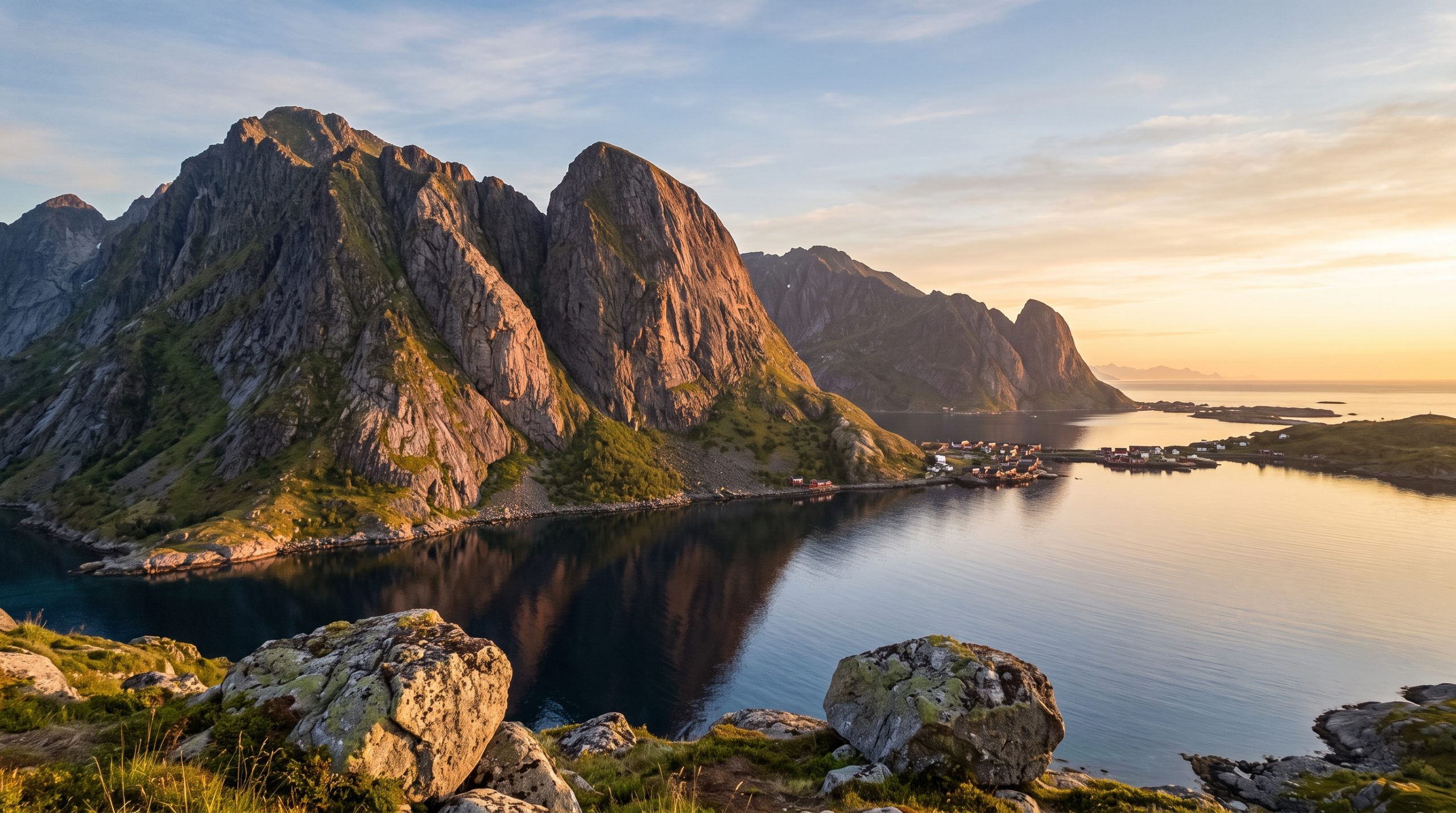
At Reine on 25 September the sun comes up at 06:59 and goes down at 18:58. The stretch we actually plan around is 17:44 to 18:58: an hour and fourteen minutes for the sun to travel the last six degrees down into the sea. Denver in the same week gets thirty-five minutes. Almost everything good about photographing an elopement in Lofoten comes out of that one difference.
The rest is geography. The E10 runs the length of the archipelago, and a bit over two hours of driving takes you from Å at the southern tip to Svolvær in the north-east, past every beach and fishing village Lofoten is known for. Those places do not share a weather system. Skagsanden and Ramberg face north and take a northerly straight on. Reine, Hamnøy and Sakrisøy sit inside Reinefjorden with the Lofoten Wall along one side and stay comparatively calm when the outer coast is white. Haukland and Uttakleiv are a road tunnel apart and point in different directions. Knowing which of those to use on a given morning is most of the work.
Lofoten is not a secret and we would rather say so plainly. Visit Lofoten’s own advice on the Reinebringen stairs is to expect crowds walking up and down, especially through July when Norway takes its holidays, and the verge by the Hamnøy bridge at midnight-sun hour is a row of tripods. None of that spoils anything. It does mean the good version of your day usually starts earlier than the version you saw on a screen, and often on a different island.
Lofoten elopement coverage, in one paragraph
We are eight: four photographers and four filmmakers, covering elopements the length of Lofoten, from Reine and Hamnøy to the Vestvågøy beaches and Henningsvær. Photography, film and planning come from one team rather than from vendors introduced to each other on the morning. A full day of coverage starts at $4,900, and our travel to Norway is included.
A late-September day on Moskenesøya, hour by hour
If you let us pick the week, this is the one we pick. On 25 September Reine gets twelve hours of sun, roughly two and a half of them in the low band under six degrees where the light is worth walking for, and skies dark enough by 21:00 for the aurora. Here is the shape of that day, built around Reine, Hamnøy and Sakrisøy so nothing needs a long drive.
- 05:45 Out of the rorbu with head torches and a thermos. Nobody else is moving.
- 06:04 Civil twilight. Blue on the water at Sakrisøy, the yellow and ochre boathouses starting to separate from the black hillside behind them.
- 06:59 Sunrise. Olstind takes the light before anything at sea level does, and the fjord stays in shadow for another twenty minutes, which is exactly the contrast we want.
- 08:30 Back indoors. Dry socks, breakfast, and the filmmaker working quietly through rings, letters, the sound of the stove.
- 10:15 The walk in. Either the Sherpa stairs on Reinebringen, close to two thousand stone steps up to the ridge above Reine, or the short crossing of the pass to Kvalvika if you would rather have sand than altitude.
- 12:30 The flat middle. The sun tops out near 21 degrees and the landscape goes honest rather than pretty, so we use it for harbours, drying racks, interiors, and the drive east to Henningsvær if that is where you are staying.
- 15:45 Dress, jacket over the top, and a short drive to whichever spot the wind has chosen for us.
- 16:30 Vows, with an hour of decent light still in hand as insurance.
- 17:44 The sun drops under six degrees and the whole coast turns copper. This is the seventy-four minutes the day was built for.
- 18:58 Sunset, and we keep working. The colour above the Lofoten Wall is better after the sun has gone than before.
- 19:53 Civil twilight ends. Last frames, then food.
- 21:00 If the sky is clear, we go back out. By 21:02 on that date the sun is far enough below the horizon for the aurora to show over the water at a north-facing beach like Uttakleiv.
Which month gives you which light
The same day in a different month is a different day. These are the five shapes worth choosing between, with the sun’s behaviour at Reine unless stated.
| Window | What the sun does | How we build the day |
|---|---|---|
| 27 May to 16 July | Never sets. Its lowest point at Reine is about 1.4 degrees above the sea, around 01:09 on the solstice | Ceremony near midnight, walk in during the evening, sleep at 04:00. No aurora at all in this window |
| Mid-August to mid-September | Sunset back before 21:00 and falling fast, still green underfoot | Two useful light windows a day, and darkness returning from late August |
| Mid-September to late October | Twelve hours of sun shrinking to ten, with long shallow light at both ends | Sunrise and sunset both reachable in one day, plus aurora nights |
| 10 December to 2 January | Polar night at Reine, and 7 December to 5 January at Svolvær. The sun stays below the horizon | Around five hours of blue twilight, roughly 09:26 to 14:46 on the solstice, worked at sea level |
| February to mid-March | Snow, and a sun that only reaches about 9 degrees in mid-February | The soft band from six degrees to the sea lasts 1 hour 44 minutes, so a whole afternoon shoots like one long sunset |
Tell us the two weeks you can travel and we will tell you which of those shapes you are buying, and what we would move to make the most of it. If your dates are still open, Check Your Date and we will come back with the light times for your exact days.
Wind, cloud and the plan that already moved
This is the thing couples write to us about more than anything else. You fly to Bodø, take the short hop across to Svolvær or Leknes, and you have one date on the calendar in an archipelago that makes its own weather every few hours.
The honest answer is that the weather here changes faster than the plan needs to. A front that closes Skagsanden can leave Reinefjorden almost still, and the two are half an hour apart. So we do not build one day, we build a day with three anchors: an exposed option, a sheltered option, and an indoor option in a rorbu with the door open to the water. The decision gets made at 06:00 with the forecast and the wind direction in front of us, and it is usually a decision about which coast rather than whether to go out at all.
Some days are grey from first light to last. We are not going to pretend otherwise. On those days the granite is wet and dark, the sea is loud, the rain sits on wool and hair, and the pictures are strong in a completely different register. Lofoten in flat light is still Lofoten. What we will not do is send you up a ridge in cloud so thick the ridge is invisible, when there is a beach twenty minutes away with a horizon on it.
Sound, aerials and the case for two cameras on one ridge
Here is the part of this page that matters most, because it is the part that changes what you receive. Photography and film are one service for us, and on a coast like this the two jobs pull in different directions at exactly the same moment.
Take those seventy-four minutes of low light. Photography wants to work close and into the sun, hunting flare through hair and the rim on a shoulder. Film wants the opposite: a wide, slow frame with you small under Olstind and the light raking across the water behind. One person cannot hold both, and if they try, one of the two ends up as an afterthought made in the gaps. With a dedicated photographer and a dedicated filmmaker on the same ridge, the wide frame runs continuously while the close frames get made inside it. You can see how that resolves in the finished galleries and films in our published stories.
Then there is sound, which in Lofoten is mostly wind. A camera-top mic on an open beach gives you a roar and a vow you cannot hear. The Expedition includes professional audio for vows and the moments that matter where conditions allow, which in practice means our filmmaker chooses where you stand: eight metres into the lee of a boulder, or with your backs to the northerly so the wind goes past the mics rather than into them. That is a judgement made on the spot by someone whose only job that hour is the film.
Aerials work the same way, as a planning problem rather than a gadget. Lofotodden National Park, established by royal decree in June 2018 across parts of Moskenes and Flakstad, prohibits drone use inside its boundary under its own protection regulation, with permission possible on application to the park authority. Kvalvika, Ryten, Bunes, Horseid and Hermannsdalstinden all sit inside that boundary. Reine, Hamnøy, Skagsanden, Haukland and Uttakleiv do not. So we decide early whether the film needs a park application or whether the aerials belong somewhere outside it, and either way the answer is settled long before anyone stands on a beach with a controller in their hands.
Eight of us also means the reassurance nobody bothers to advertise: a second camera on the ground, and a colleague in reserve at home who knows your plan.
Included in every Lofoten day, and what sits outside it
Every experience we run in Lofoten, from a single day to an Odyssey across several islands, includes the same foundation.
- Destination and location design, matched to your dates rather than to a list of famous pull-offs.
- A custom timeline built from the real light times and real travel time on the E10, including the walk-in on foot.
- Permit research and logistics guidance, including which of your locations sit inside the national park.
- Weather alternatives and backup planning, written down before you arrive rather than improvised.
- Drone footage where it is legal, safe and appropriate.
- Professional audio for vows and meaningful moments where conditions allow, on the Expedition.
- Highlights delivered in 5 days, and the full gallery or film in 3 weeks.
Guest numbers do not change what you pay. They change access, permits, transport and the timeline, which is a planning conversation rather than a price one. Two of you on the Sherpa stairs and fourteen of you at a rorbu in Sørvågen are different days to design, and both are days we design.
Where coverage starts
The Adventure is one full day with either one dedicated photographer or one dedicated filmmaker, at the starting figure named above. The Expedition, from $7,900, puts a dedicated photographer and a dedicated filmmaker on the day together, working as a pair. The Odyssey runs from two to seven days, photography and film, across one destination or several, and comes to you as a custom proposal. All of it is laid out on our pricing page.
Team travel is included, here and everywhere else we work. Our flights to Bodø, the hop across to Svolvær or Leknes, our hire car, our fuel and where we sleep are ours to arrange and ours to pay for. There is no long-haul surcharge and no European-versus-Arctic distinction.
What Lofoten adds on your side is mostly small and local, in kroner. Most of the popular trailheads and beaches now charge for parking, currently around 100 NOK for a day at the busiest ones, and we build those stops into the timeline. Beyond that: your rorbu or hotel, your hire car, your celebrant, any government or landowner permit fee that applies to your locations, and unusual transport if you want it, such as a private boat across Reinefjorden to Bunes or a charter out toward the outer islands. The research and the paperwork guidance are ours. The fees themselves are yours.
From your first message to a planned day
- You send the inquiry form with your dates, or the two or three weeks you are choosing between.
- We reply within 24 hours with an initial brochure and our first read on those dates.
- We build a tailored proposal: the region, the shape of the day, the coverage that fits it.
- You sign the contract and pay a 30% retainer. The remaining payments are set out in the proposal.
- Planning starts properly: locations, light times for your exact days, permit research, weather alternatives.
- We travel in ahead of you, and on the day the people who planned it are the people holding the cameras.
The couples Lofoten rewards
This place gives its best to people who will be outside at 06:00 in September or awake at 01:00 in June, who are steady on uneven ground, and who can hear at breakfast that we are driving the other way today and treat that as part of the adventure rather than a problem. If close to two thousand steps sounds like a good morning, Reinebringen is there for you.
If it does not, that is genuinely fine, and it changes the design rather than the ambition. There is a version of a Lofoten day built entirely on harbours, bridges, boathouses and beaches you can reach in flat shoes, and Sakrisøy at first light asks nothing of your knees. Visit Lofoten’s own guidance is that the Reinebringen climb is not recommended during the winter season, so a December or January day is built at sea level anyway, inside those five hours of blue twilight, and it is a quieter and stranger day than the summer one.
Season is the choice that matters most. Green mountains and a midnight ceremony point at June and early July. Snow on the peaks with the sun grazing the horizon all afternoon points at February. Aurora nights and both ends of the day in one go point at late September and October. If you are still weighing those up, our destination guides and the planning fundamentals are the fastest way to work out what you actually want, and then we would rather hear it in your own words than guess.
Common questions
Do we have to live in Norway or arrive early to get married in Lofoten?
You do not need Norwegian residency or citizenship, but you do need legal stay, such as a valid visa-free stay. Before the ceremony you need the certificate confirming you meet the conditions for marriage, the prøvingsattest, issued by the Norwegian Tax Administration and valid for four months. You hand it to whoever officiates. There is a processing wait, so it goes on the planning timeline early.
What paperwork do American couples usually get caught out by?
Two things. The Tax Administration asks foreign citizens for an original certificate of no impediment from their own authorities, which takes time to obtain at home. And if either of you has been married before, there is a separate declaration of division to complete. Neither is difficult, both are slow, and both sit inside the permit research and guidance we do with you.
Can you fly a drone over Kvalvika or Bunes for our film?
Not without permission. The protection regulation for Lofotodden National Park prohibits drone use inside the park, and the park authority can grant permission on application. Kvalvika, Ryten, Bunes and Horseid are all inside the boundary, while Reine, Hamnøy, Haukland and Uttakleiv are outside it. We plan the aerials around that map, not against it.
Is June or late September better for a Lofoten elopement?
June gives you a sun that never sets, at Reine from 27 May to 16 July, so vows at midnight in real light are possible and aurora is not. Late September gives you sunrise near 07:00, sunset near 19:00, over an hour of low light at each end, and dark enough skies for the northern lights. Different days, both excellent.
What happens if the forecast turns bad the morning of our date?
We move the day, not the date. Each Lofoten plan carries an exposed option, a sheltered option inside Reinefjorden and an indoor option, and we choose between them at 06:00 based on wind direction and cloud height. In an archipelago where two coasts sit thirty minutes apart, that is nearly always enough.
Can we hike Reinebringen in December?
Visit Lofoten advises against that climb in the winter season, so we plan winter days on lower ground: the villages, the bridges, Skagsanden, the fjord edge, all inside the five or so hours of blue twilight that the polar night gives you. Aerial and ridge work moves to February and March, when the snow is on the peaks and the sun is back.
Does the same person shoot our photos and our film?
Only if you choose the single-camera day, where you pick either a dedicated photographer or a dedicated filmmaker. On the Expedition they are two different people from the same team of eight, who planned your day together and who work as a pair on the ground.
Do we pay for your flights and accommodation in Norway?
No. Team travel is included worldwide, Lofoten included. What you cover locally is your own accommodation and car, the celebrant, permit fees, parking at the trailheads, and any unusual transport like a private boat.
Picking your week in Lofoten
We currently have Norway elopement dates available through 2027–2029, and in Lofoten the week you choose shapes the day more than any other decision you will make. All of this happens in writing, at whatever hour suits your time zone: you send us your dates and a sentence about the day you have in mind, we reply within 24 hours with the brochure and our honest read on that week, and the proposal follows. Tell Us Your Story and we will start with the light times.