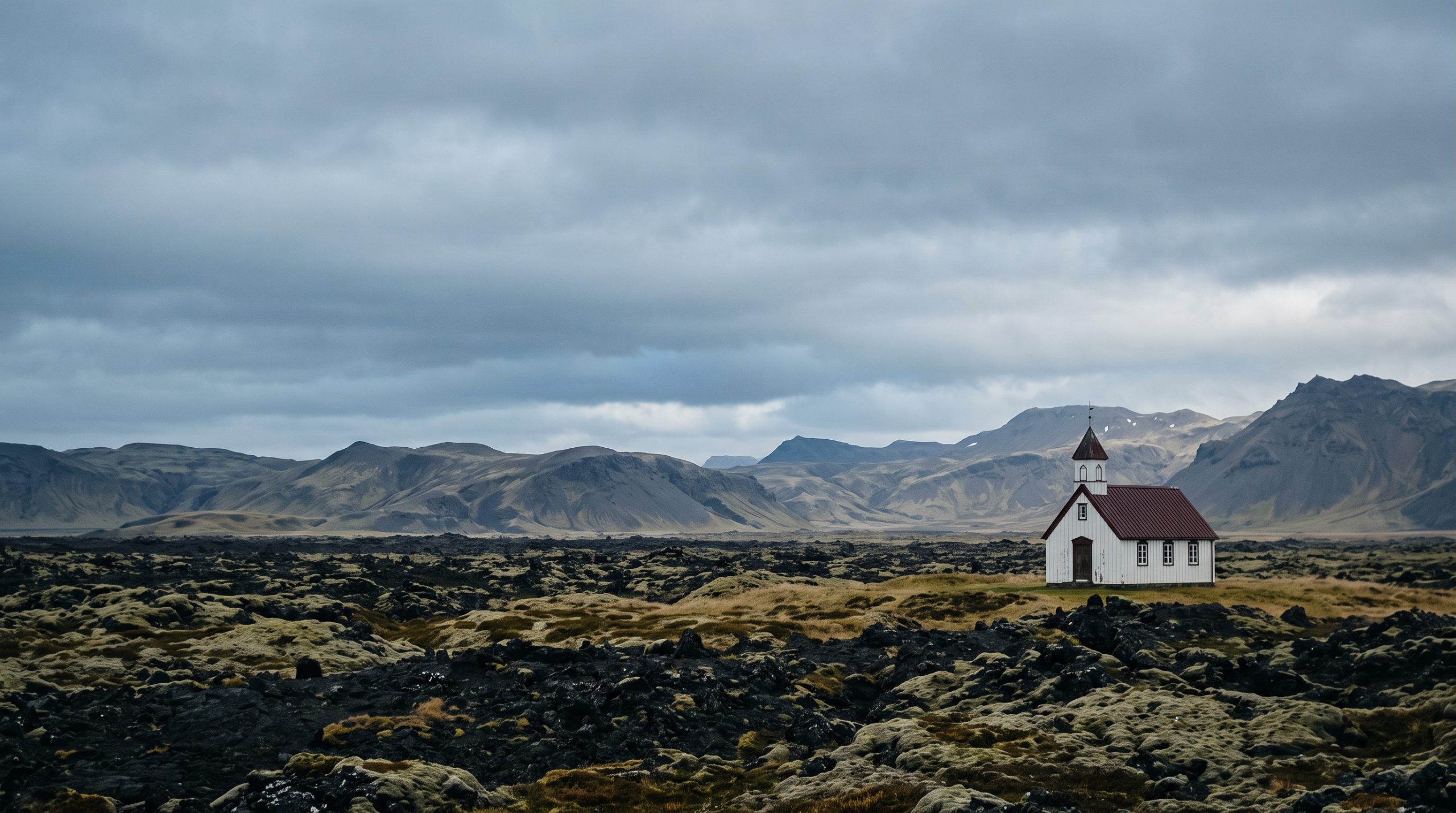
The question turns up in almost every Iceland inquiry, usually in the second email. You want the vows on black sand at ten at night in June, and you want to know whether that can be the legal thing or whether the legal thing has to happen in a room in Reykjavik with a stamp at the end of it.
Iceland’s answer is friendlier than most of Europe’s. Civil marriage sits with the district commissioner, the sýslumaður, and offices will consider leaving the building and working outside office hours for an added fee. The clock that matters is short rather than long: the certificate that authorizes your ceremony runs for 30 days. The genuinely awkward part of the chain is not Icelandic at all. It is one American document that no American authority issues.
What follows is the chain as we work it with couples: what to gather, in what order, how far back to start counting, and what actually changes on the ground if you sign at a courthouse at home and keep Iceland for the ceremony. Both are good days. They are not the same day to plan.
Iceland says yes to both, with one awkward step
Both routes are open to visiting couples. Iceland’s own guidance covers applicants with no legal residence here, documents in English are accepted, and the civil ceremony fee starts at 15,400 ISK. The one real hurdle is proving you are free to marry, because no United States authority issues that certificate. Marrying at home first removes the Icelandic file entirely.
The one document the United States does not issue
Iceland’s marriage rules changed on 1 February 2013, and since then both partners have had to submit a certificate of marital status issued by the relevant authority in their country, state or region. The US Embassy in Reykjavik is blunt about what that means for Americans: there is no federal authority in the United States competent to issue such a statement. Iceland recognizes that some countries do not produce them, and still asks for a document from the relevant authorities confirming there is no impediment to the marriage.
The workaround is an affidavit. No such government-issued document exists at home, so you make the statement yourself and have your signature notarized, either by a notary before you fly or by a US consular officer. The embassy cannot attest to your marital status, and it does not pretend to; what it can do is witness your signature, which is what most countries accept.
Then legalization, which in Iceland is mercifully short. Iceland has been part of the Hague Apostille Convention since 2004, so a state-issued birth certificate is legalized by the secretary of state in the state that issued it. One stamp per document, no consular chain, no ministry queue. Order two certified copies of each birth certificate while you are already in that system. The spare costs a few dollars and saves two weeks if one goes astray in the mail.
How the paperwork fits together
Collect in this order, because two of these have a life on them and the rest do not.
- Passports. Valid, and a photocopy of each travels with the marriage notification. Registers Iceland asks foreign nationals specifically for that copy, so it should not be the thing left out of the envelope.
- Birth certificates. Certified originals or officially certified copies from the state that holds the record. Nothing expires here, which makes this the first job and the easiest one to postpone.
- An apostille on each US document. Same system, same trip. Turnaround varies by state and some states run long, so this is the real reason to start three months out rather than one.
- Proof that you are free to marry. The certificate of marital status, or the notarized affidavit that stands in for it where no such certificate exists. This is the one to order late rather than early, because Iceland wants a current picture of your status.
- A final divorce decree, if either of you has been married before. Original, apostilled with everything else.
- Two witnesses, named. Their contact details go into the file alongside yours.
- The marriage notification form. This is the genuinely Icelandic piece. The district commissioner examines the file and, where there is no impediment, issues and certifies the certificate of no impediments, the könnunarvottorð, on that form.
One structural detail catches Americans out. The electronic version of this application on island.is is built for couples who hold legal domicile in Iceland and an Icelandic ID number. Visiting couples are not shut out of marrying, they are simply outside the digital door, so the file reaches the office by email first and the originals follow in person. Offices want originals or properly certified copies rather than a scan of a scan.
Turning the ceremony date into deadlines
Start from the hour, not the date. In late June the usable light on the south coast runs past midnight, so a ceremony at eleven at night is a normal request. In early February the same coastline gives you roughly seven hours of daylight in total, which turns the ceremony hour into the single most important decision in the plan. Fix the hour you want to be standing somewhere, then walk the calendar backwards from it.
The binding item is the 30-day life of the certificate of no impediments. The ceremony has to happen inside that window, which means the complete file needs to be in front of the district commissioner during the month before your date, not in the week of it. Everything upstream of that is American, and American document offices set their own pace.
The comfortable shape, and the one we work to, starts about three months out. Birth certificates and apostilles first, because they never expire. The marital status document or affidavit last, because it should be recent. The Icelandic file submitted with enough room left to answer a question if the office has one. Couples who already hold apostilled birth certificates from some earlier piece of admin can move considerably faster, and then office hours become the limiting factor rather than the paperwork.
Office hours are the part most planners underestimate. A civil ceremony takes place at the district commissioner’s office during office hours as standard. Coming out of the building, or working after hours, is something you request, and whether it can be granted depends on the circumstances of each individual office. There is an additional fee when it is. Ask about that before you fall for one specific ravine at nine in the evening. If the legal part ends up indoors on a Tuesday morning, that is genuinely fine, and it leaves the whole rest of the day free. Our planning fundamentals cover how a day gets built outward from one fixed hour like that.
The small things that decide whether your file clears
None of this is difficult. It is simply the detail that decides whether a file goes through the first time.
- The date you write down is not a booked ceremony. Iceland’s guidance says it plainly: the estimated date of marriage given in the application is information, not a reservation. The hour itself is agreed with the office that will perform it.
- The 30 days cut both ways. Order the clearance too early and it lapses before your date. This is the one place in the chain where being organized eight weeks ahead works against you.
- Pay the office that marries you. The fee follows the ceremony. The specific district commissioner’s office where the marriage takes place determines where the payment is made.
- Off-site is a request, not a right. Each office decides according to its own circumstances, so put the question in early and in writing, and hold a second location that suits a shorter drive.
- Guest numbers are capped by the room. Guests are welcome at a civil ceremony, subject to the capacity of the premises at each office. A party of sixteen will not always fit a small countryside office, and that alone moves some couples toward signing in one place and holding the ceremony in another.
- Witnesses can be solved locally. If you are traveling as two, the district commissioner’s office can usually provide witnesses on request. Ask rather than assume, and ask early.
Two further things are worth knowing, and both of them relax the day. There is no dress code at a civil ceremony and no requirement to exchange rings, so nothing in the legal part dictates how you look or what you say to each other. And the list of people who can legally marry you in Iceland is wider than the office door: district commissioners, priests of the national church, and the heads of registered religious and secular philosophical organizations, the lífsskoðunarfélög. That last category is the route couples use when they want a legally binding ceremony in a landscape rather than a room.
Once the ceremony is done, the district commissioner sends notification of the marriage to Registers Iceland, or Þjóðskrá. That step happens without you.
Keeping the destination day free of registry logistics
Some of the days we like best were legally done two weeks earlier at a courthouse at home, with a receipt in a folder and no ceremony attached. Nothing about that is a compromise. It removes the Icelandic file, the 30-day window, the apostilles and the office hours in one move, and it hands back the two things that actually shape an Iceland day: the hour and the location.
What changes is real. You can hold the ceremony at eleven at night in June with the sun still on the Vestrahorn ridge, or at eleven in the morning in November when that is the only light going. You can choose a celebrant whose voice you like rather than an officiant whose calendar works. Vows can run as long and as privately as you want, because nothing has to be read aloud for legal reasons and nobody has to sign anything at the end.
What does not change is also real. Land access and permits still apply wherever a landowner or an authority requires them. Weather still decides the running order, and we still hold a sheltered alternative within a short drive of every anchor point. Delivery is identical: highlights reach you in 5 days and the full gallery or film in 3 weeks, whichever route you took. Nothing in the finished work knows which one you chose, and you can see how the same coastlines behave from February to July in our published stories and films.
If you want both at once, that exists as well. A district commissioner working off-site, or a celebrant from a registered organization, and the ceremony is legal out in the landscape. It costs a little more and it needs asking about early rather than late. Our destination guides set out which Icelandic regions hold up in which months, and that usually decides the route before the paperwork does.
What each route costs, and who charges it
The Icelandic side of a legal marriage is cheap. At 15,400 ISK, a little over one hundred dollars at recent exchange rates, the ceremony fee is the smallest number in this article. The American side is where the small charges stack up, and none of them are large on their own.
| What you pay for | Legal marriage in Iceland | Ceremony only | Who sets the amount |
|---|---|---|---|
| Certified birth certificates | One each, original or certified | Not needed | Your state vital records office |
| Apostille | One per US document | Not needed | Secretary of state, per document |
| Proof you are free to marry | Notarized affidavit or certificate | Not needed | A notary, or the US consular tariff |
| Marriage license at home | Not needed | Required | Your county clerk |
| Icelandic ceremony fee | From 15,400 ISK, more off-site or after hours | None | The district commissioner’s tariff |
| Celebrant | Only if used instead of the office | Required | The celebrant |
| Location permit where required | Same either way | Same either way | Landowner or authority |
Fees and deadlines quoted here were correct at the time of writing and are worth re-checking with the office that issues them. The krona also moves, so treat any dollar figure as an approximation rather than a quote. Our own coverage is a separate matter and is set out plainly on the pricing page.
What we hold, and what only you can sign
We plan around the constraints. We hold your date against the office’s availability, set the ceremony hour by the light rather than the other way around, research the permits your locations need and guide you through them, and build a weather alternative for every fixed point in the day. Team travel is included, so flights and accommodation for the assigned team are not a line in your Iceland budget. Permit fees themselves, the celebrant, accommodation and any unusual transport stay with you.
When a photographer and a filmmaker are both on the ground, there are two of us present through the signing, which quietly helps a small ceremony. One of us stays on the vows while the other is on the hands and the certificate, and neither is running between the two. It also means the ceremony hour can be set for the best light of the day rather than for the reach of a single camera.
We are photographers and filmmakers, not lawyers. Rules change and circumstances differ, so confirm the detail with the district commissioner’s office handling your date, or with your own consulate, before you book flights. Check Your Date and tell us which route you are leaning toward, and we will build the day around it.
Common questions
Do we need to live in Iceland to get legally married there?
No. Iceland’s official guidance spells out what to submit when you do not have legal residence here, which is a certificate of marital status from the country where your legal address is registered, alongside the rest of the file. Non-residents are catered for deliberately, not tolerated as an exception.
Can a legal Icelandic ceremony happen outside instead of in an office?
It can. The standard civil ceremony happens at the district commissioner’s office during office hours, and on request it may take place outside the office and after hours for an additional fee. Whether the request can be granted depends on each office’s circumstances, so ask before you settle the location. A celebrant from a registered religious or secular organization is the other legal way into a landscape.
What do American couples submit instead of a certificate of no impediment?
A sworn affidavit. No US federal authority issues a national certificate of marital status, so you make the statement yourself and have your signature notarized, either at home before you travel or by a US consular officer. Iceland has required a marital status document from both partners since 1 February 2013.
How long does the Icelandic marriage clearance stay valid?
30 days. The ceremony must take place within 30 days of the date on the certificate of no impediments issued by the district commissioner, which is exactly why the file goes in during the month before your date rather than months ahead of it.
Do our documents have to be translated into Icelandic?
Documents in English are accepted, so an American file usually needs no translation at all. Paperwork issued in another language needs a certified translation to travel with the original, which is the step that adds weeks in much of Europe and simply does not apply here.
Who signs as our witnesses if we are traveling alone?
Two witnesses form part of the file, with contact details, and the district commissioner’s office can usually provide them if you ask. Guests are welcome at an office ceremony as well, limited only by the capacity of the room.
Can same-sex couples marry legally in Iceland?
Yes. Icelandic marriage law has been gender neutral since 2010, and the document chain, the 30-day window, the fee and the ceremony options are identical for every couple.
Does a symbolic ceremony in Iceland need any paperwork?
No marriage file, no clearance and no 30-day window. What can still apply is permission to use a place: some farms, private land and protected sites want a permit or a landowner’s consent for a ceremony, and that is true on both routes. We research those and guide you through them.
Pick the hour, then pick the route
Decide what you want the light to be doing when you turn to face each other. Almost everything else follows from that, including which route makes sense. If midnight in June is the picture in your head, a courthouse at home and a celebrant in Iceland is the cleaner path. If a Tuesday morning in a small office followed by a completely free afternoon sounds right, the legal route here is straightforward once the apostilles are back.
We currently have dates open across the 2027, 2028 and 2029 seasons. Send the inquiry form with your rough dates and the two or three places you keep returning to, and you will have a reply and our first brochure within 24 hours. From there it is a tailored proposal, a signed contract and a 30% retainer, and the planning starts. Everything happens in writing, so you can read it twice, forward it to each other and answer when it suits you. Send Us a Message.