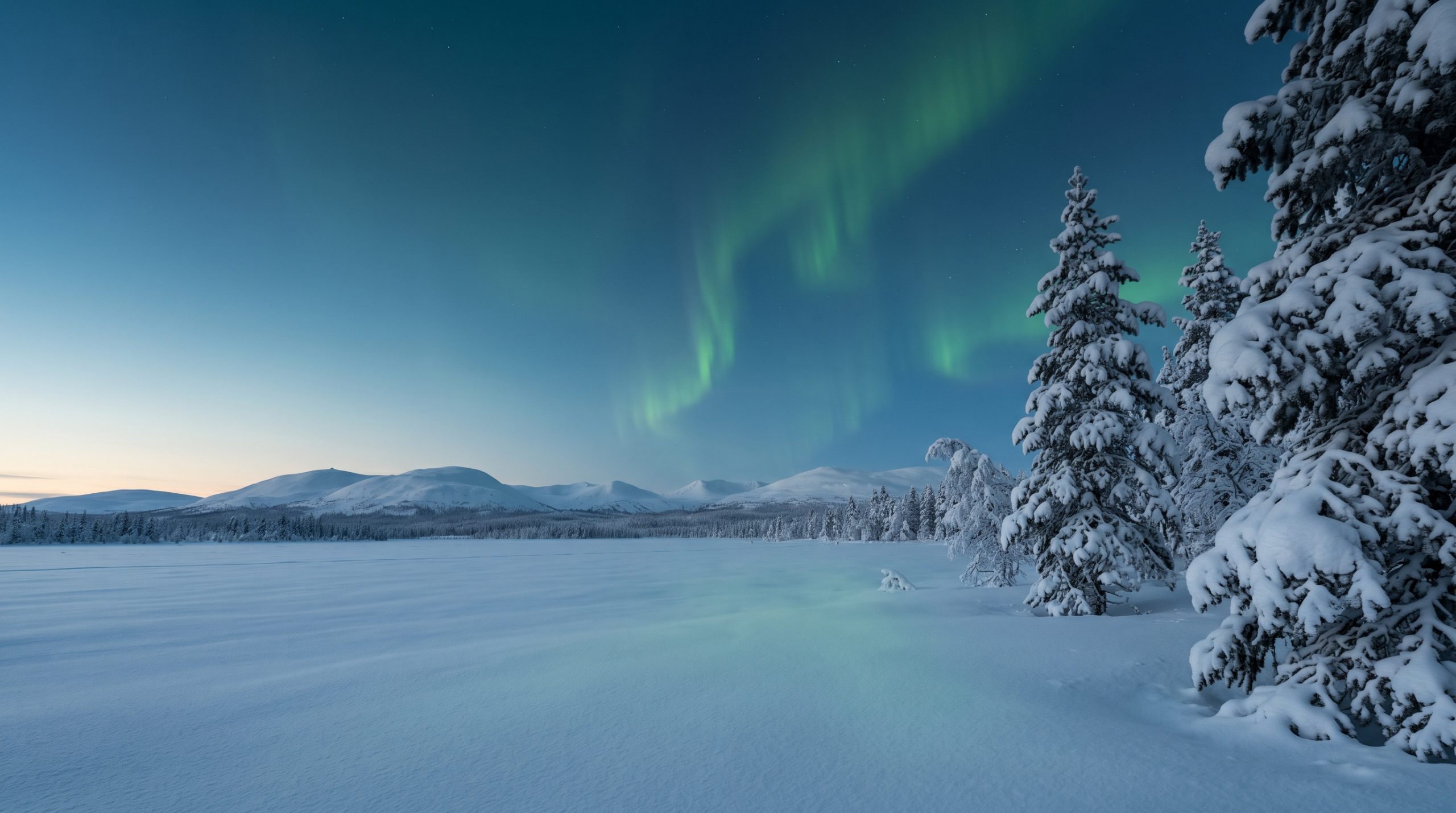
On the December solstice in Rovaniemi the sun is above the horizon for 2 hours and 33 minutes. What the almanac will not tell you is that it never really climbs. At 66.5 degrees north in late December the highest point the sun reaches all day is roughly the horizon line itself, so that whole window is one continuous low rake of gold across the snow. There is no harsh hour to plan around, because there is no high sun to make one.
Two degrees of latitude further north, in Ivalo, the sun stops clearing the horizon at all from about the first of December until early January. The edge of true polar night sits near 67.3 degrees north, one degree above the Arctic Circle, which is why Rovaniemi keeps a real sunrise all midwinter and Inari does not. That single line on the map decides where a December date should happen, and working it out is the first thing we do when a couple writes to us with a month in mind.
We are eight people: four photographers and four filmmakers. In Lapland the planning is mostly arithmetic about light, ice and drive time, and it settles things a couple would never think to ask about. The vows go at solar noon rather than at sunset. Fell roads open later in the spring than most planners expect, and the aurora window does not begin until three hours after the last of the blue has gone. Photography, film and planning are one service on this team, not three vendors comparing calendars in March.
Photo, film and planning across Finnish Lapland
We photograph and film elopements across Finnish Lapland, from Rovaniemi and Ylläs north to Inari and the Urho Kekkonen fells. Coverage starts at one full day with one dedicated photographer or one dedicated filmmaker, and rises to a photographer and filmmaker working the same day together. Planning, permit research, the timeline and team travel sit inside the price.
From 9:30 blue to 3:15 dark: how a midwinter day runs
The times below are the last week of December from a base near Rovaniemi. Each week of January adds roughly twenty minutes at each end, so a mid-February day is a different animal with the same skeleton.
- 08:30 Indoors, and deliberately so. Getting ready is warm, unhurried and worth filming properly, because outside there is still nothing for a camera to read. Batteries go into inside pockets now, not into bags.
- 09:30 First civil twilight. The snow turns the same deep blue as the sky and the fell shapes come back as silhouettes. We use this hour for the drive out, the walk in and the wide film frames.
- 11:00 Sunrise, and it happens almost due south rather than in the east, which surprises every couple who has not been this far north in winter. Color arrives across the top of the snow rather than down onto it.
- 12:15 Solar noon and the ceremony. This is the brightest and the warmest the day will be, and the light is still sitting at the angle most photographers get for twenty minutes at home.
- 13:30 Sunset, roughly thirty degrees of horizon west of where it came up, then a long fade rather than a switch. Rings, portraits, the second location, coffee from a thermos while the sky works through orange into violet.
- 15:15 Dark. Sauna, food, dry socks. Nobody shoots anything for three hours and that gap is in the timeline on purpose.
- 19:00 onward Aurora watch if the sky allows it. Long exposures for stills, a completely different set of decisions for the film.
The one planning move that separates Lapland from everywhere else we work: your vows go at solar noon. Couples arrive expecting a sunset ceremony because that is what they have been told to want, and in late December that means standing out on a frozen lake at half past one with the light already going and the warmest part of the day behind you. Noon is golden hour here. In mid-January the noon sun sits about three degrees above the horizon, and by the end of February it reaches roughly fifteen, which is when a full afternoon of usable daylight comes back and the aurora night is still long.
| When | The sun near Rovaniemi | What we build on it |
|---|---|---|
| Solstice week | Up 2 hours 33 minutes, never above the horizon line | Ceremony at solar noon, roughly six hours of workable blue and gold |
| January | Noon sun near three degrees, climbing weekly | Deep snow, empty trails, the longest aurora nights of the winter |
| February | Noon sun from about six degrees to fifteen across the month | A real afternoon plus a full night, best month for two locations |
| Late March | Equal day and night, snow still deep on the fells | The widest choice of hours all winter, sunrise and sunset both usable |
| 6 June to 7 July | Never sets in Rovaniemi | Vows at midnight in low gold, no darkness at any point |
If you are still deciding between regions rather than months, our destination guides go deeper on how each part of the north behaves through the year.
Why the filmmaker matters when the good light lasts two hours
In most places a photographer and a separately booked videographer can each take their own run at the same hour, because there are several hours. On a solstice day near the Arctic Circle there is one. If two people who have never worked together both need to own the ceremony at 12:15, one of them is standing in the other’s frame, and you will see it in whichever set of files you care about more.
When our photographer and filmmaker work the same day, the shot list is agreed the night before. One takes the low angle on the walk in, the other holds wide with the fell behind. They swap positions without a word, because they have done it in this cold before. On the Expedition, professional audio is running on the vows where conditions allow, which in practice means we have already checked the wind direction against the ceremony spot and picked the sheltered side of the ridge.
Three Lapland specifics that only a planned pair gets right:
- Tracks. Footprints in fresh snow are permanent until the next fall. One set of tracks leading into a wide frame looks intentional. Six sets look like a car park. Two people who planned the walk in take the same line, and the untouched snow stays untouched for the frame that needs it.
- Batteries and hands. Cold drains cells fast and gloves come off for rings. With a second camera on the ground, a battery swap or a warm-up in the car costs the day nothing, because someone is still rolling.
- The aurora. A still frame of the lights and a moving frame of the lights are two different technical problems with two different answers. One person carrying both gets one of them. Two people get both, from the same patch of frozen lake, at the same moment.
Drone work runs on top of that rather than instead of it. Aerials sit inside the EU open category rules, with a 120 meter ceiling and an operator registration with Traficom, and Lapland adds its own layer: twelve large wilderness areas exist in part to protect reindeer herding and Sámi culture, and individual protected areas set their own terms. We confirm the location and the window first, then decide whether the film wants an aerial at all. Snow-loaded spruce from above, near Riisitunturi in Posio, is worth the paperwork. Most other things are not.
The honest test of all of this is what comes back afterwards, so go and look at it: our published galleries and films show whole days cut two ways, stills and motion, shot by the pairs who planned them.
The northern lights question, answered with a plan
Nobody can sell you an aurora. Anyone who implies otherwise is selling you weather. What we can do is build a day that stands entirely on its own in daylight, and then treat the lights as an addition to a night that is already planned.
Practically, that means three things. We keep the night flexible rather than fixed, because a clear patch of sky in Lapland is often a forty-minute drive away rather than a lost cause. Multi-night coverage is worth pushing for when the lights genuinely matter to you, since two or three chances beat one by a margin no amount of skill can close. And we tell you the truth about what you are likely to see, which is often a pale green arc that a camera reads far better than your eyes do, until the night it goes vertical across the whole sky and you need nobody to explain it to you. A bright moon, incidentally, is a gift rather than a problem up here. It lights the snow and gives the foreground something to be.
Everything we bring, and the Finnish costs we do not control
Every experience, in every destination, includes the same foundation:
- Destination and location design for your dates, built on that week’s actual light
- Full planning support and a custom timeline built around light and real travel time
- Permit research and logistics guidance, including which authority governs the ground you want to stand on
- Weather alternatives and backup planning, held ready rather than improvised
- Drone footage where it is legal, safe and appropriate
- Professional audio for vows and meaningful moments on the Expedition, where conditions allow
- Team travel worldwide, meaning flights, accommodation and ordinary travel for your assigned team
- Highlights delivered in 5 days, and the full gallery or film in 3 weeks
Where coverage starts
The Adventure covers one full day with one dedicated photographer or one dedicated filmmaker, from $4,900. The Expedition covers one full day with a dedicated photographer and filmmaker working together, from $7,900. Beyond that, the Odyssey stretches from two to seven days across one or several destinations, photography and film together, quoted as a custom proposal. The full breakdown lives on our pricing page. Your guest count does not change the fee; it changes access, permits, transport and timeline.
What Finland adds locally
Because team travel is already included, the Lapland costs you pay separately are local ones. A civil ceremony is free at a Digital and Population Data Services Agency service point during office hours, weekdays from 9:00 to 16:15; officiated outside those hours it carries a 250 euro fee plus the officiator’s travel to your location. Any government, venue or landowner permit fee is yours, including a Metsähallitus film production permit where a protected area requires one. So are accommodation, your celebrant, and the transport that makes remote ground reachable, such as a snowmobile or husky sled charter out to a lake.
If your dates are roughly settled and you want to know what the day would actually look like, Send Us a Message with the week you have in mind and where you think you want to stand.
Six steps from first message to a planned day
- Send the inquiry form with your dates, or the month if the dates are still soft.
- We reply within 24 hours with an initial brochure.
- We build a tailored proposal around your dates, region and the shape of day you want.
- Contract signed and a 30% retainer paid. The rest of the payment plan is set out in the proposal.
- Planning begins: locations, timeline, permit research, the weather alternative and the paperwork order.
- We travel, we shoot the day, and your highlights arrive first with the full delivery behind them.
Who Lapland fits, and which month fits which couple
This works best for couples who are genuinely happy to be outside in real cold for most of a short day. Snow boots that fit, a dress or a suit that works over a base layer, and a willingness to walk twenty minutes off a plowed road on snowshoes will get you further here than any other kind of preparation. It also suits couples who like the idea of a ceremony at midday and a long, dark, slow evening afterwards, rather than an evening that runs past midnight.
It fits less well if what you actually picture is a warm evening, bare arms and a long golden hour after dinner. That exists in the north, but it is late August and early September on the water, or the stretch from 6 June to 7 July when the sun never sets in Rovaniemi and the vows can happen at midnight in low gold. Tell us which of those pictures is really yours and we will say plainly which month and which region delivers it, even if that means moving your date across the calendar. Our planning fundamentals are a good place to start if the shape of the day is still open.
Guests are welcome and change nothing about the fee. In winter they change logistics, because ten people on a frozen lake at noon need transport, a warm room within reach and a permit conversation that two people do not. Tell us the number early and it becomes a planning detail rather than a problem on the morning.
Common questions
Can we legally get married in Finnish Lapland if we are American?
An examination of impediments to marriage is requested in writing from the Digital and Population Data Services Agency and can take several weeks. The certificate it produces is valid for four months and must be brought to the ceremony. Many couples handle the legal step at home and hold the vows out on the snow.
How dark is Lapland in December, really?
Near Rovaniemi the sun is up for about two and a half hours at the solstice, and the latest sunrise of the year is 10:58 in the morning on 23 December. True kaamos begins around 67.3 degrees north, so Inari loses the sun for weeks while Rovaniemi does not. The twilight either side is long and very workable.
Is February or March better for a Lapland elopement?
Both are strong for different reasons. February gives you a noon sun climbing from roughly six degrees to fifteen across the month, deep snow and long nights. Late March gives equal day and night, snow still on the fells and the widest choice of hours. Tell us which trade you prefer.
Do we need a permit to elope in a Finnish national park?
Moving through Finnish nature is covered by everyman’s rights regardless of who owns the land. Film production in state-owned protected areas is different: Metsähallitus issues those permits, applications go to its registry office well in advance, and any temporary structure needs one. We do the research and guidance; the fee itself is yours.
Can you fly a drone over the fells for our film?
Where it is legal, safe and appropriate, yes. Aerials sit inside the EU open category, which means a 120 meter ceiling and an operator registration with Traficom, and individual protected areas add their own terms. Lapland’s twelve wilderness areas also protect reindeer herding, so we confirm location and window before planning any shot around a drone.
Will we see the northern lights on our elopement day?
We plan as though you will not, then chase them properly if the sky opens. The daylight day stands alone, the aurora sits on top of it, and staying mobile at night matters more than any single location. If the lights are central to why you are coming, multi-night coverage improves your odds more than anything else we can do.
Can we have a fire and hot drinks in the photos?
Yes, with the right ground. Campfires are not part of everyman’s rights, and in most national parks they are only permitted at designated fire sites, with any fire warning in force overriding that. So we either choose a location that has a fire site or arrange it with the landowner, and confirm it while planning.
What does the price cover if we are flying from the US?
Team travel is included worldwide, so flights, accommodation and ordinary travel for your assigned team are inside the price whichever Lapland airport you choose. Paid locally: permit fees, your own accommodation, your celebrant, and unusual transport such as a private snowmobile or sled charter out to remote ground.
Pick the week, and we will build the light around it
We are currently taking Lapland elopement bookings for 2027 through 2029, and there is a version of this day in every month of the Lapland winter. We keep the planning in one written thread, at whatever hour suits your time zone: you send your dates, we reply within 24 hours with the brochure, and the planning runs by email from there. If you have a week in mind, Check Your Date and tell us what you want the day to feel like.