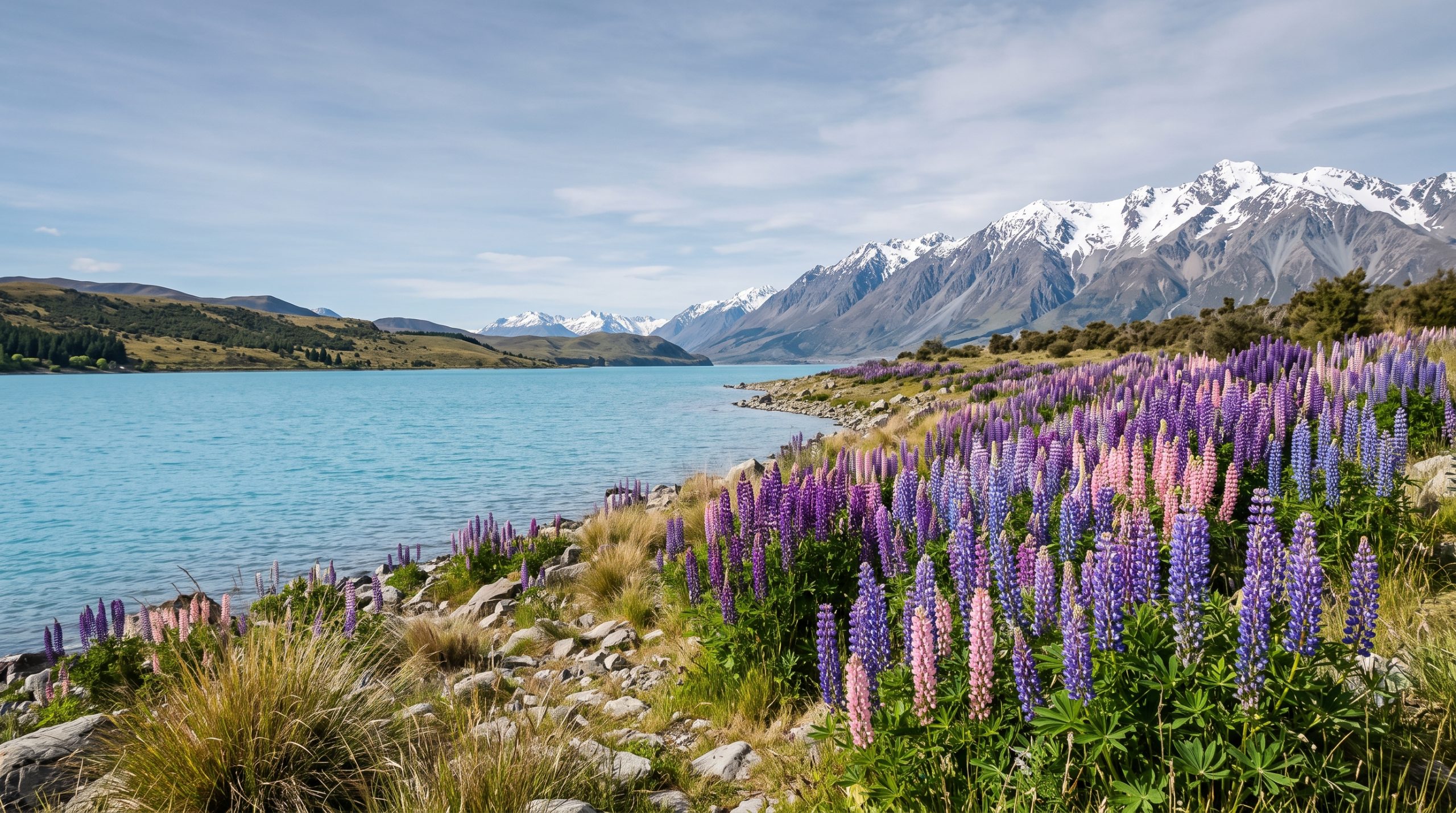
In the first week of December the sun clears the hills at Lake Tekapo at about 5.50am, and it comes up in the southeast, around 123 degrees, which puts it behind the far shore instead of over your shoulder. For roughly 68 minutes it stays under ten degrees of elevation. That is the lupin hour, all of it. By nine the light is already climbing hard, and at solar noon the sun sits close to 68 degrees above the basin, which is very nearly straight down.
The flowers run on a shorter clock than the light. Russell lupins along the Tekapo lakeshore and out along Lilybank Road come up in late November, hold their strongest colour through roughly the first fortnight of December, then go over. Nobody plants them and nobody manages them for visitors, which is why no date is ever published.
So the timing answer is narrow, and it is not the same as the answer to when this place photographs best. Both are below, month by month.
The two-week lupin window, and what happens if it slips
Book the first two weeks of December. That window carries peak lupin colour in most years, about 15 hours 20 minutes of daylight, and a sunrise near 5.50am that hands you a full hour of low light before the first coach reaches the church. If the bloom runs late, the last week of November gives almost identical light.
Month by month in the Mackenzie Basin
Sunrise and sunset below are mid-month figures for Takapō, rounded to five minutes. New Zealand moves the clocks forward on the last Sunday in September and back on the first Sunday in April, which is why April’s evenings look an hour shorter than March’s on paper.
| Month | Conditions | Light, mid-month | Crowds | Our verdict |
|---|---|---|---|---|
| January | Warm, dry-feeling, flowers fading fast | 6.15am to 9.20pm, noon sun 67 degrees | Peak of the year | Late light is superb, flowers mostly gone |
| February | Warmest, basin turning gold and brown | 6.55am to 8.50pm, noon sun 59 degrees | Still very busy | Our least favourite month here |
| March | Settling down, cool mornings | 7.35am to 8.00pm, noon sun 46 degrees | Thinning through the month | Strong and underrated |
| April | Autumn colour on the lakefront willows, frosty starts | 7.10am to 6.05pm, noon sun 35 degrees | Quiet | Best light of the year |
| May | Cold, first proper snow on the tops | 7.45am to 5.25pm, noon sun 28 degrees | Very quiet | Excellent if you dress for it |
| June | Shortest days, snow on the ranges | 8.10am to 5.05pm, noon sun 23 degrees | Emptiest month | Whole day behaves like golden hour |
| July | Coldest, most reliable snow cover | 8.10am to 5.20pm, noon sun 25 degrees | Ski traffic, lake still quiet | Book it for snow, not for flowers |
| August | Cold, days lengthening noticeably | 7.35am to 5.50pm, noon sun 31 degrees | Quiet | Snow with a workable timeline |
| September | Unsettled, spring arriving unevenly | 6.40am to 6.25pm, noon sun 42 degrees | Quiet | The month we plan around, not for |
| October | Green coming back, no lupins yet | 6.45am to 8.05pm, noon sun 54 degrees | Building | Too early for the flowers |
| November | Lupins arriving, long evenings | 6.05am to 8.45pm, noon sun 65 degrees | Rising sharply | Last week is the safe bet |
| December | Peak lupins, longest days of the year | 5.50am to 9.15pm, noon sun 69 degrees | Heaviest at the church | First fortnight, and we would book it |
How far the lupin peak moves from year to year
Late November through late December is the outer envelope. Inside it, the strongest colour lands most often in the first week or two of December, and the whole thing can shift a week or more in either direction depending on how warm the spring was. A warm spring brings the spikes on early and burns them off early. A cool, windy one builds slowly and pushes the peak towards mid-December.
Which is why we plan a lupin day as a range. If your date is fixed and the season runs ahead of you, patches on higher ground and further up the eastern shore usually run a week behind the ones by the village, and that lag often saves the frames.
These plants are an introduced species in New Zealand and they matter most where they matter least to a photograph: the braided riverbeds, which are nesting ground for native birds. So we work from formed shoulders and tracks, shoot into a patch from its edge rather than through the middle of it, and keep well back from the shingle flats near the church where birds nest through exactly the weeks the flowers are out. It costs nothing and it changes the pictures for the better anyway, because the front edge of a lupin patch is where the light gets through.
One more narrow window, and it runs opposite to the flowers. The Mackenzie Basin sits inside the Aoraki Mackenzie International Dark Sky Reserve, certified in 2012 and covering both the basin and Aoraki / Mount Cook National Park, with lighting controls in the district plan since the early 1980s. In early December the sky only reaches full astronomical darkness from about 11.30pm to 3.30am, and the bright core of the Milky Way is on the day side of the sky. From May to August that same core stands almost overhead at midnight, with eleven hours of darkness underneath it.
The weeks we steer couples out of, and where we send them
Late January and February. The lupins are finished, the basin has gone gold and dry, and the midday sun is still high enough at 59 degrees to flatten everything between about ten and four. It is also the busiest stretch of the year at the church and on the lakefront. If your travel has to fall in the southern summer, we would rather build the day around a late start and a 8.50pm sunset than fight the middle of a February afternoon.
Our redirect is late March into April. The sun tops out near 46 degrees at the equinox and 35 degrees by mid-April, the willows along the lakefront turn, the visitor numbers collapse, and the mornings come with frost and stillness on the water. It is the best light Tekapo gets, and almost nobody plans an elopement for it.
September is the other month we redirect. Spring arrives unevenly in the basin, the flowers are weeks away, and the ground is still coming out of winter without yet looking like summer. If you love that in-between look, say so and we will build for it. If what you actually want is colour, the last week of November gets you a 15 hour day, a 5.55am sunrise, and lupins that are up but not yet trampled.
Sixty-nine degrees in December, twenty-three in June
That single pair of numbers explains more about photographing here than any weather average will. At the December solstice the sun climbs to 69 degrees over Lake Tekapo and the day runs about 15 and a half hours. At the June solstice it never gets above 23 degrees and the whole day lasts just under nine hours.
What that does in practice: a December day has two separate working windows about fourteen hours apart, and a hard, bright, high-contrast block in between that we simply do not schedule a ceremony into. A June day has no such block. The sun crosses the sky low and to the north, side-lighting the ranges from first light to last, and every hour of those nine is usable. Winter gives you less time and better light. Summer gives you more time and forces you to choose your hours.
The direction changes too, and it changes the shot list. In December the sun rises at about 123 degrees and sets at about 237, so both ends of the day come across the lake from the southern half of the sky. In June it rises near 57 degrees and sets near 303, swinging round to the north, which lights the eastern shore in the morning and puts the Two Thumb Range in the evening light instead of in silhouette. Same lake, entirely different photographs. Our published galleries and films are the fastest way to see which of those two looks is the one you actually want.
Season is also what decides whether one camera is enough. A June day gives you a low sun, a narrow window and roughly eight hours and fifty minutes of usable light, and when the ceremony, the vows and the light are all happening inside that window, a single person has to pick between the still frame and the moving one. On an Expedition a dedicated photographer and a dedicated filmmaker work the same hour side by side, which is why we lean towards it for winter and shoulder-season dates while an early December evening, with light until 9.15pm, leaves room to work more slowly.
Gates, passes and the church’s own calendar
The Mount John summit road is gated and charged, and it shuts in the afternoon, hours before a December sunset. A summit sequence at last light is an arrangement made in advance rather than a drive-up, and the walking track from near Tekapo Springs is the fallback that always works. Aim there for a mid-morning wide or a winter afternoon rather than a summer sunset.
The Church of the Good Shepherd on Pioneer Drive keeps its own rules and its own calendar, and they are firm. Ceremonies must be conducted by ordained Christian clergy and are approved by the Minister in charge. Two witnesses are required. The church caps how many weddings it takes, so the date drives the booking rather than the other way round. For couples living outside the Mackenzie District the standard cost is currently NZ$2,500 plus GST, which covers exclusive use of the church and grounds for an hour and a half to two hours along with the minister’s travel and expenses, and it is paid to the church rather than to us. Photographers are asked to arrange their working time with the church first, which we do as part of the permit and access work described in our elopement planning guide.
Winter changes the approach rather than the day. The Queenstown route crosses the Lindis Pass on State Highway 8, an alpine road near a thousand metres that carries snow through the season and is cleared by highway crews, so for June, July and August dates we route arrivals in through Christchurch and build a spare day in front of the date. Snow itself is a gift. The basin can pick up 25 centimetres overnight, and the morning after is the best it looks all year.
If you already have a fortnight in mind, Check Your Date and tell us which of the two Tekapos you are after.
How the Mackenzie weather backup is built before you land
Every timeline we build for the Mackenzie has a second version attached to it before anyone gets on a plane. Not a vague intention to improvise, but named locations with the conditions each one needs, ranked, with drive times attached.
If the cloud is sitting on Mount John, the ceremony hour moves down to the lake edge, where a low base actually helps by putting a soft ceiling over the turquoise. If the basin is closed in at the northern end, we go south instead: Lake Pukaki and Twizel are about forty minutes down State Highway 8, often under a completely different sky, with Aoraki front and centre. If the wind is up on the exposed lakefront, we work the sheltered side of the Peninsula Walkway and the willow lines instead of the open shingle.
Two things make that workable. December’s fifteen-hour day means a ceremony can move from 6pm to 8.30pm inside the same evening and still finish in warm light, and our own destination guides exist because we would rather decide these things months out, in writing, than at 5am on the morning.
Common questions
When exactly do the Tekapo lupins peak?
Most reliably in the first week or two of December. The full flowering runs from late November into late December, and the peak moves by a week or more each year with spring temperatures, so we plan a range rather than a single date and keep higher, later-flowering patches in reserve.
How early do we have to get up for lupin light in December?
Sunrise is about 5.50am in the first half of December, and the sun stays low enough to shoot into for roughly 68 minutes afterwards. We are usually on location by 5am. That start also puts you at the church and the lakefront a good hour before the first tour coaches arrive.
Is there any point coming to Lake Tekapo after the lupins have gone?
Yes, and the light is better. In April the midday sun tops out around 35 degrees instead of 69, the lakefront willows turn, and the crowds are gone. In June the sun never climbs past 23 degrees, so the entire nine-hour day behaves like the edges of a summer one.
Can we actually get married inside the Church of the Good Shepherd?
You can, on the church’s terms. Ceremonies are conducted by ordained Christian clergy and approved by the Minister in charge, two witnesses are required, and the church limits how many weddings it takes each year. The venue fee is paid directly to the church, currently NZ$2,500 plus GST for couples from outside the district.
Can we do a night sky sequence at Tekapo in December?
Yes, though the window is short. In early December full astronomical darkness runs only from about 11.30pm to 3.30am, and the Milky Way core is not in the night sky at all. From May to August you get around eleven hours of darkness with the core high overhead, which is the real dark sky season here.
What happens to our plan if the weather turns on the day?
We move to the alternative we already wrote down. Each location on the timeline has a condition attached and a ranked substitute, from the sheltered lakefront to Pukaki and Twizel forty minutes south. In December a fifteen-hour day means the ceremony hour itself can shift by two or three hours without losing warm light.
How crowded is the church during lupin season?
Busiest it gets all year, which is precisely why we start at 5am. Between about 5 and 7am in early December the lakefront is effectively yours, and the light is the best of the day. By mid-morning the car park is full, so we plan the wide, empty frames for the first two hours.
Is a winter elopement at Tekapo actually workable?
Very. June gives you eight hours fifty minutes of daylight, a sun that never rises above 23 degrees, snow on the ranges and an almost empty village. We compress the day, keep drives short, and put two people on the ground so nothing in that narrow window has to be chosen between.
Holding a fortnight in the Mackenzie
We are booking 2027, 2028 and 2029, and in the Mackenzie it is the flowers that set the calendar rather than us. Tell us the year you have in mind and whether you are chasing lupins or the low April sun, and we will come back with a shape for the day, a light-driven timeline and the access work spelled out. Everything runs in writing, on your schedule, starting with a reply and a brochure inside 24 hours. Tell Us Your Story.