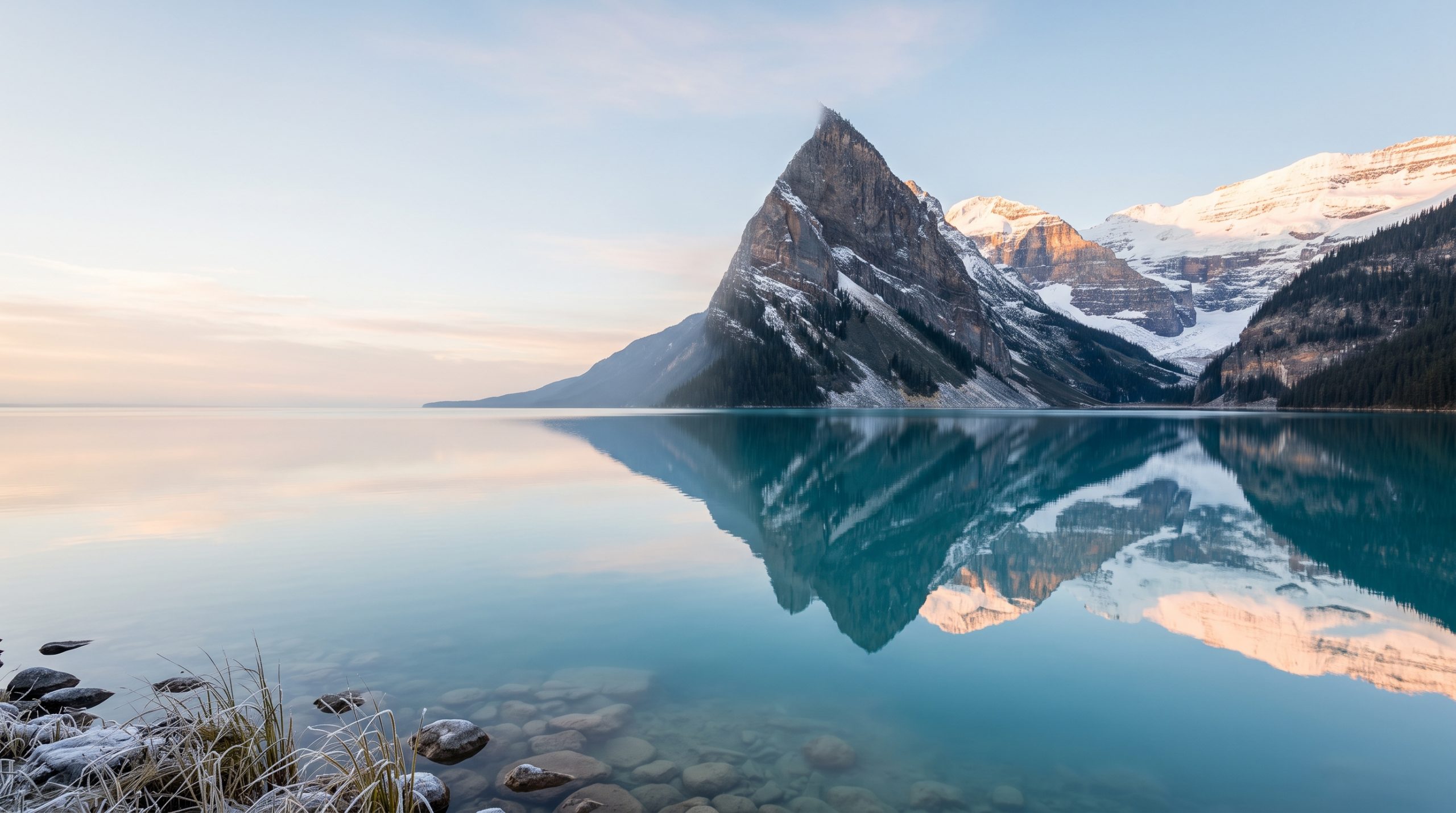
In the second week of June the sun comes up at Lake Louise at about half past five, and it comes up from the northeast, behind the hotel. So the first light of the day does not land on you. It lands at the far end of the water, on the snow of Mount Victoria, while the shoreline where you are standing sits in cold blue shade for another half hour.
That one fact rearranges an elopement here. The water is glass at that hour and it will not be glass later. The shoreline in front of the Fairmont Chateau Lake Louise is yours at that hour and it will not be yours later. The evening light that carries a whole day in other mountain places never properly shows up, because the wall of peaks on the west side lifts the sun off the lake long before the clock says sunset.
So this is not a list of viewpoints. It is one hour, and how we protect it.
Why the first hour after sunrise is the whole plan
At Lake Louise the ceremony hour starts before sunrise. Light arrives from the northeast behind the hotel, reaches Victoria Glacier first, and reflects back off water that is still flat. That means around half past five in mid-June, closer to twenty past seven by mid-September. Everything else in the day is built backwards from it.
The lot, the shuttle, and the four kilometers in between
The Lake Louise Lakeshore parking lot sits four kilometers up the hill from the community of Lake Louise, and it is paid parking from mid-May to mid-October: a flat daily rate per vehicle, in the low teens when we last paid it, charged on top of your Banff National Park entrance pass. Parks Canada is unsentimental about capacity. Once the lot is full, cars are turned around rather than allowed to circle and wait.
The alternative is the reservation-only Parks Canada shuttle from the park and ride east of the hamlet on the Trans-Canada, with Roam transit connecting up from the Town of Banff. Once you are at the lakeshore, the Lake Connector runs across to Moraine Lake every fifteen minutes on a first-come basis, which is useful later in the day and irrelevant at four in the morning. Shuttle timetables are built around visiting hours, not around first light, so a pre-dawn ceremony means your own vehicle or a driver, parked in a lot that is close to empty when you arrive.
Guest numbers do not change what we charge, but they change this part of the morning. Six people in two cars is two parking fees, two sets of headlights on the highway at half past four, and one conversation the night before about who is driving. We write that into the timeline rather than leaving it to the group chat.
What the west wall does to the evening
The lake runs roughly east to west. The hotel sits at the east end, Mount Victoria and its glacier close the far end, Fairview Mountain rises on the south side, and a high ridge walls off the north. That geometry decides your ceremony hour more than any calendar does.
Sunrise comes up on a bearing of about fifty degrees in mid-June and about eighty-four degrees in mid-September. Both are behind the hotel. The sun never rises over the glacier, so it never blinds the picture everyone comes for. Instead the peaks catch color first, the near shore holds soft shadowless light for a while, and the reflection is the brightest thing in the frame. Then the sun clears the low ridge across the Bow Valley to the east and the shoreline itself goes bright, which is a different and much less interesting photograph.
The evening is the part most couples get wrong, and it is worth being direct about. In late June the sun officially sets just after ten, on a bearing of roughly 310 degrees. But the ridge in that direction stands better than twenty degrees above the water, so the last direct light leaves the lake around half past seven, two and a half hours before the number in the weather app. By mid-September the water is in shade from about half past five in the afternoon. Stand on that shoreline at the hour you would instinctively choose for a wedding and you get flat, cool light and a turquoise that reads gray-blue. It is a famous view being unremarkable, and no amount of skill fixes it.
Get there for the first hour instead and the rock flour in the water does something a camera can actually hold: the pale glacial blue with lit snow above it and no wind on the surface. That combination is the reason our Canadian Rockies work looks the way it does, and it is the hour you are seeing in the films and galleries in our stories. If a four o’clock alarm is genuinely not who you are, tell us that early. There is a shape of day built around forest and river light instead, and we would rather tell you which month suits you than sell you a sunrise you will resent.
Flat gravel, two kilometers, and where the crowd stops
The Lakeshore Trail starts directly in front of the hotel and runs two kilometers one way, about four kilometers return, with almost no elevation change. The first kilometer is wide, flat and paved. After that the surface becomes compacted gravel and dirt with a few short pitches over twelve percent, and in spring the melt leaves soft ground in places.
In wedding clothes, that first kilometer is fine in anything, heels included. Past it, a long hem starts collecting grit, and before mid-June it collects wet grit. So we either keep the dress on the paved section and do the walking later, or we carry your shoes and time the far end for after the ground has dried. It is a small piece of choreography that decides whether you spend the last hour of the morning worrying about silk.
The crowd, honestly, is not solved by arriving early alone. It is solved by geography. Most visitors walk a few hundred meters past the boathouse and turn back, so the path empties as you go, and the far end of the lake at the glacial delta, where braided meltwater comes in under the peaks, feels like a separate place. For height, the Fairview Lookout climbs 1.2 kilometers and 100 meters of gain from the boathouse, forty-five minutes return, and looks straight down on the lake and the hotel roofline. In dress shoes that is a project. In boots with a bag it is fifteen minutes of honest work for the one frame that holds the whole basin.
The shoreline in front of the hotel matters to how two of us work. The usable band between path and water is a few meters wide, so a photographer and a filmmaker cannot split by angle here without ending up in each other’s frames. We split by distance instead: one close in for vows and hands, one back along the path or on the first switchback with a longer lens. Sound has its own rule at this lake, because the draft that comes down off the glacier arrives as low pressure on a microphone, and the first still hour is usually the only clean window for vows. Having both people on the same morning is the Expedition, from $7,900; the difference between the two full-day shapes is set out on our pricing page.
The red canoes, hour by hour
The hotel runs the only canoe rental on the water, from the boathouse. Rates currently sit at $180 plus GST an hour for visitors and $110 for hotel guests, in Canadian dollars, with half-hour options, and the boathouse takes cards only. Each canoe carries three adults. That number is the whole logistics problem: two of you plus one of us fills a boat, so the second camera needs a second boat, and we plan the paddle as two hulls moving together. Boathouse hours belong to the hotel rather than to the light, so the canoe sits in the second half of the morning, after the vows, when the peaks are lit and the surface is still holding.
Alberta marries you, Parks Canada hosts you
Two authorities govern a Lake Louise elopement, and they are responsible for completely different things. The province handles the marriage. You collect a license together, in person, at any Alberta registry agent office with photo identification, and it is issued during that visit. The government portion of the fee is $40 and each registry agent adds its own service charge. The license is valid for three months, there is no residency requirement and no waiting period, so American couples can arrive, apply and marry on the same trip. You need an authorized officiant and two adult witnesses, and the officiant files the registration with Vital Statistics within forty-eight hours.
Those two witnesses catch people out. If you are traveling here without family, they have to come from somewhere, and on a quiet morning that is usually two of us. Our guide to planning an elopement covers the sequence in more detail.
Parks Canada governs the ground. The lake, the shoreline path and every trail off it are inside Banff National Park, while the hotel terrace, lawns and boathouse belong to the hotel, and that boundary sits about where you would guess it does. Permit research and the conversation with the park are part of what we do: before a timeline is written we confirm the current requirements for your date, your headcount and the exact patch of shoreline you want. Fees the park or the province charges are yours to pay. The research and the emails are ours.
One rule is absolute and worth knowing before you picture your film. Drones are not permitted in Banff National Park. Recreational flying is prohibited outright, and anything else needs written authorization from the superintendent, so a Lake Louise film is made at eye level and from the water. It pushes the film toward movement, which suits this place anyway. Parks Canada also stops accepting commercial film applications in Banff, Yoho and Kootenay between June 1 and September 30, which is useful context if anyone suggests bringing lights and a crew to the lakeshore in July.
Ice-off, wind, and the color that peaks in August
The lake is frozen deep into spring. Ice normally goes out in the last days of May or the first week of June, occasionally later, which makes a late-May date a genuine coin toss. Both outcomes are worth having, and we say that without spin: a white lake with lit peaks standing over it is a strong photograph, just not the one on the postcard. If the postcard is the point, aim past the middle of June.
The turquoise itself is rock flour, silt ground off the mountain by Victoria Glacier and carried into the lake by meltwater. More melt means more silt, so the color strengthens through the summer and is at its milkiest in August, while June water often reads a deeper blue. Almost every planning page has this backwards.
Wind is the other variable, and it runs to a schedule. Mornings start still, then the valley wakes up and the reflection breaks into texture. Reflections are a morning asset here and nothing else. When the peaks are in cloud the lake loses its subject entirely, so our standing alternative is four kilometers back down the hill: the Bow River trail from the parking lot opposite the Lake Louise train station on Sentinel Road, nearly flat for up to 5.7 kilometers, all river, gravel bars and spruce, with no summit required for it to work. Once the Lake Connector is running, Moraine Lake is the other card in the hand. Our destination guides go further into how the Rockies seasons stack up.
Common questions
What time would our ceremony actually start at Lake Louise in June?
Mid-June sunrise is about half past five, so we usually have you at the water by a quarter past five and vows inside the first half hour of light. That puts the walk, the canoe and breakfast in the hours afterwards, and it means you are leaving the shoreline as the day visitors arrive.
Can we hold the ceremony on the Lake Louise shoreline, or only at the hotel?
The shoreline and the trails are Parks Canada ground, not hotel ground, and the two are governed separately. Alberta only requires an authorized officiant and two adult witnesses for the marriage itself. We confirm the park’s current requirements for your date, group size and exact location before we commit a timeline to paper.
Will the lake still be frozen if we come in late May?
Possibly. Ice-off usually falls in the last days of May or the first week of June, and it moves year to year with how warm the spring has been. We plan late-May mornings so they work either way, with the frozen version leaning on the peaks and the light rather than on the water color.
Can you fly a drone over Lake Louise for our film?
No, and neither can anyone else. Drones are not permitted in Banff National Park, so aerials are simply not part of a Lake Louise film. We build it from the ground and from a canoe, which is why movement matters so much in the edit here.
How much is a canoe, and can we take one out with a camera?
The boathouse currently charges $180 plus GST an hour for visitors, $110 plus GST for hotel guests, cards only. Each canoe holds three adults, so one of us can ride with you while the other follows in a second boat. It works best after the ceremony, once the peaks are fully lit.
Booking a morning that starts before the coffee shop opens
This lake rewards couples who will set an alarm for four, do the ceremony in shade, and watch the light come down the mountain while they are already married. A small group works well, since our fee does not move with headcount, though guest numbers do shape access, parking and the timeline. If a pre-dawn start is not who you are, ask us about late September, when sunrise here lands closer to twenty past seven and the same geometry still holds.
Our Banff calendar is currently open across 2027, 2028 and 2029. The full planning trail stays written and easy to revisit, at whatever hour suits you: send us your dates and the shape of morning you have in mind, and you will have a reply and our brochure inside 24 hours, then a proposal built around this specific hour of light. Check Your Date and tell us what you want the morning to feel like.