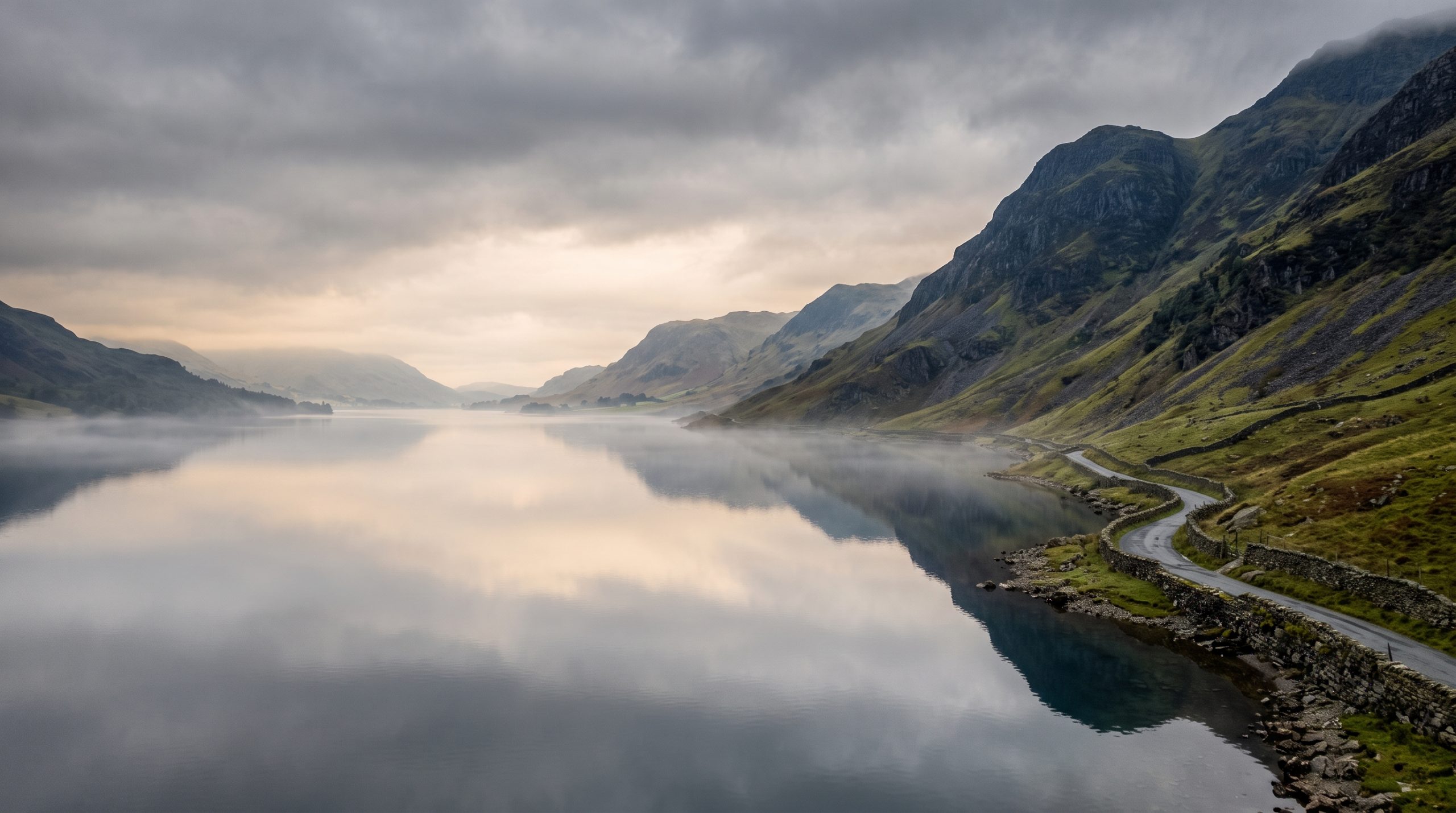
On the longest day of the year the sun comes up over Keswick at 04:36 and goes down at 21:53. Add the twilight either side and you have something close to nineteen hours of workable light, and at this latitude the sky never fully closes: at solar midnight in June the sun sits only about twelve degrees below the horizon, so there is a pale band along the northern fells all night. That one fact does more to shape what a Lake District elopement costs than any price list, because it decides how many days you actually need to buy.
The other thing worth knowing before you budget is that the Lake District is cut in two administratively. Keswick, Borrowdale, Buttermere, Cockermouth and Wasdale sit with Cumberland Council. Windermere, Ambleside, Grasmere, Coniston, Great Langdale, Glenridding and Kendal sit with Westmorland and Furness. Two registration services, two published fee lists, two separate diaries, and the valley you fall in love with decides which one you deal with.
Both services take registrar bookings up to two years ahead, which puts a 2027 date squarely in range now. Both also ask the same thing of you in writing: do not confirm and pay a venue until they have confirmed that a registrar can attend. That ordering matters more in Cumbria than almost anywhere, because the registrar’s diary, not the venue’s, is what actually fixes your date.
What we cover in Cumbria, and where it starts
We are a team of eight photographers and filmmakers covering elopements across the Lake District, with photography, film and planning as one service rather than three suppliers. Coverage starts at $4,900 for one full day with a dedicated photographer or a dedicated filmmaker. Team travel to Cumbria is included. Permit fees, celebrant, accommodation and vendors are yours.
A 04:36 sunrise in June, an 08:33 one in December
A June day in Borrowdale runs in two halves with a hole in the middle, and pretending otherwise is how couples end up exhausted by ten in the morning. Civil light arrives around 03:40. We rarely ask anyone to be standing anywhere at that hour, because the sun itself does not clear the eastern fells until 04:36 and the hour before it is grey rather than gold.
So the alarm goes at about 03:45 and we leave at 04:15. Latrigg, above Keswick, is ten minutes of driving and ten minutes of walking from town, and it looks straight down Derwentwater. Ashness Bridge and the road above it work the same way. Because the sun climbs at a shallow angle here, low light lasts far longer than it would further south, and we usually get forty to sixty minutes of it running along the fell sides rather than the fifteen you would get in the tropics.
By 06:30 the sun is high enough that the valley floor becomes the better place to be. Woodland above Watendlath, the becks, the shoreline at Calfclose Bay. Then, from roughly 10:00 to 16:00 in midsummer, the light on the tops goes hard and flat and the car parks at Honister and Buttermere fill up. We stop. You eat, and you dry your boots.
That dead window is exactly where we place the legal ceremony, and it is one of the more useful pieces of planning we do here. Registrars work the working day, so a civil ceremony at an approved premises tends to land between late morning and mid-afternoon anyway. Putting it there costs you nothing photographically, because we were never going to shoot the fells at noon.
At 17:00 we go back out, usually to a different valley from the morning one. Buttermere is the reliable choice: the lakeshore circuit is about four and a half miles and close to flat, and by six in the evening the day visitors have gone back over Honister. The last stretch, from 20:30 to sunset at 21:53, is the part most couples remember. Civil dusk follows around 22:50, which gives us the better part of an hour of afterglow with the fells going blue.
| Time of year | Sunrise | Sunset | Daylight | Shape of the day |
|---|---|---|---|---|
| Mid-June | 04:36 | 21:53 | 17h 17m | Two blocks, long midday break |
| Mid-May | 05:07 | 21:11 | 16h 04m | Two blocks, fewer visitors |
| Mid-October | 07:41 | 18:15 | 10h 34m | One continuous day |
| Late December | 08:33 | 15:48 | 7h 15m | Single push, low sun throughout |
Those times are for Keswick. Valleys with a high eastern wall, Wasdale and Great Langdale among them, lose their first direct sun a good while later than the table says, and we account for that per location rather than per date.
The shortest days, which some couples pick on purpose
Late December gives you seven hours and a quarter between sunrise and sunset, and the sun never climbs high enough to be a problem. The whole day reads like the last hour of a summer evening. No 03:45 alarm, no midday gap, one continuous run from 08:33 to 15:48 with a ceremony at 11:00 and good light still on the water at 15:30.
The trade is ground. The high passes over Honister, Wrynose and Hardknott open and close with the weather in winter, and Hardknott has sections at one in three, so we build December days on lakeshores, valley floors and low fells that stay reliably reachable. Catbells at 451 metres is a forty-minute walk from Hawes End and gives you the whole length of Derwentwater. Blea Tarn sits four minutes from its own car park.
What happens when the forecast turns
Seathwaite, at the head of Borrowdale, is the wettest inhabited place in England, with an annual average past 3,000 millimetres. Sprinkling Tarn above it collects more than 5,000. On the long-run averages, March to June are the driest months and October to January the wettest, which is why we push couples who want odds toward late spring rather than autumn.
Rain itself is not the problem, and low cloud tearing across a ridge is the frame most people drive past. The problem is committing a whole day to one valley. So we plan two, on opposite sides of the watershed, and Borrowdale and Buttermere are ten road miles apart over Honister with genuinely different weather on the same morning. Great Langdale pairs with Ullswater the same way. We hold both timelines, and we choose the night before or at first light, not three weeks out.
The ceremony location and the portrait locations stay separate decisions. That way a change in the weather never touches the legal part of your day, and the only thing that moves is where we walk afterwards.
If you already have a week in mind for 2027, send it over and we will tell you what the light does on those specific dates. Check Your Date
Why the film camera is already further up the path
Lakeland paths are single file for most of their length. The Catbells ridge, the steps beside Stickle Ghyll, half the Buttermere shore. Put a photographer and a separately hired videographer on that line and one of them is permanently in the other’s frame, or trailing behind and asking you to walk it again.
Because photo and film are one service for us, the line gets assigned before we leave the car park. The filmmaker walks two hundred metres ahead and shoots you coming into the lens. The photographer steps off the path and shoots up the slope, so the ridge reads as a ridge. Nobody repeats a walk, and nobody spends the morning negotiating.
The second reason matters more here than in most places: in Cumbria the interesting thing is usually moving. Cloud shredding off Great Gable, a squall crossing Derwentwater from the Newlands side, the light running up a ridge in about ninety seconds. Stills can imply that. Film shows it. With both cameras running we are not made to choose which version of those ninety seconds survives, and you can see how Lakeland weather behaves in our published galleries and films before you commit to anything.
Sound is the third. Every valley here has water in it, which is a gift to a film and a nuisance during vows, because a beck at close range and wind across a summit will both swallow spoken words. The Expedition includes professional audio for vows and the moments that matter, and we place those moments accordingly: in the lee of a drystone wall, or thirty metres back from the ghyll rather than standing over it. The wide shot of the waterfall still happens. It just does not happen while you are talking.
Aerials run where they are legal, safe and appropriate. Much of the classic ground, Borrowdale and Buttermere and Great Langdale included, is National Trust land, and commercial filming and photography there goes through the Trust’s film office. We confirm what is permitted before we design the film around it, rather than arriving hopeful.
There are eight of us, which is the quiet part of this. A second camera is on the ground, and there is always a colleague in reserve. On a ceremony that runs half an hour in one place, two cameras in two positions means you say your vows once.
Everything inside the fee
Every experience we run, in Cumbria and everywhere else, includes the following.
- Destination and location design for your specific dates, not a stock itinerary.
- Planning throughout, and a custom timeline built around that date’s real sunrise and real travel time between valleys.
- Permit research and logistics guidance, including which of the two registration services covers your valley and what each landowner requires.
- Weather alternatives and backup planning, which in the Lake District means a second valley rather than a second hour.
- Drone footage where it is legal, safe and appropriate.
- Team travel worldwide: flights, accommodation and ordinary travel for the assigned team, with no long-haul surcharge and no European exception.
- Highlights delivered in 5 days, and the full gallery or film in 3 weeks.
The Expedition adds professional audio for vows and meaningful moments wherever conditions allow. Guest numbers do not change the fee at all. They change access, permits, transport and timeline, which is a planning conversation rather than a pricing one.
Where coverage starts, and what Cumbria adds on top
The Adventure, the figure above, is one full day with either a dedicated photographer or a dedicated filmmaker. The Expedition is one full day with a dedicated photographer and a dedicated filmmaker working the day together, and starts at $7,900. The Odyssey runs two to seven days across one destination or several, and comes back as a custom proposal built around what you describe. All of it, including what is covered at each level, sits on our pricing page.
Travel to Cumbria is included in every one of those. We do not add flights, accommodation or transfers for our own team, and there is no separate line for getting to the Lake District from anywhere else in the world.
What you pay separately in Cumbria, in pounds:
- Ceremony and registrar fees, set by whichever service covers your valley and published by day of week rather than as one flat rate. At Westmorland and Furness, a renewal of vows or naming ceremony at an approved venue is currently £195 Monday to Friday, £275 on a Saturday and £365 on a Sunday, VAT included, while a weekday ceremony room at Kendal or Barrow is £130. Marriage and civil partnership fees are published separately by each service and reviewed annually, so a Wednesday date is worth asking about before a Saturday one.
- Notice of marriage fees, paid per person to a register office, plus the statutory waiting period between giving notice and the ceremony itself.
- Approved premises hire. A legal civil ceremony in England has to take place at a register office or at approved premises with the registrar present, so a fell-top exchange of promises is a celebrant-led or private moment and the paperwork happens somewhere licensed. Most couples we work with in the Lakes book a small licensed room or an approved venue in the valley and keep the fells for everything else.
- Celebrant, if you want words on the mountain as well as the signature in the register.
- Accommodation for yourselves, and any flowers, rings or dinner.
- Parking. National park car parks now run on a twenty-four hour tariff, the National Trust and local councils run others, and a handful of the remoter ones are still free. Small money, but it needs to be in someone’s pocket at 04:15.
- Landowner permissions where commercial filming or photography needs them, National Trust ground included. We do the research and the correspondence. The fee, if there is one, is yours.
- Unusual transport. A private boat rather than a timetabled launch on Derwentwater or Ullswater, a mountain guide for higher ground, a 4×4 for a farm track.
How a Lake District cost enquiry moves into planning
- You send the inquiry form with your date or your window, and the valleys you keep coming back to.
- We reply within 24 hours with an initial brochure.
- We write you a tailored proposal for your dates, your ground and the coverage that fits it.
- You sign the contract and pay a 30% retainer.
- Planning begins: location design, the timeline built around that date’s sunrise, permit research, the second valley.
- The remaining payments are set out in the proposal, so you know them before you sign anything.
If you are earlier in the process than that, our guide to how to elope covers the fundamentals that apply wherever you end up.
Who the fells reward
This landscape gives most to couples who will walk forty-five minutes uphill on wet stone in proper boots, carry the good shoes in a bag, and accept that we might change valley at six in the morning. Nobody needs to be a mountaineer. Catbells, the Buttermere shore and Blea Tarn all give you a great deal for very little effort, and we plan plenty of days that never go above 500 metres.
If a 03:45 alarm is not your idea of a good start, do not book June. Mid-October gives you sunrise at 07:41 and sunset at 18:15, which is a ten and a half hour day that begins at a civilized hour and holds low light most of the way through. If you want a night sky over Wastwater, that is a September to March conversation, because midsummer here never gets properly dark. And if you want the quietest version of the popular valleys, mid-May does more for you than mid-August ever will.
Tell us which of those matters most and we will build the day around it, or tell you honestly which month and which valley would serve it better. Our destination guides are a decent place to compare the Lakes against the other places we work before you write.
Common questions
Can we legally get married on top of a fell in the Lake District?
Not the legal part. A civil marriage in England takes place at a register office or at approved premises with a registrar present, so the register gets signed somewhere licensed. What happens on Catbells or at Blea Tarn is a celebrant-led or entirely private exchange of promises, and in our experience it is the part couples describe afterwards. We plan both halves as one day.
How much do registrar fees add on top of your coverage?
It depends on the day of the week and which of the two Cumbrian services covers your valley. As a working figure, Westmorland and Furness currently charges £195 for a renewal of vows or naming ceremony at an approved venue Monday to Friday, rising to £365 on a Sunday, and £130 for a weekday ceremony room at Kendal or Barrow. Marriage fees are published separately and reviewed each year.
Do you charge extra to travel to Cumbria?
No. Flights, accommodation and ordinary travel for the assigned team are inside the fee in every destination we work, and the Lake District is no different. There is no long-haul band and no European band.
Which month gives us the best chance of a dry day?
On long-run averages, March to June are the driest months in Cumbria and October to January the wettest. Late May and June combine that with the longest light of the year. Nothing here is guaranteed, which is why every plan we write has a second valley in it.
How far ahead should we book a 2027 date?
Both Cumbrian registration services take registrar bookings up to two years in advance, and both ask you not to pay a venue until a registrar is confirmed. Our planning calendar for Lake District currently covers 2027, 2028 and 2029, so for 2028 the practical order is to check registrar availability first and build the day around what comes back.
What actually happens if it rains from dawn to dusk?
We shoot. Low cloud on the Honister side while Buttermere sits clear is a normal Cumbrian morning, and the ten miles between them is our main tool. If both valleys are in it, we work the woodland, the becks and the shoreline, where rain improves the picture rather than ruining it.
Do we need a permit for the drone footage?
Aerials run on permissions and a time window rather than on luck. Much of the classic ground is National Trust land, where commercial filming and photography goes through the Trust’s film office, so we confirm what is allowed and when before the film is designed around it.
How soon do we see the photographs and the film?
Highlights reach you in 5 days. The full gallery or film follows in 3 weeks.
Your 2027 date, and how we begin
Somewhere in 2027 there is a Wednesday in late May when the sun comes up over Derwentwater a few minutes after five, the registrar diary is still open, and Buttermere has its shoreline to itself until nine. Working out which Wednesday is the first thing we do together.
From the first reply onward, the whole process stays in writing, at whatever hour suits you. You send the form, we reply within 24 hours with an initial brochure, and the planning runs by email from there, which means you are never waiting on us to be awake in the same time zone. Tell Us Your Story