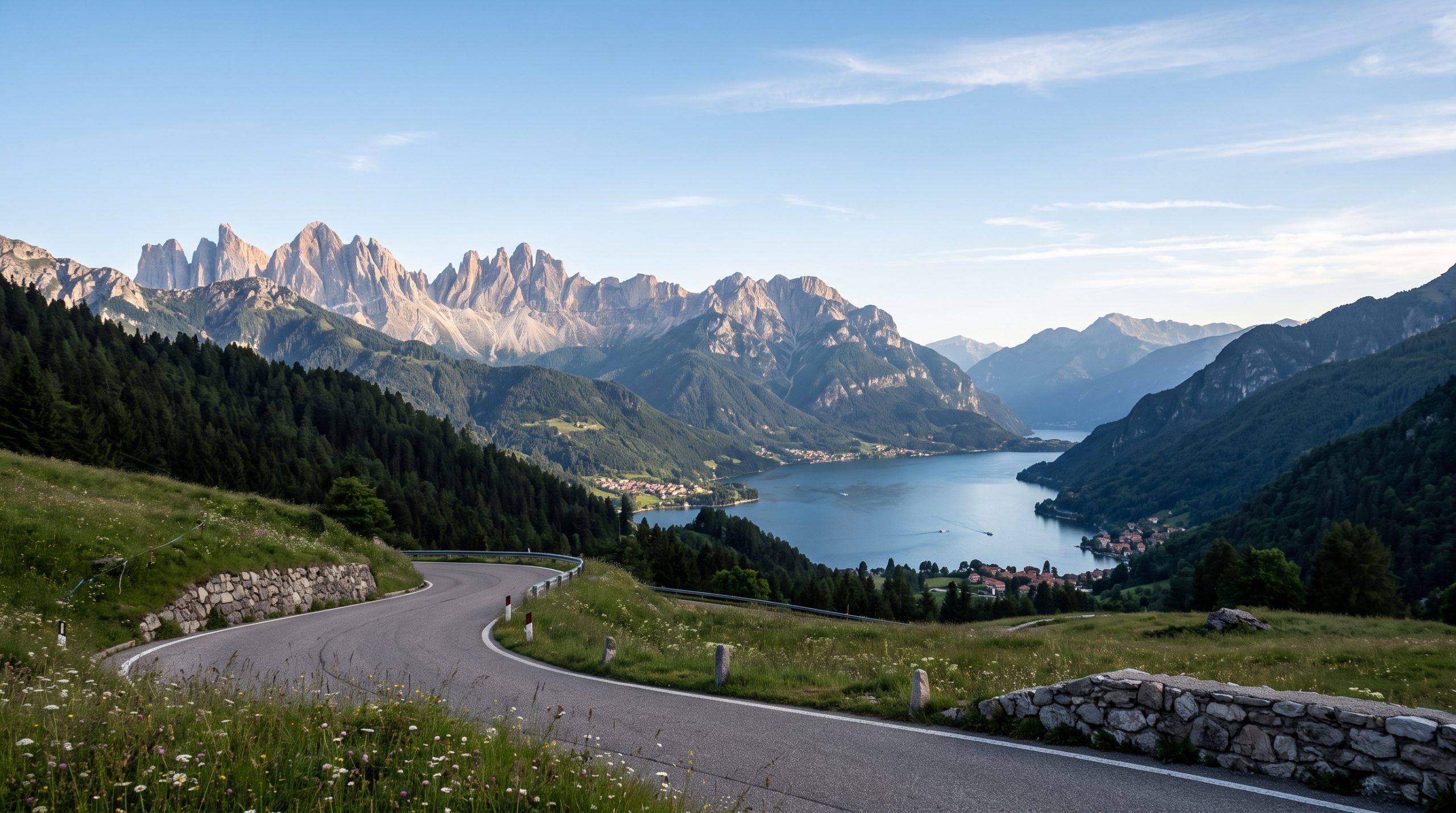
At 8:40 on a June morning we are driving the last switchbacks toward Compatsch, because at nine the road onto Alpe di Siusi closes to private cars and stays closed until five. Two days earlier the same couple stood on the slip at Varenna with coffee, watching the first car ferry come across from Bellagio.
Those two mornings sit about 450 kilometres apart, and that distance is the whole planning problem of this trip. It is solvable. Most couples just solve it in the wrong order, choosing villas and valleys first, then finding out that the drive between the regions eats a working day, that several of the Dolomite landmarks shut their access roads mid-morning through summer, and that the cable car to the finest ridge above Ortisei does not start turning until 8:30.
We build this trip in a fixed order, and it is not the order most itineraries get written in.
The two-airport version of this trip
Fly into Milan for Lake Como and out of Venice or Verona for the Dolomites, and give yourselves seven days at minimum: three nights on the lake, one full day for the 450-kilometre crossover, three nights in the mountains. Put the ceremony on your second full day in a region, never on an arrival or a driving day.
Milan to Varenna, and the first morning on the water
Rail is the honest answer for the lake half. The Malpensa Express runs airport to Milano Centrale in roughly fifty minutes, and Milano Centrale to Varenna-Esino takes a little over an hour, so Malpensa to the lakeshore is just over two hours with one change and no parking to solve. Driving it is about 92 kilometres, which a route planner will price at an hour and twenty minutes. We plan on two.
Once you are on the water, the middle of the lake works as one town with a channel through it. The car ferry links Bellagio, Cadenabbia, Varenna and Menaggio, and Varenna to Bellagio is a fifteen-minute crossing. Two details matter more than the timetable itself: weekdays and Sundays or holidays run on different schedules, and the operator’s own advice is to be at the ticket office about twenty minutes before departure, because summer queues form on the land side, not the water side. That is why we never hang a ceremony hour on one specific crossing.
| Base | Arriving without a car | What it costs you |
|---|---|---|
| Varenna | Train to Varenna-Esino, about an hour and five minutes from Milano Centrale, ferry slip a short walk downhill | Small and steep, and the lanes fill with day visitors from late morning |
| Bellagio | Train to Varenna, then the fifteen-minute ferry | The busiest promenade on the central lake between about 10am and 7pm |
| Menaggio | Como, then the C110 bus, a little over two hours from Malpensa | Quieter, but you commute by ferry to almost everything |
| Lecco side | Frequent trains from Milan, then a ferry to Bellagio of around an hour and a half | That ferry runs only from late March to early November |
For a first-light hour on the lake, we like the eastern shore around Varenna precisely because it is quiet at six in the morning and its lanes face the light. Bellagio at eleven is a lovely place to have lunch and a poor place to hold a ceremony.
The 450 kilometres in the middle
Route planners put Como to Cortina d’Ampezzo at roughly 450 kilometres and a little over four hours. Nobody drives it in a little over four hours. The route runs the A4 corridor past Bergamo, Brescia, Verona and Vicenza, which is Italy’s freight spine, and then climbs. Plan a full travel day with a real lunch stop, arrive in the mountains in daylight, and treat six hours as the working figure rather than the planner’s four.
If your mountain base is Val Gardena rather than Cortina, the drive leaves the A4 at Verona and turns north up the Brenner corridor toward Bolzano, which is faster road for longer and a gentler arrival. Either way, this is the day to hold nothing else. Pairing the crossover with an evening ceremony is technically possible and consistently a bad trade.
One rental car, picked up on the morning you leave the lake and dropped at the airport you fly home from, solves more than it costs. On the lake days you barely touch a car, and lakeside parking is a genuine sport. A one-way rental between two Italian cities is standard, and it is the single booking most worth making early, along with the flights.
The gates a route planner cannot see
This is the part that surprises people. Several of the best-known places in the Dolomites are governed by a daily access window rather than by driving time, and a map will show you none of it. Read this table as a timetable for your whole trip, not as small print.
| Place | The daily window | Booking |
|---|---|---|
| Alpe di Siusi access road, via the St. Valentin checkpoint | Closed to private cars 9am to 5pm every day. Open before 9am and after 5pm, and you may drive down at any hour | Parking at Compatsch runs on an online reservation, which you can make up to six days before arrival |
| Lago di Braies | In high summer, currently early July to mid-September, unbooked cars cannot use the access road between 9am and 4pm | Reserve parking in advance, or take the public bus, or simply arrive before the window opens |
| Ortisei to Furnes to Seceda cableways | Running roughly late May to early November, from about 8:30am to 5:30pm | Timed online slots with a limited number of tickets per half hour, so the good early slots go first |
| Passo Sella, 2,240 metres | Summer traffic-limitation days under the Dolomitesvives scheme have run from 9am to 4pm | Nothing to book, but it decides which morning you cross the pass |
| Tre Cime toll road above Misurina | Paid access road with its own opening hours and a parking system at the top | Check and pay ahead, and expect the top car park to be full by mid-morning in August |
Three consequences follow, and they shape everything we design in this region. Sunrise on Alpe di Siusi is a drive, not a cable car ride, because the road is open before nine and the lift is not. Sunrise on Seceda is a walk, because in June the first cabin leaves hours after the sun is up. And Lago di Braies at eleven in August is a queue with a lake behind it, which is why we go at six or not at all.
The most useful loophole is a legitimate one. Guests staying in accommodation up on the Alpe di Siusi plateau are outside the road restriction, so one night at Compatsch or Saltria converts a gated plateau into your own front garden for a whole morning and evening. It is often the single best booking of the mountain half.
Which valley you sleep in decides the day
The two mountain bases are not interchangeable. From Val Gardena, Ortisei and Santa Cristina and Selva put you inside reach of Seceda, the Alpe di Siusi plateau and Passo Sella, and the villages themselves have proper infrastructure for a wedding morning. From Cortina you are on the eastern side of the range, closer to Misurina, Braies and the Tre Cime road, in a town that feels like a resort rather than a farming valley.
What ruins schedules is assuming you can hold both. The pass roads between the two sides are magnificent and slow, all hairpins and 2,000-metre saddles, and an hour of map distance can be two hours of real driving behind a camper. Pick a side for the ceremony. If you want a taste of the other, we build it as a separate day with its own early start, which is exactly how our destination guides lay out multi-valley days.
Late June through September is the workable overlap for both halves of the trip. The Seceda lifts turn from late May to early November, the Alpe di Siusi cable car has shoulder closures in mid-April to mid-May and again from early November, and the summer car-ferry timetable on the central lake runs into early October. After mid-September the mountain access windows loosen and sunrise arrives at a humane hour.
What we lock first, and what stays loose
Locked early: the two bases, the crossover day, the flights in and out, any parking or lift reservation tied to a specific morning, and the permit paperwork for the locations you have chosen. Permit research and the applications are ours, and the fees themselves stay with you. Also locked: the ceremony hour, because it is calculated from the light rather than from convenience, and in the mountains that usually means early. Cloud builds over the ridges through the afternoon, and the best hour is often over before most weddings have started.
Held loose on purpose: the exact meadow, the exact ridge, the exact stretch of shoreline. Each primary location in our timelines carries a sheltered alternative roughly fifteen minutes away, chosen for a different wind direction and a different cloud base, and we decide the evening before on the forecast. That is the same principle we set out in our guide to planning an elopement, applied to a trip with two very different weather systems in it.
Two people on the ground changes what a gated morning can hold. On a day with a photographer and a filmmaker, we run two vehicles when the schedule crosses an access window: one of us is already up at Compatsch before nine, holding the position and reading the light, while the other stays with you through breakfast and the drive. Nothing waits on a single car, and there is a second full set of gear on the plateau. Our team travel is included in every destination, so that second vehicle is a planning decision rather than a line item. You can see how the two landscapes cut together in one story in our published galleries and films.
A full day with a dedicated photographer or filmmaker starts at $4,900 and a day with both working together starts at $7,900, with the two to seven day option and everything included set out on our pricing page. If you already know which region you want the vows in, and which one is the adventure day, Send Us a Message with your dates and we will build the timeline around the gates rather than against them.
Aerials over the lake and over the parks
Italy flies under the European framework with ENAC’s national rules layered on top, so a drone operator registers through the ENAC D-Flight portal, open-category flying stays within 120 metres of the ground, and the aircraft stays in sight. Alpe di Siusi sits inside the Sciliar-Catinaccio nature park and Seceda inside Puez-Odle, and park permission is a separate question from the aviation one. We confirm both before we plan a sequence around aerials, and we design every film to stand up without them.
Common questions
How many days do we need for Lake Como and the Dolomites in one trip?
Seven is the working minimum: three nights on the lake, a full day for the 450-kilometre crossover, three nights in the mountains. Nine or ten days is more comfortable and buys you a second full day of coverage in the second region instead of one hurried morning.
Can we drive up to Alpe di Siusi for sunrise?
Yes. The access road is open to private cars before 9am and after 5pm, and driving down is allowed at any hour, so a sunrise start is a drive rather than a cable car ride. Reserve the Compatsch parking online, up to six days ahead. Between 9am and 5pm the plateau is reached by cable car or bus, and guests staying up there are exempt from the restriction.
Do we need a car on Lake Como if we are driving to the Dolomites afterwards?
Usually not for the lake days. Trains reach Varenna-Esino in a little over an hour from Milano Centrale and the car ferry crosses Varenna to Bellagio in fifteen minutes. We normally pick the rental up on the morning of the crossover and drop it at the airport you fly home from.
Which months work for both the lake and the mountains?
Late June to September. The Ortisei to Seceda cableways run from late May to early November, the Alpe di Siusi cable car closes in the mid-April to mid-May shoulder and again from early November, the busiest access restrictions at Lago di Braies fall between early July and mid-September, and the central lake keeps its summer car-ferry timetable into early October.
Are drone shots possible in the Dolomites nature parks?
Sometimes, and it depends on the park as much as on the airspace. Registration through ENAC’s D-Flight portal, a 120-metre ceiling and visual line of sight are the baseline, and areas such as Sciliar-Catinaccio and Puez-Odle also answer to their park authority. We confirm the answer for your specific locations before aerials go into the plan.
How far ahead should we be booking all of this?
For late June to September, lock accommodation on both sides and the one-way car nine to twelve months out, because the good small hotels in Val Gardena and on the lake are the constraint. Lift slots open closer in, and Compatsch parking only six days ahead. On our side, a signed contract and a 30% retainer start the planning, and we are currently booking 2027, 2028 and 2029.
When do we see the photos and the film?
Highlights land five days after your day. The full gallery or film follows within three weeks, which for most couples means it arrives while they are still unpacking.
Seven days, two landscapes, one timeline
Write to us with your rough window, the two regions in whichever order you are imagining them, and one line about what you actually want the mornings to feel like. Everything we do runs in writing, start to finish. Send the inquiry form and a reply with our initial brochure comes back within 24 hours, then a tailored proposal with the timeline sketched around real light and real drives. Tell Us Your Story.