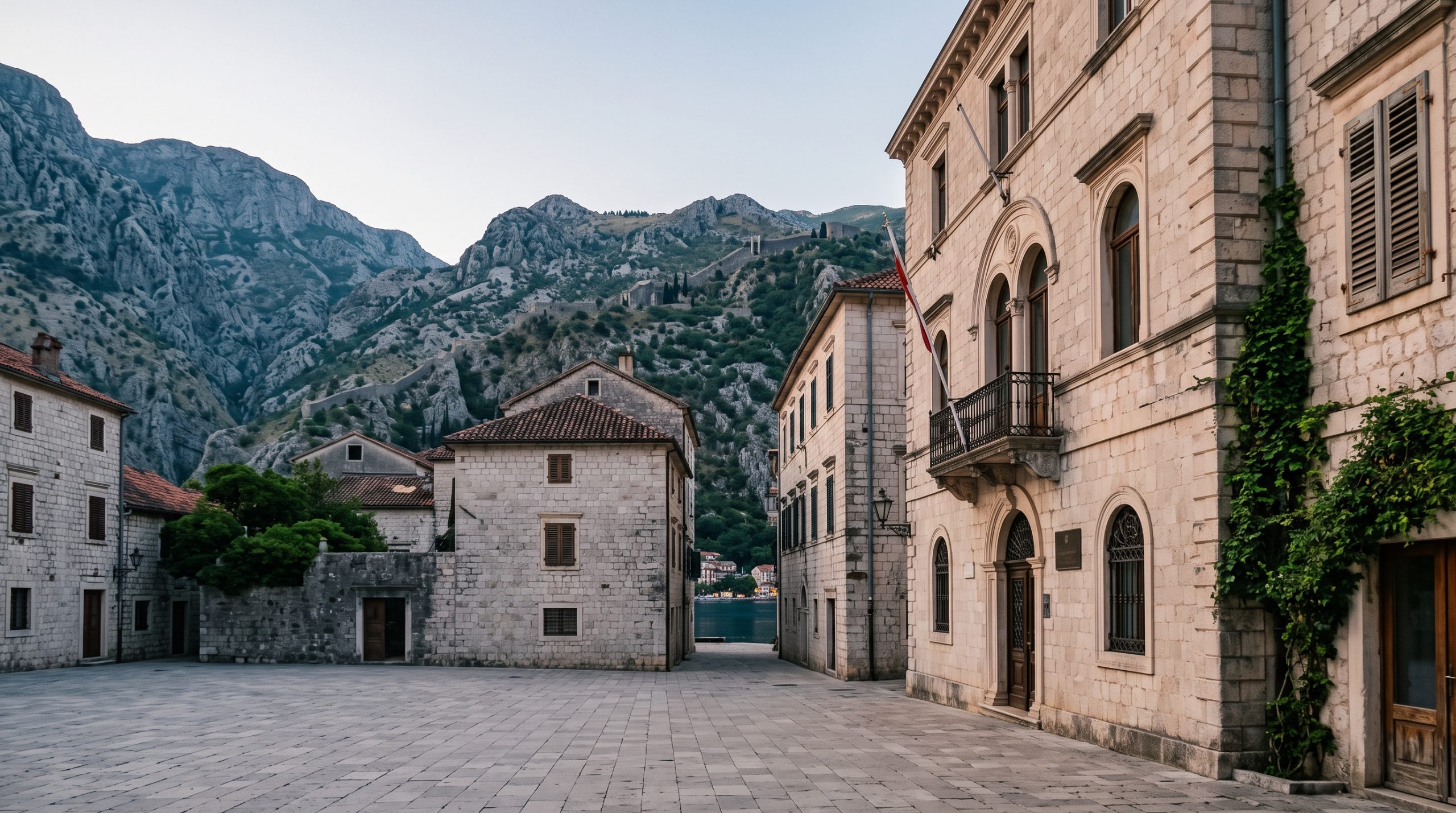
The legal part of a Kotor wedding starts long before you see the bay. The registrar wants your application at least fifteen days before the date you want to marry, and one of the documents in that file has a three-month shelf life, which means the ordering has to be timed rather than simply started early.
None of it is hard. It is a chain, and the chain only breaks in predictable places: a certificate ordered too soon, an apostille left until the month of the flights, a translation nobody booked. Get the sequence right and the legal half of the morning is over before the first cruise ship has finished tying up below the walls.
Here is what the Kotor process actually asks for, in the order it asks for it, with both fees, the deadlines that cannot move, and the alternative route a lot of couples take once they see how their calendar falls.
Fifteen days, three months, and two fees
Visiting couples can marry legally in Kotor. You apply to the municipal registrar at least fifteen days before the date, with a free-to-marry certificate less than three months old, apostilled and translated, plus passports, witness ID copies and proof of registered residence. The fee is twenty euros in the office, one hundred outside it.
Why Kotor is manageable when the file starts early
On a scale that runs from straightforward to not realistically available to visiting couples, Kotor sits comfortably in the middle. You do not have to have lived in Montenegro to marry there, though you do need a registered address while you are in the country. What there is, is a short chain of documents that have to arrive in the right condition, in the right language, inside the right window.
The step that catches American couples out is not the apostille. It is the three-month life of the free-to-marry certificate. That one date governs when you order everything else, because the certificate has to be under three months old on the day the application is lodged, and it still needs its apostille and its translation before that day arrives.
The second thing worth knowing early is that one item in the file is Montenegrin. The registrar asks for proof of registered residence issued by the Ministry of Interior, so where you are staying in the bay is part of the paperwork rather than a detail you tidy up on arrival. That single requirement shapes how long you are in the country before the date, and it is the most useful thing to settle before you choose them. If you are still working out the overall shape of the trip, our guide to planning an elopement covers the parts that behave the same way everywhere.
We are photographers and filmmakers, not lawyers. Rules change and circumstances differ, so confirm the detail with the Kotor registry office or your own consulate before you book flights.
The paperwork, in the order you have to get it
Kotor’s Secretariat for General Administration is the office that runs the marriage procedure, keeps the register of marriages and issues extracts from it. Everything below ends up on a desk there. The order matters more than the length of the list.
- Passport copies, including your witnesses. Clear photocopies of both of your passports, plus the passports or IDs of the two witnesses. The witness copies go in with the application, not on the morning, so the two people standing beside you are a decision made weeks ahead.
- A birth certificate each. This comes from the authority that recorded your birth. The US Embassy in Podgorica is explicit that it issues neither birth certificates nor apostilles, so nothing in this step can be solved once you are in Montenegro.
- Proof that you are free to marry. For American couples this is a free-to-marry statement or another proof of unmarried status, and it cannot be older than three months on the date you apply. Couples on other passports get the same thing under a different name, such as the certificate of no impediment in the United Kingdom. If a previous marriage ended, the document that ended it travels through the same route as the rest.
- Apostilles on anything issued abroad. A free-to-marry document issued in the United States needs an apostille from the state that issued it. There is one useful exception: the version issued by the US Embassy in Podgorica as a notary service does not need an apostille at all, and the embassy takes the request by email.
- Certified translation into Montenegrin. Montenegro’s tourism authority puts it plainly for foreign couples: you hand in the original certificate and a certified translation together. Translation happens after the apostille, because the apostille is part of what gets translated.
- Proof of registered residence. Issued by the Montenegrin Ministry of Interior, this is the piece that ties your file to an address in the country.
- The administrative fee. Twenty euros for a ceremony in official premises, one hundred euros for one outside them. It goes to the municipality’s bank account, which makes it a transfer to organize rather than a card tapped at a counter.
Work back from the Kotor ceremony date
The real minimum is short. Fifteen days between the application and the ceremony, and an apostille that comes back in whatever time your state takes. The comfortable minimum is longer, and it is the one we work to, because it leaves room for a document to be re-ordered without anyone rebooking a flight.
| Counting back | What happens | Room to move |
|---|---|---|
| Four to six months | Date held with us, birth certificates ordered at home | Plenty. This is the comfortable end and where we like to start |
| Around three months | Free-to-marry certificate issued, then sent for apostille | This is the window that matters. Order it earlier and it ages out before the application |
| Once the apostille returns | Certified Montenegrin translation prepared | Depends entirely on the state’s processing time, which is why the apostille goes first |
| Fifteen days | Application lodged with the Kotor registrar | None. This is the floor |
| On arrival in the bay | Proof of registered residence, fee transferred to the municipality | Little. Both are local steps with local hours |
| Ceremony day | Two witnesses, passports, a file already checked and complete | None, and that is the point of the four months |
Six details that catch couples out
These are the ones that turn a calm week into a scramble. All of them are easy to get right once somebody has told you they exist.
- The three-month clock runs to the application, not the wedding. Couples order the free-to-marry certificate the moment they get engaged, then discover it has expired by the time the file goes in. Work backwards from the application date instead.
- The office wants the original. The instruction for foreign couples is to hand over the original certificate together with the certified translation. If you will need that same document at home afterwards, order two while you are ordering one.
- Where you stand decides the fee, not how elaborate the ceremony is. Twenty euros inside official premises, one hundred outside them. An eighty-euro difference is what separates a room from a terrace above the water, which is the cheapest upgrade in the whole file.
- The Podgorica shortcut has a drive attached. The free-to-marry document issued by the US Embassy skips the apostille entirely, which is a real saving of weeks. The embassy is in Podgorica, roughly ninety kilometers inland from the bay, and the request goes in by email first.
- Registered residence means your accommodation is part of the file. Book the place you are staying before you finalize the legal timeline, not after.
- Your witnesses exist on paper before they exist in the room. Their ID copies are submitted with everything else, so a friend who decides to fly out three days beforehand is a lovely surprise and not a witness.
Fees and deadlines quoted here were correct at the time of writing and are worth re-checking with the office that issues them. Government, venue and landowner permit fees are always paid by you directly; the research and the guidance around them are part of what we do.
Sign at home and hold the ceremony on the bay
A large share of couples who marry in the Bay of Kotor sign the legal papers in their own county first and treat the day here as the wedding itself. This is not a consolation prize, and it is not a lesser version of anything. It is a calendar decision that buys back the two things Kotor makes expensive: the hour of the day, and the place you stand.
Kotor is a working cruise port. Ships come alongside a few minutes from the old town gates, and from mid-morning through late afternoon in summer the marble lanes carry a great deal of foot traffic. The town is also boxed in by mountains, which means the sun arrives late over the eastern ridge and leaves the water early behind the western one. The hours that actually photograph well are narrow, and they are early. If the ceremony hour is set by an office diary, those hours are harder to reach.
| Part of the day | Legal ceremony in Kotor | Married at home first |
|---|---|---|
| Documents | Free-to-marry certificate, apostille, translation, residence proof, fifteen-day application | Whatever your own state asks for |
| Fee to the municipality | Twenty euros in the office, one hundred outside it | None |
| Where you can stand | Official premises, or a location arranged with the office at the higher fee | Anywhere you can lawfully be |
| Hour of the ceremony | Set with the registrar | Chosen from the light |
| Witnesses | Two, with ID copies filed in advance | Yours to decide, including nobody |
| How the day looks and sounds on camera | No different | No different |
The bay gives you options inside a short drive either way. Perast sits about twenty minutes up the coast road, a single street of stone houses with two islets lying flat on the water in front of it, and it is quiet at six in the morning in a way the old town is not. The Verige strait narrows to a few hundred meters just beyond it, which is why the ferry crossing there takes minutes rather than the better part of an hour around the shore.
Both routes work. Tell us which one you are leaning toward and we will build the day around it, or tell you honestly which month in the bay suits the shape you have in mind. Perast at first light with the two islets sitting flat on the water is a different morning from the old town at nine, and both are twenty minutes apart by road.
Where our planning meets the Kotor registrar
We are not lawyers and we do not file anyone’s paperwork. What we do is plan the day around the constraints the file creates. We hold your date, we research the permits your locations need, we build the timeline backwards from the light rather than forwards from breakfast, and we keep a weather alternative in the pocket for the mornings the bay comes in grey. Destination and location design, planning, permit research and logistics guidance sit inside every experience we run, and so does our team’s travel to Montenegro.
The ceremony hour is where photography and film stop being two separate bookings. On an Expedition, a photographer and a filmmaker work the same hour together: one of them on the registrar’s table and the signatures, the other already turned around on the reaction, with audio running for the vows where conditions allow. There are eight of us, so there is always a second camera on the ground and a colleague in reserve. You can see how bay-and-mountain light behaves in finished work in our published elopement stories and films, which is a more honest preview than any description of a location.
Coverage, what is included and how the day is structured are all set out on our pricing page. Highlights reach you five days after the day itself, and the full gallery or film at three weeks. We are booking 2027, 2028 and 2029, and the Kotor calendar behaves differently in April than it does in August, which is worth raising early. If you have a date in mind, Check Your Date with us and we will tell you what the light does that week.
Common questions
How far in advance do we have to apply to get married in Kotor?
At least fifteen days before the date you want, with the municipal registrar in the town where you are marrying. That is the legal floor rather than a plan. The free-to-marry certificate has to be under three months old when the application goes in, and it needs an apostille and a translation before that, so we work to a four-month runway.
How much does the Kotor registry office charge for a civil ceremony?
Twenty euros for a marriage in official premises and one hundred euros for one outside them, paid into the municipality’s bank account rather than handed over at a desk. Montenegro uses the euro, so there is no separate currency to organize. Any venue or landowner fee for your chosen location sits on top and is paid by you directly.
Do we need to be in Montenegro before the wedding day?
Part of the file is a Montenegrin document. Proof of registered residence comes from the Ministry of Interior, which means your accommodation in the bay is part of the paperwork rather than a separate matter. Plan to be settled in Kotor comfortably ahead of the date instead of landing the night before.
Does our American paperwork need an apostille for Montenegro?
Documents issued in the United States do. A free-to-marry certificate issued at home carries an apostille from the state that issued it. The one exception worth knowing is the version issued by the US Embassy in Podgorica, which needs no apostille, though the embassy cannot issue birth certificates or apostilles for anything else.
Can two women or two men marry at the Kotor registry office?
Montenegrin marriage law is written around a man and a woman. Montenegro has recognized same-sex life partnerships since 15 July 2020, and registering one requires at least one partner to be a Montenegrin citizen. Visiting same-sex couples therefore complete the legal marriage at home and hold the ceremony in the bay, which changes nothing at all about the day we plan and photograph.
Is a church wedding in Kotor legally binding?
The civil ceremony in front of the registrar is what creates the marriage in Montenegro. A religious service can sit alongside it, before or after, but it does not register anything by itself. Couples who want both usually keep them on separate parts of the same day.
Where do we get extra copies of our Montenegrin marriage certificate?
From the same office. Kotor’s Secretariat for General Administration keeps the register of marriages and issues extracts from it, so certified copies come from the desk that handled your file. Ask for more than one while you are still in town, because requesting them from an ocean away is slower than requesting them from the old town.
Choosing the hour, then the date
Most couples plan this backwards. They fix a date, then find out what the bay does at that hour in that month. The better order is to decide what you want the morning to feel like, let that choose the hour, then let the hour choose the date the registrar writes down. Everything else in the file is a sequence, and sequences are easy once someone has walked them before.
Send us the outline of what you have in mind and we will reply with a brochure and honest notes within a day. Everything we do runs in writing, so you can read, think and answer at whatever hour suits you. When you are ready, Tell Us Your Story and we will start with your date and the light on it. If you are still comparing places, our destination elopement guides are the next stop.