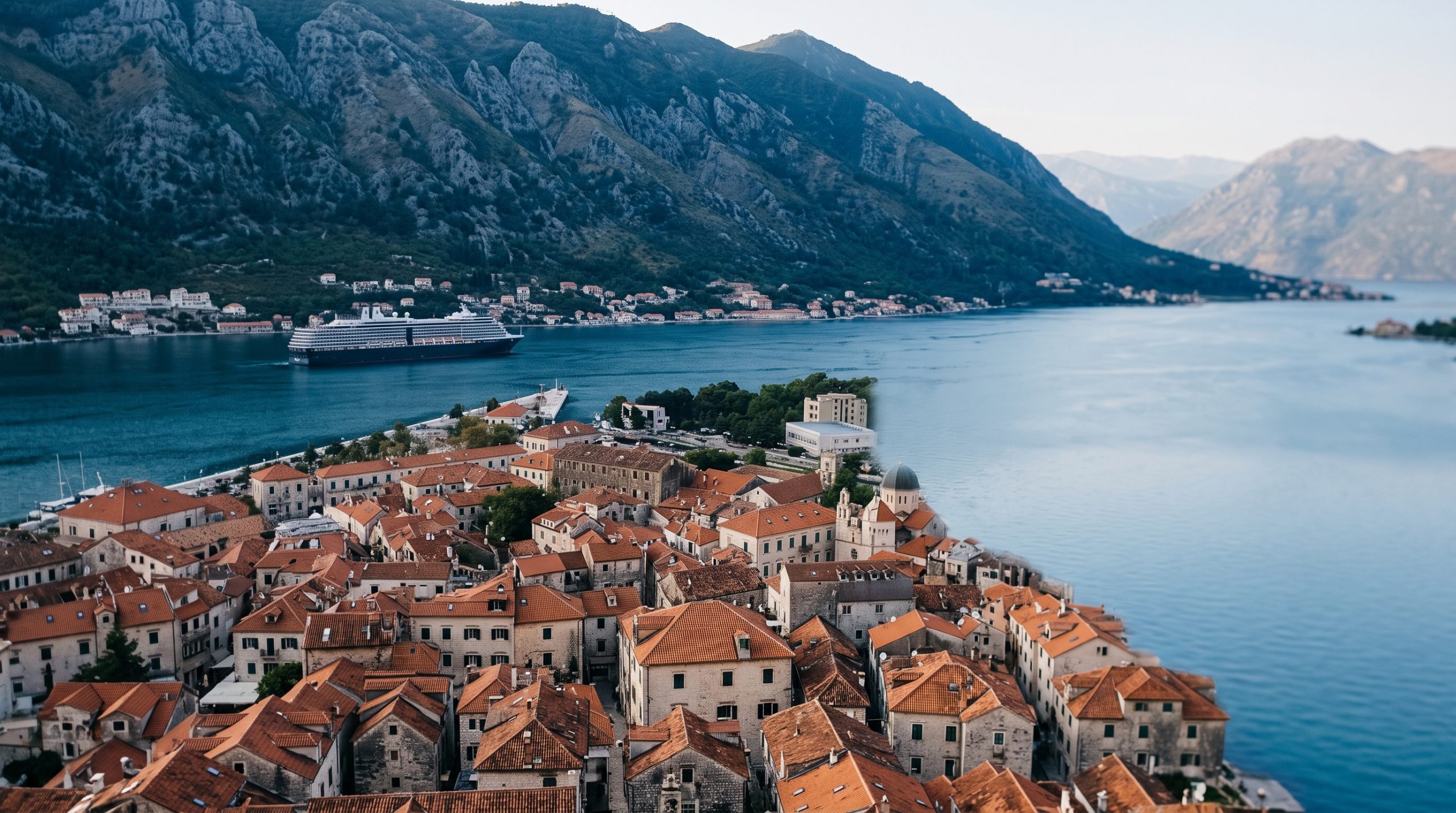
At twenty past six on a September morning the Kotor waterfront belongs to one man hosing down a cafe terrace and to the water, which is flat enough to hold the whole west shore upside down. By half past ten the same fifty meters of quay carries a queue for the wall steps and four raised umbrellas on poles. Nothing about the town changed overnight. A ship arrived.
The Port of Kotor publishes its own numbers and they are blunt: 476 cruise ship arrivals and 586,403 cruise passengers in 2024, against 226,479 people who stayed overnight. More than twice as many visitors came for a day as came for a night. That is the planning problem in one line, and it is also the solution, because every one of those arrivals was published in advance with a date, an hour and a passenger figure attached.
You do not have to guess which day in Kotor will be quiet. You can look it up two or three seasons out, before you book a flight or a house on the bay. Here is how we read that list when we are building a day here.
How to read a Kotor ship day before you pick a date
Open the Port of Kotor cruise pages and add up the passenger capacity announced for your date, not the number of ships. Then read the departure hours. A date with fewer than a thousand announced berths, and nothing listed past early evening, gives you a town that empties out well before dinner.
What one line of the arrivals list is really telling you
Every line on the schedule holds the same five things: the ship, the line that operates it, the date, the hours it is due in and out, and the number of passengers it can carry. That last figure is a ceiling rather than a headcount, but it scales honestly. A ship rated for 3,900 people and a ship rated for 400 do not produce the same town, and the published range in Kotor runs across that whole span, from small sailing ships carrying a couple of hundred to the largest ships approaching four thousand berths.
The common mistake is counting hulls. Three small ships on one date can be a quieter morning than one large ship on its own, and a date that looks busy at a glance can be the best one of the week. Add the berths. The number you want is the total.
Arrival hours cluster tightly. Most ships are due in at seven or eight in the morning and out again between late afternoon and early evening, so the working day of a cruise arrival is long, and it lands almost exactly on the hours when the inner bay is in flat direct sun anyway. Read the departure column as carefully as the arrival column. A ship listed out at 23:59 is staying the night, and the evening streets you were counting on will not be empty.
| What the line says | What that is on the ground | What we do with it |
|---|---|---|
| Arrival 07:00 or 08:00 | The first people reach the Sea Gate within about half an hour of the gangway going down | Ceremony done and the rings on before the first group crosses the square |
| Departure 17:00 to 19:00 | The streets start thinning an hour before, as passengers head back aboard | We keep the second half of the day for the Old Town rather than the first |
| Departure listed 23:59 | An overnight stay. The evening does not clear | Evening hour moves across the water to Muo, Prčanj or Perast |
| One ship, 3,900 berths | One sustained load through the middle of the day | Dawn in town, mid-morning on high ground, back down for dusk |
| Three ships, 900 berths between them | Barely readable as a busy day | Normal shape, with the wall steps back on the table |
| Anchored off rather than alongside | People come ashore in tender loads across the morning, not one surge | Longer usable window at the start of the day, shorter at the end |
Port schedules run two and three seasons ahead, which is the same horizon we work on. We are currently booking 2027, 2028 and 2029, and dates in the nearer of those years already have ships and passenger figures attached to them. If you are still choosing a week rather than a day, that list beats any general advice about seasons, including ours. The rest of the sequence, from first inquiry to the shape of the day itself, sits in how an elopement actually comes together.
Dawn on the west shore, last light on the rock face
Kotor sits at the base of a limestone wall that rises almost vertically off the back of the Old Town. On 15 September the almanac gives sunrise at 06:24 and sunset at 18:55, and neither hour means on the quay what it means on paper.
In the morning the sun comes up behind that wall, so the first thing it touches is whatever faces it from across the water: the east-facing hillsides at Muo and Prčanj and the ridge above them. The Old Town lanes stay in deep shade for a long time after the sun is technically up, which is the single best thing about a ceremony inside the walls at that hour. Nothing is squinting, nothing is blown out, and the stone reads warm rather than white.
In the evening it reverses. The sun drops behind the Vrmac ridge across the bay roughly an hour before the almanac says it sets, the streets go blue, and the last warm light of the day sits high on the rock face and the fortification walls above the town. The town is dark and the mountain is glowing. You can see how the bay behaves at both ends of a day in our published elopement films and galleries.
| Mid-September hour | The town | Where we would be |
|---|---|---|
| 05:40 | Dark. Bakery lights and a street sweeper | Driving the west shore road, setting up facing back at Kotor |
| 06:24 | Sunrise on paper. Hillsides opposite light up, town still in shade | First frames across the water, then into the Old Town lanes |
| 07:30 | Gangway down. Cafes putting out chairs | Vows in a shaded lane or a small church courtyard |
| 09:30 | Direct sun finally on the quay. Square filling | Gone. On high ground above the bay or out toward Perast |
| 17:00 | Ship departing. Coaches loading | Back down, unhurried, town emptying as we arrive |
| 18:00 | Streets in shade, fortification walls still lit | Rooftop or high lane, shooting the glow above the town |
| 18:55 | Sunset on paper. Water goes silver, then blue | Waterline, long lens, lights coming on behind you |
The overlap with the ship schedule is almost too neat to be true. The hours the bay is empty are the hours the light is worth working in, and the hours the quay is under hard midday sun are the hours several thousand people are ashore.
Where the bay road slows the clock: Verige, the shore road and the coach hour
The Bay of Kotor is a chain of basins joined by narrow necks, and the road traces the waterline of every one of them. A route planner reads that as an ordinary two-lane road and hands you a confident number. On a morning with two ships in, plan on roughly double it. The shore road through Dobrota and Muo runs along house frontages with no bypass and nowhere to overtake, and it carries the excursion coaches, the tender traffic and the local school run at the same hour.
The one genuine shortcut is the ferry across the Verige strait between Kamenari and Lepetane. The crossing itself takes about five minutes and saves roughly 30 km against driving around the head of the bay through Risan and Perast. A car ticket is currently around five euros, pedestrians and cyclists cross free, and the boats run through the night at a reduced frequency. The crossing is never the variable. The ramp queue is, and in high season it is worth building fifteen minutes of slack into any plan that crosses it.
Something that looks good on a map and is not worth doing: driving the old serpentine road up toward Njeguši for the view over the bay in the middle of a ship day. Early it is one of the great roads in Europe, with the whole bay unfolding below you switchback by switchback. Between mid-morning and mid-afternoon you spend the climb backing into passing places for descending traffic, and the famous viewpoint has a minibus parked across it. Same view at 06:30, nobody on it.
One more timing detail that catches people out: the ticket booths at the fortification entrances open at eight in the morning in season, which is close enough to the first arrival hour that the wall steps go from empty to shared very quickly. We treat the climb as a light-ship-day option, not a default. More of how we think about routes like this along the Adriatic sits in our destination elopement guides.
What we change when the list says two ships
A heavy date is not a lost date. It is a date with a different shape, and most of the shaping happens months before anyone lands in Montenegro.
We move the ceremony hour clear of the arrival window rather than trying to outrun it. We hold a second location on the opposite shore, close enough to reach in the time between two frames and quiet regardless of what is tied up at the quay. We time nothing important to sit next to a ferry departure or a coach hour. And we build the timeline on ship-day drive figures rather than the ones a phone gives you, which is usually the difference between a calm morning and a morning spent apologizing to a celebrant.
The other thing that changes on a bay day is how many of us are working. With a dedicated photographer and a dedicated filmmaker both assigned, we run two vehicles. While one of us stays with you on the waterfront, the other is already at the next spot, seeing whether the light and the crowd are what the plan assumed and sending word back if they are not. On a coastline where a wrong turn costs twenty minutes of shore road, that is the difference between arriving to a plan and arriving to a surprise. A full day with photographer and filmmaker working together starts at $7,900, and the rest is on our pricing page.
Guest count does not move the fee. It moves access, permits, transport and how long it takes to get eleven people down a lane, all of which we build into the timeline instead. Tell us the week you are looking at and we will read the schedule against it before you commit to anything. Send Us a Message
Aerials over the bay, and the ridge where they stop
Aerial work in Montenegro runs on approval from the Civil Aviation Agency, which clears the flight and the pilot as two separate items, with liability insurance forming part of the file. We open that paperwork at the planning stage rather than the week of the date, and we design a film around aerials only once it is confirmed. Lovćen National Park does not permit drone flying, so the high ridge above the bay is a ground location for us and the aerials stay over the water.
There is a scheduling reason to care as well. A large ship alongside the Kotor quay fills the middle of every wide aerial of the inner bay, and no amount of framing hides it. If aerials matter to you, that hour goes before the first arrival or after the last departure, and the published list tells us which of the two windows is longer on your date.
Common questions
How far ahead is the Kotor cruise ship schedule published?
Two to three seasons ahead. Dates in the nearer years already carry ship names, hours and passenger figures, and the further years fill in steadily. The arrival pattern itself barely moves from year to year, so for a date two or three years out we plan on the pattern first and confirm the specific ships as the list populates.
Is one big ship worse than three small ones in Kotor?
Usually, yes. Count berths rather than hulls. One ship rated for 3,900 passengers puts far more people through the Sea Gate than three ships of three or four hundred, and it does it in a single load rather than three small ones spread across the morning.
What time do cruise passengers actually leave Kotor?
Most departures are listed between late afternoon and early evening, and the town starts thinning about an hour before that as passengers head back aboard. The exception is a departure listed at 23:59, which means the ship is overnighting and the evening streets stay busy.
Is Perast quieter than Kotor when a ship is in?
Not automatically. Perast is one of the standard excursions from a Kotor arrival, the boats out to Our Lady of the Rocks run all morning, and the waterfront is small enough that a single coach fills it. It is a better bet in the evening than at eleven in the morning.
Do we need a completely ship-free date for good photos in Kotor?
No. The hour does more work than the date. On the heaviest date of the season the Old Town before eight in the morning is still yours, and the light in the bay at that hour is better than anything the middle of the day offers. A light list widens the options rather than creating them.
Can you fly a drone over the Bay of Kotor for our film?
With approval from the Civil Aviation Agency covering both the flight and the pilot, and insurance in place, yes over the bay itself. Not inside Lovćen National Park, which does not permit drone flying. We confirm the approval before we plan any part of a film around aerials.
Bring us three dates and we will read the list
Bring us three candidate dates, or even three candidate weeks, and tell us what you want the day to feel like. We will read the published arrivals against each one and tell you honestly where the emptier town is worth more than the convenient date. The rest stays on email: brochure first, then the proposal, with the signed contract and 30 percent retainer opening the detailed planning. Highlights are back five days after the day itself and the full gallery or film within three weeks. Check Your Date