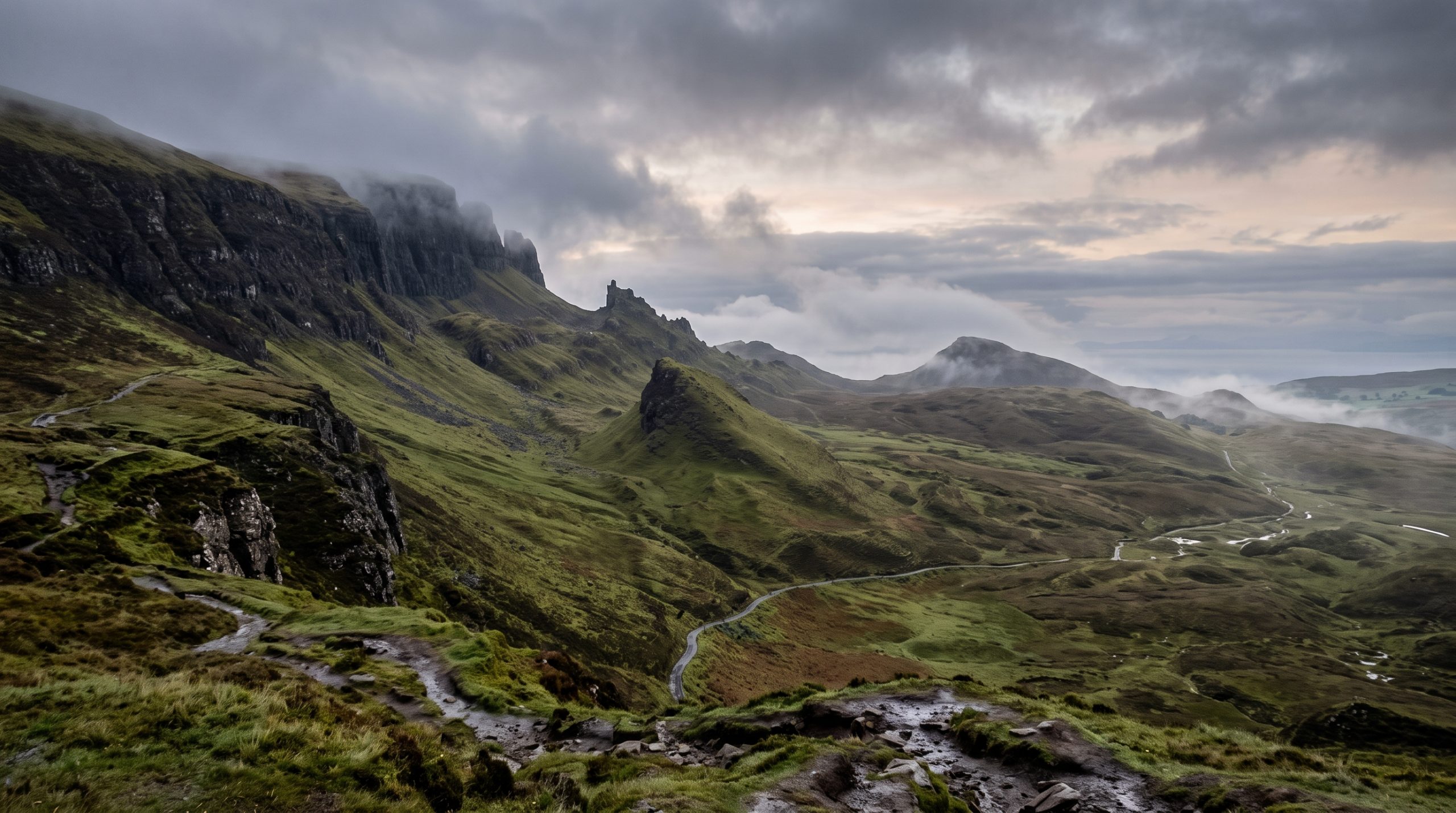
The drive from Inverness Airport to Portree is 112 miles, and the island’s own travel guidance puts it at about two and a half hours when the roads are quiet. In late July, behind a motorhome on the A87 with a stop at Eilean Donan you did not plan, it is closer to three and a half. That gap between the number on the screen and the number on the clock is most of what planning a Skye elopement really is.
The rest is paperwork with a 29-day floor under it, a handful of car parks that fill by late morning, and light that behaves completely differently in June than in late September. None of it is difficult. All of it rewards knowing the numbers before you book flights.
The 29-day rule, the airport and the drive
Fly into Inverness, allow three hours to Portree rather than the two and a half a route planner shows, and give the Highland Council registrar notice at least 29 days before your date, ideally 10 to 12 weeks. Four nights on the island is the shortest stay that works. Almost everything else follows from those four numbers.
What the Highland Council registrar needs, and when
Scotland is one of the easier places in Europe to marry outdoors, and that is a legal fact rather than a marketing line. A religious or belief celebrant, humanists included, can solemnise a marriage anywhere. A registrar can conduct a civil ceremony at a place agreed with the registration authority. There is no approved-venue list to design your morning around.
You each complete a marriage notice form, separately, and send it to the registrar for the district where the ceremony will take place. Anywhere on Skye, that is Highland Council. The earliest you can give notice is three months before the date, and the legal minimum is 29 days. Highland Council’s own advice is 10 to 12 weeks, and that is the number to plan on, because 29 days leaves no room if a document has to be sent again.
The notice fee is currently £45 per person, and notices go in by post or in person by appointment. The registrar then issues your marriage schedule, the document your celebrant signs and the one piece of paper that cannot be improvised. It reaches you in the days before the ceremony, in office hours, which is a solid reason not to put your date on the morning after you land. If the sequence is new, our guide to how eloping actually works takes it from first email to signed schedule.
What you will not need is a folder of site permits. Most of the ground you came for sits under Scotland’s statutory right of responsible access, set out in the Scottish Outdoor Access Code. Where a landowner, croft or car park operator does want to hear from someone first, that research is ours. Any fee they charge is yours.
Getting to the island: Inverness, the bridge and the Mallaig ferry
Skye has no scheduled passenger flights, so every route ends in a drive. Inverness is the closest useful airport, which for most American couples means a hop from London, Manchester or Amsterdam onto a small aircraft. Glasgow and Edinburgh give you more flight choice and cost you a long day on the road.
There are two ways onto the island. The Skye Bridge from Kyle of Lochalsh to Kyleakin has been toll-free since 2004, needs no booking and is open at any hour, which makes it the default. The CalMac ferry from Mallaig to Armadale takes about 45 minutes and operates year-round, with a reduced winter service; vehicle pre-booking is strongly recommended. Lovely arrival, and a real shortcut from Fort William or the south. From Inverness it is no shortcut at all.
| Route | What it involves | What to plan on |
|---|---|---|
| Inverness Airport to Portree by car | 112 miles on the A82 and A87 over the Skye Bridge | About 2 h 30 on quiet roads, three hours or more in summer |
| Inverness to Kyle of Lochalsh by train | The Kyle line, roughly two and a half hours | Add the Citylink coach over the bridge to Portree |
| Mallaig to Armadale by CalMac ferry | About 45 minutes, southern end of the island | Book ahead for a vehicle; the route operates year-round with reduced winter service |
| Kyle of Lochalsh to Portree | Free bridge crossing, then the A87 north | Just under an hour, no toll and no booking |
Book the hire car before almost anything else: the Inverness fleet is finite and Skye is where it goes in August. Fill the tank in Broadford or Portree too, because filling stations elsewhere are sparse and many keep short hours.
Where the map lies on Skye
Skye looks compact and behaves like somewhere twice the size. The A87 spine is fast enough, but almost everything worth standing on sits at the end of a single-track road with passing places, where your speed is set by the least confident driver in front of you. Local advice for the A87 in summer is to add about twenty percent to whatever the route planner says. We build to that.
The bigger trap is not the roads. It is the car parks. The Quiraing car park currently lists 40 spaces and fills quickly in busy periods, while the Old Man of Storr has a much larger dedicated parking area and can also become busy later in the morning. Neither is a problem at six in the morning. No amount of buffer in a timeline solves a full car park at eleven, which is why the good hours on Skye are the ones nobody else wants.
| Location | Getting in | Parking | What the route planner leaves out |
|---|---|---|---|
| Old Man of Storr | A855 north of Portree, fast road | Highland Council, currently £6 for up to six hours and £8 for up to twelve | The driving is easy. It is the uphill path that eats forty minutes |
| The Quiraing | Narrow hill road climbing out of Staffin | Highland Council pay and display, currently £3 for up to three hours and £6 for up to six, charged 8am to 8pm, 40 spaces | Slow, blind final miles, and a car park small enough to decide your morning |
| Fairy Pools, Glenbrittle | 20.5 miles from Portree, about 30 minutes | Outdoor Access Trust for Scotland, currently £8 a car and £10 a motorhome | Five single-track miles off the B8009, then 2.4 km on foot each way before you see anything |
| Neist Point | Long run west through Dunvegan and Glendale | No parking charge | Single track most of the way, small car park, steep concrete path down to the headland |
Two things we will usually talk you out of. Neist Point at sunset and the Quiraing at sunrise on the same calendar day is a cross-island haul in the dark at both ends, and it turns your wedding into a driving day. The Fairy Pools in the middle of a July afternoon is the other. The walk in is easy and the water is beautiful, but by ten the path is a queue, the light on the pools is flat and high, and you are sharing the best rock with forty strangers. Go early, go on a shoulder-season weekday, or go somewhere else.
Portree, Broadford or the far west
Where you sleep decides how early you have to get up, and on Skye that is the whole game. Portree puts you within twenty minutes of the Storr and about forty-five of the Quiraing, with late restaurants and a supermarket, which matters more than it sounds when you are drying a hem at nine at night. Broadford suits a late arrival over the bridge or an early departure, and costs you distance to Trotternish.
The far west, around Dunvegan and Glendale, is quieter and puts Neist Point on your doorstep while pushing everything else an hour or more away. Sleat, in the south, is the softest landscape on the island and the easiest arrival from the Mallaig ferry. Our destination guides go deeper on how each corner behaves across the year.
Light, layers and the hour that actually matters
Skye sits far enough north that the calendar changes your day more than the weather does. In the third week of June, the sun comes up close to 4:30am and goes down close to 10:20pm, and the sky between those two never really goes dark. In late September, sunrise is close to 7:10am and sunset close to 7:20pm, which is a civilised twelve hours with a proper golden hour at each end. Those two months want completely different timelines.
A late-September day, hour by hour
- 6:40am, leave Portree in the dark with coffee in the car
- 7:10am, sunrise on the Trotternish, and the car park is yours
- 7:20am to 8:45am, the first and best hour on the ridge
- 9:15am, back down, dry off, breakfast, change
- 1:00pm, second look on, and a slow drive west
- 3:00pm, ceremony with your celebrant, schedule signed
- 4:30pm, an unhurried hour somewhere sheltered and low
- 6:15pm, out on the coast for the last light, sunset close to 7:20pm
- 7:50pm, the sky keeps working for another half hour after the sun has gone
June stretches the same day at both ends and loses its middle. A 4:30am start is worth it, because there is real light on the Quiraing before anyone else is awake, and an 8pm ceremony still leaves two hours of usable sky. What June will not give you is a reason to be anywhere good between eleven and four, so we build that as rest, food and a change of clothes.
Weather here is rarely one thing all day. A grey Skye morning often clears by the time you have walked twenty minutes, and the cloud that rolls over the Cuillin at four is usually gone by six. Our published elopement stories and films are worth an hour of your evening for exactly this reason: you can see what a Trotternish morning under low cloud looks like photographed properly, and what a film does when the wind gets hold of a veil.
What to wear when the Trotternish wind is up
Fabric decides more than cut does. Crepe, heavier silk and structured satin hold their shape in wind. Chiffon and tulle turn into sails, which is extraordinary on film and a two-person job on a ridge, so bring someone who can hold a veil or leave the long one at the hotel. Hems get wet and then brown, because the ground is peaty and holds water for days after rain. Plan for it rather than mourning it at eleven in the morning.
Walk in boots and change at the top. Merino under a dress is invisible and changes your whole morning. Wool copes with wind and damp far better than linen, and a waistcoat means you can lose the jacket for the ceremony hour and still look put together. Bring an outer layer you like the look of, because you will wear it in half the frames. The one thing worth deciding in advance is hair: anything that depends on being still will not survive a Quiraing gust, and a low, deliberate style photographs far better in wind than a set that is fighting it.
Buffers, a second vehicle and a plan B fifteen minutes away
Here is how those numbers become a schedule. We build every Skye drive at real time rather than map time, then buffer both ends of the ceremony hour, so nothing you care about sits next to a ferry departure or a car park that might be full. Every location has a second one held in reserve within about fifteen minutes, chosen for a different wind direction, so a call made at 6am costs you nothing.
On an Expedition day there are two of us working, a photographer and a filmmaker, which on Skye usually means two vehicles. One can be at the Quiraing reading the car park and the cloud base while the other is still with you at breakfast. On a long single-track run out to Glendale, a second full set of gear on the island means the day carries on regardless. There are eight of us, so there is always a colleague in reserve as well.
Coverage starts at $4,900 for The Adventure, a full day with one dedicated photographer or filmmaker, and $7,900 for The Expedition, where a photographer and filmmaker work the day together, with team travel included worldwide and the full detail on the pricing page. Guest numbers change access and transport, never the fee. Highlights reach you in five days, the full gallery or film in three weeks.
Tell us the month you are looking at and the kind of morning you want, and we will say honestly whether Skye in that month gives it to you. Check Your Date.
Common questions
How many days do we need on the Isle of Skye?
Four nights is the shortest stay we would recommend: one to arrive and sleep off the flights, one spare for weather, the elopement day itself, and one to leave without a 5am airport run. Five or six nights buys a genuine second location and a calmer week.
Can we legally get married outdoors on Skye?
Yes. A religious or belief celebrant, including a humanist, can solemnise a marriage anywhere in Scotland, and a registrar can conduct a civil ceremony at a place agreed with the registration authority. There is no approved-venue restriction to work around, which is why Scotland suits an outdoor ceremony so well.
How far ahead do we give notice for a 2027 date?
You can give notice up to three months before your date and no later than 29 days before. Highland Council advises 10 to 12 weeks, and the fee is currently £45 per person. Book the date, accommodation and hire car far earlier than that, especially for June to September.
Do we need a hire car on Skye?
For an elopement, yes. Buses exist but they do not run at 5am, and the hours that make Skye worth the flights are the ones before and after public transport. Reserve the car as soon as your dates are fixed, because the Inverness fleet gets thin in summer.
Can you fly a drone over the Quiraing or the Fairy Pools?
Aerials in the UK sit under Civil Aviation Authority rules, and what is permitted depends on operator and flyer registration, the weight and class of the aircraft, and the separation kept from people outside the day. Landowners and site operators can add conditions. We confirm all of it for the exact spot before planning a sequence around it, and drone footage is included wherever it is legal, safe and sensible.
What happens if it rains for the whole day?
It rarely rains for a whole day on Skye, and the light in the hour after rain is the best light the island produces. Every timeline we build carries a sheltered alternative and a movable ceremony hour, so we shift by ninety minutes rather than abandoning anything.
Booking a 2027 date on Skye
We are currently booking 2027, 2028 and 2029. Everything we do runs in writing, asynchronously, whatever your time zone: you send us your dates and the day you have in your head, we reply within 24 hours with our initial brochure, and a tailored proposal follows. A signed contract and a 30 percent retainer start the planning, and from there the timeline, the paperwork and the weather alternatives are ours to carry rather than yours. Start Your Story.