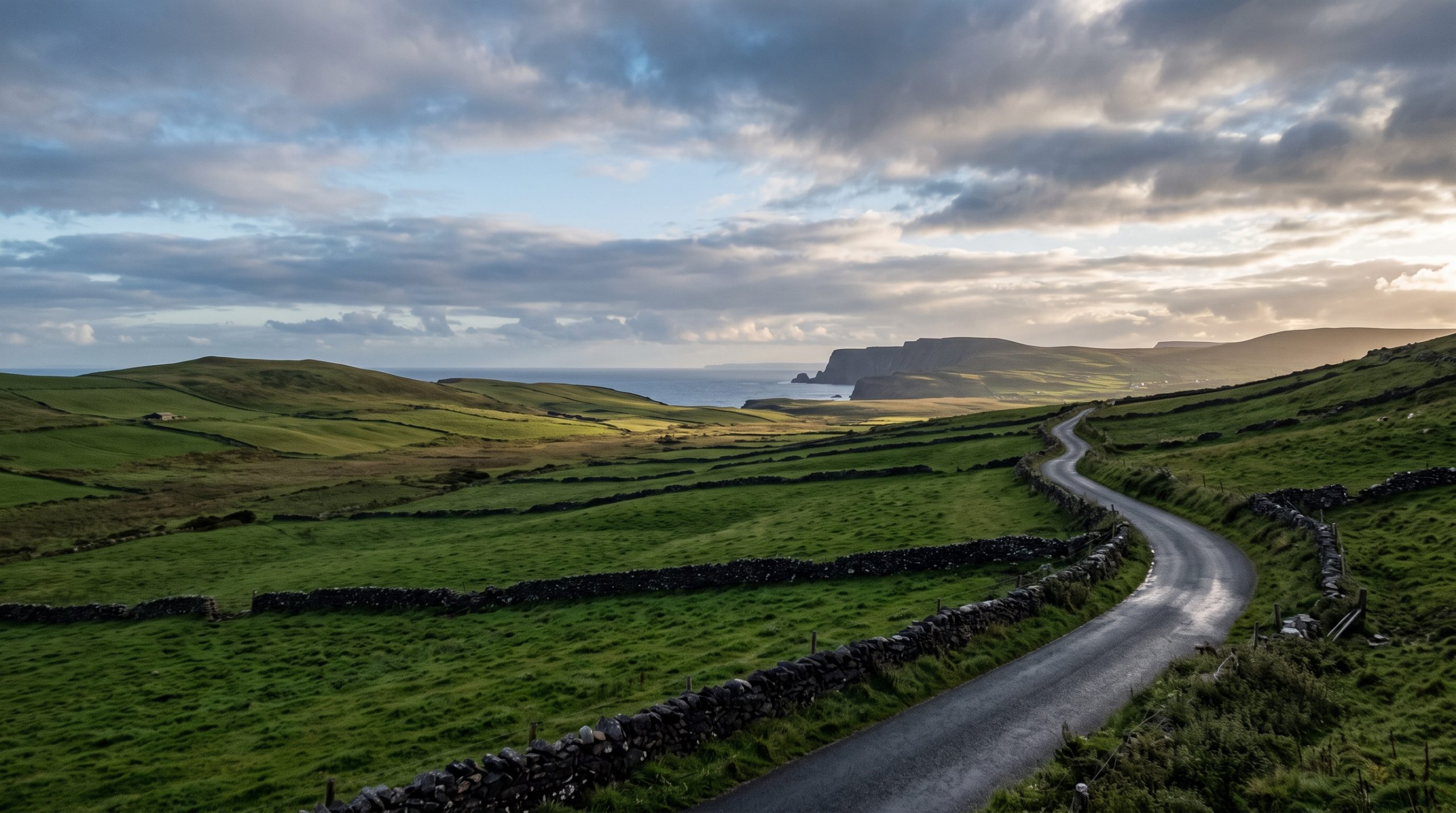
The most useful fact about eloping in Ireland has nothing to do with cliffs. Notice of your intention to marry has to reach a Registrar at least three months before the ceremony, the fee is 200 euro, and no amount of good planning shortens that clock. Everything else is built behind it.
The second most useful fact is about roads. Since 7 February 2027 the default speed limit on Ireland’s rural local roads is 60 km/h rather than 80, and those are exactly the roads that lead to the ground worth standing on: the single-lane section of the Slea Head Drive, the boreens above Dunquin, the Conor Pass with its 2-tonne weight limit. A route planner hands you a number for those roads. We plan on a different one.
What follows is the operational half of an Ireland elopement: paperwork dates, airports, the drive times we build timelines on, what the light does season by season. We are booking 2027, 2028 and 2029, and this is the order we work through with couples.
Three months of notice, five days of lead-in, one week in Ireland
Plan an Ireland elopement around three fixed points: notice to a Registrar at least three months ahead, with a non-refundable 200 euro fee; an in-person appointment with that Registrar no later than five days before the ceremony, which sets your arrival date; and roughly a week on the ground. Fly into Shannon or Kerry rather than Dublin.
The notice clock, and the one appointment you cannot do from home
Notice goes to a Registrar in the Civil Registration Service at least three months before the date you intend to marry. The 200 euro notification fee is non-refundable and is usually paid at the appointment. You both sign a declaration that there is no impediment to the marriage, and the Registrar issues the Marriage Registration Form, valid for six months from your intended date.
Couples living outside Ireland can ask a Registrar for permission to make that three-month notification by post, and if permission is granted a form arrives to complete and return. That removes one transatlantic trip, not the last step: you still meet the Registrar in person at least five days before you marry, sign the declaration in front of them, and collect the Marriage Registration Form.
That five-day rule sets your flights rather than the other way around, which makes it the most underestimated line in Irish elopement planning. A Saturday ceremony puts the appointment on the Monday of that week at the latest, and civil registration offices work weekdays, so a public holiday pushes it earlier still. The first Mondays of May, June and August are public holidays in Ireland.
Two details change itineraries in a good way. The Registrar you notify need not be the Registrar for the district where you live or marry, so the appointment can happen near the airport you land at. And after the ceremony the Marriage Registration Form is signed by you both, by whoever solemnises the marriage, and by two witnesses. If nobody else is coming, standing in as your two witnesses is an ordinary part of our day.
Document lists and the order everything happens in sit in our guide to how to elope. Permit research for the ceremony site starts the week your date is held.
Landing on the right side of the island
Most couples price flights into Dublin first, because that is where the seats are. Dublin is also on the opposite coast from most of what people come to Ireland to stand on, so treat the drive west as a travel day with a hotel at the end of it.
| Arrival airport | Opens up | Worth knowing |
|---|---|---|
| Shannon (SNN) | Clare and the Cliffs of Moher, north Kerry, the road north into Galway | The Atlantic-coast gateway, and one of two Irish airports where you clear US immigration before flying home |
| Kerry (KIR), at Farranfore | Dingle Peninsula, Killarney, the Iveragh coast | Small terminal, connections through Dublin or the UK. Plan on about an hour to Dingle town |
| Cork (ORK) | West Cork, Beara, Sheep’s Head | The gentler south-west, if your idea of the coast is coves and lanes rather than cliff edges |
| Ireland West Knock (NOC) | Connemara, Mayo, Sligo | Puts Achill and the Mayo coast within a morning, and keeps you out of Galway city traffic |
| Donegal (CFN), at Carrickfinn | Glenveagh, the Derryveagh mountains, the north-west headlands | Tiny, and sitting on the coast itself. Connections run through Dublin |
| Dublin (DUB) | Wicklow, and everywhere else with a long drive attached | The widest choice of transatlantic flights. Plan on roughly two and a half hours to Galway and closer to five to Dingle |
Where you sleep matters more than where you land. Twenty minutes from the ceremony site beats a better-reviewed hotel fifty minutes away, because at a 4:55am departure that gap is an hour of the best light you get all day. We base couples in Dingle town itself, in Doolin or Lahinch for Clare, near Clifden for Connemara, and out on the Rosguill or Fanad side rather than back in Letterkenny. Our destination guides go region by region on where the ground actually is.
What boreens, coaches and the Go Mall sign do to the schedule
Irish default limits now run 120 km/h on motorways, 100 on national roads with national secondary roads moving to 80, 80 on regional roads, and 60 on rural local roads since 7 February 2027. The sign for that last category carries no number: a white circle crossed by five diagonal black lines, with a plate reading Go Mall, Slow. Where it appears, the road has stopped being a road in the sense a route planner means.
Two places where the planner is wrong in a way that moves a ceremony hour:
- The Slea Head Drive (R559). Visitors drive it clockwise out of Dingle because the coaches do, and part of the cliff road is single lane. Follow the road signs rather than the sat nav, which will cheerfully route you counter-clockwise, or up An Clasach between Ventry and Dunquin, signed for local access only.
- The Conor Pass (R560). A 2-tonne weight limit and a 7.2 m length limit keep coaches and campers off it, and there are long stretches where two cars cannot pass and you hold beside a lay-by until the oncoming car is through. Twenty of the best minutes of driving in Ireland, and not a shortcut. We never put it between you and a ceremony start time.
Our working rule west of the Shannon is to add a third to whatever the planner says, then add the stopping: lambs on the tarmac at Dunquin in April, a tractor with a slurry tanker, a coach easing back into a passing place. A stretch billed as 25 minutes runs to 40, and we drive the exact route at the exact hour the evening before.
Two things are possible and not worth doing. Dublin to Dingle on the morning of the ceremony is one. Pairing the Cliffs of Moher with Slea Head in one day is the other, because the Shannon estuary sits between them and what you have booked is a driving day with two brief stops in it.
What the light actually does here, May to December
Ireland sits far enough north that the month decides the shape of the day more than the location does. The times below are for the Dingle Peninsula. Donegal runs a few minutes later at midsummer and darker earlier in December.
| Date | First usable light | Sunrise | Sunset | Light holds until |
|---|---|---|---|---|
| 15 May | 05:05 | 05:47 | 21:29 | 22:10 |
| 21 June | 04:30 | 05:20 | 22:06 | 22:55 |
| 20 September | 06:50 | 07:23 | 19:45 | 20:20 |
| 20 October | 07:40 | 08:14 | 18:37 | 19:10 |
| 21 December | 08:05 | 08:47 | 16:31 | 17:10 |
Midsummer reads as generous and behaves as the opposite. A 5:20 sunrise means leaving accommodation before 4:30, and wanting the last light at 22:06 as well signs you up for a nineteen-hour day, so we pick one end of a June day and protect it properly. Late September gives a 07:23 sunrise and a 19:45 sunset inside one civilised day, which is why so many of our Irish dates sit there.
One piece of geometry to know before you picture the ceremony. This is a west-facing coast, so sunrise comes from behind the land and strikes the cliff faces from inland, while the sun-into-the-ocean frames belong to the evening. Both ends of that show up plainly in our published films and galleries, and it often moves a couple’s ceremony hour.
The Cliffs of Moher Visitor Experience opens 08:00 to 21:00 from May to August and 09:00 to 17:00 in January, November and December, closed only on 24, 25 and 26 December, tickets booked online before you arrive. In the middle of a July day the platforms are shared with coach parties and the light is flat and overhead. At 08:00, or after 19:00 in June, it is a different cliff.
A mid-May day on the Dingle Peninsula, hour by hour
A real shape, built on 15 May light: usable light from about 05:05, sunrise 05:47, sunset 21:29, and enough to see by until 22:10.
- 04:30 Coffee in the room in Dingle town. Warm layers over whatever you wear later, and real footwear for wet grass.
- 04:55 Out on the R559, clockwise. Empty road, headlands starting to separate from the sea.
- 05:20 On the ground west of Ventry, twenty minutes to spare before the colour arrives.
- 05:47 Sunrise behind the ridge inland. The cliffs light before the water does.
- 07:15 Back in Dingle. Breakfast, then two hours of sleep, which is the best decision available to you.
- 11:00 Second location on sheltered ground, chosen the day before for the wind direction we actually got.
- 13:00 to 16:30 Rest. Not padding in the timeline, this is what makes the evening work.
- 18:15 Dressed and driving out. Twenty minutes of buffer built in, because the road decides.
- 19:15 Ceremony on the headland, two witnesses signing the Marriage Registration Form immediately afterwards.
- 20:15 to 21:30 The long slow hour, which on this coast in May is closer to two.
- 22:00 Last frames, then dinner somewhere in Dingle that keeps a kitchen open late.
What the roads do to that plan is the whole job. We hold twenty minutes of slack in every transfer, keep the ceremony hour clear of the 10:00 to 16:00 window when coaches work the peninsula, and never set a start time straight after a ferry sailing. Every location has a sheltered alternative fifteen minutes away, matched to wind direction rather than to how it photographs.
On a day with drives like these, two of us on the ground is operational rather than luxurious. With a photographer and a filmmaker working together we run two vehicles, so while one stays with you at the headland the other is already at the next site reading the wind and the light. A second full set of bodies and lenses rides in that car, which counts when the nearest camera shop is two hours inland.
Aerials, permits, and what we confirm before the timeline is fixed
Ireland follows the EU drone rules, administered by the Irish Aviation Authority. Operators of a drone weighing 250 g or more, or of any drone with a camera, register with the IAA, which currently costs 41 euro and lasts two years, and pilots hold the A1 and A3 competency certificate. Flights stay at or below 120 m. Airspace is only half the question. The other half is the ground, because whoever owns or manages a site decides whether commercial filming happens there, and Ireland’s national parks and state heritage sites run their own permission process on their own timetable. We confirm both, early, before aerials go into a film.
Permit fees are yours, along with accommodation, the celebrant and anything unusual on wheels or water. The research and the applications are ours. The Adventure covers one full day with a dedicated photographer or filmmaker from $4,900, the Expedition one full day with both working together from $7,900, and what sits inside each is on the pricing page, worldwide team travel included.
If you have a month in mind and no idea yet which coast fits it, send us a message with the dates you are considering. We will tell you what the light does on those dates and which peninsula suits the day you describe.
Common questions
Do we both have to travel to Ireland before the ceremony day?
Yes, for one appointment. With a Registrar’s permission the three-month notification can be made by post from home, but you both still meet the Registrar in person at least five days before you marry, sign the declaration and collect the Marriage Registration Form.
How far ahead do we give notice for a 2027 date?
At least three months before the ceremony, and the Marriage Registration Form runs for six months from your intended date, so the practical window is three to six months out. Hold the date with us and start the notification before you book flights.
Which airport should we fly into for the Wild Atlantic Way?
Shannon for Clare and the Cliffs of Moher, Kerry for the Dingle Peninsula, Ireland West Knock for Connemara and Mayo, Donegal for the north-west headlands, Cork for Beara and West Cork. Dublin works if the drive west is its own day.
Is it worth driving Dublin to Dingle in one go?
Plan on around five hours plus stops, and the last hour is the slow one. It is a fine travel day and a poor ceremony morning. If your flights only land in Dublin, we put the drive on the day before and keep the ceremony day inside the peninsula.
How early is a June sunrise ceremony in Kerry?
On 21 June the sun rises around 05:20 on the Dingle Peninsula, with usable light from about 04:30, so you leave accommodation by 04:30 at the latest. The same date holds light until nearly 23:00 if an evening ceremony suits you better.
Can we plan on drone footage over the coast?
Often, and we confirm it rather than assume it. IAA registration and the A1 and A3 competency cover the airspace side, the 120 m ceiling applies everywhere, and the site owner or managing body decides the rest. We check both for your locations before aerials go into the plan.
How many days should we be in Ireland?
About a week. The five-day registrar rule means arriving at least five days before the ceremony unless that appointment happened on an earlier trip, and a spare day beyond it gives us a second weather option for the coastal hour.
Pick the month, and we will build the day around it
Ireland does not reduce to one ideal date. It is a coast where September light, a 60 km/h boreen and a Registrar’s appointment on a Monday all have to agree with each other, and that is the part we do. Highlights reach you five days after the day itself, the full gallery or film three weeks after. Everything happens in writing, which suits a five-hour time difference: you write, we reply with the brochure inside 24 hours, then a proposal, a signed contract and a 30% retainer, and planning begins.
Tell us the season you are picturing, sunrise behind the mountains or sunset into the Atlantic, and how much driving you will happily do for somewhere quiet. Start Your Story and we will shape the week around your answer.