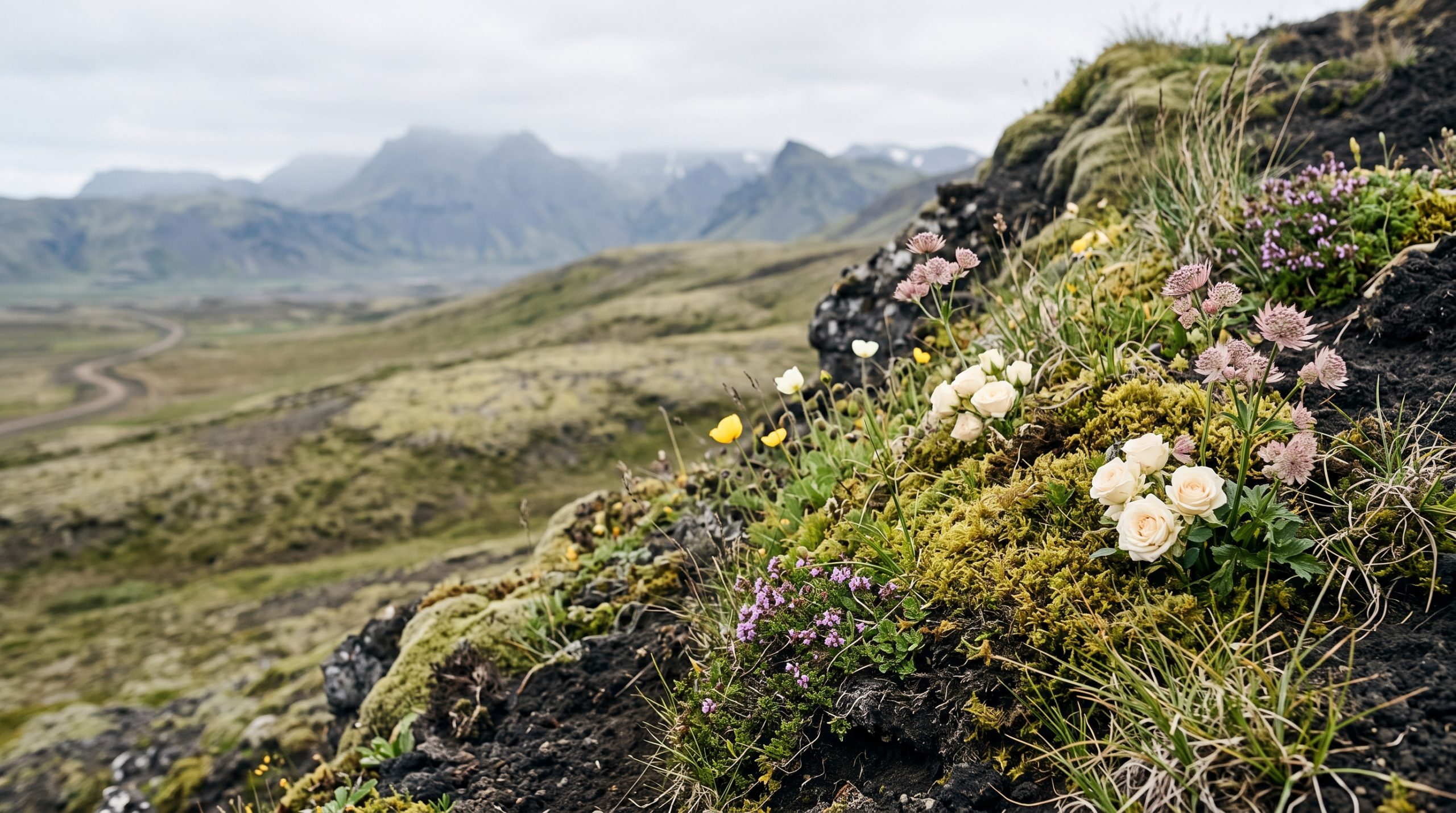
The first thing to know about flowers in Iceland is that the country runs three separate supplies, and only one of them is outside in the grass. There is what grows wild, which lasts a few weeks. There is what the geothermal greenhouses push out under glass and electric light all year. And there is everything flown in from mainland Europe, which is most of what sits in a Reykjavík cooler on any given morning.
The second thing is a number. Iceland’s plant health rules let a traveler carry in a bouquet of cut flowers and branches of up to 25 plants. Above that personal allowance you are importing plants, which means a phytosanitary certificate from the country where they were grown and clearance from Matvælastofnun, the Icelandic Food and Veterinary Authority, under regulation 189/1990. Nobody wants that on their wedding week.
So the practical answer is almost always the same. Have the flowers made here, plan around what is genuinely available in your month, and let the landscape carry the rest. What follows is that plan in real dates, real drives and real deadlines.
Three places an Icelandic bouquet comes from
Iceland wedding flowers come from wild ground, from geothermal greenhouses, or from a flight out of mainland Europe. Wild bloom runs from late May through July. Greenhouse and imported stock is available year round through Reykjavík florists and ordered weeks ahead. Travelers may carry in a bouquet of up to 25 plants, and anything larger needs import paperwork.
Wild: lupine, and the flower Icelanders voted for
The purple in every Iceland summer photograph is Nootka lupine, lúpína in Icelandic, and it is not native. It came from the coastal northwest of North America in the middle of the last century to hold thin soil in place and put nitrogen back into it, and it worked so well that it now takes entire valleys. Icelanders are split on it. The plant is treated as an invasive species and is also the single most photographed thing growing in the country.
The bloom is short. Purple starts showing in June, runs strongest through the second half of that month in the southwest lowlands, and the largest fields fade through late July into early August. The south coast is thick with it, including the ground above the black sand at Reynisfjara. If lupine is the reason you are picking a date, understand that you are picking a two to three week window rather than a season, and that a cold spring shifts the whole thing later.
Iceland’s national flower is a completely different proposition. Holtasóley, mountain avens, won a public vote in 2004: a low woody perennial in the rose family, white petals around a yellow center, flowering from late May through July, and one of the toughest plants in the North Atlantic. It also grows at ankle height. You do not carry it. You kneel in it, and it becomes the foreground of a frame with a glacier tongue sitting behind your shoulders.
The honest version is this. If you are imagining walking out into a meadow and gathering an armful of stems, Iceland is not that country. What it hands you instead is scale, weather and ground color that no florist can buy. Picking has limits too: in national parks and protected areas the protection rules rule out anything with a lasting effect on the site, so nothing is cut there, and everywhere else it is the landowner’s call. Asking is part of the location work we do before a date is fixed, and our destination guides go region by region on what each area gives you month to month.
Under glass: what Iceland grows for itself
Iceland grows flowers the way it grows tomatoes and cucumbers, with hot water out of the ground and a great deal of electric light. Hveragerði, 45 km east of Reykjavík over the Hellisheiði pass, is known as the country’s flower town for that reason: geothermal heat under the houses and LED lighting through the dark months, so production does not stop in December. Cut flowers, potted plants and greens all come out of that system.
What it does not give you is range. A Reykjavík florist working with home-grown and imported stock can build something lovely in any month of the year, but the variety list is shorter than the book your florist at home flips through. A named garden rose in one specific blush, unusual foliage, anything trend-driven this season: those arrive from mainland Europe or they do not arrive. Bring a color, a texture and a shape rather than a variety name, and the answer is nearly always yes.
Flown in: the 25-plant line at the border
Matvælastofnun is Iceland’s plant health authority, and regulation 189/1990 governs what may be brought in. Commercial consignments travel with a phytosanitary certificate from the country where the plants were grown. For people rather than freight, the allowance matches what can be sent by parcel post: a bouquet of cut flowers and branches of up to 25 plants, plus bulbs, corms and tubers from Europe in unopened packaging.
Twenty-five stems is more than it sounds and less than a wedding order. It covers a small hand-tied bouquet and a buttonhole if you are set on flowers from home. It does not cover ceremony arrangements, an arch, or a loose garden-style bouquet with filler and foliage. It also assumes the flowers come through a transatlantic flight, a night in a hotel room and a drive, which is a great deal to ask of a rose.
What travels perfectly is everything that is not a plant. Your grandmother’s brooch, the ribbon from your mother’s bouquet, a handkerchief, a scrap of lace with a date stitched into it. Those go in the carry-on, and we have them wired into a bouquet built here. That is the version that works every time.
| Where it comes from | What you can realistically get | When to lock it in | What to plan around |
|---|---|---|---|
| Wild ground | Lupine backdrops in June and July, mountain avens and low ground color from late May | At the date stage, because the bloom decides the week | Nothing cut on protected ground, landowner permission everywhere else |
| Icelandic greenhouses | Year round supply grown on geothermal heat and LED light | Weeks ahead, through a Reykjavík florist | A shorter variety list than you are used to at home |
| Flown in from Europe | Most of what a Reykjavík cooler holds, including specialty varieties | Weeks ahead, with a named second choice for every stem | Freight timing and availability at the source |
| Carried in your luggage | Cut flowers and branches, up to 25 plants | Before you pack | Anything larger counts as a plant import with certification |
Wind, rain and the back seat of a rental car
Iceland’s climate is generous to cut flowers in one way and brutal in another. The air is cool even in July, so nothing wilts in a hot car the way it does at an August wedding in Texas. The wind is the whole problem instead. On an exposed headland or a black sand beach the gusts arrive from one direction and then, ten minutes later, from another, and the first thing they take is the outer petal of anything soft and fully open.
So the shape of the bouquet matters more here than the flower list. Compact and hand-tied holds up, and so do wired stems and foliage with real substance to it. Tall airy spires shed, very open blooms bruise, and two meters of trailing silk ribbon becomes a separate weather event, which can be glorious in a film and impossible in a still frame taken thirty seconds later. We plan for both: the wind-facing wide frames go early in the coastal hour while everything is at its best, and the closer detail work happens in the lee of a rock, a bank or the car.
Practicalities that actually matter. The bouquet rides in a jar of water in the footwell, not loose on the seat. Someone carries a cloth for the stems, because wet ribbon marks a pale dress. Boutonnieres go on after the drive, never before it. You can see how a small, dense bouquet reads against Iceland’s dark ground and white water in our published elopement stories and films, which is a more useful reference than a mood board when you are talking to a florist.
Where the map lies between the florist and the light
Route planners in Iceland are optimistic in a specific way. They assume you drive Route 1 at the limit, do not stop, and never meet a coach turning at Seljalandsfoss. They also assume no single-lane bridge, no gravel spur to a trailhead, no crosswind on Mýrdalssandur, and no ten-minute pause because the light did something worth pulling over for. On a normal summer day the gap is twenty to forty percent, and it is bigger the further east you go.
| Route | Distance | Route planner | What we schedule |
|---|---|---|---|
| Keflavík Airport to Reykjavík | 50 km | 45 minutes | 1 hour |
| Reykjavík to Hveragerði | 45 km | 40 minutes | 50 minutes |
| Reykjavík to Vík | 187 km | 2 hours 30 | 3 hours 30 |
| Reykjavík to Arnarstapi, Snæfellsnes | 190 km | 2 hours 30 | 3 hours 15 |
| Reykjavík to Jökulsárlón | 370 km | 5 hours | 6 hours 30 |
Read those numbers as a flower schedule and one plan drops out immediately. Collecting a bouquet in Reykjavík on the morning of a ceremony on the south coast is technically possible and practically miserable. A Vík ceremony means leaving the city three and a half hours before you want to be standing anywhere, in wedding clothes, with flowers on your lap, and the morning is exactly when the light is worth having. Jökulsárlón on the same day is not a plan at all.
The fix is unglamorous. Flowers get collected the day before, or delivered to where you are sleeping, and they spend the night in water in the coolest room you have. If you are basing yourselves east of Selfoss, that also means the order goes to a florist who will hand it over on your travel day rather than your wedding morning. This is the kind of sequencing we work out first, and the same logic applies to hair, rings and anything else with a pickup attached to it. Our guide to planning an elopement covers how the whole order of operations fits together.
How the flower plan changes the day we build
Once we know what the flowers are, the timeline moves around them. A bouquet with soft, open blooms means the exposed frames come first and the sheltered spot is held for later. A ceremony on a windward beach gets paired with a backup fifteen minutes inland that we have already walked, so a shift in wind direction changes the location and nothing else. Where aerials matter to the film, we confirm the rules and the window for that specific site before we build any part of the day around a drone.
The two-camera arrangement matters most on days with long drives. With a photographer and a filmmaker both on the ground, one of us can be ahead at the ceremony spot reading the wind and the crowd while the other stays with you and your flowers, and there are two vehicles and two full sets of gear rather than one of each. There are eight of us, so there is always a colleague in reserve. Highlights reach you in 5 days and the full gallery or film in 3 weeks.
Coverage runs from $4,900 for a full day with a dedicated photographer or filmmaker, from $7,900 for a day with both working together, and multi-day options are set out on our pricing page. Team travel is included worldwide, so getting us to Iceland is not a line you have to budget for. When you are ready, send us a message with your month and we will tell you what is flowering then.
Common questions
Can we bring our own bouquet from the US to Iceland?
A traveler may carry in a bouquet of cut flowers and branches of up to 25 plants. Anything beyond that is a plant import, which needs a phytosanitary certificate from the country where the flowers were grown and clearance from Matvælastofnun under regulation 189/1990. Most couples order in Iceland and bring the ribbon instead.
When do the lupines actually bloom in Iceland?
Purple starts in June and is strongest through the second half of the month in the southwest and along the south coast. The biggest fields fade through late July and into early August. Plan a two to three week window rather than a whole month, and expect a cold spring to push it later.
How far ahead do we order flowers for an Iceland elopement?
Weeks, not days. We put the order in as soon as the date and locations are settled, and we ask for a named second choice for every variety so a substitution is decided in advance rather than on the morning. Reconfirming the week of travel is part of the timeline we build.
Is anything flowering in Iceland in September or October?
The wild bloom is finished by then. Autumn color comes from ground cover, grasses and low light instead, which suits a darker bouquet well. Greenhouse and imported stock runs year round, so a Reykjavík florist can still build exactly what you want in October or February.
Will the wind on a black sand beach ruin the bouquet?
Not if the bouquet is built for it. Compact hand-tied shapes with wired stems and sturdy foliage hold their form in gusts, while very open blooms and long trailing ribbon are the parts that suffer. We shoot the exposed frames first and move to sheltered ground for close work.
Can we pick wildflowers ourselves for the ceremony?
Not in national parks and protected areas, where the protection rules exclude anything with a lasting effect on the site. Elsewhere it depends entirely on the landowner, and asking is part of the location work we do. Lupine is the plant people ask about most, since it is introduced and actively managed.
Where do we keep the flowers the night before?
In water, in the coolest room available, out of direct sun and away from a heater. Icelandic guesthouses run warm because heating is cheap here, so a bathroom or an entryway usually beats the bedroom. Recut the stems in the morning before they go in the car.
Send us your month and your flower list
Tell us the window you are looking at, whether the purple fields matter to you, and whether there is something from your family you want held in your hands. We will come back with what is genuinely available then, which locations suit it, and how the driving has to be sequenced so the flowers arrive in better shape than you do. All of it happens in writing, at whatever hour suits you, and the first reply and brochure come back within 24 hours.
Booking is open for 2027, 2028 and 2029, and planning starts once the contract is signed and the 30% retainer is in. Check your date and we will start from the flowers if that is where you want to start.