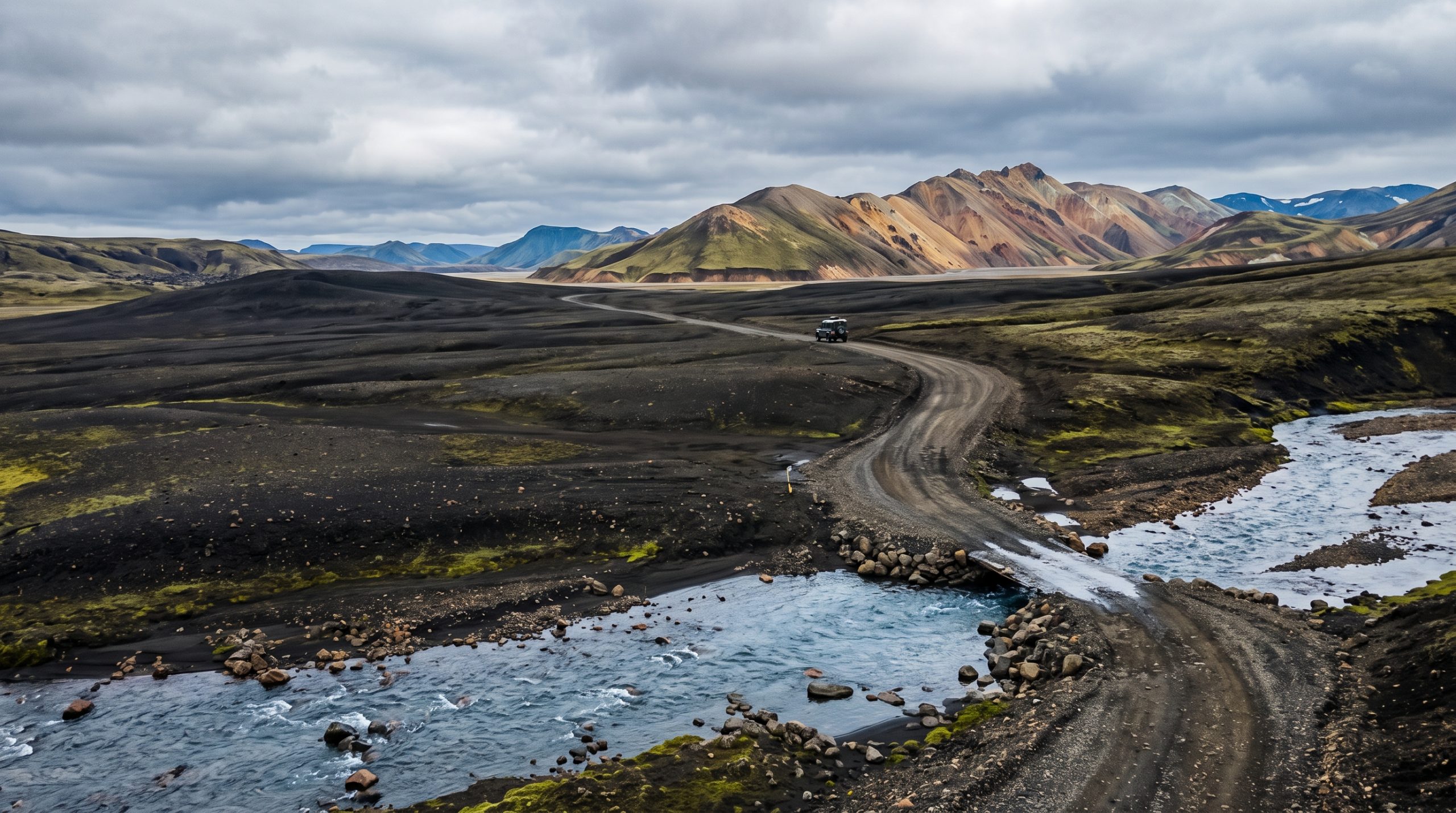
Most of the places couples ask us about in Iceland can be reached in a small two-wheel-drive rental in July. The South Coast, the Golden Circle, Snæfellsnes, the lava fields out on Reykjanes: paved, signed, and fine in a compact car. The four-wheel-drive question only becomes real when the spot you want to stand in sits behind a road number with an F in front of it.
That F stands for fjallvegur, mountain road. It changes three things at once: which vehicles are legal, what your rental insurance will and will not carry, and which weeks of the year the place exists for you at all. Landmannalaugar sits behind one. Þórsmörk sits behind one that essentially no rental agreement will let you drive.
So the answer is not a yes or a no. It is a short chain of decisions, and it runs in this order: where you want to stand, which road serves it, when that road opens, and what the rental company needs to hear when you book rather than when you collect the keys.
Where the 4×4 question actually begins
You need a 4×4 in Iceland only if your route includes an F-road, because F-roads are restricted by law to four-wheel-drive vehicles. Paved routes like the Ring Road, the South Coast and Snæfellsnes need nothing special in summer. Highland locations such as Landmannalaugar do, and they open only for a short season.
What the F on the sign restricts
F-roads are highland tracks designated by the Icelandic Road and Coastal Administration, and only four-wheel-drive vehicles are permitted on them. Take a two-wheel-drive car onto one and you are outside your rental agreement, which puts you outside your insurance at the same time. Rental fleets mark specific cars as permitted on F-roads, and that marking is the thing to ask for by name.
A vehicle that is legally allowed on an F-road is not automatically the right vehicle for every F-road. Ordinary fleets carry standard four-wheel-drive cars rather than the heavily modified mountain vehicles that run the deep interior, and the rental companies say so themselves: some routes sit beyond what their cars are rated for. Ground clearance and tyres decide far more than the badge on the tailgate.
Three roads carry the same restriction without carrying the letter. Kjölur, road 35, across the saddle between the Langjökull and Hofsjökull icecaps. Kaldidalur, road 550, the old track down the western edge of Langjökull. And Jökulhálsleið, road 570, which climbs over the shoulder of Snæfellsjökull and looks on a map like a tidy shortcut across the peninsula. It is not a shortcut. It is a four-wheel-drive mountain crossing with a view, and it is the one line on a Snæfellsnes map that catches planners out.
Above all of it sits a rule with no exceptions: driving off marked roads is illegal everywhere in Iceland, including for a single frame. Every location in our destination elopement guides is somewhere you can legally park and legally stand.
The one valley your rental car will not reach
Þórsmörk sits around 30 kilometres up F249, and the road crosses the Krossá. Rental agreements in Iceland exclude that road almost without exception, even for capable four-wheel-drive cars, and water damage from fording a river sits outside every insurance tier we have read. So the valley is reached the way Icelanders reach it: on the four-wheel-drive river bus that runs in season, or in a chartered super jeep with a driver who takes that crossing daily. Both are bookable and timetabled, and a timetable is something we can build a ceremony hour around.
When each highland road actually opens
There is no fixed calendar, and any date you read is a pattern rather than a promise. Vegagerðin, the Icelandic Road and Coastal Administration, opens each highland road individually after physically inspecting snowpack and river levels, and publishes live status on road.is and umferdin.is. Across the network the openings run in stages from late May to mid-July, and the roads close again through September into early October.
| Road | Where it takes you | Typical opening | Worth knowing |
|---|---|---|---|
| 35, Kjölur | Between Langjökull and Hofsjökull | Late May to early June | Usually the first highland route open; no unbridged rivers |
| 208 north | Sigalda to Landmannalaugar | Early in the highland season | Reclassified from F208 and carries no fords |
| F208 south | Landmannalaugar towards Eldgjá | Mid to late June | Several unbridged crossings; roughly 55 km at highland pace |
| F249 | Þórsmörk | Mid to late June | Excluded by rental agreements; reach it by river bus or charter |
| F26, F88, F894 | Sprengisandur, Askja, Kverkfjöll | Often not before early July | The deep interior opens last and closes first |
Landmannalaugar adds one more date to your planning. Parking there runs on a reservation and service fee system operated through Parka: through the core of summer, currently 20 June to 13 September, any private or rental car arriving between 9:00 and 16:00 needs a space booked in advance, and bookings for the season open in early April. The car park itself is open around the clock, and the service fee applies whenever you arrive, so coming outside that window removes the reservation rather than the fee. For an elopement that is close to a gift. The hours we want you there, early morning and late evening, are precisely the hours the reservation window leaves alone.
What this means in practice is that a mid-June date cannot rest on a single highland location. We design those weeks with two viable versions of the same day, which is the same discipline described in our guide to planning an elopement: the plan you want, and the plan that is just as good and does not depend on a road inspection going your way.
Booking a vehicle that is allowed where you are standing
Tell the rental company your road numbers when you book, not when you arrive. Permission to drive F-roads is a property of the vehicle class, not a box you tick at the counter, and the cars that carry it are a subset of any fleet. Book the car in the same week you sign your accommodation, and name the roads in writing.
Then read the insurance the way you would read a lease. Icelandic rental cover is sold in layers, and the layers matter here more than almost anywhere. Collision damage waiver is the base. Gravel protection covers the chips a passing car throws into a windscreen on an unpaved road. Sand and ash protection covers what a south coast wind does to paint. Undercarriage and chassis damage on F-roads generally needs cover of its own. Water damage from a river crossing is excluded on every tier we have read, on every vehicle, including ones rated to cross. A handful of companies sell a separate water-damage product; if yours does, read exactly which crossings it names.
For most of the elopements we plan in Iceland, gravel and ash cover is the line that earns its keep and four-wheel drive is optional. A mid-size car handles Route 1 in summer perfectly well.
Two habits worth carrying with you. Park nose into the wind and keep a hand on the door as you open it, because gusts in an exposed car park move faster than they look. And in the east and the Westfjords, refuel at half a tank rather than a quarter: the gaps between stations are long and many rural pumps are unstaffed and card-only.
Where the route planner lies to you
Iceland’s speed limits are 90 km/h on paved rural roads, 80 on gravel and 50 in towns, and a route planner quietly assumes you will hold them. On paved Route 1 that is close to true. On gravel it is fiction. Nobody sensible drives the legal 80 on a washboard surface with soft edges, and on a highland F-road the honest planning figure is about a third of what the map hands back.
| Surface | What the route planner assumes | What we plan on |
|---|---|---|
| Paved Route 1 | 90 km/h | Close to it between towns, minus every stop you will make |
| Gravel side road | 80 km/h | 50 to 60, and slower where the surface corrugates |
| Highland F-road | Treated as an ordinary road | Around 30 km/h |
| Unbridged ford | No time at all | 10 to 20 minutes for each crossing |
| Wind and rain on gravel | The same as a dry day | Another quarter on top |
Fords are where the arithmetic really breaks. A crossing costs time before it costs anything else. You stop, you look at it properly, you watch the line another vehicle takes, and then you go. There are several of them on F208 south. For scale on the long interior routes, Sprengisandur, F26, runs seven to ten hours end to end, which is a day of its own rather than a transfer.
The paved network has quieter taxes of its own. Route 1 still has single-lane bridges and blind rises where you drop to walking pace. Sheep stand on the verge all summer and move without consulting you. Roadworks turn into gravel diversions with no warning. And nobody drives past Skógafoss without stopping, which is fine, but it is twenty minutes that was not in the plan. We build long-transfer days with roughly a quarter added on top of map time, and we keep the ceremony hour clear of any moment when a bus departure is making decisions for us.
How the vehicle changes the day we build
On a highland day we usually run two vehicles, and that has less to do with luggage than with time. While the photographer stays with you at the car for the ten unglamorous minutes of getting ready that nobody puts in a timeline, the filmmaker can already be a kilometre ahead on the ridge, reading where the light will land and setting up the aerial legally before you arrive. When the approach is ninety minutes of gravel, that saved half hour is the difference between vows in good light and vows in whatever light is left.
Aerials here run on operator registration with the Icelandic Transport Authority through its Flydrone portal, a ceiling of 120 metres, visual line of sight, and whatever the specific protected area adds on top. Vatnajökull National Park, for example, publishes its own general and regional rules for drones. We confirm all of that against the official drone map before a sequence is planned around aerial coverage, so the film you are expecting is the film we can legally fly.
Photography, film and planning come from one team of eight here, which on an F-road day means one timeline, one vehicle plan, and no stranger meeting you in a gravel car park at 4am. If you want to see how highland tracks, midnight light and glacier edges actually read once they are finished, spend ten minutes in our elopement stories and films. Highlights reach you five days after the day itself, and the full gallery or film lands within three weeks. What a day like this includes, and what it costs, sits on our pricing page.
Team travel is included worldwide, so our flights, our vehicles and our accommodation are not a line you pay on top. What stays on your side are the things you would book anyway: your own rental car, permit and parking fees, and unusual transport such as a super jeep charter into Þórsmörk. Tell us the location and we will tell you exactly which of those a day there needs. Send Us a Message.
Common questions
Do we need a 4×4 for a South Coast elopement in October?
Not for the roads. Route 1 and the marked spurs down to Reynisfjara and Skógafoss are paved and maintained through the winter, and an October day there turns on wind and light rather than traction. A higher car with good tyres is comfortable if snow arrives early inland, but the highland tracks above you are closed by then in any case.
Can we drive to Landmannalaugar in a standard rental SUV?
Often yes, if the car is marked by the rental company as permitted on highland roads and you take the northern approach from Sigalda, which is now signed 208 and carries no unbridged rivers. F208 south, with its fords, is a different road entirely. Add the parking reservation, currently required for arrivals between 9:00 and 16:00 from 20 June to 13 September.
How far ahead do we need to book the car and the parking?
Book the vehicle as soon as your date is fixed, and state the road numbers on the booking so you are given an F-road permitted car rather than whatever is left on the lot. Landmannalaugar parking opens for the summer in early April; without a reservation you simply plan your arrival before 9:00 or after 16:00, which is where the good light is anyway.
Will the F-roads be open for a solstice date in the third week of June?
Some will, some will not, and nobody can promise which, because Vegagerðin sets each road’s date after inspecting it that spring. Kjölur and the northern approach to Landmannalaugar are usually open by then; Askja and Sprengisandur usually are not. For a June date we design the day on ground that works either way and treat the highland location as the upgrade we take if the road opens in time.
Does our rental insurance cover a river crossing?
No. Water damage from fording is excluded on every tier we have read, even on a vehicle rated to cross, and undercarriage damage on F-roads usually needs its own cover. A few companies sell a separate water-damage product. If a crossing is central to your location, settle it with the rental company in writing before you pay.
Can we reach Þórsmörk for the ceremony without driving F249 ourselves?
Yes, and it is the sensible way in. The four-wheel-drive river bus runs the valley in season, and super jeep charters run with drivers who make that crossing daily. Both carry our gear, both have fixed departures, and we set the ceremony hour against the return time rather than hoping the day stretches.
Is a 4×4 worth it for a winter elopement on Route 1?
For grip and confidence on a long transfer, often yes. For access, no: F-roads are shut from autumn through spring, so nothing behind an F sign is on the table. A December day is built around roughly four hours of daylight and a tight cluster of paved locations near your base, which beats spending that daylight in the car.
Choose the ground first, the car second
Send us the two or three places you keep coming back to and the week you have in mind. We will tell you which of them sit behind an F, when that road realistically opens in that week, and what the vehicle and the timetable do to the shape of the day. If your date and your location are fighting each other, we will say so and offer you ground that gives you the same feeling with a road that is open.
We are booking 2027, 2028 and 2029, and the highland season inside each of those years runs to a handful of weeks. Write to us with the date and the shortlist and you will have a reply and our first brochure within 24 hours, then a proposal built around those specific roads. A signed contract and a 30% retainer start the planning, and all of it happens in writing, at your pace. Start Your Story