On September 30 in Reykjavik the sun comes up at 07:33 and goes down at 19:01, and by 21:47 the sky is fully dark. One date gives you a sunrise you can reach without a 3am alarm, a low-sun hour that lands before dinner, and seven hours of darkness after it. Mid-May gives you 18 hours and 22 minutes of daylight and no true darkness at all.
That is the real difference between Iceland’s two shoulder months. Peak-season prices on flights, cars and rooms are part of why couples write to us about May and September, and they are the least interesting part of the answer.
What actually changes is the light, the darkness, which roads are open yet, and how many people are standing where you want to stand. August 2027 set an all-time monthly record of 312,964 foreign departures through Keflavik. May runs at roughly 155,000. If Iceland is still one of three countries on your list, our destination elopement guides break down the others on the same terms.
The shoulder-season ten days we would take first
September 15 to 25. Mid-September holds about 13 hours of daylight, puts the low-sun hour at 18:15 instead of 22:25, and returns four to five hours of genuine darkness for aurora. The south coast is emptying rather than filling. The second half of May is our runner-up, and it is a different day entirely.
May and September next to peak August, in numbers
Daylight times are Reykjavik at mid-month, and Iceland keeps the same clock all year, so solar noon sits at about 13:25 no matter the season. Visitor figures are foreign departures through Keflavik, counted monthly by the Icelandic Tourist Board.
| Month | Light in Reykjavik | Conditions | People | Our verdict |
|---|---|---|---|---|
| April | 05:57 to 21:00, 15h03 | Snow holding on high ground, low ground bare | Quiet, season not lifted | Winter texture, coastal plans |
| May | 04:14 to 22:36, 18h22 | Driest stretch of the year begins, no darkness | About 155,000 | Long light, highlands shut |
| June | 02:55 to 00:04 at solstice, 21h09 | Driest month in Reykjavik, near 40 mm | Climbing steeply | Midnight sun, zero dark |
| July | 03:40 to 23:26, 19h46 | Warmest month, mean close to 12 C | About 302,000 | Everything open, everyone here |
| August | 05:18 to 21:45, 16h27 | Warm, dusk creeping back after the 20th | 312,964, a record | Peak, not shoulder |
| September | 06:50 to 19:55, 13h05 | Darkness returns, colour on the low ground | Thinning week by week | Our first choice |
| October | 08:17 to 18:09, 09h52 | Wetter, windier, snow arriving on the passes | Quiet again | Aurora up, access down |
Read the table as two arguments rather than a ranking. May sells you time. September sells you angle, darkness, and space on the black sand.
What the light does at 22:25 in May and 18:15 in September
The number that matters is not sunset, it is how long the sun spends under ten degrees of altitude, because that is the whole warm, directional part of the day. In mid-May that window runs 20:35 to 22:25 in the evening, roughly an hour and fifty minutes, and it repeats before 06:00 in the morning. In mid-September the same window is 18:15 to 19:45, about ninety minutes, with its twin at 06:50.
The bigger difference is what happens between those windows. On May 15 the sun climbs to nearly 45 degrees at noon, which flattens a black-sand beach into grey and puts hard shadows under everyone’s brow. On September 15 it tops out at 28.8 degrees, and by the 25th at 25. The sun never really gets overhead, so a two o’clock ceremony still has direction in it. That is why a September timeline can put vows at 17:30 and still be inside the good light, while a May timeline pushes the best hour to nearly bedtime or asks you to be on the coast at 04:14.
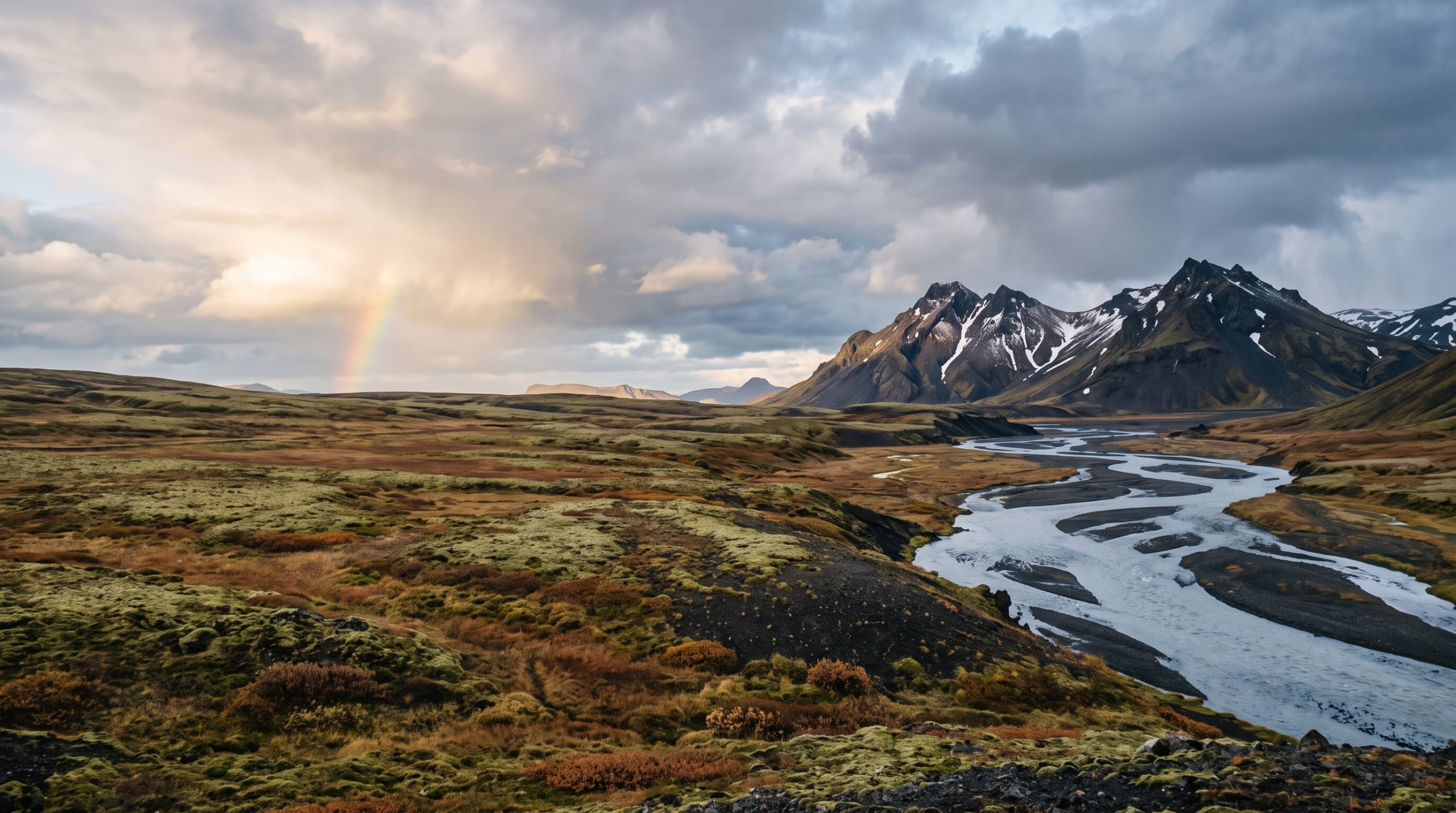
Both months photograph beautifully and they do not photograph alike. May reads green, wet and bright, with grass coming back and snow still on the tops. September reads amber and low, birch scrub and moss turning across the lava, cloud with more shape in it. Our published elopement galleries and films are the fastest way to see which one is your day rather than ours.
Ninety minutes of usable light at each end of a September day is also the practical reason we pair a photographer and a filmmaker on the same hour rather than running them on different days. Two people work that window at once, one holding the wide landscape while the other stays close for vows and audio, and the coverage options set out how each shape is built.
The windows that open and close inside these eight weeks
Aurora is the narrowest of them, and it is decided by darkness, not by cold. From late April until early September there is no astronomical darkness over southern Iceland at all, so nothing is visible even on a night with strong solar activity. True darkness returns around September 8 to 10. By September 15 it runs 23:01 to 03:42, and by September 30 it has stretched to 21:47 through 04:47.
Treat that as a chance, never a promise. Clear sky is the limiting factor rather than the aurora itself, and a September evening with cloud simply gives you a different night. We build the wedding day around the coast and the light, then hold two separate late nights in the plan, so a clear window on either of them is a bonus you get to keep and a cloudy pair costs you nothing you were counting on.
The other windows are wider. The midnight sun tail runs deep into August, with civil dusk still at 22:28 on August 20, which is why late-August nights feel bright rather than dark. Autumn colour in Iceland is a ground-level event rather than a forest one, low birch and moss turning through the second half of September, and it shifts by a week or two with the year. Ice is the constant, since the glacier lagoon calves in every month, which is why we lean on that coastline in shoulder weeks when the highlands are out of play.
What is still shut in May, and what starts shutting in October
Iceland’s interior is reached by F-roads, which open in stages once snow melts and the rivers drop, with Vegagerdin publishing the status of each one. The easier passes such as F35 Kjolur usually come first, late May into early June. F208 to Landmannalaugar and F249 to Thorsmork typically follow mid to late June. The remote interior often waits until early July, and the whole network closes again somewhere between mid-September and mid-October.
The planning consequence is simple. A May elopement is a coastal and peninsula elopement: the south shore between Vik and the glacier lagoon, Snaefellsnes, Reykjanes, Thingvellir, the headland at Stokksnes. A first-half-of-September elopement can usually still include the highlands, and a late-September one should be built to work without them, with the highland day treated as an upgrade if the road holds.
The three weeks that lose the shoulder-season advantage
The first ten days of May are the weakest stretch in the shoulder. Winter texture has gone from the low ground, green has not properly arrived, there is no darkness left for aurora, and the interior is weeks from opening. If snow in the frames is what you wanted, mid-March does it far better: about 11 hours 40 minutes of daylight, a low-sun hour from 18:05, and real darkness afterwards. If green is what you wanted, wait for the last week of September.
Late August is the other one, and it gets marketed as shoulder because the price charts start to soften. It is not shoulder. August is the busiest month Iceland has ever recorded, and two weeks later the same road between Vik and Jokulsarlon carries a fraction of the traffic and gives you a dark sky as well. Moving a date from August 25 to September 12 changes almost nothing about the landscape and almost everything about who else is in it.
None of this makes a fixed date wrong. Couples come to us with early May locked because of work, family or a visa, and that day is very much workable: sunrise just after 05:00 is genuinely usable light, so we build two working blocks with a long gap in the middle, favour west and north-facing coast for cross-light, and put the ceremony where the wind is not. Tell us the date you already have and we will tell you honestly what it gives you, which is more useful than a ranked list of months. Our guide to planning an elopement covers the paperwork and sequencing that sit underneath all of this.
How we build the shoulder-season fallback before you fly
Iceland weather is a planning input rather than a gamble. Reykjavik collects around 870 mm of precipitation a year, spread across a lot of days rather than concentrated into a few, so a day with showers in it is the normal day and we work in it. What we do not do is hope.
Every timeline we build carries named alternatives selected by wind direction, not by mood. When the wind is onshore from the south, we take the exposed black-sand frontage out of the plan and move to river valleys, canyon walls and inland moss fields fifteen to forty minutes away. When it swings north, that same south coast becomes the sheltered side and we go back to it. The ceremony hour is written with a two-hour tolerance rather than a fixed time, and we confirm the final shape against the Icelandic Met Office forecast the day before, when Iceland’s forecasts finally become worth reading.
Shoulder months make that easier in one specific way. May has 18 hours of daylight to move things around inside, and September has enough darkness to hold a second attempt at a night sky. Eight of us work across the team, so there is always a colleague in reserve and a second camera on the ground. If you want us to sketch what your date actually looks like, Send Us a Message with the month you are circling.
Common questions
Is September actually quieter than August in Iceland?
Measurably. August 2027 recorded 312,964 foreign departures through Keflavik, an all-time monthly high, with July close behind near 302,000. Those two months alone carried about 27 percent of the year. September sits in the spring-and-autumn band that made up 32.4 percent of the year across six months, and it empties week by week.
Can we see the northern lights during a September elopement in Iceland?
From roughly September 8 onward, yes, when the sky is clear. Full darkness on September 15 runs 23:01 to 03:42, and by September 30 it stretches from 21:47 to 04:47. Nobody can promise aurora, so we plan two late nights rather than one and build the day itself around the coast.
May or September for an Iceland elopement, if we can only pick one?
September, and specifically the 15th to the 25th. You trade five hours of daylight for a low sun that never climbs above 29 degrees, aurora-capable nights, and a south coast at a fraction of August’s traffic. May wins only if you specifically want light at midnight.
Will the highland roads be open if we elope in May?
No. F208 to Landmannalaugar and F249 to Thorsmork usually open mid to late June, and the remote interior often not until early July. A May day is built on the coast, the peninsulas and the glacier lagoon, all of which are open and all of which are quieter than they will be six weeks later.
What happens if the weather turns on our date?
We move, using a plan written before anyone lands. Each location has a named alternative chosen by wind direction and a ceremony hour with a two-hour tolerance, so a change of conditions changes the route rather than the day.
How far ahead should we hold a September date in Iceland?
We currently have elopement dates available through 2027–2029, so holding a September date two years out is normal rather than early. An inquiry gets a reply and our initial brochure within 24 hours, then a tailored proposal, then a signed contract and a 30 percent retainer to begin planning. The planning stays in writing from the first message onward.
Choosing between May light and September darkness
Choose the darkness or choose the daylight, then let everything else follow that one decision. If you want vows at 17:30 with the sun low and a chance of aurora at midnight, you want the second half of September. If you want to be on a beach at 22:00 with the sun still up and the whole interior still buried in snow, take the back half of May and use the hours. Send us the dates you are weighing and we will reply in writing with what each one gives you, what it takes away, and which locations hold up in the wind that time of year. Check Your Date and we will take it from there.