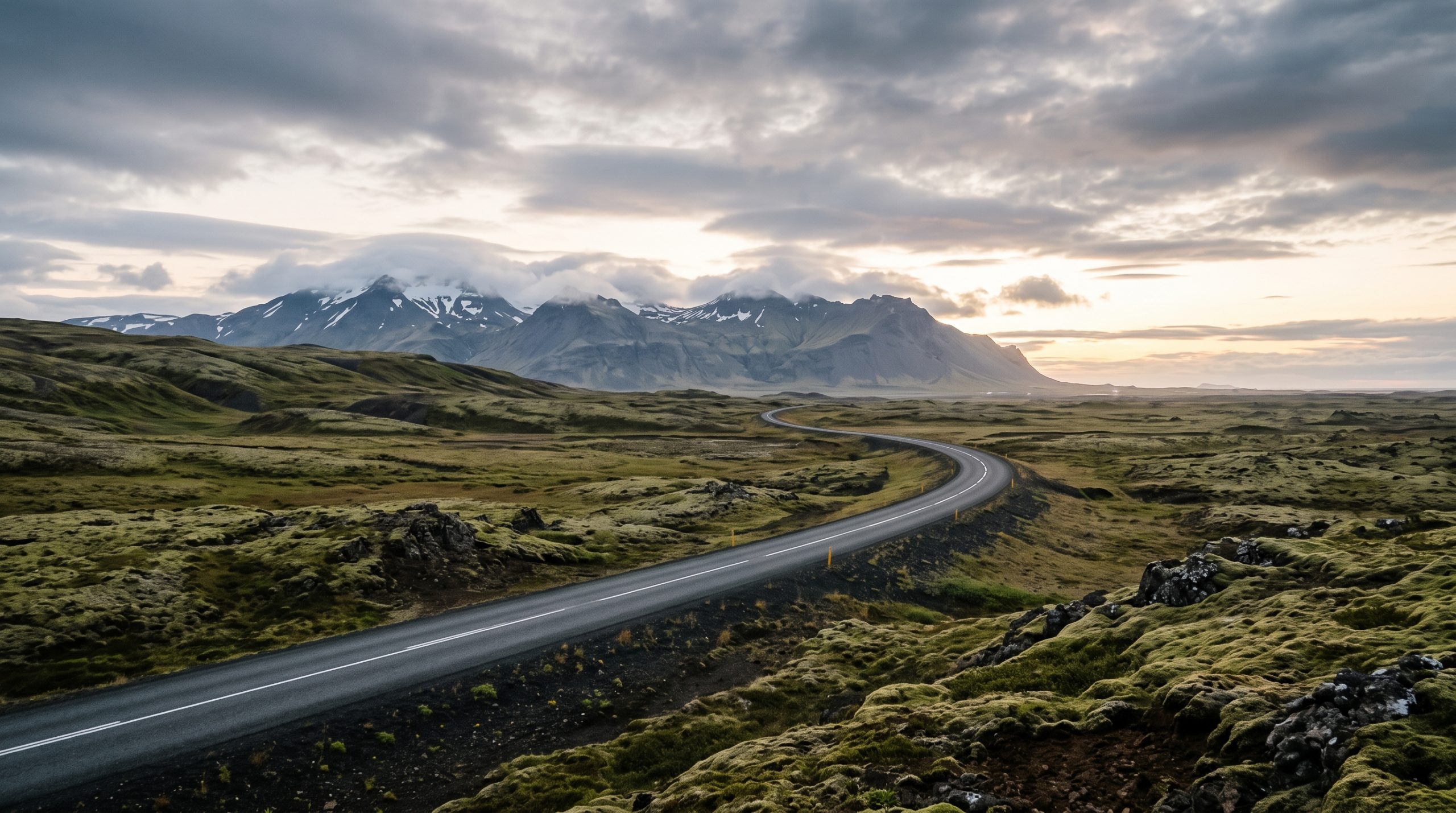
On June 21, the sun comes up over Reykjavík at 2:55am and does not set until three minutes past midnight. There is no real darkness in between, just about three hours of twilight with the sun sitting under the horizon and the north still glowing. Six months later the same city waits until 11:20 for sunrise and loses the light again by half past three, a little over four hours in total.
Those are not the same day in different jackets. In June the difficulty is choosing which of twenty usable hours to spend, and getting to the south coast waterfalls before the first coaches do. In December everything has to happen inside one long, low, gold-colored window, with no second attempt at any of it. Plan a summer timeline for a January date and you will spend your morning in the dark, driving.
The admin has grown more specific over the last couple of years, too. Most of the well-known stops now charge for parking, generally around 1,000 ISK per vehicle per day, and Skógafoss joined that list in 2027. Photography and filming inside protected areas run on a permit from the Nature Conservation Agency of Iceland, while Þingvellir and Vatnajökull issue their own. The highland roads open when Vegagerðin, the road administration, judges the ground able to carry a car. None of that is your job. It is the reason an Iceland day gets planned backwards from access and light rather than forwards from a mood board.
The three shapes an Iceland elopement takes with us
We photograph, film and plan Iceland elopements as one team of eight. One full day with a dedicated photographer or a dedicated filmmaker is the Adventure. One full day with both working together is the Expedition. Two to seven days, one region or several, is the Odyssey. Team travel to Iceland is included in all three.
The 2:55am day and the 11:20am day
Every timeline we write for Iceland begins with two lines: what the sun does on your date, and how far apart your locations really are once you allow for a gravel road and a wind that pushes a car around. The rest follows from those. Below is how the same set of locations gets sequenced in the two extremes.
June: the day that starts the night before
Because it never gets properly dark, the June day is not one block, it is two, with sleep in the middle. We tend to put vows somewhere between 9pm and 11pm, when the sun is low and warm and the last day-trippers are back on the Ring Road. Then we stop. At 2am we are out again for the second location, and that is the hour Iceland gives you almost for free: the light is still soft, the car parks are empty, and the coaches will not arrive for another eight hours.
This is also where we would rather be blunt than diplomatic. Seljalandsfoss at 2pm in July is a car park with a waterfall behind it. Gullfoss at midday is loud, wet and full of people, and the frames look like everyone else’s frames. The same two places at 1am in June are yours. If your date is in high summer and you want the famous names, the price of admission is a strange sleep pattern, and it is worth telling us early whether that sounds fine or awful.
One summer detail nobody puts in the brochure: on still evenings in the Mývatn area, the midges are thick from roughly mid-June onward. We either build that region around a breeze or move it to a different day of an Odyssey.
December: four hours, and no repeats
Winter is the season we most enjoy planning, and the one couples most often misjudge. Four hours of daylight sounds like a problem until you understand that all four of them are golden, because the sun never climbs high enough to go harsh. There is no bad light in a December Iceland day. There is only not enough of it.
So the shape tightens. We are usually in the room with you by 9:30, in the dark, for the getting-ready frames. First location by 10:30, while the southeastern sky goes pink ahead of sunrise. Vows near the middle of the day, when the sun is as high as it will get and still low enough to rim-light everything it touches. One short drive, rarely more than 40 minutes. Last location by 3pm for the long, slow finish. Then somewhere warm, and if the sky clears, an aurora attempt after dinner. We plan the film so it works whether or not the aurora shows up, because nobody gets to promise it.
The equinox weeks
Late March and late September are the quiet compromise: roughly twelve hours of daylight, sunrise and sunset at hours a human being can enjoy, and low sun morning and evening rather than only at the edges. Snow still sits on the south coast in March. September brings the first aurora nights back and the highland tracks are still open. If you want one week that does the most work, these are the weeks we point at, and our destination guides go region by region on what each month actually offers.
| Season | Reykjavík light | How we shape the day |
|---|---|---|
| June solstice | Sunrise 2:55am, sunset 12:03am, no true night | Two blocks, vows late evening, second location around 2am, sites empty |
| December solstice | Sunrise about 11:20, sunset about 3:30pm, just over four hours | One continuous run, short drives, vows at midday, aurora as a bonus |
| Late March and late September | About twelve hours, both ends usable | Full day with real morning and evening light, two or three locations |
Wind, spray and vows you can actually hear
Iceland is where hiring photography and film separately shows itself fastest, and the wind does the exposing. A photographer can stand on the exposed lip of a ridge and work at a thousandth of a second with a short lens braced against a hip. A filmmaker cannot. A gimbal fighting a 20 m/s gust reads as a shudder on screen, and a microphone in that gust records a roar and nothing else. So the two crafts want slightly different ground at the same location, and if they meet for the first time on the morning, one of them quietly loses.
We settle it in planning instead. The vow position gets chosen so the couple stands with the gust behind a rock shoulder or a turf bank, close enough to the lens for the wide frame to still read as landscape, and sheltered enough that the audio on the Expedition captures what you actually said rather than the weather. At the waterfalls it is spray instead of wind: a photographer can wait out a gust and dry the front element between frames, but a film shot needs twenty unbroken seconds of clean glass. That means we film the approach from upwind first, then move in close for stills. One person alone makes that judgement twice and gets it right once.
Aerials work the same way. Drone footage is part of what we deliver where it is legal, safe and appropriate, and in Iceland’s protected areas that means a permit with real lead time rather than a decision made at the trailhead. The Nature Conservation Agency allows up to fifteen working days to process an application, and longer for the Mývatn and Laxá conservation area. If the aerial pull-back over a canyon is the shot you have been imagining, it belongs in the plan in month one, not on the morning.
Then there is winter arithmetic. With four hours of light, taking turns halves your coverage. Two people on one timeline means the vows are photographed and filmed once, together, from positions agreed the night before. You can see how that plays out in our galleries and films, where the still frame and the moving frame of the same minute sit side by side.
The forecast question, and what we do with it
This is the thing couples write to us about more than anything else in Iceland. There is no honest forecast for your date three months out, and often not much of one three days out. Weather here arrives in bands that cross the island in hours, which cuts both ways: a morning that looks written off frequently is not, by two in the afternoon.
The planning answer is not optimism, it is structure. Every Iceland timeline we build has a primary region and a secondary one within reach of where you are sleeping, chosen so the two want opposite conditions. A low ceiling that flattens a mountain ridge is excellent for canyons, moss and waterfalls. A hard easterly that makes one side of Snæfellsnes unworkable leaves the other side calm. From about 48 hours out we are reading the Icelandic Met Office and Vegagerðin’s road map together, and we tell you which of the two plans is live the evening before, then again at breakfast.
The timeline itself is written as a sequence rather than a clock, so it can slide by an hour or by twelve without breaking. In summer that is easy, since there is usable light at both ends of the night. In winter we hold the drives short specifically so a change of plan costs minutes instead of the whole afternoon. Your date does not move. Where you stand on it might, and that is the trade that makes an Iceland day work.
If you already have a week in mind, or two candidate weeks and no idea which is better, send them over with the regions you are drawn to and we will tell you honestly what each one gives you. Send Us a Message.
What is covered, and what Iceland charges on top
In every experience
- Destination and location design for your date, not a list of the same six stops.
- Full planning support, plus a custom timeline built around light and honest travel time.
- Permit research and logistics guidance, including which authority governs each site you want.
- Weather alternatives and backup planning, in writing, before you fly.
- Drone footage where it is legal, safe and appropriate.
- Team travel worldwide, Iceland included: flights, accommodation and ordinary travel for the team assigned to you.
- Highlights delivered in 5 days. The full gallery or film in 3 weeks.
- The Expedition adds professional audio for vows and other moments that matter, where conditions allow.
The fee does not change with your guest count. Two of you or twelve, the number affects access, permits, transport and the shape of the timeline, not what you pay us.
Where coverage starts
| Experience | Length | Who is with you | From |
|---|---|---|---|
| The Adventure | One full day | A dedicated photographer or a dedicated filmmaker | $4,900 |
| The Expedition | One full day | A dedicated photographer and a dedicated filmmaker together | $7,900 |
| The Odyssey | Two to seven days | Photography and film, one or several regions | Custom proposal |
There is no half-day version, in Iceland least of all, because half a day here is one location and one weather window. Full detail on what each experience contains sits on our coverage and pricing page.
The Icelandic line items you pay directly
We quote these in krona rather than dollars, because the exchange rate moves and the krona figure is the one you will actually be charged.
- A civil ceremony with the District Commissioner currently starts at 15,400 ISK. It takes place at the office during office hours, and holding it elsewhere or after hours costs more and depends on the district.
- Permit fees where a site requires them. The Nature Conservation Agency’s current tariff is 83,200 ISK for photography and filming in protected areas, and 41,600 ISK for drone use in up to two of them. Þingvellir and Vatnajökull run their own permits.
- Parking, at most of the sites you have heard of, generally around 1,000 ISK per vehicle per day. At Þingvellir one payment covers all the lots until midnight.
- Accommodation, your celebrant, florals, hair and makeup, and anything you are eating or drinking.
- Unusual transport when the location needs it: a helicopter, a private boat, a super-jeep charter, a certified glacier guide.
From first message to signed contract, in six steps
- You send the inquiry form with your dates, or the two weeks you are choosing between.
- We reply within 24 hours with an initial brochure and our first read on what your date makes possible.
- We build a tailored proposal around the regions and the shape of day you want.
- You sign the contract and pay a 30% retainer. The remaining payments are set out in the proposal.
- Planning begins: location design, the timeline, permit research, the weather alternatives.
- We travel, we shoot, and highlights reach you five days later.
If you are earlier than that and still working out the legal side or the guest question, start with how to plan an elopement and come back when the dates are firmer. Our planning calendar for Iceland currently covers 2027, 2028 and 2029.
Who Iceland fits, and how we reshape it for everyone else
Iceland rewards a particular temperament. Couples who do best here are relaxed about a plan that changes at breakfast, willing to be outside in weather they would normally avoid, and comfortable on uneven ground, because the good positions are usually a few hundred meters from the car over lava, black sand or a wet path.
If that is not you, the destination is not the problem and there is no need to give it up. A gentler shape exists: shorter walks, more time indoors between locations, an equinox week instead of a January one, and a region like the Snæfellsnes peninsula or the Golden Circle where the driving between good ground is short. Couples who want the highlands and the interior tracks need a summer date, since the F-roads, F208 into Landmannalaugar among them, open when Vegagerðin clears them, usually somewhere from mid-June into early July.
Tell us what you actually want your day to feel like, including the parts that sound unadventurous, and we will either build that day or tell you which month and which region give it to you properly.
Common questions
Do we have to be legally married in Iceland, or can we do the paperwork at home?
Both work. Plenty of couples handle the legal marriage at home and hold their ceremony here with a celebrant, which removes the document requirements entirely. If you want the legal marriage in Iceland, the District Commissioner examines your papers and issues a certificate of no impediments, and the ceremony must then take place within 30 days of that certificate.
How far ahead should we book an Iceland elopement?
Our planning calendar for Iceland currently covers 2027, 2028 and 2029. Twelve months out is comfortable for most dates, and it matters more if your list includes a site with its own permit process, because those reviews run in working days rather than hours. Once the contract is signed and the 30% retainer is paid, planning starts immediately.
Who handles the permits for the places we want to stand?
We do the research and tell you exactly which authority governs each location, whether that is the Nature Conservation Agency, Þingvellir, Vatnajökull, a municipality or a private landowner. You pay the permit fees themselves directly. We also keep our applications well ahead of the deadline, since filing inside five working days of the date can add a surcharge.
What happens if a storm sits on our date?
The date holds and the locations flex. Every timeline has a second region within reach that wants different conditions, and from 48 hours out we track the Met Office and the road map and tell you which plan is live. Nothing about the day depends on one particular viewpoint being calm.
Can we reach the highlands in May or early June?
Usually not. The interior F-roads open on Vegagerðin’s judgement of the ground, typically from mid-June into early July, and F208 into Landmannalaugar is often among the first. For a May date we build on low ground instead, where the south coast and Snæfellsnes are at their greenest and emptiest.
Will there be other people around while we say our vows?
Not if we have planned it properly. In summer that means being at the famous sites between 11pm and 6am, when the car parks are genuinely empty. In winter it means moving against the coach pattern, since Reykjavík to Skógafoss is a two-hour drive and the first groups do not arrive until well into the short morning.
Is a full week actually different from one very good day?
Yes, mostly in weather freedom and range. Across an Odyssey we can hold a location until the conditions arrive rather than taking what your one date offers, and we can cross regions, from the south coast to the east fjords to Mývatn, which is not honestly possible in a day.
How soon do we see the photos and the film?
Highlights reach you 5 days after the day itself, and the full gallery or film follows within 3 weeks. That holds whether we shot on the Golden Circle or five hours east of it.
Picking your week
The most useful message you can send is short: your two or three candidate weeks, the regions you keep coming back to, and one line about the kind of day you want to have. We will tell you what the light does on those dates, which of the weeks we would choose, and what it would cost to bring photography and film together on it. Everything from there happens in writing, at whatever hour suits your time zone: the brief, the proposal, the timeline, the weather plan. Nothing has to be squeezed into your working day.
Iceland is at its best for the couples who commit to a plan and then let it move. If that sounds like the two of you, Check Your Date.