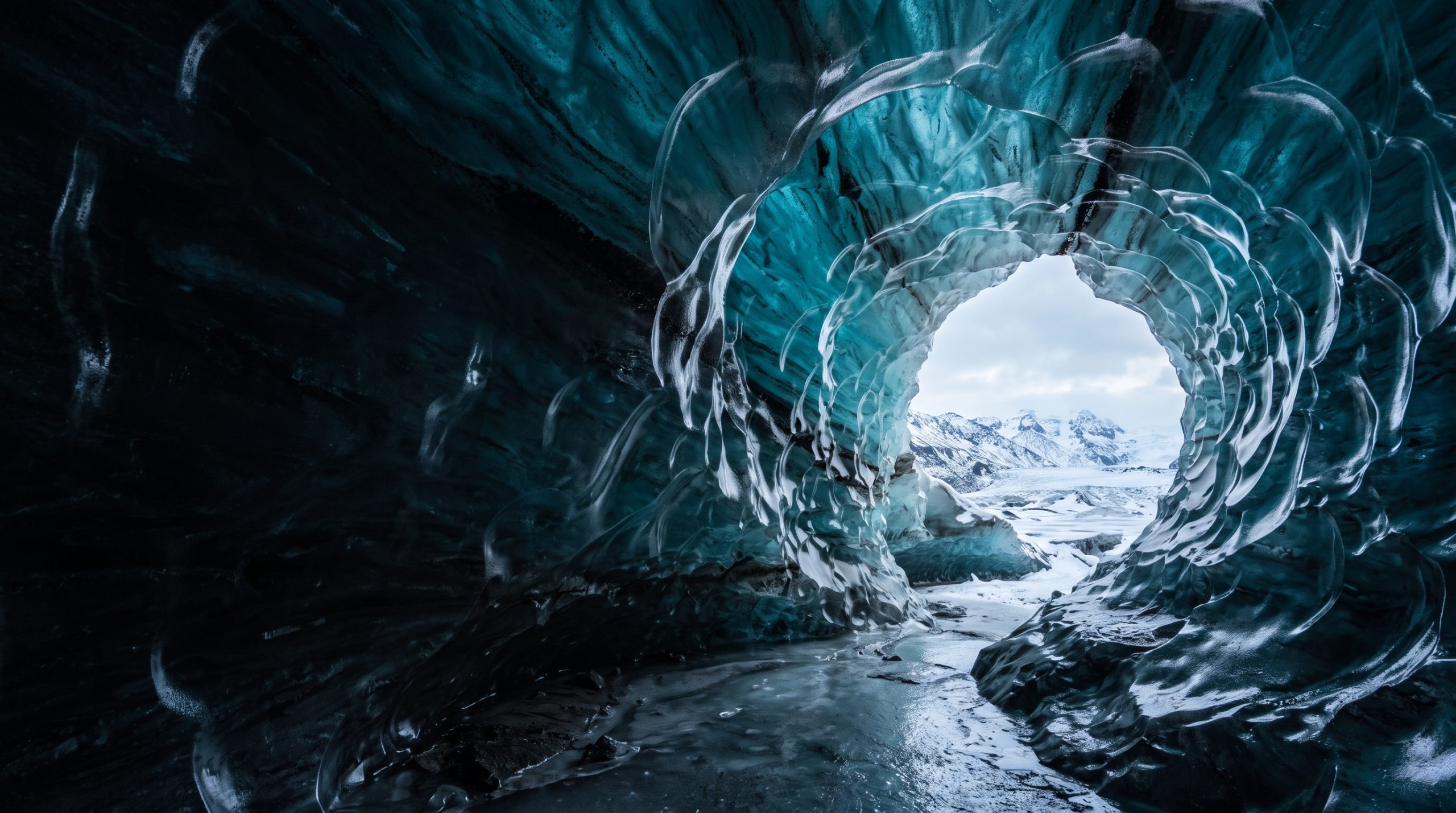
On the winter solstice at Breiðamerkurjökull, the outlet glacier that feeds Jökulsárlón, the sun clears the horizon a little before eleven in the morning and is gone again by around a quarter past three. At its highest point it sits roughly two and a half degrees above the ice. That is about the height of a streetlight seen from the end of the block, and it decides almost everything about a December ice cave day: what the ice looks like from the inside, when you can be in a dress, how many hours exist at all.
Natural ice caves under Vatnajökull are a cold-season feature. They form from meltwater each year, and a new set appears every winter in different places, which is why the operators who take people in hold contracts with Vatnajökull National Park that run from 1 November. Nobody can tell you in June which cave you will stand in next February. The honest version is that you book a date, a team and a glacier operator, and the cave itself gets chosen in the week you arrive.
So the two questions couples send us are the right ones. Which month, and what does the whole thing add up to.
November to March, plus the cave that ignores the calendar
Natural ice caves in Vatnajökull are accessible from around November through March, always with an operator contracted to the national park. The Katla cave under Mýrdalsjökull, 20 km from Vík, runs year round. Costs sit in two piles: our coverage, set out on our pricing page, and the glacier operator, paid per person.
Two and a half degrees above the horizon
The blue in an ice cave is daylight. Dense glacier ice absorbs most of the spectrum and lets blue through, so the colour you see inside is a function of how much light is landing on the roof above you. In late December, at this latitude, very little is. The sun tracks sideways along the horizon instead of climbing over the glacier, so light arrives through the mouth of the cave rather than down through the ceiling.
That has a real consequence and most pages skip it. In the deepest part of winter, the interior of a cave often reads slate, graphite and pewter rather than the electric blue in the photographs that sold you on the idea. The blue is there, but it lives in specific places: within a few metres of the entrance, in the thin sections of roof, in the scalloped hollows where the ice has been polished by water. We work those places and we do not pretend the whole chamber glows.
The compensation is enormous. Those four hours around the solstice are one continuous low-angle light, from the moment the sun appears to the moment it leaves. There is no harsh midday to plan around, because there is no midday in any useful sense. Outside the cave, on the glacier tongue and on the black sand, you get warm raking light across the ice for the entire time you are standing on it.
So a December plan looks like this. The glacier slot takes the middle of the light, because that is when there is enough of it inside the cave to be worth carrying a camera in. Vows go at one end of the day or the other, somewhere sheltered and close to the vehicle. Headlamps come out on the walk back, and nobody minds, because by then it is four in the afternoon and you are two hours from a hot spring.
Why February and March ice reads bluer
The sun climbs fast once January turns. By mid-February its highest point over Breiðamerkurjökull is around fourteen degrees, and by mid-March around twenty-four. That is the difference between light skimming the glacier surface and light pressing down through it, and it is the reason late-season caves photograph closer to the blue people have in their heads.
Daylight comes back at the same rate, and that changes the shape of a day more than the colour does.
| When | Daylight near Jökulsárlón | Sun at its highest | What it does to the day |
|---|---|---|---|
| Early November | Around 8 hours | About 11 degrees | Early caves, freshly scouted, and enough light for two locations |
| Solstice week | Just over 4 hours | About 2.5 degrees | One glacier slot, vows at the edge of the light, darkest interiors |
| Mid-January | Around 5.5 hours | About 5 degrees | Coldest, driest ice underfoot, still a very short day |
| Mid-February | Close to 9 hours | About 14 degrees | Blue starts reaching further into the cave, room for a full timeline |
| Mid-March | Almost 12 hours | About 24 degrees | Brightest interiors, flat middle hours, golden light split to the ends |
March gives you a real day and takes back the constant golden light. The good exterior hours retreat to early morning and late evening, and the middle of the day goes contrasty on fresh snow. It also brings more people onto the glacier, and the usual advice does not apply here, because you cannot arrive early. You arrive when the operator’s vehicle leaves. The lever we actually have is which departure we ask for, and how the hour is used once we are in: the first slot of the morning or the last of the afternoon, and a plan for working the corners of the cave while other groups are queuing for the obvious frame at the entrance. If your date lands in a busy stretch, we move the ceremony itself out onto the ice or down to the shoreline and treat the cave as the portrait window rather than the altar. Our published galleries and films will show you which of those two shapes speaks to you faster than any description here can.
Crampons, a helmet, and a hem that touches ash
Here is the part nobody writes down. You will be issued crampons and a helmet before you go anywhere near the ice, and you will wear both. Crampons strap over boots, not over anything with a heel or a thin sole, which means the boots go on at the vehicle and stay on across the glacier. Most couples change footwear at the cave mouth, hold the frames they want, and put the boots back on for the walk out. Plan for two minutes of standing on ice in the shoes you actually want in the pictures, not twenty.
The helmet matters more than people expect. It goes over whatever you have done with your hair, and it comes off inside for the frames that need it, so an updo that survives being compressed and released is worth more than one that does not. Veils and helmets are workable if the veil goes on after the walk. We say all of this in the timeline weeks ahead, so it is a decision and not a surprise.
Then there is the floor. Glacier ice here is streaked with volcanic ash, and the surface inside a cave is wet, gritty and dark. A pale hem will pick up ash within a few minutes of arriving. That is not a problem, it is just a fact to decide about: either the dress goes over an arm for the walk and comes down at the cave, or the ash marks become part of the day and get rinsed out afterwards. Both are fine. We have seen both. What is not fine is finding out at the entrance.
A cave is also a corridor, not a hall, which is where working as one team stops being marketing and becomes physics. There is usually one good line of sight and one good pool of light, and two people who arrived separately that morning will spend it standing in each other’s frames. Ours have worked the same rooms before: the filmmaker takes the mouth for the wide, moving frame while the photographer works close and low against the ice, and then they swap without discussing it. Sound is its own problem, because meltwater drips constantly and crampons are loud on ice, and wind funnels straight into the entrance. On The Expedition, professional audio for the vows is part of the coverage where conditions allow it, which usually means the vows happen a few metres back from the mouth rather than in it.
Kötlujökull, 20 km from Vík
If your date falls outside the winter window, the Katla cave is the answer. It sits in the Kötlujökull outlet of Mýrdalsjökull, 20 km from the village of Vík, and operators run it year round rather than only in the cold months. The only way in is a modified super jeep with the driver who belongs to it, roughly 40 minutes each way over black sand, with about three hours from the village and back. On the far side there is a walk of one to two kilometres over uneven ground to the entrance. The ice here is laced with dark ash bands from the volcano underneath, which reads very differently on camera to the clear blue of Breiðamerkurjökull, and Vík is around two and a half hours from Reykjavík rather than a full day’s drive east. For a July or September wedding date in Iceland, this is the one that still works. Our destination guides cover how it pairs with the rest of the south coast.
Who lets you in, and what gets filed
Nobody walks into a Vatnajökull ice cave independently. Access runs through companies holding a current contract with Vatnajökull National Park, and under the park’s terms those companies keep an experienced lead guide involved in a daily assessment of each cave and its surrounding ice formations. If a site is not right on a given day, the operator uses a different one. This is exactly why our plans name a glacier and an area rather than a named cave, and why the day is built so it holds together whichever chamber we end up in.
Professional filming inside the national park is a separate matter from the tour. The park runs a permit application process for filmmaking and similar production work, and that application is ours to research and prepare as part of planning. Any fee the park or a landowner charges is yours to pay directly. Drones sit under two sets of rules at once here, the Icelandic Transport Authority’s national rules and the park’s own general and regional restrictions, which differ from area to area inside the park. We confirm what is permitted for your specific date and location before any aerial is written into the film, rather than after.
The legal side of getting married happens well away from the glacier, in paperwork and with a celebrant, before anyone puts on crampons. We walk couples through the Icelandic requirements during planning, and our guide to planning an elopement covers the sequence in general terms.
Where the money goes on a glacier day
Our side is straightforward. The Adventure covers one full day with either a dedicated photographer or a dedicated filmmaker, from $4,900. The Expedition puts a photographer and a filmmaker on the same day, working together, from $7,900. The Odyssey runs from two to seven days across one or several destinations, photography and film, quoted as a custom proposal. Every one of them includes destination and location design, a timeline built around real light and real travel time, permit research, weather alternatives, drone footage where it is legal and appropriate, and team travel worldwide. Highlights reach you in five days and the full gallery or film in three weeks.
What you pay separately on an Iceland ice cave day is specific and short: the glacier operator, per person; permit fees where they apply; your celebrant; accommodation; and any unusual transport, which on this coast usually means the super jeep charter. Operator rates move with the season and with group size, so the current figures for your date go into your proposal alongside the rest of the plan. Our fee does not change with guest count. What does change is access, because the number of seats in the operator’s vehicle is a real limit, and permits and glacier logistics get more involved as the group grows.
Common questions
Can we actually hold the ceremony inside the ice cave?
Yes, and it works best as a short one. Caves are shared with other groups and the acoustics are wet and loud, so we usually place the vows a few metres inside where there is room to stand, keep them tight, and build the longer part of the ceremony outside on the glacier or at the black sand shoreline where there is space and quiet.
In December, will the cave look as blue as it does in photographs?
Partly. Around the solstice the sun peaks about two and a half degrees above the horizon near Jökulsárlón, so little light reaches the roof and the interior reads darker and greyer than the images that circulate. The strong blue sits near the entrance and in thin sections of ice. February and March interiors are noticeably brighter.
Is there anywhere to change out of hiking boots at the cave?
There is no building of any kind. The vehicle is the changing room, and the last swap happens standing at the cave mouth. We plan the timeline so the shoes you want in the frames are on your feet for a few minutes rather than the whole walk, and someone is carrying the boots.
What if the operator switches us to a different cave that morning?
That is normal here, and it is why we do not sell you a named cave. Contracted operators assess each site daily and move groups to another one when it is the better call. Our timeline is built around a glacier and a light window, so a change of chamber changes the frames, not the plan.
Can we elope in an ice cave in July?
Yes, at Katla. The natural caves in Vatnajökull are a November to March proposition, but the Kötlujökull cave near Vík is run year round by super jeep operators, so a summer date still gets you inside real glacier ice with a dress and a ceremony, in ash-banded rather than clear blue surroundings.
Booking a cave that does not exist yet
The cave you will stand in next winter is currently meltwater running under a glacier. That sounds like a reason to wait and it is the opposite. What we lock early is the date, the team, the operator slot and the hour of light we want to be standing in, all of which are finite in a four-hour December. The cave gets chosen in the week you arrive, by people who were on that ice the day before. We are booking 2027, 2028 and 2029 now.
The planning stays in writing from the first message onward. Send us the date you are holding and roughly what you picture, you will have our reply and first brochure back within 24 hours, and a tailored proposal for your month on this coast follows from there. Check Your Date.