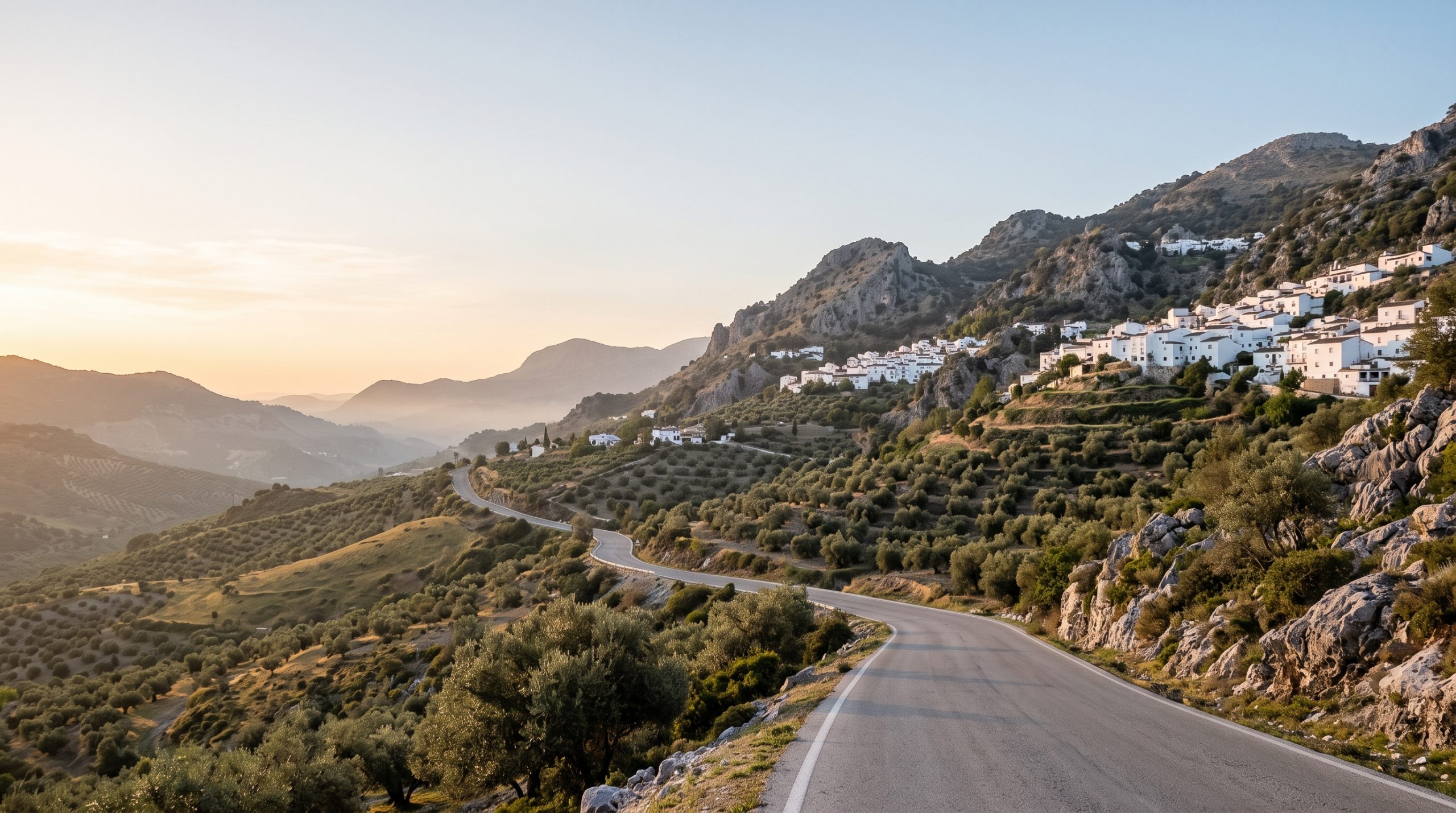
On the first of August, the sun comes up over Seville at 07:28 and goes down at 21:31. Fourteen hours of daylight, and the middle six are unusable, because Seville averages a high of 36°C in July and only steps down to 35.5°C in August. Andalusian elopements are built at both ends of the day. Everything else follows from that.
What you get in return is a region that changes character with every hour of driving. Snow sits above Granada while the coast is in shirtsleeves. There is a limestone plateau north of Malaga where the rock looks stacked by hand, a run of white towns along the Grazalema ridges, and 460 square kilometres of protected coast at Cabo de Gata where the headlands are volcanic and the light is bone dry.
The complication is not distance. It is gates. The best ground in Andalusia sits inside natural parks and ticketed monuments, and several of the roads you would want at sunrise are closed to cars at exactly the hours everyone else wants them. This is what we check, in the order you will need it.
Start here: Malaga, a rental car, four nights
Fly into Malaga, rent a car at the airport, and plan four nights minimum. Malaga holds the region’s only nonstop from the United States, a seasonal United service to Newark of about eight and a half hours. From there, Granada, Ronda and the Antequera karst all work as bases, and the ceremony hour goes where the light allows.
Flying in, and choosing your corner of Andalusia
Malaga-Costa del Sol (AGP) is the practical front door. United’s seasonal nonstop covers the 3,688 miles from Newark in roughly eight and a half hours; outside that season the trip runs through Madrid, Lisbon or a northern European hub on one connection. Seville (SVQ), Granada (GRX), Almeria (LEI) and Jerez (XRY) take European connections and are worth it when your ground sits at that end of the region, though they usually add a change of plane to save an hour of driving.
Then choose one corner and stay inside it. Couples who fold Granada, Ronda and the Almeria coast into four nights spend the trip on the motorway, watching the good light through a windscreen. Our destination guides go deeper region by region, but this is the shape of the decision.
| Corner | Land at | What the ground gives you | Nights we would plan |
|---|---|---|---|
| Granada and Sierra Nevada | GRX or AGP | Alhambra views from the Albaicin, snow into late spring, a paved road climbing to 2,500 m | Four to five |
| Ronda and the white towns | AGP | Gorge edges, cobbled lanes empty before 8am, olive country in every direction | Three to four |
| Antequera and El Torcal | AGP | Karst limestone that photographs like architecture, ten minutes on foot from a car park | Three |
| Cabo de Gata, Almeria | LEI or AGP | 460 square kilometres of protected coast, volcanic cliffs, the driest light in Spain | Four |
| Seville and the river country | SVQ | Courtyards, riverside light, the latest sunsets in mainland Spain in high summer | Three |
The paperwork stays home
Spanish civil marriage is built around residency. The Registro Civil expects one partner to be a Spanish national or to hold legal residency in Spain, so almost every American couple we work with here completes the legal marriage at home and treats the day in Andalusia as the ceremony itself: their own words, a celebrant they chose, nobody else in the frame. It works in reverse too. The U.S. Embassy in Spain confirms that a marriage valid where it was performed is automatically valid in the United States, and that a Spanish certificate proves it once an apostille is attached.
That removes a registry slot in a town hall you have never seen, on a date you did not choose, and leaves the part you came for. If you are still deciding what shape the day should take, our guide to how to elope covers the fundamentals. Permit research and landowner permission are ours to chase; the fees themselves, along with your celebrant and accommodation, sit on your side.
Light in the south: 21:31 sunsets and 36°C afternoons
Andalusia sits at the western edge of Central European Time, which pushes sunset very late in summer and makes a 9pm ceremony genuinely possible. The trade is heat. Seville’s July average high is 36°C, close to 97°F, and the flat white light that comes with it is the bigger problem. At the other end of the year, January averages a high of 16°C, and December is both the wettest month and the dullest, at around five hours of sunshine a day.
| Window | What the light and the weather do | What we build into it |
|---|---|---|
| March to mid-May | Green hills, wildflowers, snow still visible on Sierra Nevada, mild afternoons | Mid-level mountain ground and white towns, ceremony in the last two hours of light |
| Late May and June | Very long days, hot and dry by mid-afternoon, reliable skies | A dawn start, a long midday break, then a ceremony after 8pm |
| July and August | Peak heat inland, sunset near 21:30, sea breeze on the coast | Coast or altitude only, two short blocks of work, nothing in between |
| September and October | Heat easing, sea still warm, the best all-round balance of the year | Full days, two locations, the widest choice of ground |
| November to February | Short crisp days, snow above Granada, some genuinely wet weeks | Interior courtyards, low-level ground, a weather alternative held for every hour |
One altitude note: at 2,500 m on Sierra Nevada you want a warm layer in July. The valley can be in the thirties while the ridge asks for a coat.
Where barriers, shuttles and timed slots reshape the route
Route planners in Andalusia are not wrong about distance. They are wrong about whether you will be allowed to drive it.
El Torcal de Antequera. The Torcal Alto visitor centre sits at the end of one narrow mountain road with a small car park. On weekends, public holidays and any day the park expects a heavy influx, that road closes to cars for part of the day and a shuttle bus runs up from the closure point instead. Your map will route you to the top at 11am on a Sunday in April. In reality you park at the bottom and wait for the bus. We work Torcal on a weekday, at first light, before the question arises.
Sierra Nevada. From Granada the A-395 climbs to the ski station, and the public paved road ends at Hoya de la Mora at around 2,500 m. Past that barrier only authorised vehicles continue, though the national park runs a microbus higher in season. The road beyond reaches roughly 3,400 m below Pico Veleta, with Mulhacen at 3,480 m behind it, the highest ground on the Iberian peninsula. How far up you get is decided by snow rather than the calendar, so we build spring days on the middle slopes and the Alpujarras villages and hold the high ground for summer.
The Alhambra. Tickets go on sale around three months ahead on the official site, palace entry is a timed slot, and returned tickets sometimes reappear as late as two hours before a visit. None of that buys you a location. A ticket is admission to a monument with several thousand other people in it, which is why we shoot the Alhambra as a view rather than a venue: from the Albaicin, from the hills to the east, from a rooftop. The most famous of those viewpoints is shoulder to shoulder at sunset and quiet at 7am, and we will steer you to the second version.
Caminito del Rey. A superb walk and a poor ceremony site. It runs one way only, on timed entry, at ten euros a person for general admission, eighteen with a guide, or a combined ticket a little over eleven euros that includes the shuttle bus back. Tickets are released a whole season at once and early slots go first. You enter with a group and you keep moving, so there are no vows on the walkway. Walk it the day after, in trainers, as two people on holiday.
Real drive times. On the mountain roads between the coast and the white towns, add a third to whatever the planner tells you. They climb, they turn constantly, and there is no overtaking a coach on them. A map also hides the last 400 metres: old centres in Ronda, Granada and the pueblos blancos are pedestrian or permit-only, so the final approach to your hotel is on foot, with a dress bag, over cobbles. Worth knowing before booking a room at the top of a hill.
Aerials: what we confirm before we plan a film around them
Drone work in Spain runs under the European framework that AESA administers. Most of what we do sits in the open category and its A1, A2 and A3 subcategories, which need no prior authorisation but do require a registered operator, a remote pilot of at least sixteen, visual line of sight, an aircraft under 25 kg and a ceiling of 120 m above ground. Anything beyond that moves into the specific category, which needs an authorisation from AESA.
Location is the other half of the answer. Airspace over the Costa del Sol is busy and controlled in places, and ENAIRE’s drone map is the reference for what applies where. On top of that, flying inside a national park such as Sierra Nevada needs permission from the park authority, and rules across Andalusia’s natural parks, Cabo de Gata and El Torcal among them, are set park by park. We confirm the zone and the park before designing a film sequence around aerials, and we build a version that stands up if the answer is no.
How we shape a day around the gates
Every timeline we write for Andalusia carries three things a generic one does not: a start time set by actual sunrise on your date rather than a round number, a buffer on any leg that crosses a mountain road, and a second location held in reserve within fifteen minutes of the first. We never put the ceremony hour up against a shuttle’s last run or a monument’s closing time. Vows that finish because a bus is leaving are not vows.
There are eight of us, four photographers and four filmmakers, and on Andalusian days that matters operationally. Two vehicles mean one of us can be at the second location reading the light and the parking while the other stays with you at the first. It also means a full second set of bodies and lenses is on the ground, an hour from wherever you stand, in a region where the nearest camera shop is a two-hour drive and shut for lunch. Photography, film and planning come from one team, so nobody arrives as a stranger on the morning. You can see what that produces in the films and galleries we publish, the clearest look at how this coast and these mountains render.
Delivery is quick by design: highlights within 5 days, the full gallery or film within 3 weeks. Team travel is included worldwide, so flights and accommodation for the assigned team sit inside the coverage rather than being added afterwards, and the fee does not change with guest count. Two guests or twenty, the difference shows up in permits, transport and timeline. Both shapes of coverage, one dedicated photographer or filmmaker for a full day and the pairing that puts both on the ground together, are set out on our pricing page, along with the longer multi-day option for couples combining Granada with the coast.
A month in mind and a corner of Andalusia you keep coming back to is enough to start with. Send Us a Message and we will tell you what that date does to the light and the access.
Common questions
Can two Americans legally get married in Andalusia?
In practice, no. Spanish civil marriage is built around residency, with the Registro Civil expecting one partner to be a Spanish national or a legal resident. Couples complete the legal marriage at home and hold the ceremony here, which is also the version that gives you a sunrise on a ridge instead of a numbered ticket in a town hall.
How many nights do we need in Andalusia?
Four as a floor: an arrival day, a spare day for jet lag and scouting, the elopement day itself, and one day held back in case weather moves things. Five or six if you want two distinct regions, which is where a multi-day format across Granada and the coast makes more sense than one long day.
Can we do this without renting a car?
Only if you stay urban. Trains and buses connect Seville, Cordoba, Malaga and Granada well, but none of them reach a limestone plateau at 6am. A city day in Seville or Granada works entirely on foot. Park and mountain ground needs a car, and unusual transport like a 4×4 charter or a private boat is arranged separately and billed to you directly.
Can we have our ceremony inside the Alhambra?
No. It is a ticketed monument on timed entry, with tickets released around three months out, and admission does not give you a private space to stand still in. Use it as the view instead: vows in the Albaicin or on high ground east of the city, with the palaces and the Sierra Nevada snow line behind you.
Can you fly a drone over Sierra Nevada or Cabo de Gata?
Sometimes, and we confirm it before promising it. The airspace side means a registered operator, visual line of sight and a 120 m ceiling in the open category, checked against ENAIRE’s drone map. The ground side means park authority permission inside a national park like Sierra Nevada, and park-specific rules in natural parks such as Cabo de Gata.
Is late June too hot for an Andalusia elopement?
Inland at 4pm, yes. At 6am and again after 8pm it is one of the finest times of the year to be there, with sunset near 21:30 and warm light for an hour before it. June works if you accept a split day, or move it to the Cabo de Gata coast or above 1,500 m where the air is cooler.
What should we wear for a mountain morning and a 36°C afternoon?
Natural fibres that breathe, linen and cotton over anything synthetic, and a lining you can stand in for two hours. Add a warm layer for altitude even in July, because Hoya de la Mora at 2,500 m is a different climate from the valley. Bring shoes with grip for limestone and a second pair for the ceremony, and expect steady coastal wind, which changes what is worth doing with long hair.
What to send us first
A month, a rough guest count, and the corner of Andalusia you keep returning to when you look at photographs. We keep every planning decision in writing, so there is no time zone to negotiate: you write, the initial brochure comes back by the next day, and a tailored proposal follows. A signed contract and a 30% retainer open the planning, and our calendar is currently open across 2027–2029.
Tell us the date you are circling and we will tell you honestly what Andalusia does with it, including the months we would steer you away from. Start Your Story.