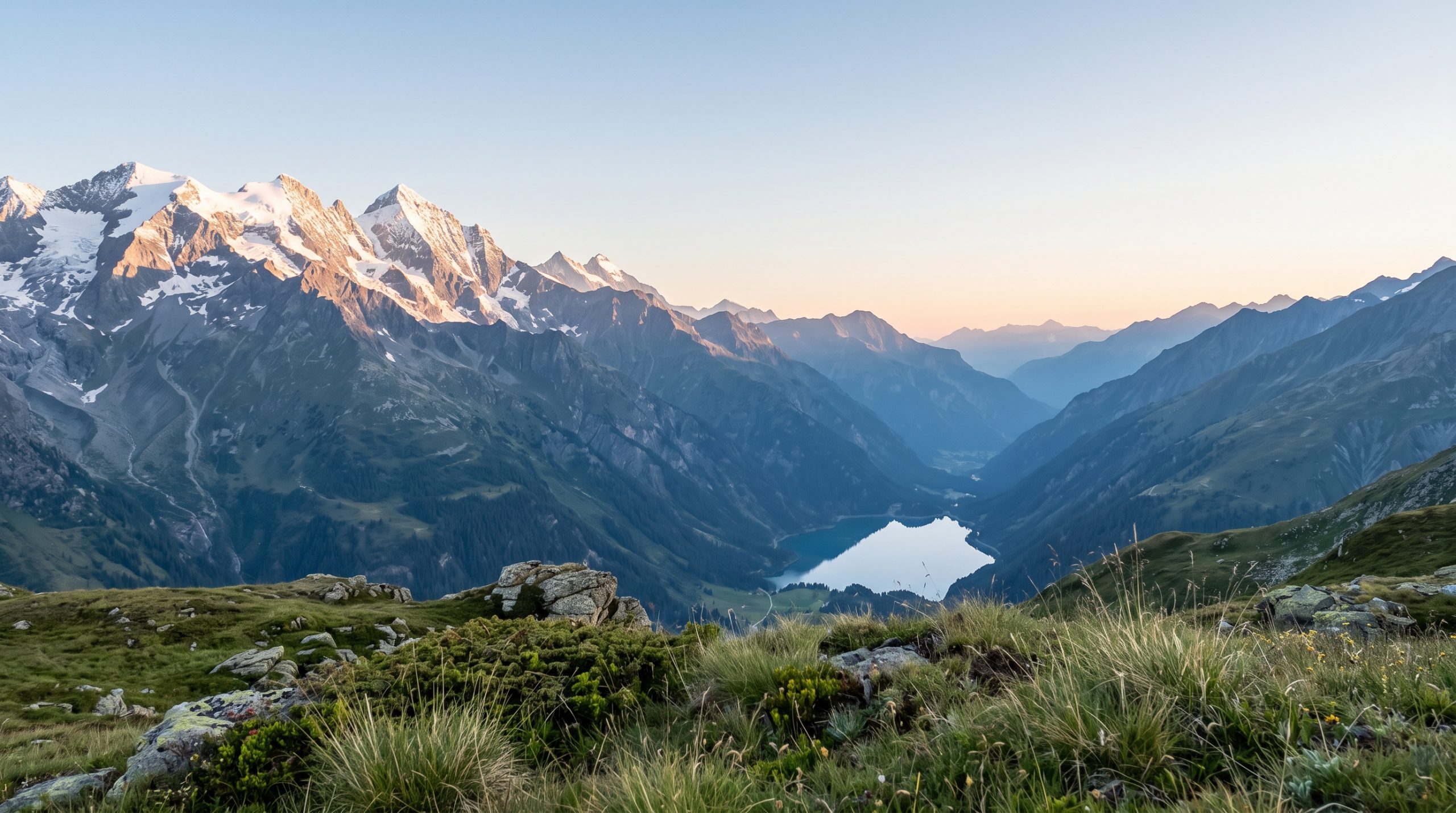
The first train up the Gornergrat leaves Zermatt at 07:00 in the main season. In the middle of June, the sun over the Matterhorn is already up by about half past five. That gap of roughly ninety minutes is the most useful fact in Swiss elopement planning, because it quietly decides your month, your mountain, and whether the ceremony belongs to the morning or the evening.
Switzerland runs on machines with timetables. Cog railways, cable cars, a car shuttle through a tunnel under a pass, a village that will not let your rental car past the next town along. None of that is difficult once you plan around it. All of it is difficult if you plan the day off a route planner.
So here is the operational version: the paperwork, the transfer times we actually schedule, the first and last departures, the drone rules, and the places where the map is not telling you the truth.
Airports, days and paperwork, in one paragraph
Fly into Zurich or Geneva, then allow two to four hours of trains to reach the mountains. Book five nights so the weather has somewhere to move. Your marriage licence comes from a Swiss civil register office, stays valid for three months, and the ceremony needs two witnesses over 18. Above the valley floor, cable car timetables set your hours.
The licence, the witnesses, and where the signing happens
Switzerland is refreshingly plain about marriage. You must both be at least 18, have legal capacity, and not already be married or in a registered partnership. You apply to a civil register office, it reviews the file, and the authorisation it issues is valid for three months. Inside that window you can marry at a Swiss register office of your choice, with two witnesses over 18 present.
Two things follow from that three-month clock. The paperwork is a late job, not an early one, so starting it a year out achieves nothing at all. The date is the early job: rooms in Zermatt and Mürren, and the hours we want on the mountain, are held long before a file is opened. Our calendar is open across 2027–2029, while the paperwork conversation belongs in the quarter before your date.
The legal signing happens indoors, in front of those two witnesses. Almost every couple we work with treats that as a pleasant errand and puts the ceremony that matters somewhere else: a ridge at first light, a meadow above a cableway station, a terrace at 1,638 metres with the Jungfrau wall across the valley. If that split is new to you, our guide to how eloping actually works sets out the sequence. The witnesses are the item to raise early, because a couple travelling with no guests still needs two people in the room, and that is planning work we do with you months ahead rather than in the final week.
Landing, then the last hour: car trains, car parks and villages with no cars
The flight is the easy part. What costs couples their first morning is the final leg, which is rarely a road running all the way to the door.
| Leg | How it works | Numbers that matter |
|---|---|---|
| Zurich Airport to the Bernese Oberland | Rail station sits under the terminal; change at Bern or Luzern for Interlaken Ost, then the valley line to Lauterbrunnen | Roughly two and a half hours, one or two changes, no car required |
| Geneva Airport to Zermatt | Along the lake to Visp, then the Matterhorn Gotthard Bahn, which runs into Zermatt itself | Roughly three and a half hours with a change at Visp |
| Driving from the Bern side into Valais | BLS car shuttle through the Lötschberg, Kandersteg to Goppenstein; you stay in the car | 15 minutes in the tunnel, from CHF 26 booked online |
| Täsch to Zermatt, because cars stop at Täsch | Shuttle train from the terminal car park, or a Zermatt taxi | 12 minutes, every 20 minutes from 5:55 to 21:55, CHF 17.20 return, Swiss Travel Pass valid |
| Motorway to the Schilthorn valley station | Wilderswil or Interlaken exit, through Lauterbrunnen to Stechelberg, then up by cableway | About 20 minutes of driving; cableway to Mürren every 30 minutes |
If you drive at all, the motorway vignette is CHF 40 and it is annual. There is no day version and no week version, so a four-night trip pays exactly what a resident pays. Look at the windscreen before you leave the rental desk, and if there is no sticker, the electronic vignette is sold online.
What the road-to-rail handoff adds
A route planner will show you a road into Zermatt. It ends in Täsch, and that is where your car spends the week. The published 12-minute shuttle is honest, but from parking the car to standing in your hotel lobby runs closer to an hour once you have found a bay, moved luggage and waited for a departure. Plan the hour and the arrival stops being stressful.
That same planner will cheerfully route you over the Furka or the Grimsel in April. The high passes clear late. In 2028 the Furka, Grimsel and Nufenen all reopened on 29 May, which is normal rather than unlucky. For a spring date, treat those passes as scenery you might be given and let the Lötschberg car shuttle be the thing you schedule between the Oberland and Valais.
The 20-minute run from the motorway to Stechelberg is a fair figure in May at seven in the morning. On a July afternoon the valley has one road, coaches on that road and a car park to solve at the end of it, so we write 35 minutes into the timeline and nobody watches the clock.
Where the timetable disagrees with the light
Sunrise on a Swiss summit is not a preference. It is an arithmetic problem between the sun and the first published ascent, and the answer changes every few weeks.
| Window | Sun up, approximately | Earliest published ascent | How the day gets built |
|---|---|---|---|
| Mid-June | About 5:30, with light in the sky until close to 21:30 | Gornergrat 07:00; Schilthorn 09:00 | First light from village level or ground you can walk onto, then the ceremony in a very long evening |
| Early September | About 7:00 | Gornergrat 07:00 | Ridge light becomes reachable by train, and the evening is still generous enough for two locations |
| Early October | About 7:45, dark by around 19:00 | Gornergrat 07:00 | First train and first light finally agree; a compact, efficient day at altitude |
| Early November | Later again | Gornergrat pauses for works, from 2 to 14 November in 2028 | We build around the Schilthorn window of 09:00 to 17:00 and low-level ground |
On the Zermatt side, the Gornergrat railway runs its main season from late April to early November, every 24 minutes from 08:00, with the first train out of Zermatt at 07:00 and additional journeys published before 08:00 and after 17:00. That published elasticity at both ends of the day is why so many of our sunrise and sunset hours end up on this mountain rather than another one.
The Schilthorn is a different animal. The summit sits at 2,970 metres, the ride from the valley takes about 24 minutes, and the cableway runs every 20 minutes between 09:00 and 17:00, with the last journey up and down at 17:00. No timetable is going to sell you dawn or dusk at 2,970 metres. What it will sell you is Mürren at 1,638 metres, which has no road, no coaches and paths you can walk out of at 5am without asking anyone’s permission. That is where the early hour goes.
Then there is the Lauterbrunnen valley floor, which behaves unlike anywhere else. The walls are enormous and the Staubbach falls drop close to 300 metres down the western side, so official sunrise happens long before any light reaches the meadows, and the floor loses that light early in the afternoon. The valley is genuinely at its best in flat, soft weather and in the middle of the day. We use it then, and put the golden hours on the terraces above it.
Choosing a base: Zermatt, the valley floor, or a village with no road
Three bases cover most of what couples come to Switzerland for, and they are not interchangeable.
| Base | What you wake up to | Access | Who it suits |
|---|---|---|---|
| Zermatt, car-free | The Matterhorn from the village street, before coffee | Shuttle train from Täsch every 20 minutes; the Gornergrat station faces the main railway station | Couples who want the ridge at first light and no driving all week |
| Lauterbrunnen, on the valley floor | Cliff walls, waterfalls, and sun that arrives late | Road access and parking; trains and cableways leave from here in four directions | Couples who want a car and a hub, not a summit every day |
| Mürren, 1,638 metres, no road at all | The Jungfrau wall directly across the valley | Cableway from Stechelberg every 30 minutes, with the Schilthorn above | Couples who want quiet, and light they can walk into rather than ride to |
The trade-off in the car-free villages is luggage. Everything you bring travels by train or cableway and then by hand or hotel trolley, which changes what you pack a dress into and how early you leave for a ceremony above the village. It is a small tax for waking up somewhere with no engine noise. Our destination guides go deeper on individual valleys if you are still choosing between regions.
Aerials: what we confirm before a film leans on drone footage
Switzerland has run under the European drone framework since 2023, which means the operator registers, passes the online test, and works inside published geo-zones. The Federal Office of Civil Aviation is the authority that issues permission, its drone map and the swisstopo app show which airspace is restricted, and anything the open category does not cover needs a specific-category authorisation from that office. Nature reserves and the ground near airfields are the two categories that catch people out at planning stage, so we check them against your locations before a shot list exists.
One regional rule matters more than any other for elopements. Drone flights are prohibited in Lauterbrunnen, in the Rosenlaui valley and on the Jungfraujoch, and in Lauterbrunnen that applies even below 250 grams because the airspace is narrow and busy. So a Lauterbrunnen film is built from the ground, from the cliff paths and from the trains, and it is a better film for it. Drone footage is included in every experience where it is legal, safe and appropriate, which on the Swiss side of our work usually means the wider Valais slopes rather than the famous valley.
If you want to see how the two sides differ before you commit, our published films and galleries put a cog railway morning and a cliff-valley afternoon side by side. Highlights reach you 5 days after the day itself, and the full gallery or film lands within 3 weeks.
The buffers we build so the mountain does not run your day
A Swiss timeline is mostly a set of deliberate gaps. The ceremony hour never sits next to a last descent, because a vow exchange with one eye on a departure board is not a ceremony. Every location has a second option held at a different altitude, so cloud sitting on 2,900 metres moves the day down rather than cancelling it. Transfers carry the padded number, not the published one. And a first-light start is booked against a village you can walk out of, so the plan survives a lift opening late.
That is also where working as one team stops being a marketing line. On the Expedition, a photographer and a filmmaker travel together, which means one can ride up on an earlier departure to see exactly where the light is landing while the other stays with you over breakfast. With 24-minute headways on a cog railway, that single decision is worth twenty minutes of your best hour. Two sets of gear already on the mountain also means a lens change or a battery is never the reason a moment goes unrecorded. Team travel is included worldwide, and how the one-day and multi-day experiences differ is set out on our pricing page.
Tell us the month you are thinking about and the kind of morning you want, and we will tell you which valley and which lift line up with it. Check Your Date and we will come back with the honest version, including the months that fit your idea better than the one you asked about.
Common questions
Do we have to be legally married in Switzerland, or can the mountain part be symbolic?
Either works. The legal marriage is a civil ceremony at a Swiss register office with two witnesses over 18, on a licence valid for three months. Plenty of couples handle the legal step at home instead and keep Switzerland entirely for the ceremony they actually want to remember.
How far ahead do we start the Swiss marriage paperwork?
The authorisation is only valid for three months, so the file opens in the quarter before your date rather than a year out. Dates, rooms in car-free villages and the hours on the mountain are the parts booked far ahead, often twelve months or more.
Do we need a rental car for a Zermatt elopement?
No. Zermatt is car-free and private vehicles stop at Täsch, so most couples arrive by train from Visp and never think about parking. If you do drive, the shuttle from Täsch takes 12 minutes, runs every 20 minutes from 5:55 and costs CHF 17.20 return.
Can we actually reach a summit for sunrise?
It depends on the month and the mountain. The first Gornergrat train leaves Zermatt at 07:00, which beats sunrise in October but not in June. The Schilthorn cableway starts at 09:00 all year, so early light there comes from Mürren and the paths above it.
Is it possible to fly a drone in the Lauterbrunnen valley?
No. Drone flights are prohibited in Lauterbrunnen, in the Rosenlaui valley and on the Jungfraujoch, including drones under 250 grams in Lauterbrunnen. Aerials get planned for locations where they are permitted, and the Lauterbrunnen film is built from the cliff paths and the valley floor instead.
What happens if the cable car closes for weather on our date?
The timeline already contains a second location at a lower altitude, chosen during planning rather than invented on the morning. Mountain weather in the Alps is usually local, so a ridge lost to cloud at 2,900 metres often means a forest, a river gorge or a meadow gaining everything.
Late June or early October for a Swiss mountain elopement?
Late June gives you light until nearly 21:30 and open high passes, with the trade that sunrise arrives before the lifts. Early October puts first light after 07:00, so summits become reachable, and the day is short enough to plan tightly around two locations.
Pick the month first, then the mountain
Start with the month and the kind of morning you want; the valley, lift and paperwork can follow from that. We keep the planning trail on email so every decision is easy to revisit across time zones. Your first message gets a brochure within a day, and once the contract is signed and the 30% retainer is in, we start building the route in detail. Start Your Story and tell us the month you have in mind.