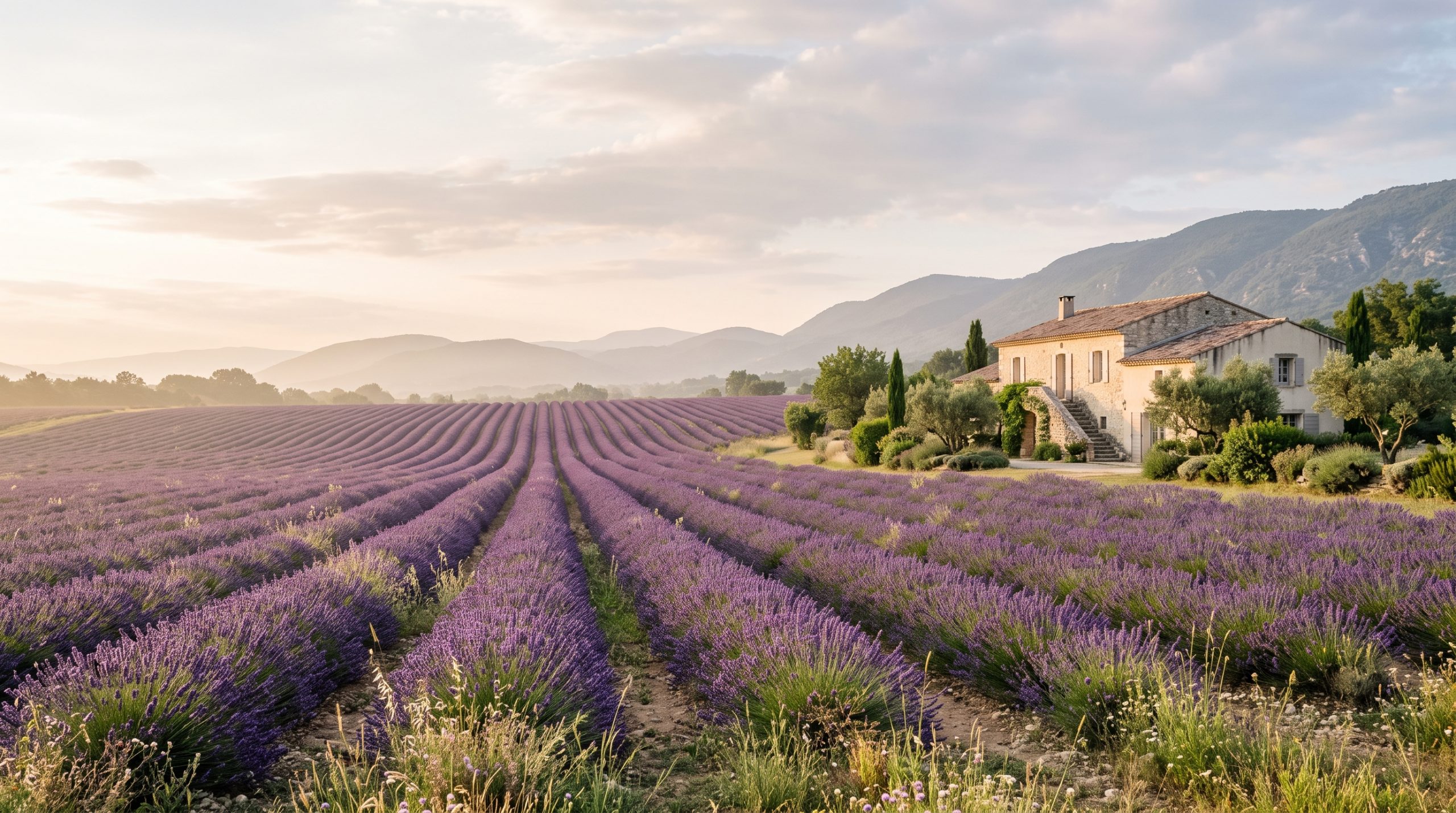
On the Valensole plateau in late June, the sun clears the horizon at four minutes to six. The sky starts lifting around twenty past five, which is why the field gets chosen the night before and nobody is still looking for it at dawn. By nine the light has gone white and flat, the roadside verges are lined with rental cars, and the good hour is behind you.
That one fact governs most of what follows. Provence is not a difficult place to get married in. The roads are paved, the bakeries open early, and Gordes and Roussillon sit eight kilometres apart as the crow flies. What it asks is that you get the order of your planning right: the paperwork, then the week, then the base, then the hour.
This is what we build with couples who marry in the Luberon, on the plateau and above the Verdon gorge, and what we would tell you before you book a single flight.
The frame: two bases, one narrow purple window
Fly into Marseille Provence with one European connection, pick up a car, and give yourselves five nights split between a Luberon village and the Valensole side. Marry legally at home so the ceremony here can be symbolic and held anywhere. Then build the day around first light, not lunch.
Marry at home, hold the ceremony in the field
French law recognises one form of marriage: the civil ceremony at the mairie. A ceremony at a farmhouse, on a ridge or in a lavender row is a symbolic one, fully yours to write, with no legal standing. Those are two separate events in two separate places, and the distinction surprises most American couples.
Marrying legally in France is possible, and it is a project. The dossier de mariage goes to the mairie of the commune where the ceremony will be held, 30 to 40 days ahead depending on the commune, to allow for the publication of banns and the pre-wedding interview. Banns are displayed for at least 10 days before the date. At least one of you needs 40 continuous days of residence in France beforehand, and that residence decides which mairie you are entitled to use. The file itself wants a full birth certificate less than six months old for non-EU nationals, passports, proof of address, a certificat de coutume or an accepted equivalent, and a sworn French translation of every document that is not already in French. American couples have the longest road here, because the US Embassy does not issue a certificat de coutume.
So almost every couple we work with in Provence signs the legal paperwork at home, in their own county, weeks before they fly. It is not a compromise. It is what frees the morning: no 11am appointment in a municipal room, and vows at 6:30am with wheat on one side and lavender on the other instead. If you want the legal ceremony to happen in France as well, tell us early and we will build the timeline around the mairie’s calendar rather than the light. Our guide to how eloping actually works covers the sequence in more detail.
Getting in, and where to put your suitcase
There is no nonstop service between the United States and Marseille Provence, so every American routing arrives with a connection, usually through a European hub. Land a day earlier than you think you need to, so a delayed bag does not become a delayed morning. Currently the only nonstop from North America into Marseille is Air Transat’s Montreal service, year-round, with a seasonal run from Quebec City.
Rent a car. Marseille Provence sits about 21 kilometres from Aix-en-Provence in a straight line, and everything after that is departmental roads. Trains reach Avignon and Aix, but a lavender field at 5:20am is not a station.
Then choose a side. Trying to hold the Luberon and the plateau from one hotel means the drive eats the hour you came for.
| Base | On your doorstep | What it costs you |
|---|---|---|
| Luberon hill villages: Gordes, Roussillon, Bonnieux | Sénanque 2 km below Gordes, Roussillon’s ochre 8 km on, dry-stone terraces and walled lanes | Valensole is 63 km east in a straight line, and the road does not travel straight |
| Valensole and the plateau edge | More than 800 km² of lavender and wheat, Moustiers-Sainte-Marie 19 km on, the Verdon beyond | Two or three weeks a year carry the reason you chose it |
| Moustiers-Sainte-Marie or La Palud-sur-Verdon | The gorge rim, the Route des Crêtes, 700 m of air below the cliff edge | Few beds, and lavender becomes a drive rather than a doorstep |
Basing yourselves in Marseille or Nice and driving up each morning is technically possible and practically not worth it. You will spend the best light on a motorway. Our destination guides go region by region if you are still comparing Provence against somewhere else entirely.
How narrow the bloom window really is
The lavender does not flower everywhere at once, which is the most useful thing to know when you are picking a date. Altitude sets the order. The Provence-Alpes-Côte d’Azur tourist board puts Valensole at its best from the end of June into the first days of July. Around Avignon, in the Comtat Venaissin, and near Aix-en-Provence, the beginning of July is the moment. Higher up around Sault the season only starts in July and can hold into August, which is the quiet card to play if your week is late.
The plateau itself runs to more than 800 square kilometres of lavender and wheat, and the colour shifts as the sun crosses it. The board’s own advice is to avoid the sun at its highest, because the view is better in softer light. That is a tourist board telling you to get up early.
Two honest notes. The fields immediately beside the main roads are the most photographed lavender in Provence, and from mid-morning in early July you share them with everyone who read the same article. We drive past those. And these are working farms: the rows are somebody’s crop and the bees are working them, so nothing gets picked and nothing gets flattened. We ask the owner before we set a ceremony in a row rather than on the track between them.
| Date at Valensole | Sky lifts | Sunrise | Sunset | What the land is doing |
|---|---|---|---|---|
| 10 May | 05:44 | 06:17 | 20:49 | Rows green, no colour on the plateau yet |
| 20 June | 05:17 | 05:54 | 21:22 | Colour arriving, the lower Luberon ahead of the plateau |
| 28 June | 05:20 | 05:56 | 21:22 | Valensole at its strongest |
| 8 July | 05:26 | 06:02 | 21:20 | Valensole tipping over, the Sault season opening |
| 15 September | 06:46 | 07:15 | 19:47 | Rows cut to gold stubble, warm evenings, almost nobody about |
Read that last row before you rule it out. Mid-September hands you a 07:15 sunrise rather than a 05:56 one, and the plateau in cut gold is a strong day almost nobody books.
Twenty-three kilometres that can take three hours
The Route des Crêtes above the Gorges du Verdon is the region’s clearest case of a route planner being confidently wrong. The D23 starts 800 metres outside La Palud-sur-Verdon in the direction of Rougon, runs about 23 kilometres, and passes something like 15 named viewpoints. A satellite navigation system offers something near forty minutes. The departmental tourist office says to allow an hour and a half to three hours, and the tourist office is right, because you will stop and because part of the loop is one-way. Join it in the wrong direction from the village and the loop simply does not work. Tunnel work has also closed the one-way section on weekdays during working hours, so we confirm the road’s current state in writing before we plan a morning on it.
Three more places where the map and the drive disagree:
- Gordes to Sault. Twenty-six kilometres apart as the crow flies, with the Monts de Vaucluse in between and no road over the top. The drive goes around. We treat it as a separate day, not a detour.
- Gordes down to Sénanque. Two kilometres, and a lovely two kilometres at seven in the morning. From mid-morning the descent is coaches and full lay-bys. There is one good hour and it is early.
- The lanes between the hill villages. Walled, narrow, and shared with tractors through the harvest weeks. What looks like a shortcut across a plateau on satellite view is usually a farm track, and it usually ends in a farm.
The other thing the map hides is that the plateau and the gorge are not one morning. Valensole to La Palud-sur-Verdon is 29 kilometres in a straight line and the road follows the country, not the line. Pick one for sunrise and give the other its own evening.
The 5:20am start, hour by hour
A real late-June plateau day, built on the times in the table above.
- 04:30 — we arrive where you are staying. Dressing, letters, the quiet part of the morning.
- 05:05 — in the car. The field was chosen and driven the previous evening at the same hour, so there is no searching.
- 05:20 — the sky lifts. Wide frames while the plateau is still blue and cold enough for a jacket over the dress.
- 05:56 — sunrise. The rows go gold on one side and stay blue on the other for about twenty minutes. This is the hour you flew for.
- 06:30 — ceremony. Vows read aloud, celebrant and witnesses if you want them, nobody else on the road.
- 07:45 — breakfast in the village, still in the dress if you like. The bakery is open and the plateau is empty.
- 09:00 to 17:00 — off the plateau and out of the light. Sleep, swim, eat lunch slowly. The warning about high sun applies to your comfort as much as the frames.
- 17:30 — second location. Moustiers-Sainte-Marie, the lake, or the gorge rim if the evening is clear.
- 21:22 — sunset from higher ground, then roughly another half hour of usable sky before the light goes at 21:58.
Two hours of that day carry the film, and they sit at opposite ends of it. The 6am hour and the 9pm ridge are what the edit is built from, and you can see how that reads in the finished work on our stories and films before you commit to a shape for your own day.
What we hold in reserve
Buffers are the whole craft in a region of departmental roads. We drive every route the day before at the hour we will actually drive it, and the ceremony never sits next to a road we have not seen. Every day we work here carries a second location, usually lower and more sheltered, because the mistral arrives out of the north down the Rhône valley and an open plateau rim is a hard place to read vows. If it blows, we move to the walls and the terraces.
Aerials sit inside a real framework. France works under DGAC and EU rules: drones with a camera are registered through AlphaTango, flights stay below 120 metres and within sight of the pilot, and protected or restricted zones need permission before anything leaves the ground. Those zones are published on the government’s Géoportail drone map. We check the map and the landowner before we plan a single aerial into a film.
On our coverage options, a single day comes with either a dedicated photographer or a dedicated filmmaker, the fuller day puts both on the ground with professional audio for the vows where conditions allow, and a two-to-seven-day shape exists if you want the plateau and the gorge on separate days. With two of us working we run two cars on a plateau day: one stays with you through breakfast while the other is already at the evening location, reading the light and the wind before you drive out. Team travel is included worldwide, so flights and accommodation for the assigned team are not yours to solve. Highlights reach you in five days, the full gallery or film in three weeks. Permit fees, celebrant, accommodation and anything unusual on wheels or water are yours; the research and the logistics are ours.
If you have two candidate weeks and no idea which is better, that is exactly what to write to us about. Check Your Date and tell us which fields you have been looking at.
Common questions
Can we legally get married in Provence if we live in the US?
Legally, yes, but the route is long: a dossier submitted to the mairie 30 to 40 days ahead, banns displayed for at least 10 days, 40 continuous days of residence in France for one of you, and sworn French translations of every document. Most American couples sign at home and hold the Provence ceremony as a symbolic one.
When exactly is the lavender out, and what if we can only come in late July?
The regional tourist board puts Valensole at its best from the end of June into the first days of July, and the fields around Avignon and Aix-en-Provence at the beginning of July. Late July is not lost: around Sault, at higher altitude, the season only starts in July and can run into August.
Do we need a rental car for a Provence elopement?
Yes. A field on the plateau at 5:20am is not on a timetable, and taxis do not idle on the departmental roads at dawn. One car for you, and on a two-person day a second for us, so scouting and coverage happen at once.
How many days should we plan in Provence?
Five nights is the honest minimum for one wedding day done properly: arrive and reset, scout the evening before, the day itself, then a second lighter day for the other side of the region. Anything shorter and the drives start deciding your timeline for you.
Can you fly a drone over the lavender fields and the Verdon gorge?
Sometimes, and only after checking. France follows DGAC and EU rules, with registration through AlphaTango, a 120 metre ceiling, visual line of sight, and permission required in protected or restricted zones listed on the Géoportail drone map. We confirm zone status and landowner consent before aerials go into the plan.
What if the mistral is blowing on our date?
We move. The mistral comes down the Rhône valley from the north and the open plateau feels it most, so every day we build carries a lower, sheltered alternative among walls, terraces and hollows. The ceremony hour moves with the wind, and the vows are not read into a headwind.
Is the Route des Crêtes worth the drive?
Yes, if you give it the time it actually takes. Twenty-three kilometres, around 15 viewpoints, an hour and a half to three hours by the departmental tourist office’s own reckoning, and a one-way section that has to be joined in the right direction from La Palud-sur-Verdon.
Picking your week with us
We keep the whole planning thread in writing, which suits a project spread across time zones. Send the inquiry form and you get a reply and a first brochure within a day, then a proposal built for your dates. A signed contract and a 30% retainer start the planning, and Our planning calendar is open for 2027, 2028 and 2029. Tell us the week you are considering, whether you want purple or gold stubble, and how early you are genuinely willing to wake up. Start Your Story and we will tell you honestly which week in your window is the better one.