The document that decides whether your Norway wedding is legal is called a prøvingsattest, it comes from Skatteetaten in Oslo, and it is valid for four months. That one number shapes more of a Norwegian elopement plan than the weather does. Book the flights first and you can end up holding a certificate that lapses before you land.
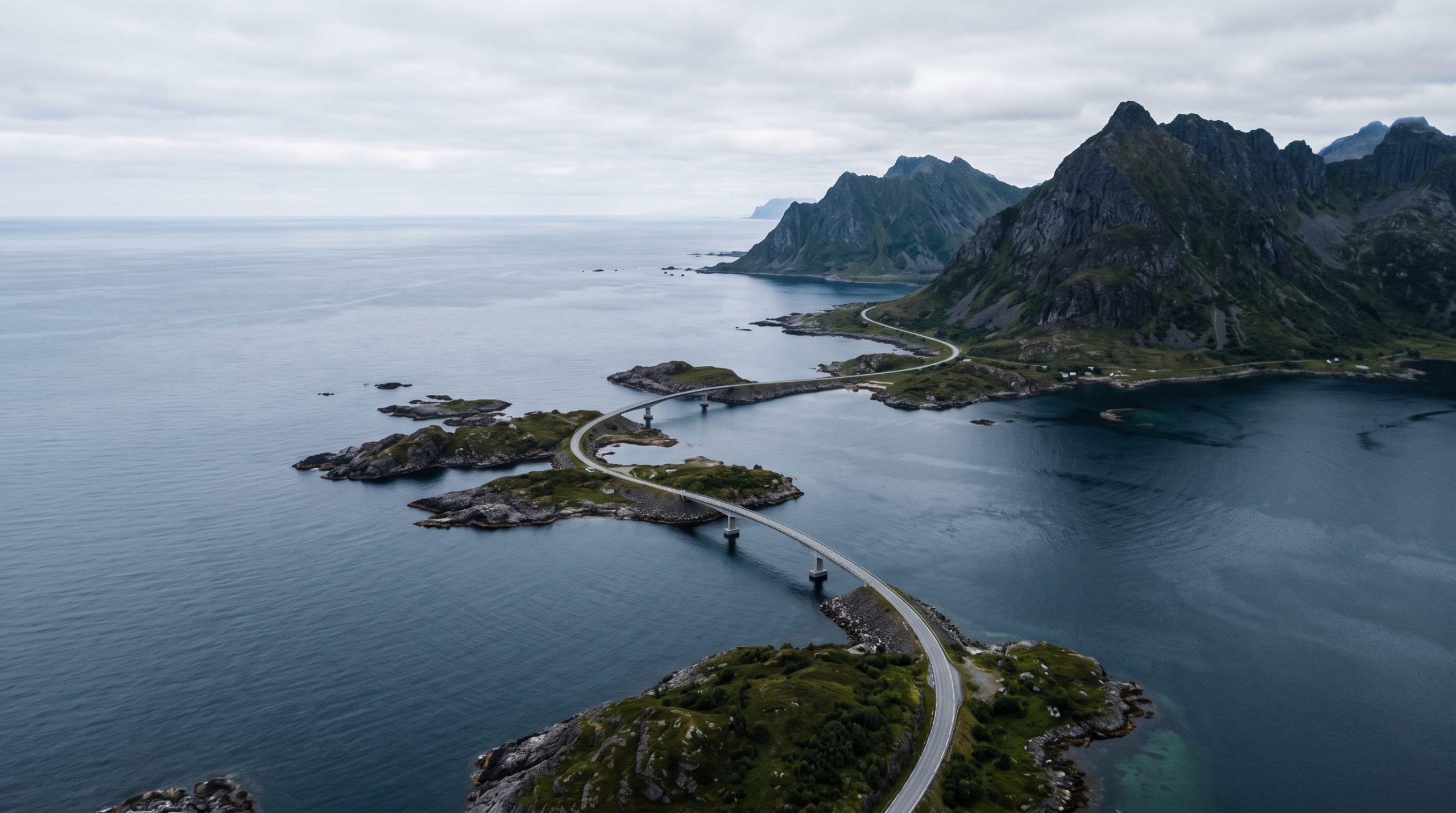
The second number that catches couples out is on the ground. The E10 through Lofoten is a National Scenic Route, and it runs island to island across bridges narrow enough that one car waits while the other comes over. A route planner reads all of that as steady movement. It is not.
So this is the operational version of a Norway elopement. The paperwork clock, the roads, the drone rules, and how we build a day that absorbs all three without you feeling any of it.
Start here: the certificate, the car and the calendar
Plan a Norway elopement backwards from Skatteetaten’s certificate of no impediment, which is valid for four months and takes weeks to issue. Add a rental car, because the good ground is rural. Allow more driving time than any map gives you, confirm drone permission for your specific area, and hold a weather alternative nearby.
The prøvingsattest, and the four-month window it opens
Skatteetaten, the Norwegian Tax Administration, is the office that decides. It reviews your documents and, if everything holds, issues the prøvingsattest: the certificate confirming there is no legal obstacle to your marriage under Norwegian law. Both of you must be at least 18. You each complete a personal declaration, and you each nominate a sponsor. Skatteetaten is specific here. Sponsors must be at least 18, and the two of you cannot act as each other’s sponsors.
Foreign citizens also have to send supporting documents. Skatteetaten asks for proof of name, age and citizenship when you do not have a Norwegian national identity number, and the original certificate of no impediment from your home country (or the accepted civil-status alternative if your country does not issue one). That original must normally be apostilled or legalised, be no older than four months, and be in English or a Nordic language or accompanied by the required certified translation. Non-Nordic citizens must also document lawful residence in Norway. If either of you has been married before, there is a further declaration of division to complete, and that form is published in Norwegian only.
There are two routes in. The online application folds the sponsor statements into the same form so nobody posts anything, but it runs on Norwegian electronic ID. Couples travelling from the United States generally take the paper route and send originals to Skatteetaten, Postboks 9200 Grønland, 0134 Oslo. Either way, the review is measured in weeks rather than days.
Then the clock starts. The prøvingsattest is valid for four months. Skatteetaten currently sends it to both of you in Altinn (or by post if you have opted out of digital communication), and you are responsible for sending it to the person conducting the ceremony. You still present valid ID at the wedding. Four months sounds generous until you set it against a review that can take weeks. Apply too early and it expires before the date. Apply too late and it is not back in time. The workable window is narrower than it looks, and it is the first thing we map when a couple names a month. Our guide to how an elopement actually comes together walks the same sequence in general terms.
| When | What happens | Why it sits there |
|---|---|---|
| 12 months out | Region chosen, team assigned, landowner and permit questions opened | Access questions in rural Norway take far longer to answer than accommodation does |
| 6 months out | Home-country certificate of no impediment requested, sponsors confirmed | This is the document couples wait longest for, and Skatteetaten will not proceed without it |
| Around 3 months out | Application submitted to Skatteetaten, once the supporting documents are ready | Allow processing time while keeping the four-month validity comfortably over the wedding date |
| 8 weeks out | Car, cabin, and any boat, guide or 4×4 transfer | Rural Norway runs on a small number of vehicles and a small number of beds |
| Before the ceremony | Marriage licence sent to the officiant; valid ID kept with you | Skatteetaten sends the licence in Altinn or by post, and you are responsible for providing it to the officiant |
Three Norways, and they do not plan alike
Norway is not one logistical problem. The Arctic archipelago, the fjord shelf country in the south west and the high interior mountains each impose a different constraint, and the constraint usually sets your hour, not the view.
Lofoten is a chain, and the E10 is the spine of it. Hardanger is vertical: you park, you climb, and the road that gets you closest is open only part of the year. Jotunheimen is protected landscape, which changes what a film can be made of before you have packed a bag. Our destination guides go region by region on what each one gives you.
| Region | What governs the day | The number to hold |
|---|---|---|
| Lofoten | Road width and traffic on the E10 | Svolvær to Å is roughly two and a half hours of moving time, and most of a day in practice |
| Hardanger and Trolltunga | The seasonal toll road up to P3 Mågelitopp | P3 runs 8 June to 30 September |
| Jotunheimen | Protected status | Drones are prohibited across the national park and protected landscape |
Where the map lies: the E10 and the Mågelitopp road
Two Norwegian roads generate more surprised messages than everything else put together.
The E10 through Lofoten
Ask a route planner for Svolvær to Å and it offers something around three hours. Local operators who drive it every week put the moving time closer to two and a half. Both are honest, and neither is the number to build a ceremony hour on. The E10 is narrow. Bridges are single lane with passing bays, so you wait, politely, while somebody comes across. Sheep have right of way in practice if not in law. Summer traffic moves at a relaxed pace behind camper vans, and you will stop anyway, because the road keeps handing you reasons to.
Plan on four hours end to end with a real stop in it. On a wedding morning we plan on more than that, and we work in the opposite direction: pick the location first, then find the piece of the E10 that does not have to be driven twice.
The road up to Mågelitopp
Trolltunga looks like a car park and a walk. It is a road system with a gate. From P1 Tyssedal you climb to P2 Skjeggedal, and the continuation up to P3 Mågelitopp is a toll road, paid at the machine at P2 before you drive it. That toll currently sits at NOK 220 and it is separate from the parking fee. Every vehicle pays it, rental cars and AutoPASS holders included, which surprises people who assume a transponder covers everything in Norway.
P3 opens for the season on 8 June and closes on 30 September. It is a small car park, in the region of thirty spaces, charged per day, and it can be reserved ahead through the official Trolltunga site. From P3 the hike is 20 km return with 800 metres of total ascent, and the official estimate is seven to ten hours round trip. From P2 it is longer again.
Here is the part worth saying plainly. A seven to ten hour round trip is the entire day. It does not sit next to a flight, a boat, a second location or a dinner reservation, and a couple who asks it to do all four arrives at the tongue with nothing left for the walk down. If Trolltunga is the picture in your head, the day gets built around the walk and nothing else goes in it. That is a very good day. It is simply only one thing, and it is worth telling us early that it is the one thing you want.
Drone permission is a location question before it is a gear question
Aerials are part of most Norwegian films we make, and Norway is unusually clear about how they work. Luftfartstilsynet, the Civil Aviation Authority, sits behind the system. Operators register at flydrone.no, and registration applies to any drone of 250 grams or more, and also to lighter drones carrying a camera or sensor able to capture personal data, which covers essentially every camera drone anyone would put on a wedding film.
A crew arriving from outside the European system with no registration there registers in the first EASA member state where it intends to fly, so if Norway is the first stop, the registration is Norwegian. Competence comes through the online A1/A3 course and exam, which is available in English. In the open category, the drone stays within visual line of sight and no more than 120 metres from the nearest point of the ground or water. Separation rules depend on the aircraft class and subcategory: the 150-metre rule applies to A3 operations, where you must stay at least 150 metres from residential, commercial, industrial or recreational areas; it is not a blanket rule for every drone above 500 grams. Work outside the open-category limits can require authorisation in the Specific category.
The part that decides your film is local. Many Norwegian national parks and protected areas carry their own drone bans, and the Nature Diversity Act protects birds and wildlife from disturbance everywhere in the country, inside a protected area or outside one. Jotunheimen prohibits drones across the national park and the protected landscape. Protected status and drone permission are separate questions and they do not always answer the same way, so we settle the specific area before a single aerial goes into a plan. Where the answer is no, the film gets built on the ground, and our published films and galleries will show you that the ground version is not a consolation prize.
How the ground rules reshape the timeline we build
All of the above turns into a small number of scheduling decisions, and they are the same ones every time.
We do not put a ceremony hour next to a departure. Not a ferry, and not the last sensible hour on a seasonal toll road. If the road to P3 closes on 30 September, a late-September day gets a full day of slack in front of it rather than an afternoon.
We hold a second location fifteen or twenty minutes from the first, chosen for a different wind direction rather than a different view. In Lofoten that usually means one place open to the sea and one in the lee of a ridge, and the choice gets made on the morning, not the month before.
We also plan the driving as work rather than transit. Two and a half hours of moving time is a four hour operational block, and four hours of Lofoten road with a dress in the back is a different animal from four hours of motorway.
This is where having two of us on the ground stops being a luxury and becomes logistics. On The Expedition a dedicated photographer and a dedicated filmmaker work the same day, which usually means two vehicles. One can be at the ceremony location an hour early, reading the light and the wind and checking the ground is where we left it, while the other stays with you through the drive and the last twenty minutes before you walk out. Two sets of bodies, lenses and batteries also means a long day on an island road carries a spare of everything. With eight of us on the team, there is a colleague in reserve as well.
Delivery is the same wherever in Norway you go: highlights in five days, the full gallery or film in three weeks. Coverage starts with The Adventure, one full day with a dedicated photographer or filmmaker, and The Expedition puts both on the same day from $7,900, with flights, accommodation and ordinary travel for the assigned team included worldwide. The detail of what each experience covers is set out on the pricing page.
If you already have a month in mind, send us the month and the region and we will write back with what the ground actually does then. Tell Us Your Story
Common questions
What does Skatteetaten need from an American couple marrying in Norway?
A personal declaration from each of you, a statement from each of your two sponsors, proof of name, age and citizenship where required, and the original certificate of no impediment from your home country (or the accepted civil-status alternative). The foreign document normally needs apostille or legalisation, must be no older than four months, and may need a certified translation. Non-Nordic citizens also need proof of lawful residence in Norway. Both of you must be at least 18, and you cannot act as each other’s sponsors. If either of you has been married before, add the declaration of division.
How long is a Norwegian prøvingsattest valid?
Four months. That is the whole planning problem in one number, because the review before it is issued is measured in weeks. Submitting a year ahead does not help you, and submitting a month ahead is tight. We usually build the application into the schedule around four months before the date.
Do we need to register a drone in Norway if we are bringing one from the US?
Registration happens at flydrone.no, and an operator with no European registration registers in the first EASA member state where they intend to fly, which means Norway if Norway is the first stop. Registration generally applies from 250 grams upward and also to lighter camera drones unless the relevant exception applies. Visitors flying with a camera or other sensor must also register the use of photo, video or other sensors with the Norwegian National Security Authority before flying. On our films this is our job, not yours.
Can we have aerials over a ceremony in a Norwegian national park?
Sometimes, and it depends entirely on which park. Many national parks and protected areas carry their own drone bans, and Jotunheimen prohibits them across the park and the protected landscape. We confirm the specific area before any aerial goes into the film plan, and where the answer is no we design the film around ground work instead.
How long does the drive from Svolvær to Å in Lofoten really take?
A route planner says around three hours, and local operators put the moving time nearer two and a half. Plan on four with one proper stop. The E10 is narrow, bridges are single lane with passing bays, and summer traffic behind camper vans sets the pace whether you like it or not.
When is the road up to P3 Mågelitopp open for Trolltunga?
The P3 season runs from 8 June to 30 September. The toll for the stretch from P2 Skjeggedal up to P3 is paid at the machine at P2 before you drive it, currently NOK 220, and it is charged separately from parking. Every vehicle pays, including rental cars.
Can we split a Norway elopement across two regions?
Yes, and that is what The Odyssey is for: two to seven days, photography and film, one destination or several, put together as a custom proposal. Lofoten and a fjord region in the same trip is a real plan, though it wants at least one full travel day between them rather than an evening.
Does bringing a few guests to Norway change what we pay?
No. The price does not move with guest count. What guests do change is access, permits, transport and the shape of the timeline, because a small car park and a single-lane bridge respond very differently to one vehicle than to four.
Sending us a 2027 date
We are booking 2027, 2028 and 2029, and Norway rewards the couples who start with the certificate rather than the flights. Tell us the month you are circling and the picture in your head, and we will come back with what the ground does in that month, where the paperwork clock has to start, and which region fits the day you are describing. Everything happens in writing, so you can read, think and reply when it suits you. A reply and an initial brochure land within 24 hours, and planning begins once the contract is signed and the 30% retainer is paid. Check Your Date