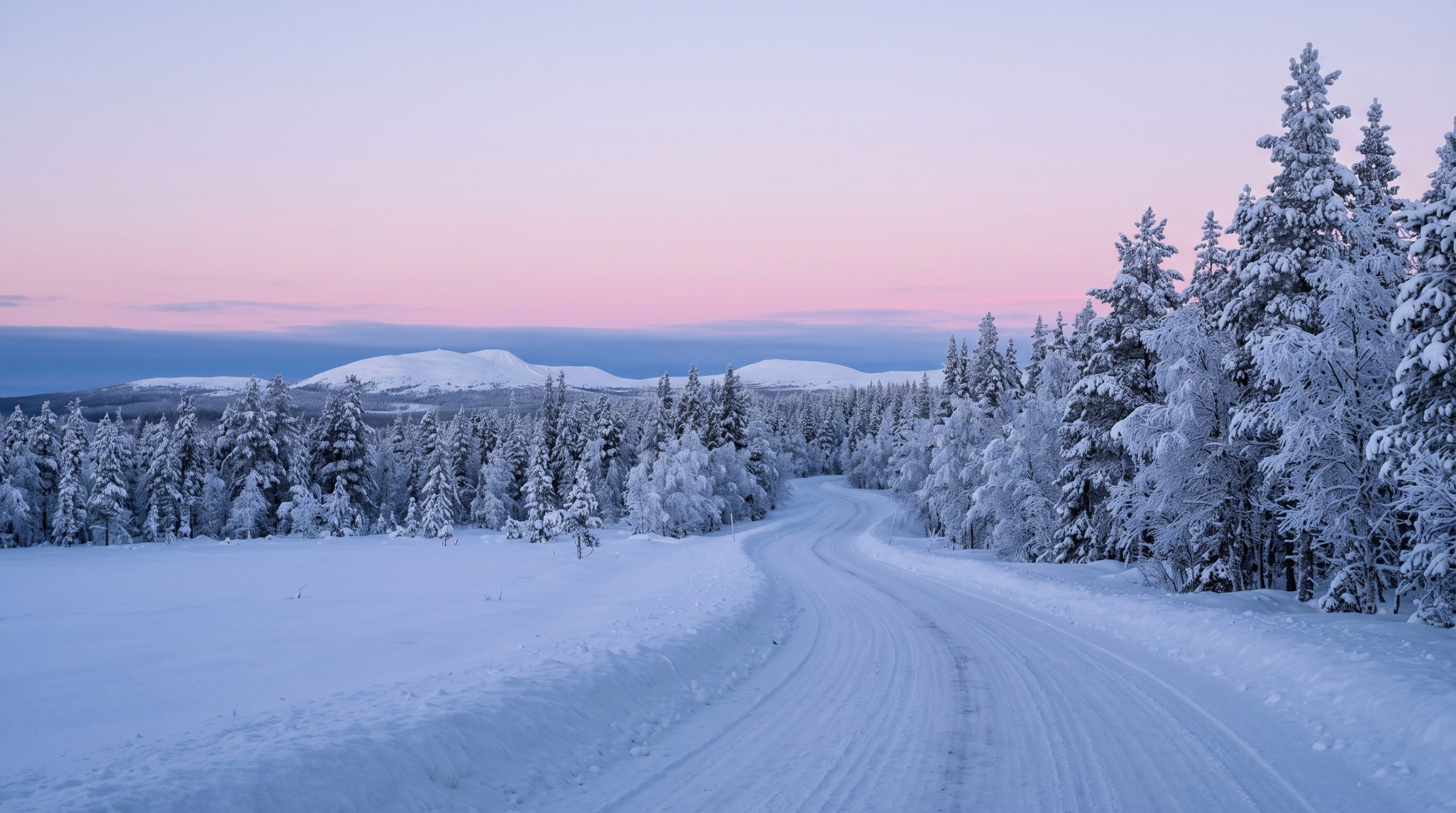
On December 21, 2027, the sun clears the horizon in Rovaniemi at 11:08 and is gone again by 13:22. Two hours and fourteen minutes. Drive north to Saariselkä and it does not rise at all between roughly December 6 and January 7. Those numbers decide more about a Lapland elopement than the venue, the dress or the aurora forecast.
The rest is solvable, and mostly a question of order. Finland requires an examination of impediments to marriage that sits at least seven days before the ceremony. Your airport is either twenty minutes or two hours from the bed you sleep in. And from November to April the route planner is optimistic about every road north of Rovaniemi.
What follows is the operational version: what to book, in what order, and what we build into a timeline once you have your week.
Airports, drives and how many days Lapland needs
Fly to Helsinki, then north to Kittilä, Ivalo or Rovaniemi. Kittilä puts you twenty minutes from Levi and about half an hour from Ylläs. Allow five nights: one for the ceremony, two for weather, two for aurora attempts. Start the Finnish impediments application months ahead, not weeks, because foreign paperwork takes longer.
Pick your month by the light it gives you
Every decision in a Lapland timeline is downstream of one question: how long the sun is up, and how high it gets. In late February it rises at Ylläs at 08:00 and stays under six degrees above the horizon until 09:26. That is not a compromise. Sunrise light lasts ninety minutes instead of twenty.
| Window | Sun above the horizon | What it gives you |
|---|---|---|
| Late August to late September | About 12 hours at Ylläs on September 25, 07:13 to 19:17 | Open water for reflections, ruska color, first properly dark nights |
| October and November | Under five and a half hours at Levi by November 15, 09:28 to 14:43 | Low light all day, snow arriving, strongest statistical months for aurora |
| December to early January | No sunrise at Levi from about December 12 to January 1; Rovaniemi still gets 2h14 on December 21 | Kaamos: continuous blue and pink twilight, roughly 09:40 to 15:00 |
| February | 9h13 at Ylläs on February 25, 08:00 to 17:13 | Deep snow, a full working day, both ends of the light at civilized hours |
| Mid-March | About 11h30 at Ylläs on March 15, 06:46 to 18:19 | Snow, warm afternoon light, aurora season still running |
| Late May to late July | Sun never sets: about June 7 to July 6 in Rovaniemi, May 22 to July 22 in Inari | Midnight sun, green fells, a ceremony at 1am in full light |
Polar night is more local than couples expect. At Äkäslompolo, under Ylläs, the sun fails to rise for about fifteen days. At Saariselkä it is closer to five weeks, and at Inari roughly December 3 to January 10. Rovaniemi never loses the sun at all. If a horizon sunrise on the wedding morning matters, two degrees of latitude is the whole decision.
On the aurora we will not oversell. Visit Finland puts the season from the end of August to April, with October and November statistically the strongest months. Late August has one advantage: the lakes are unfrozen, so a display can appear twice. What nobody can do is put the aurora in a timeline. We plan several night attempts across your stay rather than stake the film on one, and our destination guides go further into how each month behaves.
Four airports, and what each one costs you in road hours
Rovaniemi is the airport most couples find first, because Finnair runs several connections a day from Helsinki, year-round. It is not always the right one. If your locations are on the Ylläs or Levi fells, Kittilä saves two hours of driving each way, and those four hours matter when the usable light is nine.
| Airport | Bases in reach | Road time we plan on | Worth knowing |
|---|---|---|---|
| Kittilä (KTT) | Levi, Ylläs, Muonio | 20 to 25 minutes to Levi, about 30 to Ylläs | Airport buses are timed to flight arrivals; next month’s tickets go on sale on the 20th |
| Rovaniemi (RVN) | Rovaniemi, the Kemijoki forests, Ylläs at a push | Two hours to Ylläs on the map, two and a half in our timelines | The most dependable Helsinki connections in Lapland |
| Ivalo (IVL) | Saariselkä at 25 km, Inari at 50 km | Half an hour, then another half hour on to Inari | Avis, Europcar, Hertz, Scandia Rent and Sixt have desks here |
| Oulu (OUL) and Kuusamo (KAO) | Rovaniemi at 2.5 hours from either | Half a travel day, both ways | Worth it only when a direct European flight lands there and nothing closer does |
Direct flights from European cities into Rovaniemi and Kittilä cluster in the Christmas weeks and thin out sharply either side, so a February or late March date means building the trip around a Helsinki connection rather than hunting a nonstop that will not exist that week. An overnight train from Helsinki will also carry your car north, a pleasant way to arrive if you have a spare day.
Winter road time in Lapland: the minutes we add
Lapland’s roads are wide, well maintained and almost empty, which is exactly why route planners get them wrong. The estimate assumes a dry surface. From late October it is packed snow, driven at the speed conditions allow rather than the number on the sign.
Rovaniemi to Ylläs is quoted at about two hours. We build two and a half into the plan every time and have never wished we had booked the shorter version. Inari to Rovaniemi is 340 km, a travel day rather than a morning transfer, and Inari to Kittilä is 200 km of the same. Reindeer stand on these roads at any time of year, and they are not wild animals in a hurry to move; they belong to herding cooperatives and they know they have right of way.
The other thing the map hides is darkness. A 200 km drive at 11am in March is a pleasure. The same drive in December happens in twilight and feels twice as long. When the bright hours run from 10am to 2pm, we would rather spend them on the fell than on the E75.
Two routes we would talk you out of. Reaching Ylläs from Rovaniemi without a car is technically possible: on days the train reaches Kolari there is a bus to Levi and a shuttle onward, and the Ylläs arrival page itself warns that transfer times can be very long. Good travel for a backpacker, poor travel the day before your wedding. The second is stacking two flights, a transfer and a two-hour drive into the ceremony day. It works four times in five, and the fifth time you are getting dressed in a parking lot.
The Finnish paperwork, in the order you do it
Finland is one of the more straightforward countries in Europe to marry in, and the sequence matters more than the difficulty. The Digital and Population Data Services Agency, DVV, is the authority, and it handles couples where both spouses are foreigners.
- Request the examination of impediments to marriage from DVV. It takes a minimum of seven days, and DVV advises allowing several weeks when one or both of you is not Finnish.
- Collect the certificate. Unless it states otherwise it is valid for four months from issue, so there is no advantage in starting a year out.
- Book your officiator. Civil marriages are performed by DVV or the District Court, and the person conducting them is a district registrar or a notary public.
- Decide where you stand. A civil ceremony is free of charge on DVV or District Court premises during office hours. At a venue of your choosing after office hours, DVV charges 250 euros plus the officiator’s travel to you.
- Bring two witnesses aged at least fifteen, or do not. Both of you must be present, and if you are eloping as two, DVV’s own staff can act as your witnesses.
That last point solves the biggest legal worry couples bring us about Lapland: you do not have to fly anyone in. If you would rather be married before you reach the snow, the paperwork works in reverse and the Lapland day becomes the ceremony you actually wanted. Both routes are covered in our guide to planning an elopement.
A late-February day at Ylläs, hour by hour
These are real times for February 25 at Äkäslompolo, under Ylläs. Late February is our quiet favorite: full winter, deep snow, a day long enough that nothing is rushed.
The hours we actually work in
- 07:03 Civil twilight begins. The snow goes blue before there is any sun at all.
- 08:00 Sunrise. The sun stays under six degrees for another eighty-six minutes, so the long shadows and warm color arrive while you are still on your first coffee.
- 09:30 Out to the first location, on snowshoes or by snowmobile if the frames you want sit off the plowed road.
- 12:36 Solar noon, and the warmest part of the day. This is where the ceremony goes, with the officiator’s travel time built backward from it.
- 14:00 Champagne somewhere sheltered, then three hours of low sun angles.
- 17:13 Sunset, then blue hour until about 18:10.
- 19:15 Full dark, and the first realistic window for aurora frames.
Compare that with December, when the whole working day at Levi sits inside the twilight between 09:37 and 15:00 and the sun never appears. Both produce work we are proud of, and completely different work. Our published galleries and films are the fastest way to see what each kind of light does before you commit to a month. Once your day is done, highlights reach you in five days and the full gallery or film within three weeks.
What to wear when you are standing still
Photographers and filmmakers move constantly through a winter day. Couples stand. That difference is the whole clothing problem, and it is solved with layers you can shed in ninety seconds, not with a heavier coat.
- Merino wool against the skin, top and bottom, under everything including the dress. Cotton holds moisture and gives it back at the worst moment possible.
- Footwear rated for standing rather than walking. Insulated boots for the approach, with the shoes you want in the frames carried in a bag.
- Fabric with weight for the ceremony hour. Wind takes a light chiffon skirt and does not give it back; heavy crepe, wool suiting and a lined cape hold in the same gust.
- Liner gloves under mittens, so hands and rings come out for a minute and go straight back in.
Buffers, aerials and the second vehicle
All of that turns into three habits on our side. The ceremony hour never sits next to a departure, a bus or a rental return, so a fifteen-minute delay on a snow road costs you nothing. Every location comes with a sheltered alternative within about fifteen minutes, usually a forest interior or a lakeshore on the lee side of a ridge, so a shift in the wind changes the frame and not the plan. Long transfers go into the bright hours, which in December means before two in the afternoon.
Aerials get confirmed before we design a film around them. In Finland that means EU open category rules administered by Traficom: a registered operator, the aircraft kept within sight, a ceiling of 120 meters above the ground. Inside Pallas-Yllästunturi National Park, 1,020 square kilometers of fell and forest managed by Metsähallitus, the park’s own regulations govern what happens on the ground, and we clear the plan with them first. Restriction zones around Kittilä, Rovaniemi and Ivalo airports get checked at the same time, which occasionally moves a location by a kilometer.
The two-camera question is not a marketing line here, it is transport. On a day with a two-hour transfer, one of us can be at the ceremony site with a stove and a tripod while the other is still with you in the car, and the frames from both exist. Two sets of bodies and batteries in two bags means the cold does not end the coverage. We are eight, four photographers and four filmmakers, so there is always a colleague in reserve and never a videographer you met that morning. Team travel to Finland is included in every experience, and the shape of each one is set out on our pricing page.
If you have a week in mind, or two you are choosing between, send them to us with the month you are leaning toward and we will tell you what the light does in each. Check Your Date and you will have a first read on the shape of it inside a day.
Common questions
Can we get legally married in Finland as Americans?
Yes. DVV runs the examination of impediments to marriage for couples where both spouses are foreigners, and issues the certificate you marry on. Civil ceremonies are conducted by a district registrar or a notary public, on DVV premises or at a location you choose.
How far ahead do we start the Finnish marriage paperwork?
The examination takes at least seven days, and DVV advises allowing several weeks when either spouse is foreign. The certificate is valid for four months, so the practical window is to have the application moving about three months out.
Which airport should we fly into for a Lapland elopement?
Kittilä for Levi, Ylläs and Muonio. Ivalo for Saariselkä and Inari. Rovaniemi for the most dependable Helsinki connections. Choosing the wrong one of the three costs you two hours of road in each direction.
Is December too dark for elopement photos in Lapland?
No, but it is short. The sun never rises at Levi between about December 12 and January 1, and the usable twilight runs roughly 09:37 to 15:00. That is five hours of continuous blue and pink light.
Can you guarantee northern lights in our film?
Nobody honestly can. The season runs from the end of August to April, October and November are statistically the strongest months, and clear sky matters most. We plan several night attempts across your stay so the film never depends on one sky.
Do we need a rental car, or are transfers enough?
At Kittilä the airport buses are timed to flight arrivals and reach Levi in about 20 minutes, with the following month’s tickets released on the 20th. Ivalo has rental desks at the terminal. On the wedding day we prefer our own vehicle.
Are drones allowed for our elopement film in Lapland?
Aerials fly under EU open category rules administered by Traficom, with a registered operator, the drone within sight and a 120 meter ceiling. National park areas add Metsähallitus regulations, and airport restriction zones have their own boundaries. We confirm all of it before an aerial goes into your film plan.
Choosing your week, and telling us the shape of it
Pick the light first. Long February days for a real sunrise and a proper afternoon, mid-December kaamos for the strange blue quiet, early July for a ceremony at 1am with green fells behind you. Then tell us which one pulls at you and what you want the day to feel like. Everything with us happens in writing, at whatever hour suits your time zone. We are booking 2027, 2028 and 2029.
Tell Us Your Story and we will send back a first read on your month, your airport and the hours we would build the day around.