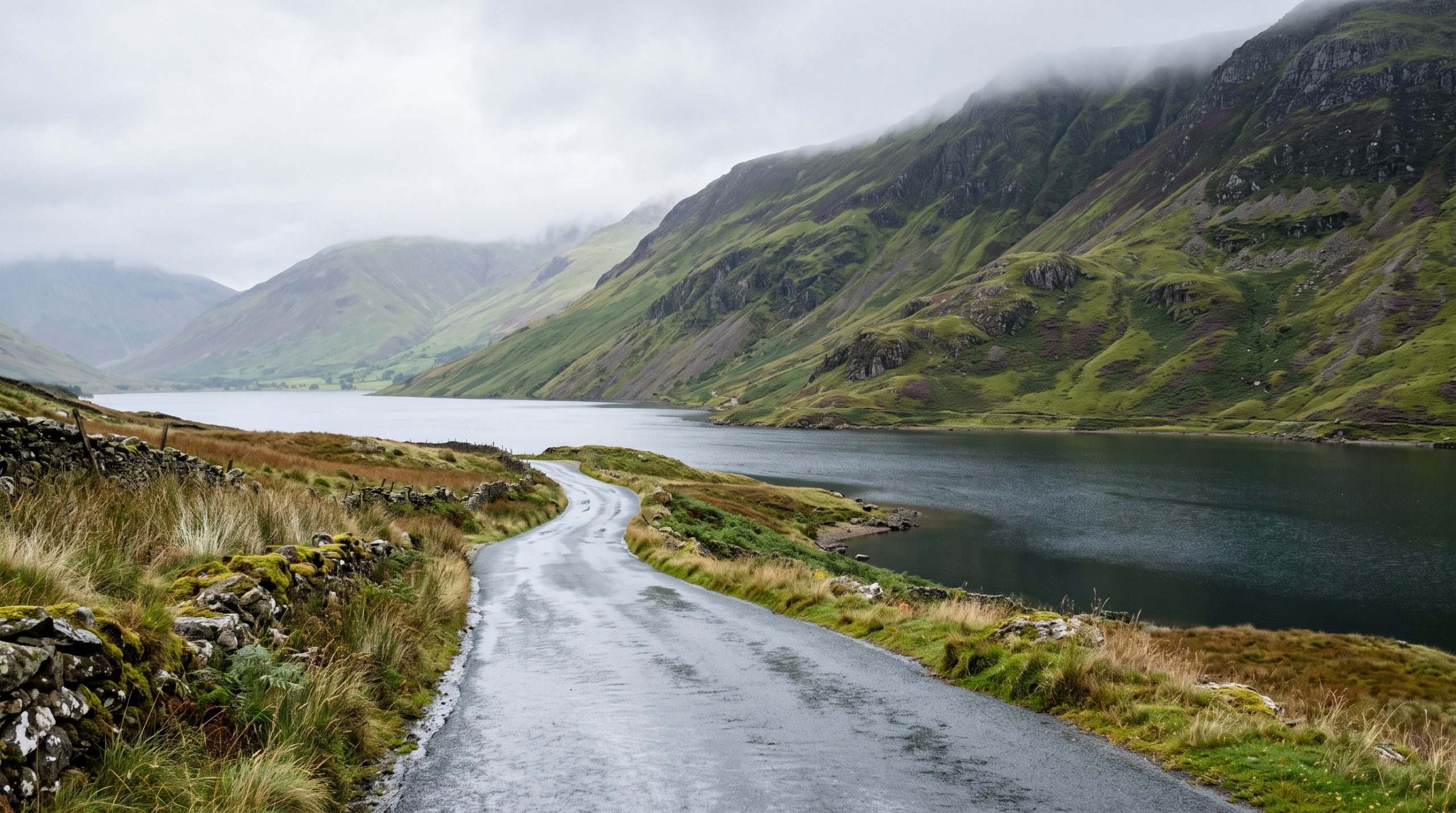
Honister Pass is 3.7 miles of the B5289, running from Seatoller in Borrowdale to Gatesgarth at the foot of Buttermere. On a map it reads like a shortcut. In the car it is a single lane climbing a fellside at gradients reaching 19.3%, where the courteous move is to reverse fifty yards downhill so a farm truck can come through. Treat it as a six-minute hop between two locations and the rest of your afternoon slides with it.
That gap between what a route planner promises and what the Lake District actually hands over is most of the planning work here. The other part is paperwork, and it begins earlier than almost anyone expects. England and Wales require 28 days of notice before a marriage, given face to face at a register office, in the district where you have been living.
What follows is written for a couple with a browser open and a half-built spreadsheet, in the order those questions actually arrive.
Two councils, 28 days and one narrow road
A Lake District elopement runs on three fixed points. Twenty-eight days of notice, given in person in England. A legal ceremony in a register office room or at an approved venue, not on a summit. And driving times running at roughly half the pace a map suggests. The valley, hour and light are yours.
The paperwork clock, and why it sets the length of your trip
The legal side of marrying in England is not difficult. It is simply slower and more geographic than most planning guides admit, and it decides how long you need to be in the country.
Notice comes first, and it cannot be done from home
Both of you must have lived in a registration district in England or Wales for seven full days immediately before you give notice, and notice has to be given in person. Not by post, not by proxy, not by video, not online. Your notice is then displayed publicly at the register office for 28 days, and the legal document that permits the marriage is normally issued the day after that window closes. Once you have notice in hand, you have twelve months to marry.
Add those numbers up and a legal English wedding is a five-week commitment to the country, not a long weekend. This is why a great many couples sign the legal paperwork at home and let the Lake District day be the ceremony itself: vows written for each other, spoken where they wanted to speak them, with no timings and no registrar’s diary attached. Both routes work, and the choice belongs to you rather than to us. Our guide to how eloping actually works walks through the difference in plain terms.
Which council you are dealing with
Cumbria no longer exists as a single authority. The national park is split between Cumberland Council in the north and west, with register offices including Carlisle and Whitehaven, and Westmorland and Furness Council in the south and east, with offices at Penrith, Kendal and Barrow in Furness. Notice, registrars and ceremony bookings all run through the relevant registration service, while the venue itself is yours to book.
Fees are set by the council and reviewed, so read them as a shape rather than a final invoice. In Westmorland and Furness, a traditional ceremony in the Kendal register office is currently £140 on a weekday, Barrow is £275, and a Saturday at Kendal, Penrith or Barrow is £415. Penrith’s weekday slot is listed for Fridays. A registrar attending an approved venue currently costs £620 Monday to Friday and £730 on a Saturday, with a £130 deposit taken from that fee when you book, and £46 to amend a booking. Those three register offices hold no ceremonies on Sundays or bank holidays, which quietly removes a day from the week.
What the pass-road estimate leaves out: Honister, Hardknott and the passing places
Here is the number that reframes everything. A well-known Lake District driving loop leaves Keswick, crosses Honister, runs down to Buttermere and comes back around by Langdale, and scenic-drive guides put it at 70 to 90 miles and six to eight hours with photo stops and a short walk. That is an average under fifteen miles an hour. Your map app will quote something close to two hours for the same loop. The app is wrong, and it is wrong in the direction that costs you your best light.
The reason is not traffic. It is geometry. Hardknott Pass tops out at 393 metres, is single track over the summit, and carries gradients of up to one in three. It is the most direct road from the central lakes to west Cumbria, and direct is not the same as quick. Wrynose, on the Little Langdale side, climbs at similar angles to the Three Shire Stone at its top. Honister is gentler in headline terms at 19.3%, and still asks for low gear on the descent and a willingness to reverse to a passing place. None of this is unpleasant. It is one of the great drives in England. It just cannot be compressed.
| Route | Distance | What we budget | Why |
|---|---|---|---|
| Keswick, Honister, Buttermere, Langdale loop | 70 to 90 miles | Six to eight hours with stops | Single-track climbs and no overtaking; a full day in itself |
| Ambleside, Kirkstone Pass, Patterdale, Glenridding, back on the A592 | About 30 miles | Two to three hours with a stop | The widest of the big passes and the one we will route a timeline over |
| Seatoller to Gatesgarth over Honister, B5289 | 3.7 miles | Twenty-five minutes as its own leg | Gradients to 19.3%, single lane in sections, passing-place etiquette |
| Eskdale to the Duddon Valley over Hardknott | Summit at 393 metres | A spare afternoon, never a ceremony-day transfer | One in three at the top, hairpins, single track over the summit |
So here is the honest advice about Hardknott and Wrynose. Drive them. Drive them the day after, in jeans, with the whole afternoon free and nowhere to be. Stringing them together on the day you are getting married buys you a spectacular hour of driving and takes away the hour you actually came for. The lay-bys at the valley heads are small and they fill, so we build days where arriving at a particular parking space at a particular minute is never the hinge the whole plan swings on.
North lakes or south lakes: where to base yourselves
Base decisions here are really terrain decisions. Pick the ground you want to stand on and let the accommodation follow, because a forty-minute drive at the start of the morning is a genuinely different day from a ten-minute one.
| Base | Registration service | Within a short drive | Suits couples who want |
|---|---|---|---|
| Keswick | Cumberland Council | Borrowdale, Honister, Buttermere, Derwentwater | Early starts on the western fells and lake-level water |
| Ambleside or Windermere | Westmorland and Furness | Langdale, Kirkstone, the A592 to Patterdale | A first Lake District trip and gentler driving, with Kendal nearby |
| Coniston or the Duddon Valley | Westmorland and Furness | Wrynose, Hardknott, Eskdale | The emptiest ground in the park, and are happy on single track |
| Ullswater and Patterdale | Westmorland and Furness | The eastern fells, Penrith | Long water, high ground behind it, and a straightforward run in and out |
One quirk worth knowing: not one of those register offices sits in the middle of the national park. Kendal, Penrith, Barrow, Carlisle and Whitehaven all ring its edges. If your day includes a legal ceremony in a register office room, it includes a drive out to the boundary and back again, and that round trip has to be designed rather than assumed. Our destination guides go deeper on which valleys hold up in which season.
Who owns the ground, and who signs off a drone
Permission in the Lake District follows ownership, not the park boundary. The Lake District National Park Authority’s own guidance is refreshingly clear about it: to film on public land you need permission from the authority responsible for that land, to film on a public highway you need permission from Westmorland and Furness and Cumberland Council as appropriate, and to film on private land you need the landowner’s agreement. A single morning can therefore cross three different sets of permissions, and knowing whose field you are standing in is half the job.
Aerials add a second layer, and the two are independent of each other. Civil Aviation Authority registration is the floor: an operator ID labelled on the aircraft, and a flyer ID for whoever is at the controls, with both required for anything from 250 grams up to 25 kilograms, and an operator ID needed even for a sub-250 gram machine that carries a camera. The flyer ID is renewed on a theory test every five years and the operator ID annually. Then comes the ground, because a drone still takes off from and lands on somebody’s land.
We do the permit research and the logistics work that sits behind all of this, and we confirm the aerial position for your specific locations before we design any part of the film around a drone shot. If the answer for one valley is no, we know it in the planning stage and build the sequence differently. Government, venue and landowner permit fees themselves are paid by you, direct, so nothing is marked up on the way through.
How we build a day the road cannot break
The park sits just above 54 degrees north, which gives you very long June evenings and short December afternoons. We set the ceremony hour off the light rather than off the diary, then work outwards: what time the first vehicle leaves, how long the walk in really takes when one of you is carrying a dress, where the sheltered alternative is if the wind turns onto the ridge. Every timeline we build has a second location held in reserve, usually fifteen to twenty minutes away and in a different aspect, so a change in the weather is a change of plan rather than a lost afternoon.
We never put a ceremony hour immediately after a long pass crossing. Buffers go where the road is narrowest, not where the timeline looks tidiest.
On a day with a dedicated photographer and filmmaker, that pairing does real operational work in a place like this. When the valley you want is forty minutes from your base, one of us can hold the light at the vow spot while the other walks ahead to check whether the tarn track is actually walkable in the boots you brought. Two sets of gear and, where it helps, two vehicles, mean a reroute costs minutes instead of the whole golden hour. There are eight of us, so there is always a second camera on the ground and a colleague in reserve. The way weather and edges come out in the finished work is easier to see than to describe, and our galleries and films are the place to look. Highlights reach you within five days, the full gallery or film within three weeks.
One full day with a dedicated photographer and filmmaker working together starts at $7,900, a single-artist day starts at $4,900, and everything else, including multi-day and multi-destination work, is set out on our pricing page. Team travel, planning, permit research and the timeline are all part of it, in every destination. If you have a date in mind for 2027, 2028 or 2029, Send Us a Message with the valley or the feeling you are after and we will tell you honestly what that morning looks like.
Common questions
Can we legally get married on a fell top in the Lake District?
Not the legal part of it. A civil marriage takes place in a register office room or at an approved venue, arranged through the registration service, with the words prescribed by law. What happens on the fell is the ceremony you write yourselves, and for most couples that is the part that matters. Vows on a summit, signatures somewhere with a roof.
How long do we need to be in England before we can get married there?
Longer than a weekend. You both need seven full days living in a registration district in England or Wales before you can give notice, notice must be given in person, and it then sits on display for 28 days before the legal document is issued. After that you have twelve months to marry. Many couples handle the legal marriage at home instead and treat the Lake District day as the ceremony.
Do we need a permit for elopement photography in the Lake District?
It depends whose land you are on, which is exactly why we research it per location. The national park authority directs you to the body responsible for public land, to Westmorland and Furness or Cumberland Council for public highways, and to the landowner for private ground. Permit research and logistics guidance are included in every experience; the fees themselves are paid by you.
Is Hardknott Pass worth driving on our wedding day?
No. It is one of the finest roads in England and it is the wrong road to put inside a timeline. Single track over a 393 metre summit at gradients up to one in three does not reward a deadline. Drive it the day before or the day after, with time to stop wherever you feel like stopping.
Can you fly a drone over Buttermere or Derwentwater?
Sometimes, and it is decided location by location. Two things have to line up: Civil Aviation Authority registration, meaning an operator ID on the aircraft and a flyer ID for the pilot, and permission for the ground the drone leaves from and returns to. We confirm both for your specific spots before any part of the film depends on an aerial.
Is a weekday better than a Saturday for a Lake District elopement?
Usually, on both counts. Registrar fees in Westmorland and Furness are lower Monday to Friday than on a Saturday, no ceremonies are held there on Sundays or bank holidays, and the honeypot valleys are markedly quieter midweek. A Tuesday in Borrowdale is a different place from a Saturday in Borrowdale.
How many days should we plan in the Lake District?
For the day itself we plan a minimum of three: one to arrive, drive the passes and see the ground in person, one for the elopement, and one to spare for weather. If the legal ceremony is happening in England too, the notice timings above set the real length of the trip, and that is worth mapping before you book flights.
Setting a date, in writing
A plan with this many moving parts is easier when every decision stays in one written thread. Send the month, the ground you keep coming back to, and how early you are genuinely willing to get up; we will reply within a day with the first brochure and build the proposal around those valleys. The signed contract and 30% retainer open the detailed planning, with the remaining payments set out in the proposal. Check Your Date and we will start there.