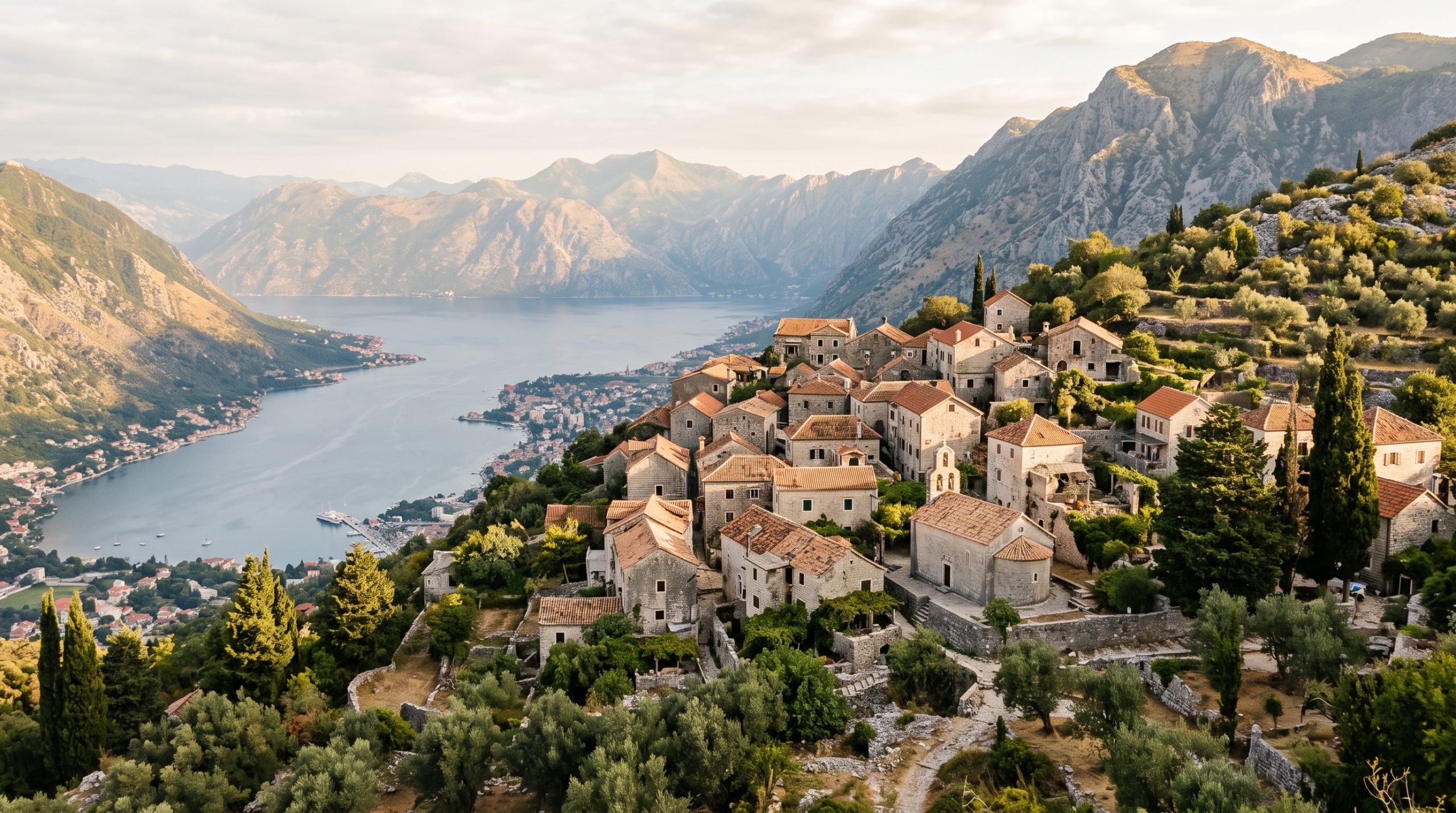
Somebody opens a shutter in Gornja Lastva most mornings. The families who lived here moved down to the water at Donja Lastva and Tivat once the coastal economy took over, and then kept the houses anyway. They still drive up to water the vines and sit on a stone bench for an hour.
In its working years the village fed itself. About 500 people, more than a hundred houses, seven olive mills, a grain mill, twelve threshing floors, twenty-four wells. What is left is roughly twenty stone houses at 300 meters on the Tivat flank of Vrmac, a square, and a parish church consecrated in 1410. Grape trellises over most of the yards. Cisterns still cut into the ground.
That is what makes it a good place to stand and say something out loud, and also what makes it a place to be careful in. Nobody sells tickets here. You are getting married in someone’s street.
Twenty stone houses, a 1410 church, one narrow road
Gornja Lastva is a stone village at 300 meters on the Tivat side of Vrmac, roughly 20 houses around a parish church consecrated in 1410. There is no gate and no ticket desk. The square and the lanes are open ground; the yards and the church interior belong to people you ask first. Paperwork goes through the Tivat registrar.
The climb from Donja Lastva, and what it does to a hem
One narrow asphalt road goes up, starting from Donja Lastva on the waterfront and climbing the 300 meters to the village. Walked, it takes about an hour, uphill the whole way, with the bay opening out behind you. Driven, it is short. It is also narrow enough that meeting a car means somebody gives way, which matters more than the distance does when several vehicles are trying to arrive inside the same ten minutes.
Once you are up, the walking that counts happens inside the village. The lanes are old stone, laid unevenly, with steps in places and grass and dry stalks pushing up between the slabs. A stiletto finds every gap. A long train collects dust and every seed head going by September. What works is flat leather soles or sneakers for the moving around, proper shoes carried up and put on where you stand, and a hem you have decided in advance you do not mind getting dusty, because it will. Nobody needs carrying over anything here. We would rather you walked the lane yourself, slowly, than arrived on the square out of breath.
There is a longer way in. The ridge traverse from the Kotor side crosses Sveti Ilija at the top of Vrmac, passes the old Austro-Hungarian fort, and comes down the Tivat flank to the water, roughly 13 kilometers and four and a half to five hours of walking. That is a hiking day, not a ceremony morning. We use pieces of it instead: the open ground above the houses, or the last stretch of descent into the village, then a car for the rest.
Why the ridge behind you sets the ceremony hour
Gornja Lastva faces southwest, out over Tivat Bay toward Luštica and the open water. Behind it, to the northeast, the ground keeps climbing to the Vrmac ridge. That geometry is the most useful thing anyone can tell you about photographing this village, and almost nothing written about the place mentions it.
Sunrise is not an event on this square. The high ground behind the village takes the first light and holds it, so the lanes stay in cool blue shade long after the sky above has gone warm. In summer, when the sun comes up well round to the northeast, it rises behind the whole mass of the ridge. Mornings up here are quiet and worth having. They are not golden.
Then the sun crosses over and the middle of the day gets hard. The open parts of the village have almost no shade; shade lives in the yards, under the grape trellises the families built for exactly that reason. By late afternoon everything turns. West-facing stone takes the light straight on, the walls go the color of the inside of a peach, and the ninety minutes before the sun drops behind Luštica are the reason to be standing here at all.
So the ceremony goes late. In June that means a late dinner and a later night; by the end of September the sun is down earlier and the whole day sits more comfortably. Rather than a rule of thumb, we send the real sunrise, sunset and ridge-shadow times for your date along with the timeline.
| Hour | What the light is doing | What we use it for |
|---|---|---|
| First light | Ridge lit, village still in shadow | Empty lanes, getting-ready detail, the church front cool and even |
| Mid-morning | Sun clears the ridge, contrast climbs fast | Walking the road, the view down to the bay |
| Midday to mid-afternoon | Hard overhead light, shade only in the yards | Shelter, food, portraits under the trellises |
| Last ninety minutes | Full west light on the stone | Vows on the square, the lanes at their best |
| After the sun drops | Long afterglow over Luštica | Lamps, wine, the quiet part of the evening |
Who to ask before you stand in the square
The village, the yards and the church
Roughly twenty houses, and every one of them belongs to somebody. The square and the lanes are the village’s shared ground, and a small ceremony standing on them is a question of asking the right neighbor rather than booking a venue. The yards, the terraces, the benches and the cisterns are private, and the answer there is a person’s yes, not a form.
The church is its own conversation. It is dedicated to the Nativity of the Virgin Mary and was consecrated in 1410, with the shape you see today given to it in the 16th century. Its baroque altar of multicolored marble stood in the church on Our Lady of the Rocks off Perast before the villagers bought it in the 1700s, and the altarpiece is attributed to the Venetian painter Andrea Trevisano. That is not an interior anybody hands over lightly. What happens inside the building is the parish’s decision and is arranged with the parish; most couples we bring up here stand outside with the front of the church behind them.
This village is actively looked after. The cultural society Napredak has run the village feast for more than forty years and puts on a summer program of concerts, exhibitions and readings, and the heritage organization Expeditio has brought international architecture workshops here to study traditional coastal building. People care what happens on this square. Permit research, landowner permission and the logistics behind both are our work and are included; the fees themselves are yours.
The fifteen days the registrar needs
For a legally registered marriage, US citizens apply to the marriage registrar in the town where the wedding takes place, and the US Embassy in Montenegro asks for that application at least 15 days before the date. Tivat is the town for Gornja Lastva. You will need the registrar’s Application for Marriage form, original birth certificates translated into Montenegrin and carrying an apostille if they were issued in the US, a document showing you are free to marry, and photocopies of your passports along with those of your two witnesses. A free-to-marry document issued by the Embassy in Podgorica does not need an apostille.
Plenty of couples decide the paperwork and the ceremony do not have to happen in the same place on the same afternoon. Sign in Tivat, then come up the hill and say the real thing on the stone. Our guide to planning an elopement walks through both routes without pretending one of them is the correct answer.
Two cameras in a lane you can touch both sides of
Some of these lanes are narrow enough to put a hand on each wall. That is wonderful for a photograph and awkward for two people working at once, because a photographer and a filmmaker in the same lane end up in each other’s frames unless somebody has already decided who owns which end of it. We are one team of eight, so that gets settled in the planning instead of in the lane. One works long from the steps above, the other stays close for hands and faces, and they trade places on a nod. The slope has an opinion about sound, too: the ridge above is open and pulls a breeze down through the houses most afternoons, so vows spoken in the middle of the square can come out thin on a recording. We put the audio in the lee of a wall.
Stone this old behaves in a particular way on camera. It holds warm light and hands it back, and it goes almost blue once the shade arrives. If you would rather see that finished than described, our galleries and films are where the work lives. Highlights reach you five days after the day itself, and the full gallery or film three weeks after.
A day here runs either as The Adventure, with one dedicated photographer or one dedicated filmmaker, from $4,900, or as The Expedition, with a photographer and filmmaker working together and professional audio for the vows, from $7,900, and the experiences page sets out what sits inside each, team travel included.
The days the square fills, and the days it doesn’t
This is not a coach stop. Visitor numbers have climbed year on year, and the village is still small enough that most days it holds a couple of cars, a few hikers and whoever came up to check on a house. Two things change that. 8 September is the church’s feast, the Nativity of the Virgin Mary, and the village has treated it as the day everything here descends from since 1410; the square is the whole point that day, and it will not be yours. The summer program brings evenings of music and readings to the same square, lovely to be near and impossible to be private in.
The rest of the traffic is hikers. Signposted trails leave from the edge of the village, so people come down off Vrmac through the houses at hours nobody can predict. Arriving early does not fix this, and it costs you the light. A weekday, in the last ninety minutes before sunset, mostly does fix it.
Who Gornja Lastva fits, and who wants the ridge instead
The village suits couples who would rather stand somewhere lived in than somewhere built to be looked at. Worn slabs, and somebody’s tomatoes ripening against a wall. It suits small numbers, partly by feel and mostly because of that road: six guests and two cars is a different afternoon from twenty guests and seven cars. Our fee does not move with guest count, but the road, the parking and the timeline all do.
It is also enclosed and green, and the sea is a view rather than a presence. If what you actually picture is open horizon and nothing but sky, that is the ground above the houses on the Vrmac ridge, or the Luštica coast on the far side of the bay, and it is worth telling us so before anybody designs anything. Couples who want both usually land on the multi-day shape, the Odyssey, where the village takes one evening and the water takes another. Our destination guides cover how Boka and the coast south of it fit together across several days.
Common questions
Can we get married inside the parish church in Gornja Lastva?
It is a consecrated Catholic parish church, still in use and still the center of the village’s year. Whether anything happens inside it is the parish’s decision rather than the municipality’s or ours, and it is asked for a long way in advance. Most ceremonies here happen outside, on the square, with the front of the church behind you.
Can we drive up, or do we have to walk from Donja Lastva?
You can drive. One narrow asphalt road climbs from Donja Lastva on the waterfront to the village at 300 meters, and it is short in a car. On foot the same road takes about an hour, all uphill, which is a fine way to spend a morning and a poor way to arrive in wedding clothes in July. We keep the walking for the lanes at the top instead.
Is 8 September a good date to plan around?
It is the feast of the Nativity of the Virgin Mary, the church’s own day, and the village celebrates it. Being in Gornja Lastva for that is genuinely something. A private ceremony on the square that afternoon is not realistic, so we would either move you up to the open ground above the houses or put your own day in the week before.
Is there anywhere up there to change out of walking shoes?
There is no public building for it, and the yards with their trellises and stone benches are private. In practice couples dress at their accommodation down in Tivat or Donja Lastva, come up ready, and change shoes at the top of the road. We build a shaded gap into the middle of the timeline, because the open parts of the village offer almost none.
What happens if cloud sits on Vrmac on our date?
Low cloud on the ridge usually means soft even light in the lanes, which suits this stone better than a hard blue afternoon. Real rain we plan for separately: deep doorways and covered thresholds in the village, the short drive back down to the bay, and a second window later the same evening or the following day where your dates allow it. That alternative is written into your timeline before you travel.
From the waterfront to the square: one day, end to end
The shape that works here is unhurried. A slow morning by the water in Tivat or Donja Lastva, lunch and shade through the worst of the heat, up the narrow road in the late afternoon, vows on the square while the west light is still on the stone, then the lanes and the vines and the long view down to the bay until the afterglow goes off Luštica, and dinner late and low down by the sea. Photography, film and planning come from the same eight of us, which is why there is always a second camera on the ground and a colleague in reserve.
We handle the planning in writing so nothing depends on matching time zones, which suits couples planning across time zones. Send the inquiry form and you will have a reply and our brochure within 24 hours, then a proposal built for your date, then a contract and a 30% retainer, and the planning starts. We currently have Montenegro elopement dates available through 2027–2029. Check Your Date and tell us what you want this village to be for.