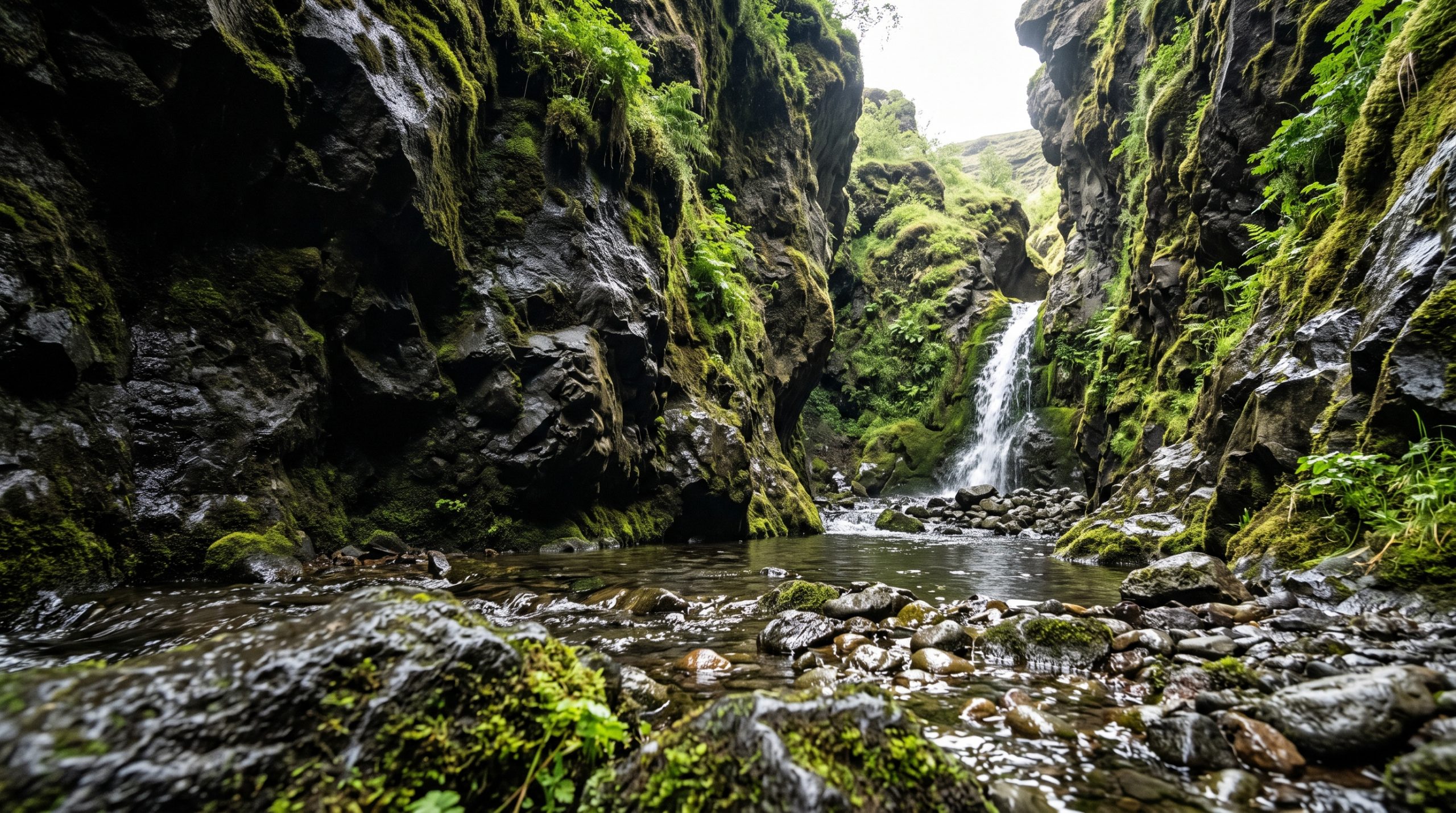
Road 327 out of Þjórsárdalur is signposted Stangarvegur, and for its final kilometers it is loose gravel and potholes rather than road. You park at the Stöng ruins, walk fifteen minutes across open ash and heather, and the ground drops into Gjáin: a green basin with a 15-meter waterfall in it, angelica growing thick along the water, columnar basalt stacked around the pools.
Nauthúsagil, reached from an entirely different turning, works nothing like that. There is no walking down into this one. You go up, into a slot barely wider than two people standing side by side, with a stream running down the middle and ropes, chains and wooden steps fixed where hands are needed. The free parking area sits roughly 10 km past Seljalandsfoss on Route 249, marked with a Katla Geopark sign, and most people drive straight by it.
Both are about two hours from Reykjavík. Both are small and sheltered in a country where the famous places are neither. Both are also far more seasonal than the South Coast waterfalls, and both reward an odd hour more than they reward good weather, which is most of what this page is about.
Wide floor or narrow slot
Gjáin is a sheltered green basin in Þjórsárdalur, a 15-minute walk down from the Stöng ruins, with a 15-meter waterfall and room to stand. Nauthúsagil is a narrow gorge off Route 249 that you climb on ropes through a stream. Both are summer ground, and a legal ceremony in either needs an Icelandic-licensed officiant and two witnesses.
The Stöng walk, and what it does to a hem
From Reykjavík you leave the Ring Road just past Selfoss, run 18 km up Road 30, then turn onto Road 32 into Þjórsárdalur. Gjáin sits about 136 km from the city, which is a two-hour drive on paper and longer in practice, because Road 327 at the end is gravel with potholes and a 4×4 is recommended. Couples staying out along the Golden Circle have it easier: Gullfoss is 30 to 40 minutes away.
There are two ways in. Park at the Stöng ruins, the excavated Viking-age manor that Hekla buried under ash in 1104, and walk in: 2.1 km round trip, roughly fifteen minutes each way, no scrambling, and the ravine appears all at once at the end of it. Or carry on to the upper parking area on the south side and take the steps down, which puts you about 500 meters there and back from Gjárfoss.
In wedding clothes, the Stöng approach is the kind one. It is open ground, dry underfoot in summer, and nothing on it asks for a free hand. A long hem picks up dust and seed heads, and both shake out. The steps down from the upper lot are the only place where somebody wants to be holding fabric rather than a camera bag, so we walk that stretch slowly and lift the hem for the last of it. There is nothing at either parking area: no toilets at Gjáin, no shelter, nothing to buy. Changes happen at the car, and we plan the drive back down 327 at gravel speed rather than map speed.
Gjáin was a valley secret until it turned up in the fourth season of Game of Thrones, and it has been on itineraries ever since. What still protects it is the surface of Road 327. No coach reaches the Stöng lot, so a busy hour here means a handful of cars and a few small groups moving through the same short loop of ravine, rather than a line of people waiting for a view. Mid-morning to late afternoon is when those cars are there. Early and late, the basin usually belongs to whoever walked in.
Gjáin is a shade location, not a sunset one
What makes the basin photograph is also what makes it awkward: walls. Gjáin lies below the level of the valley, an old riverbed with a much smaller river in it now, so the floor sits in its own shade for long stretches of the day while the rim above is still lit. That is a gift, not a problem, and almost nobody plans for it.
Direct sun does the basin no favors at all. Wet basalt, deep moss and white water inside a small enclosure hand a camera the hardest thing there is: blown highlights and black rock in one frame. Overcast is better here. Light rain is better still, because the moss saturates and the Rauðá runs full. We build the Gjáin hour for shade or cloud, and when the sky is hard and clear we push the ceremony into the long end of the evening and use the bright middle of the day for the driving and the open valley above.
Our published galleries and films are the quickest way to see what this kind of low-contrast, water-heavy light does: how deep green sits against ash grey, and how a film cuts when everything is happening within thirty steps.
Gjáin also has something Nauthúsagil does not, which is depth. The floor is compact but it has layers, and that matters when a photographer and a filmmaker are covering the same vows. One works close with a wide lens while the other holds back near the steps, and neither turns up in the other’s frame. Water sets the audio here, so vows go on the quieter pools rather than at the foot of Gjárfoss, where a 15-meter fall wins every argument with a microphone. Choosing between our coverage options in a place like this comes down to whether you want the film at all: one dedicated photographer, or a photographer and filmmaker working together with proper audio on the vows.
Nauthúsagil: ropes, a stream, and the queue at the last climb
Leave the Ring Road onto Route 249 about 120 km east of Reykjavík, at the Seljalandsfoss signs. Pass Seljalandsfoss and Gljúfrabúi, where parking is charged at a flat rate, currently around 1,000 ISK, and keep going as the pavement gives way to gravel. After roughly 5 km of that, a small free lot appears with a Katla Geopark sign on it. Standard cars manage the approach in summer. From Seljalandsfoss the whole thing is about 10 km and about fifteen minutes.
A path runs from the lot to the creek, and from the creek onward you are in and beside the water more or less continuously. Stepping stones, wooden steps, ropes and chains have been fixed where the rock needs them. The gorge narrows and darkens as you climb, until the waterfall at the top comes into view in a chamber that feels a long way from the farmland you parked in. Waterproofs are not optional, and neither are shoes you are happy to soak.
In wedding clothes this is a completely different sentence. You will be wet to the knee before the first bend. The rope section wants both hands, so nobody carries flowers up it, and a train is something two people manage together rather than one person fighting. What we do is split the gorge: vows and rings in the wider lower section, where two people can stand facing each other and a celebrant has somewhere to be, then the climb, then the frames at the top with the fall behind you. Footwear changes happen at the car, because there is nothing at that lot except the sign.
Crowds here are refreshingly simple, and arriving early genuinely does work. Through the middle of the day you can find yourself waiting a turn at the final climb, because one party fits at a time. First thing in the morning and late in the evening the gorge is usually yours, and the light inside barely differs between the two, which is a rare thing to be able to say about a location in Iceland.
Who owns these ravines, and what actually needs asking
The land, and the permits attached to it
Gjáin has been protected since 30 January 2020, when part of Þjórsárdalur became the first area in Iceland designated as a landscape protection area. Within it, Gjáin, Háifoss and Granni, and Hjálparfoss each carry natural monument status of their own. For a couple this changes very little: entry is free, there is no gate and no ticket. For us it changes the paperwork, because professional photography and filming in protected areas run on a permit application to the state agency that administers them, and that agency does not grant permission to close a public site to other visitors. Nobody in Iceland can promise you an exclusive Gjáin. What we can do is pick the hour when it is empty anyway.
Nauthúsagil is farm ground off Route 249, out near Stóra-Mörk. Access is open and the lot is free, and where landowner or municipal permission applies to what we are doing, that request belongs to us and gets made long before the timeline is written.
Aerials sit on their own track. Operator registration with the Icelandic Transport Authority currently runs a little under 6,000 ISK and lasts five years, a registration already held in the EU or EEA is recognized here, and drones from 250 g upward add a free online exam. Protected areas then set their own terms on top of that. So we confirm the aerial permission and its window before any part of a film leans on it, and Þjórsárdalur is wide enough that a landscape shot rarely needs to originate inside the natural monument itself.
The paperwork
A legal Icelandic marriage needs an officiant licensed under Icelandic law and two witnesses. That officiant can be a representative of the District Commissioner, a registered religious officiant, or a humanist celebrant. The minimum cost of a civil ceremony is 15,400 ISK, and holding one away from the office or outside office hours is by request, subject to that particular office and an additional fee. The ceremony also has to take place within 30 days of the certificate of no impediments being issued, which is the deadline that quietly shapes everything else. Plenty of couples marry legally at home and keep the ravine for the vows, and our elopement planning basics set out both routes.
The months the moss is actually green
Gjáin is a summer ravine, and there is no diplomatic way around that. The green that carries those photographs is there from roughly June into September; by October the color has gone out of the basin, and through winter it holds snow while Road 327 becomes a different proposition entirely. Nauthúsagil fills with snow too, and Route 249 beyond the pavement is not always passable in the winter months.
Inside the season, two things move a plan. Rain lifts both the Rauðá and the Nauthúsagil creek, which improves the water and slows the footing, so we lengthen the walk-in rather than trim the ceremony. The gravel decides the rest. If 327 is rougher than the car you have, Hjálparfoss and its fanned basalt columns sit a few minutes off Road 32 on Road 3361 and are reachable in anything, with the Þjóðveldisbærinn reconstruction on the same short stretch. On the Nauthúsagil side, Seljalandsfoss and Gljúfrabúi are 10 km back down the road and hold up well on a day when the creek is running too high to enjoy in a dress.
If you want a horizon instead
These are ravines for couples who like the idea of a location the size of a room. If what you actually want is distance and sky, the same valley answers that: Háifoss drops 122 meters about 25 minutes away on Road 332, which asks for a 4×4 and gives you the biggest view in Þjórsárdalur. If you are bringing guests who would rather skip gravel and ropes, tell us early; guest numbers never change our fee, but they change access, permits and the timeline. Describe the morning you want rather than the photograph you want, and we will tell you which of these two ravines fits it, and which month fits it better. Our destination guides put both of them in the wider South Iceland picture.
Common questions
Can we legally get married inside Gjáin itself?
Yes, with an officiant licensed in Iceland and two witnesses present. A District Commissioner ceremony away from the office is granted by request, depends on that office and carries an additional fee, so most couples heading into Þjórsárdalur use a celebrant who travels to the ravine. Others marry at home and keep Gjáin for the vows.
Do we need a permit to hold a ceremony in a protected area like Gjáin?
Not for the ceremony. Gjáin sits inside a protected landscape area and carries natural monument status, and it is still free to walk into. Permits cover what we do professionally, including photography, filming and aerials in protected areas, and that application is ours to make. No permit in Iceland gives anyone exclusive use of a public site.
What happens to a long dress on the Nauthúsagil ropes?
It gets wet to the knee and it comes home fine. We order the day so the hem meets the water once: vows in the wider lower gorge, then the climb with fabric gathered and both hands free, then the frames at the top. Sturdy footwear for the walk in, with the shoes you want photographed carried up dry.
Is there anywhere to change or find a bathroom at either ravine?
No. Neither has facilities, with no toilets at Gjáin and nothing at the Nauthúsagil lot but the Katla Geopark sign. We time changes for your accommodation or the car. On the Nauthúsagil side, the paid car park at Seljalandsfoss about 10 km back is the last serviced stop before the gravel.
Can we visit both ravines in the same day?
Possible, and not worth it. Gjáin leaves the Ring Road just past Selfoss and runs inland up Road 30; Nauthúsagil leaves it 120 km east, under Eyjafjallajökull. Doing both in one day means most of that day is spent driving, with two gravel approaches at the ends of it. We usually give each ravine its own day, which is what our two-to-seven-day coverage exists for.
If we start at 6am, will we have Nauthúsagil to ourselves?
Very likely. Queues build at the final climb through the middle of the day, since only one party fits on it at a time. Early morning and late evening are the quiet hours, and because the gorge is in its own shade regardless, you give up nothing by taking the empty one.
Which ravine to name when you write
If you already know which one is yours, say so and say why: the basin with the waterfall and room to stand in, or the slot you climb with a stream over your boots. If you have no idea, describe the kind of morning you want and we will put one of them at the center of a timeline built around light, driving time and the walk in. Our current Iceland availability runs across 2027–2029, and the whole process stays in one written thread, so our reply and the first brochure reach you within 24 hours of your message with nothing to arrange in between. Check Your Date