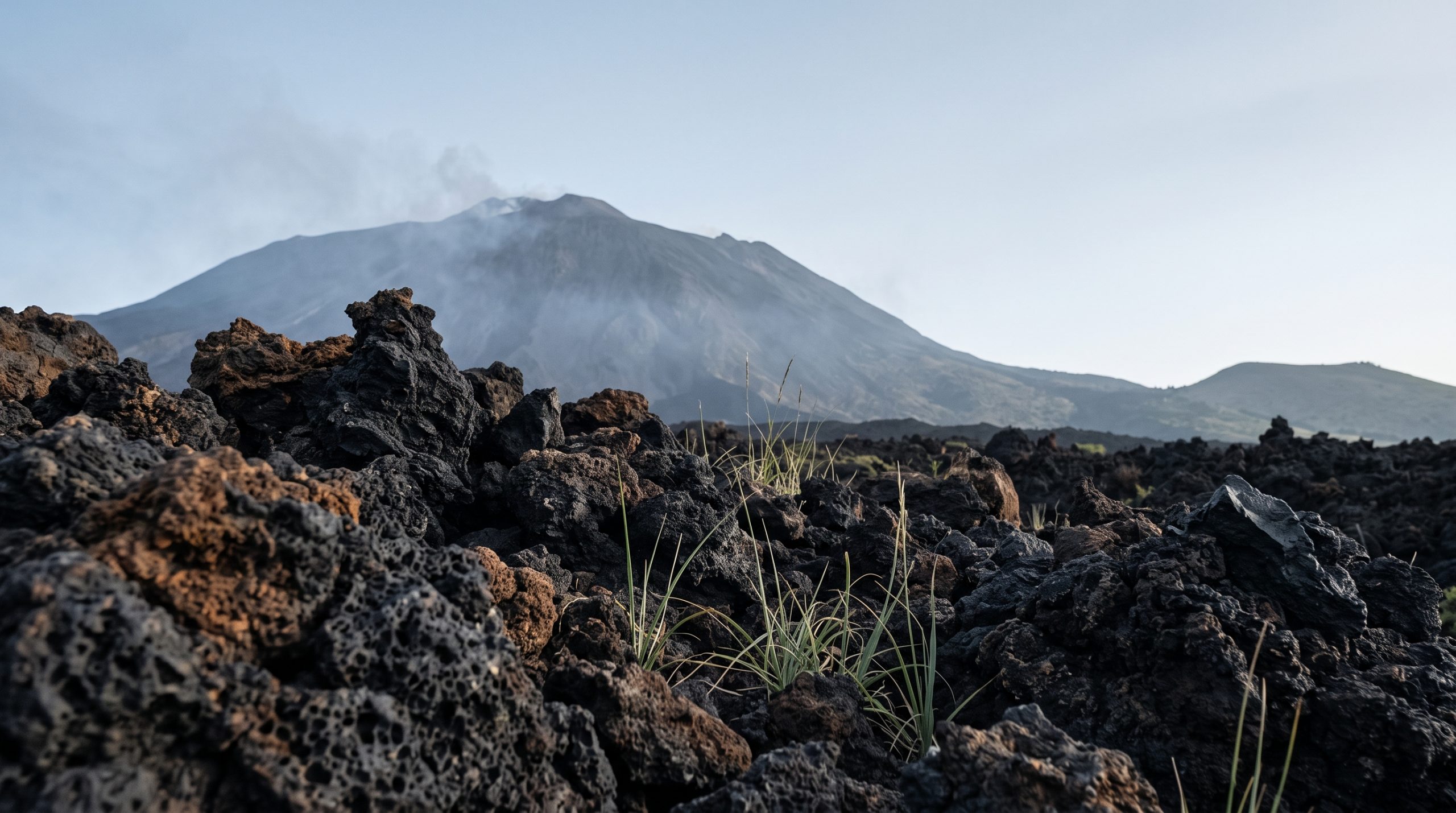
Just past Rifugio Citelli on the north-east flank there is a green gate on the right of the road and a sign that reads Comune di Sant’Alfio, Monti Sartorius, 1667 m. Behind it a path goes into a wood of pine and Etna birch, then out onto the cinder of a fissure that opened on 29 January 1865. Two of the cones it built are big enough to walk the rim of. The whole loop takes between half an hour and an hour.
That is what most pages about getting married on Etna’s lava fields miss. A lava field is not one surface. It is dated ground. The 1865 cinder at Sartorius has had a hundred and sixty years to break down, hold a path and grow trees out of its cracks. The 1892 cones at Silvestri sit beside a coach park. The 2002 flow above Linguaglossa is still raw and almost plantless, one of very few places anywhere you can walk on a flow that recent and that well preserved.
Which year you stand on decides how far you walk, how the ground photographs, and what your shoes and hems look like afterwards. And there is a second constraint nobody puts in a brochure: Etna has two front doors, and by road they are 50 km apart.
What the paperwork allows out on the cinder
Vows out on the lava are symbolic, and a symbolic ceremony needs no venue approval. Italian law keeps the binding civil ceremony inside a room the comune has designated, and the registers cannot leave that comune’s territory. So the signing happens down in one of the towns that ring Etna, and the mountain gets the ceremony you will remember.
1865, 1892, 2002: the year under your feet
Age is what separates one black slope from another. A flow that cooled in the 1860s has softened into fine cinder that takes a footpath. A flow from 2002 is still clinker: blocky, sharp-edged, loose, superb in a wide frame and unkind to a hem.
| Flow | Where you stand | Underfoot | The walk |
|---|---|---|---|
| 1865, Monti Sartorius | North-east flank, off the road just past Rifugio Citelli, signed at 1,667 m | Compacted cinder path through pine and endemic Etna birch, seven old cones | Marked loop, 30 to 60 minutes, around 80 m of climb |
| 1892, Crateri Silvestri | South side, directly beside the SP92 at about 1,900 m, below Rifugio Sapienza | Grey-black ash and gravel, no shade, no shelter | None. You park and you are on it, which is the whole problem |
| 2002, Piano Provenzana | North side at 1,800 m, 18 km above Linguaglossa | Raw blocky lava, almost no vegetation, sharp edges | Short approach from the station, then deliberate footing rather than strolling |
In wedding clothes the Sartorius loop is the friendliest ground on this mountain. The first stretch is shaded, the gradient is mild, and the surface is firm enough for flat shoes with no ankle work. Only the last few metres onto a rim narrow and loosen, and that is a fifteen-second, two-handed moment in a long dress rather than a scramble. Everything you wear will carry black dust down with it. A dark hem hides it and pale silk does not, so we build a brush-down at the car into the timeline instead of pretending it will not happen.
The Silvestri craters deserve a straight answer, because every image search puts them first. They are two 1892 cones a few steps from the tourist bus parking, free to walk on, and by mid-morning they belong to whoever the buses brought. They photograph like exactly what they are: the accessible bit. We use them for ten honest minutes of scale on the way past, and we do not put a ceremony there.
The 2002 ground at Piano Provenzana is the opposite, and it is the reason to come to the north side. Almost nothing grows on it yet, so the flow lines run uninterrupted to the edge of the frame and read as movement rather than as rubble. It is not a surface you walk across in a dress. You work its edge and the track that crosses it, which is plenty.
Fifty kilometres between the two front doors
Etna is one mountain with two separate approaches that do not connect near the top. Piano Provenzana on the north and Rifugio Sapienza on the south sit 50 km apart by road. That single number governs more elopement timelines here than the weather does. You choose a side for the day. You do not hop between them for a change of scenery.
For the north side, leave the A18 at Fiumefreddo, follow the SS120 to Linguaglossa, then climb 18 km of the Mareneve road through the Ragabo pine forest to the station at 1,800 m. From Taormina that is about an hour and a quarter; from Catania about an hour and a half. Parking is currently 5 euros for the whole day. It is a good paved mountain road with hairpins and nothing worse, and the north side is markedly quieter than the south.
For the south side, the SP92 climbs from Nicolosi or from Zafferana Etnea to Rifugio Sapienza at about 1,900 m, where parking is metered by the hour and comes to a few euros for a full day. From there the Funivia dell’Etna lifts you to 2,500 m in twelve to fifteen minutes, for a return fare of around 52 euros per adult. There is no uphill-only ticket, which quietly makes the cable car a decision about your whole afternoon rather than a shortcut you take on a whim. If you are weighing Etna against Sicily’s coast, our destination guides are where we work through that kind of choice in detail.
Where the light lands, and the hour it leaves
Etna’s east flank falls toward the Ionian Sea, and that is the whole light story. From Piano Provenzana the sun comes up out of the water, low and sideways, and for roughly an hour it rakes across the 2002 flow. Black lava is the most demanding ground in photography. Lit from overhead it swallows everything and flattens into grey by mid-morning. Lit from the side at first light it does the reverse: every ripple and fold throws its own small shadow, and the flow finally looks like the liquid it used to be.
Afternoon on the north-east is a different proposition. The summit stands above 3,300 m and sits south-west of Piano Provenzana, so the mountain itself takes the sun out of that ground while the sky overhead is still bright. Light leaves early there, earlier than any sunset table suggests. The south side holds the other end of the day, looking west over the interior of the island, which is why an evening ceremony and a dawn ceremony on Etna are not the same location with the hours swapped. They are different sides of a volcano.
Look through our published galleries and films with that in mind and the pattern is hard to miss: dark ground comes alive when the sun is low to it, and drone lines across a lava field only exist while there is a shadow to draw them.
The hours the coaches own
On the south side in high season and on public holidays, arriving early is genuinely about finding a parking space rather than about having anything to yourself. The buses reach the 1,900 m car park through the morning and Silvestri is their first stop, so early is never enough there. What works is distance and time: twenty minutes on foot onto older ground, or the last hour of the day once the coaches have gone back down and the light is doing something anyway. On the north side this barely registers as a problem.
Which points at the sort of couple Etna repays: people who will take a 4am alarm in exchange for having a lava flow to themselves, and who would rather walk half an hour in flat shoes than be delivered to a viewpoint. If that reads as work rather than as a good morning, tell us when you write. There is a gentler version of this day lower on the flank with the same volcano behind you, and we would far rather build that than sell you an alarm clock you will resent.
Who says yes, and who we ask first
Etna is a UNESCO World Heritage property and a regional park. Ente Parco dell’Etna, set up in 1987 as the first of Sicily’s parks and still headquartered in Nicolosi, manages around 59,000 hectares and issues the authorizations that apply inside the boundary.
Two things about that are worth knowing before you plan anything. The core of the property has no roads and no permanent population, and its use is set aside for research and recreation; vehicle access to the mountain tracks runs through gates and is reserved for park business and authorized operators, which is why every 4×4 climbing the upper slopes belongs to a licensed company. Walking in on foot with two cameras and no structures is a far smaller ask than arriving with vehicles or anything that has to be built.
The second is the altitude ceiling. On the south side the Comune di Nicolosi sets it by ordinance and it shifts with the mountain’s activity; in recent years walking has been free to 2,500 m, with a licensed volcanological guide required from there up to 2,750 m. The north-side ordinance covering the track from Piano Provenzana at 1,800 m to Piano delle Concazze at 2,800 m makes specific provision for professional photographers working accompanied by authorized personnel, and that is the door we use when a couple wants frames from genuinely high ground. Aerials follow whatever rules apply that day in that zone, so we confirm the window before we build any part of the film around them.
Permit research and logistics guidance are part of every experience we run, alongside the location design, the timeline built around light and real driving time, and the weather alternatives. What the park, a comune or a landowner charges in fees is paid by you. If the Italian sequence is new to you, our planning fundamentals set out the order things happen in.
Two cameras on a crater rim
Room to stand matters here more than it does almost anywhere. The rim path at Sartorius is single file in places, and a cinder crater is a bowl, so anyone on the far side is in the frame whether they meant to be or not. One team solves that by choreography rather than luck: the photographer holds the rim, the filmmaker drops onto the inner slope for the low angle, and neither one appears in the other’s work because both knew the plan before the walk in. Wind decides the rest. Above the treeline there is nothing to break it, so we put the vows in the lee of a cone or down among the birch where voices hold, and keep the exposed ground for the wide frames where wind only helps.
A full day with a dedicated photographer or a dedicated filmmaker starts at $4,900, and the Expedition puts both of them on the mountain together from $7,900, with team travel to Sicily included either way; the coverage page holds the rest of the detail.
Tell us which side of the mountain pulls at you and which hour of the day matters most, and we will come back with a shape for it. Send Us a Message
Common questions
Can we be legally married out on the lava, or does it have to be symbolic?
Out on the lava it is symbolic. An Italian civil marriage has to be celebrated in a place the comune has formally designated, and the civil registers cannot travel outside that comune’s territory. The usual shape is the legal formality in a room in one of the towns around the mountain, then vows and rings up on the cinder with nobody else there.
Is there anywhere to change out of hiking boots up there?
There is no changing room on Etna. The south side has a bar and restaurant at the 1,900 m car park; the north side has the ticket offices and a small cluster of buildings at Piano Provenzana. In practice we build the change into the timeline at the car, boots on for the walk in and shoes swapped at the last sensible moment.
Do we need the cable car if we are not going to the summit?
No. Every lava field worth a ceremony sits below it: the 1865 cones at 1,667 m, the 2002 flow at 1,800 m, the ground around Rifugio Sapienza at about 1,900 m. The Funivia dell’Etna is transport to 2,500 m rather than a location, and because it sells return fares only, taking it commits the afternoon. We use it when the film genuinely wants high ground.
Should we base ourselves on the north side or the south side?
From Taormina the north side wins on arithmetic alone: about an hour and a quarter to Piano Provenzana, against a longer run around and 50 km between the two access roads. Catania sits roughly an hour and a half from the north station. Morning vows favour the north-east because that is where first light arrives; evening vows favour the south. Tell us which of those two you want and the rest follows from it.
Do we need snow chains to drive up in April?
Possibly. On these mountain roads the requirement to run winter tyres or carry chains covers roughly mid-November to mid-April, so an April date can still mean the hire car needs to be equipped, and that is worth confirming with the rental company by name when you book. Higher ground holds snow long after the coast has warmed, which changes where we put the ceremony rather than whether it happens.
A day shaped around the mountain
The version that works looks like this. Paperwork settled in town beforehand, headlights up the Mareneve road well before dawn, and you are standing on the 2002 flow while the sun is still coming out of the sea. Vows in the shelter of an 1865 cone by mid-morning with the birch behind you. Coffee at 1,800 m, then down through the vineyards on the flank for the rest of the afternoon, or across to the other side of the volcano if you have given Etna two days rather than one.
Highlights reach you five days after we come down off the mountain, and the full gallery or film three weeks later. We keep the planning in one written thread, from the first reply and brochure inside 24 hours through to the proposal and the 30 percent retainer that starts the planning. We currently have Sicily elopement dates available through 2027–2029. Send us the month you have in mind and the hour that matters, and we will tell you honestly which side of Etna suits it. Check Your Date