The legal side of a Montenegrin elopement turns on two numbers you can carry in your head. Fifteen days is how far ahead of your date the U.S. Embassy in Podgorica tells American citizens to file the marriage application with the registrar in the town where they intend to marry. Twenty euros is the administrative fee if you marry inside the registrar’s official premises, and one hundred euros if the registrar travels out to you.
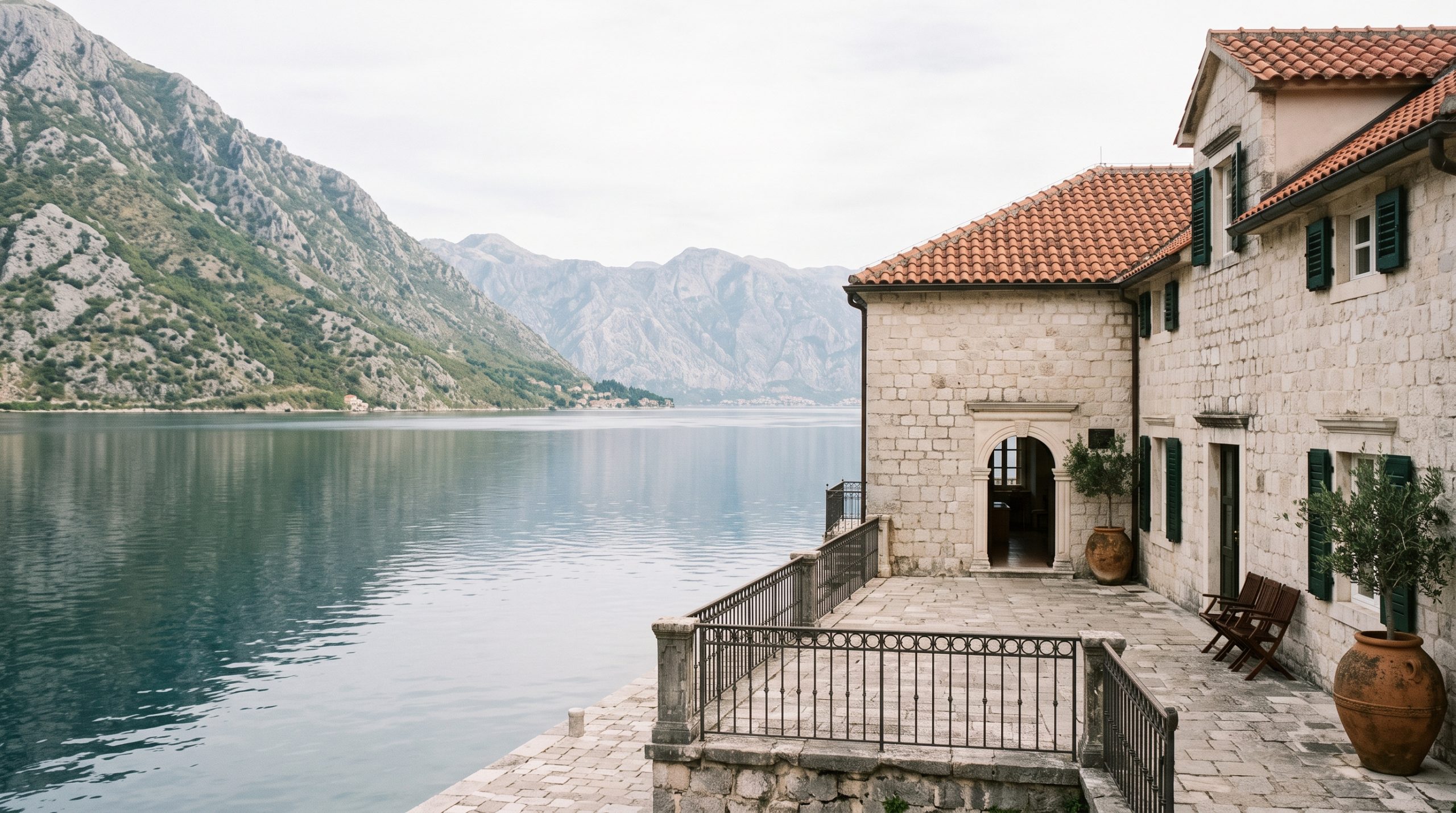
That second figure is the useful one. A fee schedule that prices marrying outside official premises is a fee schedule that expects it to happen, which is why the legal ceremony can sit on a stone terrace above the Bay of Kotor instead of under municipal strip lighting. Montenegro uses the euro, so American couples are reading a currency they already recognize, and the administrative sums here are smaller than lunch for two in Perast.
What follows is the document chain in the order you have to build it, the deadlines counted backwards from your date, and the six details that quietly cost couples a week. We are photographers and filmmakers, not lawyers. Rules change and circumstances differ, so confirm the detail with the relevant registry office or your own consulate before you book flights.
Yes, and the chain is shorter than it looks
Foreign couples can marry legally in Montenegro without living there first. You file an Application for Marriage with the registrar in the town you have chosen, at least 15 days before the date, supported by birth certificates, proof that you are free to marry, apostilles, certified Montenegrin translations, two witnesses’ ID copies and a receipt for the fee.
Where Montenegro adds time to the legal route
Nothing in the Montenegrin list is exotic. A birth certificate, a statement that you are free to marry, two apostilles, translations, copies of four passports, a bank receipt. Any couple who has renewed a passport can assemble that.
The friction is elsewhere. Two of the required papers are issued inside Montenegro rather than at home: proof that your stay is registered with the Ministry of Interior, and proof that the administrative fee has reached the municipality’s account. Add the 15-day filing rule to those, and the legal route stops being a piece of admin you finish before the flight and becomes a shape that your trip has to accommodate.
So the honest rating is fiddly, not hard, with one real consequence: doing the legal marriage in Montenegro makes the trip longer than most couples first imagine. The U.S. Embassy is direct about the other variable, noting that requirements differ slightly from town to town and that you should check with the registrar in the town where you plan to marry. Kotor’s list is not automatically Budva’s. The office you will actually stand in front of is the office whose list governs, and its answers on how early it accepts a file, and whether both of you must appear to lodge it, are the ones to build the calendar around.
If you are at the stage of deciding what kind of day you want before deciding where the signatures happen, our guide to planning an elopement works through that order of operations.
The documents, in the order you have to get them
Build the chain from the bottom up. Nine items, each sitting on a different office’s timetable, and the two that travel by mail are the ones to start in month one.
- Valid passports. Clear photocopies of both passports go into the file. Keep the originals with you for the application and the ceremony.
- A fresh certified copy of each birth certificate. Order new copies from the vital records office of the state that issued them rather than traveling with the only original you own.
- An apostille on each birth certificate. In the United States the apostille comes from the Secretary of State of the state that issued the document, not from a federal office. Montenegro’s national tourism board describes the apostille stamp as applying to the documents you submit, and the Embassy names it explicitly for the proof of unmarried status, so apostilling the birth certificates as well is one extra errand that removes the question.
- Proof that you are free to marry, dated inside a three-month window. The Embassy is precise here: a statement or certificate of unmarried status must be no older than three months from the date of your application, and if it was issued in the United States it needs an apostille. A document issued by the U.S. Embassy in Podgorica does not.
- Documentation closing any previous marriage. If either of you has been married before, the registrar will want the paper that formally ended it, translated like everything else.
- Certified translation into Montenegrin. Originals plus certified translations is the standard the tourism board sets out. Who is permitted to certify the translation is decided locally, which is another question for your registrar rather than for the internet.
- Photocopies of your two witnesses’ passports or IDs. The Embassy lists these alongside your own. Witnesses must be adults; Montenegrin family law sets 18 as the age at which a person can marry, and the same threshold is the practical one for standing as a witness.
- Proof of registered residence from the Ministry of Interior. This one only exists once you are in the country and your stay has been registered, which is why arriving several days ahead of the application makes the file simple rather than tense.
- The receipt for the administrative fee. Twenty euros for official premises, one hundred for a ceremony outside them, paid into the municipality’s bank account. Proof of payment is itself a document in the file.
Then the Application for Marriage form itself, collected from the registrar in your chosen town and filed at least 15 days before the date. That form is the starting gun, not the finish line.
Turn the Montenegro date into a paperwork calendar
There is a real minimum and a comfortable minimum, and they are not close together. The real minimum is roughly six weeks: long enough to get certificates issued, apostilled, translated and lodged, if no office keeps you waiting and nothing sits in the mail. The comfortable minimum is four months, and four months is what we plan to, because apostille turnaround is the one step in the chain you have no influence over.
| Time before the date | What happens | Whose clock it runs on |
|---|---|---|
| 4 months | Choose the municipality, ask the registrar for its current document list, fix the ceremony hour to the light | The registrar’s office |
| 3 months | Order fresh certified copies of both birth certificates, then send them for apostille | Your state’s vital records and Secretary of State |
| 2 months | Certified translations into Montenegrin | The translator’s |
| 6 to 8 weeks | Request proof of unmarried status so it lands inside its three-month validity window | The three-month rule |
| Arrival, then at least 15 days before the date | Register your stay, pay the fee into the municipality’s account, file the Application for Marriage | The 15-day filing rule |
| Ceremony day | Originals in a folder, witnesses present, hour already matched to sunrise or the last hour of light | Yours |
Fees and deadlines quoted here were correct at the time of writing and are worth re-checking with the office that issues them. The three-month window on the unmarried-status document is the item most worth diarizing, because it is the only one that can expire while you wait for something else.
Six details that cost couples a week
None of these are dramatic. Each one is a small assumption that turns out to be wrong at the point where correcting it costs days.
- Ordering the free-to-marry document first. It is the fastest paper to obtain and the only one with a three-month shelf life. Couples who tick it off in January for a June date find it has aged out by the time the application is filed. Order it late, deliberately, once the apostilles are moving.
- Treating the apostille as part of the certificate. It is a separate transaction with a separate office and its own queue. A birth certificate ordered on Monday is not an apostilled birth certificate; that is a second envelope and a second wait.
- Expecting to pay the fee at the counter. The Embassy is specific that payment goes to the municipality’s bank account, with the details confirmed by the local registrar. You are producing a bank receipt as evidence, not handing over notes, so this is a step to complete before the day you lodge the file.
- Forgetting that two documents are Montenegrin. The registered residence proof and the fee receipt cannot be arranged from home. They set the earliest possible date for a complete file, and by extension the earliest possible ceremony date once the 15-day rule is applied.
- Assuming one national checklist. Requirements vary between towns, and the Embassy says so plainly. Ask the specific office in Kotor, Budva, Perast or Podgorica, get its list in writing, and work from that list only.
- Booking the ceremony hour before checking the light. An 11am slot on the Bay of Kotor in July is the harshest hour of the day, with the old town at its busiest. The same location at 6.30am is quiet, and the water throws light upward onto the stone. The registrar’s availability and the sun are two separate constraints, and they are much easier to reconcile four months out than four weeks out.
Sign at home and celebrate above the bay
A large share of the couples we work with in Montenegro complete the legal marriage at home, then hold the ceremony here. This is not a downgrade, and we would push back on anyone who frames it that way. It is the version where you spend your two weeks driving the coast road and walking up to Lovćen at dawn instead of standing in line at a municipal office with a folder of translations.
What changes: no 15-day filing rule, no registered residence requirement, no three-month clock, no apostilles, no translations, no administrative fee. You choose your celebrant or ask a friend to lead the words, and the location can be anywhere you are legally allowed to stand.
What does not change: the ceremony. You still write your own vows and read them to each other in the place you chose. The rings still go on. The light at 6am over the Verige strait is identical whether or not a registrar is present, and the record of the day is identical too.
This route is also the practical answer for same-sex couples visiting Montenegro. Under Montenegrin family law, marriage is between a man and a woman. Montenegro does recognize same-sex life partnership, and the first was registered in Budva in July 2021, but the law requires at least one of the partners to be a Montenegrin citizen, so it is not a route open to two visiting Americans. The legal step happens at home, in your own state, and the ceremony happens above the Adriatic. We plan those days exactly as we plan any other, and our destination elopement guides cover the locations without reference to whose paperwork sits where.
Tell us which of the two shapes you want, or tell us you are undecided, and we will lay out honestly what each one does to your calendar. Send Us a Message with your rough dates and we will come back with the version we would build.
What we can hold together: date, hour and light
Our part of this is logistics and craft, not law. We do not file your paperwork and we do not act as your legal advisers. What we do is permit research and logistics guidance, location design, and a timeline that holds up against both the registrar’s availability and the movement of the sun, plus a sheltered alternative within a 20-minute drive for the mornings when the bay decides otherwise.
Two of us on the ground matters more than usual on a legal ceremony in Montenegro. Two witnesses are required, and couples eloping without guests sometimes arrive with nobody to sign. On The Expedition, a photographer and a filmmaker are both there for the full day, which is worth raising with your registrar in advance if you need witnesses; either way, the second pair of hands means the ceremony hour can be set for the light rather than for whoever is available to hold a camera. Coverage shapes and what each one includes are set out on our experiences and pricing page.
Team travel is included worldwide, so flights and accommodation for the assigned team are not a line item you negotiate for Montenegro or anywhere else. Highlights reach you in 5 days and the full gallery or film in 3 weeks. If you want to see what the bay, the Lovćen switchbacks and the Adriatic light actually look like when the day is over, our published stories and films are the honest answer to that question.
Guest count does not change our fee. It changes access, permits, transport and the timeline, which is a different conversation and one we have in writing before anything is booked.
Common questions
Do we have to live in Montenegro before we can get married there?
No. There is no requirement to live in Montenegro for a set period first. What the registrar wants is proof that your current stay is registered with the Ministry of Interior, which is a document about the trip you are already on rather than about residency.
How far ahead do we file the marriage application?
The U.S. Embassy in Podgorica tells American citizens to apply at least 15 days before the intended date. Published guidance elsewhere quotes a shorter minimum, and municipal practice varies, so the number we plan to is the Embassy’s 15 days, confirmed with the registrar in your chosen town.
Does a US birth certificate need an apostille for Montenegro?
The Embassy names the apostille requirement explicitly for a US-issued proof of unmarried status, and Montenegro’s tourism board describes the apostille stamp as applying to the documents you submit. Apostilling the birth certificates as well costs one extra step and removes any doubt at the counter.
Can we legally get married on a beach or a terrace in Montenegro?
The fee structure itself answers this: 20 euros for a ceremony in official premises, 100 euros for a ceremony outside them. The registrar can come to you. Which locations a given municipality will travel to is decided locally, so agree the exact spot with that office when you file.
Who can be our witnesses if we are eloping without guests?
Two witnesses are required and their passport or ID copies go into the file with yours. Couples without guests sometimes ask the team on the ground, which is one of the questions worth putting to your registrar early, since the office decides what it will accept.
Can a same-sex couple legally marry in Montenegro?
Montenegrin family law defines marriage as between a man and a woman. Same-sex life partnership has been available since 2021, but it requires at least one partner to be a Montenegrin citizen. Visiting couples marry at home and hold the ceremony in Montenegro, which is a route we plan often.
Will a Montenegrin marriage be recognized in the United States?
A marriage performed in line with local law is generally recognized in the United States, and the Embassy is clear that its own personnel cannot perform marriages. Ask the registrar for extra certified copies of the marriage entry before you fly home, because ordering them later from another continent is slow.
How much does the registrar charge and how do we pay?
Twenty euros inside official premises, one hundred euros outside them, paid into the municipality’s bank account rather than over the counter. The local registrar supplies the account details, and your proof of payment forms part of the application file.
Choosing the date first, then the paperwork
Pick the week and the light you want, then decide which of the two legal routes fits it. That order works; the reverse order is how couples end up with a ceremony at 11am in a room with a view of a car park. We are currently booking 2027, 2028 and 2029, planning begins once the contract is signed and a 30% retainer is paid, and everything on our side happens in writing, so you can read a proposal at your own pace and across time zones. Send the inquiry form and you will have a reply and the initial brochure within 24 hours.
Tell us the month, the two or three places you keep returning to on the map, and whether the signatures are happening in Montenegro or at home. We will build the day around the answer. Start Your Story.