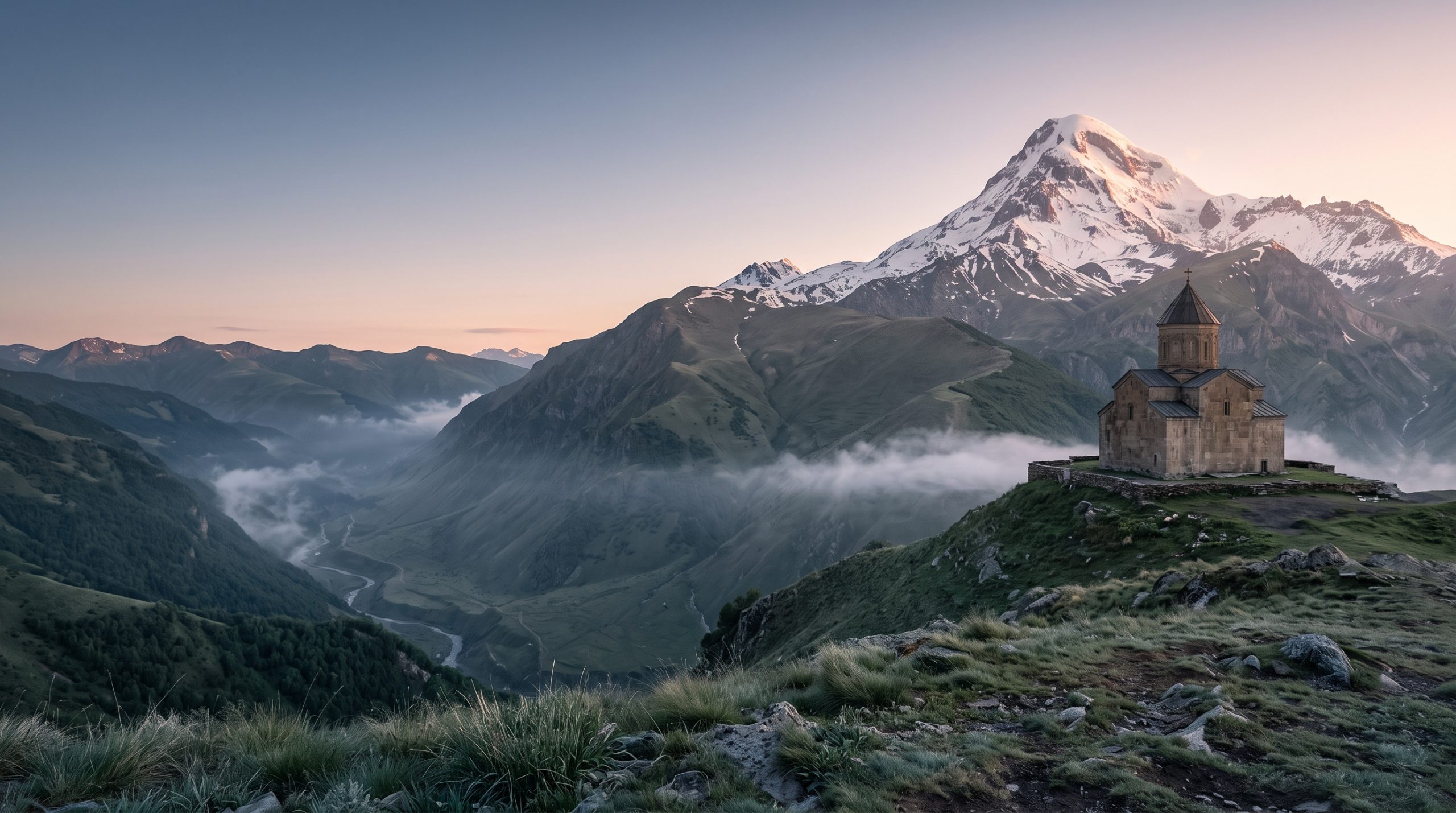
At first light, Kazbek’s east face turns copper while the church below it is still sitting in blue shade. From the meadow at Gergeti Trinity you can watch the edge of the sun work its way down the mountain and cross the valley toward you, and it takes the better part of half an hour to arrive. Couples who walked up in the dark are cold for that half hour and completely absorbed by it.
Nearly every Kazbegi plan that reaches us asks for a ceremony at sunset. We usually write back suggesting the reverse, and the reason is one piece of geography. Kazbek stands a little over nine kilometers west-northwest of the church, 5,054 meters of it, and the frame everybody already has in mind looks straight at the mountain. In the evening the light is behind it. In the morning the light is behind you.
Everything else about a day here follows from that: what time the alarm goes, whether you ride or walk the last stretch, where you sleep the night before, and how the legal paperwork fits around a church that keeps its own rules.
What is actually possible at 2,170 meters
A small private ceremony on the meadow below the 14th-century church is not something anyone permits or charges for. The legal marriage is registered separately, free of charge, at a Public Service Hall with two adult witnesses. The church interior belongs to the Georgian Orthodox Church and follows its own rules, so vows happen outside, at 2,170 meters.
The mountain is west, so the ceremony is in the morning
From the meadow, Kazbek’s summit stands roughly seventeen degrees above the horizon. That is not a backdrop, that is a wall. In the third week of June the almanac gives Stepantsminda a sunset close to 8:45pm, but the last direct light leaves the church well over an hour before then, because by that point the sun is tracking into the massif at about 290 degrees and losing height fast. In mid-September the printed pair is around 6:40am and 7:10pm, and the same thing happens: the churchyard goes cool and flat while the eastern side of the valley is still lit and warm.
Evening here is not useless. It is a fine hour for shape, for the bell tower cut black against a bright western sky, for a couple reduced to two dark figures on a green shoulder. It is a poor hour for faces, and it is short. If you have been promised a golden-hour ceremony in front of Kazbek, the mountain is the thing in the way.
Sunrise flips the geometry. The sun clears the ridge across the Terek behind you and lands on the church, the bell tower and the mountain at once, all of it front-lit from the same side you are standing on. In the third week of June the sun is technically up around 5:25am, though on the meadow itself it arrives thirty to forty minutes later while the eastern ridge is cleared. That gap is the best part of the morning: the summit burning while your foreground is still cold and blue.
So the ceremony hour we build at Gergeti sits inside the first two hours of daylight, and everything else in the day is arranged to make that hour easy to reach. If you want to see how a mountain morning like this renders, with cool shadowed grass against a lit peak and two people small in the middle of it, that is what our galleries and films are there for. Highlights reach you in 5 days and the full gallery or film in 3 weeks.
Three hours up the Georgian Military Highway
Stepantsminda, the village under the church, sits about 150 kilometers north of Tbilisi. Three hours of driving, closer to three and a half if you stop at Ananuri or the reservoir, and honestly you should stop.
The road is the Georgian Military Highway, 208 kilometers end to end between Tbilisi and Vladikavkaz, and it is the only road link between Georgia and Russia. That means freight, and it means the tempo is not yours to set. It climbs past Gudauri to the Jvari Pass at just under 2,400 meters, then drops into the Terek valley for the last stretch north.
The same drive is what most visitors do twice in one day. Minibuses leave Tbilisi’s Didube station through the morning, take about three hours each way, and the last ones back leave in the late afternoon. That rhythm decides who is on the meadow at any given hour, and it is why we never plan a Kazbegi elopement as a day trip. You arrive the afternoon before, sleep in Stepantsminda or up in Gergeti village, and your morning begins with a ten-minute transfer instead of a three-hour one. Two nights in the valley is the shape that works. Our guide to planning an elopement goes into that kind of structural decision in more depth.
The last hour on foot, and what it is like in a dress
From the east bank of the river you cross the bridge, turn left, and climb the village road past guesthouses and Cafe Gergeti. That alone takes 20 to 30 minutes before the trail proper even begins. The valley path from there is a little over an hour of steady climbing, and less coming down. There is a second route through the forest that keeps crossing the jeep road, is rockier underfoot and gives you nothing to look at through the trees. We do not use it.
In wedding clothes the walk is a dust problem rather than a technical one. The surface is grass, gravel and loose stone, there are cattle and sheep on the slope, and the last pitch above the top houses is steep enough that you will want a free hand. What works: boots on, dress in a bag, one of us carrying it, and a change at the top out of the wind behind the churchyard wall. If you plan to walk both ways with time at the church, block out three hours. Most couples ride the switchback road up with a local jeep driver at 4am and walk down after breakfast, which is the kinder order. That charter sits on your side of the ledger, as unusual transport always does.
The ground at the top is smaller than photographs suggest. There is the walled churchyard, the separate bell tower, built in the same century as the church and a little after it, and a sloping shoulder of grass falling away toward the valley. When a photographer and a filmmaker work here together, that geometry has to be agreed before anybody walks up: who holds the wide arc, who moves, where the second camera stands so it is not in the first frame. Wind crosses that ridge almost constantly, which is why vows on The Expedition go onto a proper microphone rather than being left to a camera thirty feet away.
Paperwork, permission and the church’s own rules
Georgia makes the legal part genuinely simple, which is a large part of why couples fly here. Marriage is registered by the Public Service Development Agency, at its territorial offices, Public Service Hall branches and wedding houses. Registration without added ceremony services is free of charge. Both of you must attend, since registration through a representative is not allowed, and two legally capable adult witnesses attend with you.
Documents: a foreign passport is accepted without a Georgian translation where it carries your details in Latin transliteration, and a foreign citizen has to show a document proving lawful presence in the country. Anything else issued abroad, such as proof that an earlier marriage has ended, needs to be apostilled or legalized and then translated into Georgian with the translation notarised. A ceremonial registration, or a registrar coming out to a location of your choosing, carries a service fee rather than the free rate. Most couples we plan for register in Tbilisi on the way through and keep the mountain morning as their own ceremony, with nothing official attached to it. We do the research, assemble your document list and time it around your arrival. The fees themselves stay on your side, along with permits, celebrant and accommodation.
Inside the church is a different question. Gergeti Trinity is a working church, and the Orthodox marriage sacrament requires both partners to be baptized Orthodox. Stepping in as a visitor is another thing, and worth doing: shoulders covered, a scarf over the head for women, no camera pushed into anybody’s prayer. It is a parish, not a location.
The meadow is village and church ground, grazed and walked through daily. Further out, the wider valleys sit inside Kazbegi National Park, established in 1976 and run by the Agency of Protected Areas, a fragmented territory of roughly 8,700 hectares rather than one block, with its administration in Stepantsminda itself. If your ceremony moves into one of those valleys, we clear it there first. Aerials run under the Civil Aviation Agency’s rules, with the aircraft registered and marked before we fly, and we keep drone work on the Chkheri valley side rather than the corridor running north out of town. Our destination guides cover the other mountain regions we work in.
When the vans come up the hill
By late morning the churchyard has a slow-moving queue at the doorway, jeep taxis are turning at the top of the road, and the meadow holds a busload’s worth of people. That lasts through the afternoon.
Arriving early genuinely fixes it here, and that is not true of every famous viewpoint. The crowd at Gergeti is a day-trip crowd on a three-hour drive, so almost nobody is standing on that ridge at 6am except the handful of people who slept in the valley. You will meet a shepherd and possibly one climber heading for the glacier. That is the whole population of your ceremony.
When a morning does not go to plan, the alternatives are close. The lower meadow below the church loses the height but keeps the mountain, and the birch slopes above Gergeti village hold light late. Further out there is the Sno valley, and Juta, where the road gives up beneath the Chaukhi towers and the day turns from church to raw rock.
Snow, cloud, and choosing a month
Kazbek makes its own weather, and it makes most of it after breakfast. A summer summit that is sharp and clear at 6am is often behind cloud by 11, which is another argument for the early hour and also a reason we never promise you the mountain. We plan the morning so a clouded peak still gives you the church, the meadow and the light.
June to early September gives you green meadow, wildflowers on the slope and warm afternoons for everything that is not the ceremony. Late September into October is our own favorite: the birch goes gold, the air is usually clearer, and by the first week of October the sun is not up until around 7:03am, so the alarm becomes civilized. Winter turns Kazbegi into a different country. The highway is maintained year round because of the freight it carries, but timings loosen after heavy snow, so we build a January elopement around the village, the birch line and the valley floor, and treat the church itself as the bonus rather than the plan. Spring holds snow on the meadow later than most planners expect, and the jeep road stays soft for weeks.
If a 4am alarm and an hour of walking is not your idea of a good morning, tell us that in your first message rather than working around it. There is a gentler version of this day, built lower down the valley with a longer breakfast in it, and there are months where the light does more of the work for you. We would rather shape the day around what you actually want, or tell you honestly which month suits it better.
Common questions
Is there anywhere to change out of hiking boots at the church?
There is no building you can use up there, so the change happens outside, usually in the lee of the churchyard wall or behind the bell tower. We carry the bag, hold a wind block, and keep the whole thing to a few minutes. Anything that needs a mirror is better done at the guesthouse before you set off.
Can we drive to Gergeti Trinity Church instead of walking up?
Yes. A switchback road runs up from the village and local jeep drivers use it constantly, which is how most couples reach the church in wedding clothes, particularly for a pre-dawn start. We build the timing and meeting point into your schedule; the vehicle charter itself is booked and paid by you, as with other unusual transport.
Do we need to bring our own witnesses to register the marriage in Georgia?
Two legally capable adults have to be present at the registration. Friends or family traveling with you are the simplest answer. Neither of you can send a representative, so both attend in person with the witnesses.
Can we hold the ceremony inside Gergeti Trinity Church?
The Orthodox sacrament of marriage is for partners who are both baptized Orthodox, so for most international couples the answer is no, and the vows happen outside on the shoulder of grass with the church behind them. The interior is small and dim in any case, and it is in daily use by a working parish.
How often is Mount Kazbek actually visible from the church?
Often enough to plan around, and often enough behind cloud that we never guarantee it. Early morning gives you the best odds by a wide margin, and multi-day coverage gives you more than one chance at a clear summit, which is one reason two nights in the valley beats one.
A two-night shape for a Gergeti morning
The version that works reads like this. You drive up from Tbilisi in the afternoon, registering the marriage in the city on the way if that is your plan, and sleep in Stepantsminda or Gergeti. The alarm goes around 4am. You ride the switchbacks in the dark or start walking into the grey, you are standing on the meadow before the ridge behind you lights up, and you have the place to yourselves for the entire first hour of sun. Breakfast afterwards feels like a reward. The afternoon goes to the Sno valley or Juta, then a second night in the mountains, then the highway south.
Our flights, accommodation and travel to Kazbegi are inside what you pay, in Georgia as everywhere else. One full day with a dedicated photographer or filmmaker starts at $4,900, the same day with both of us working together at $7,900, and the pricing page sets out what each one covers. We currently have Georgia elopement dates available through 2027–2029 now. Send us the form and you will have a reply and our first brochure within 24 hours; from there it is a tailored proposal, a contract and a 30% retainer, and planning starts. From the first reply onward, the whole process stays in writing, at whatever pace suits your time zone. Tell us the month you are thinking about and we will tell you what the light is doing. Check Your Date.